
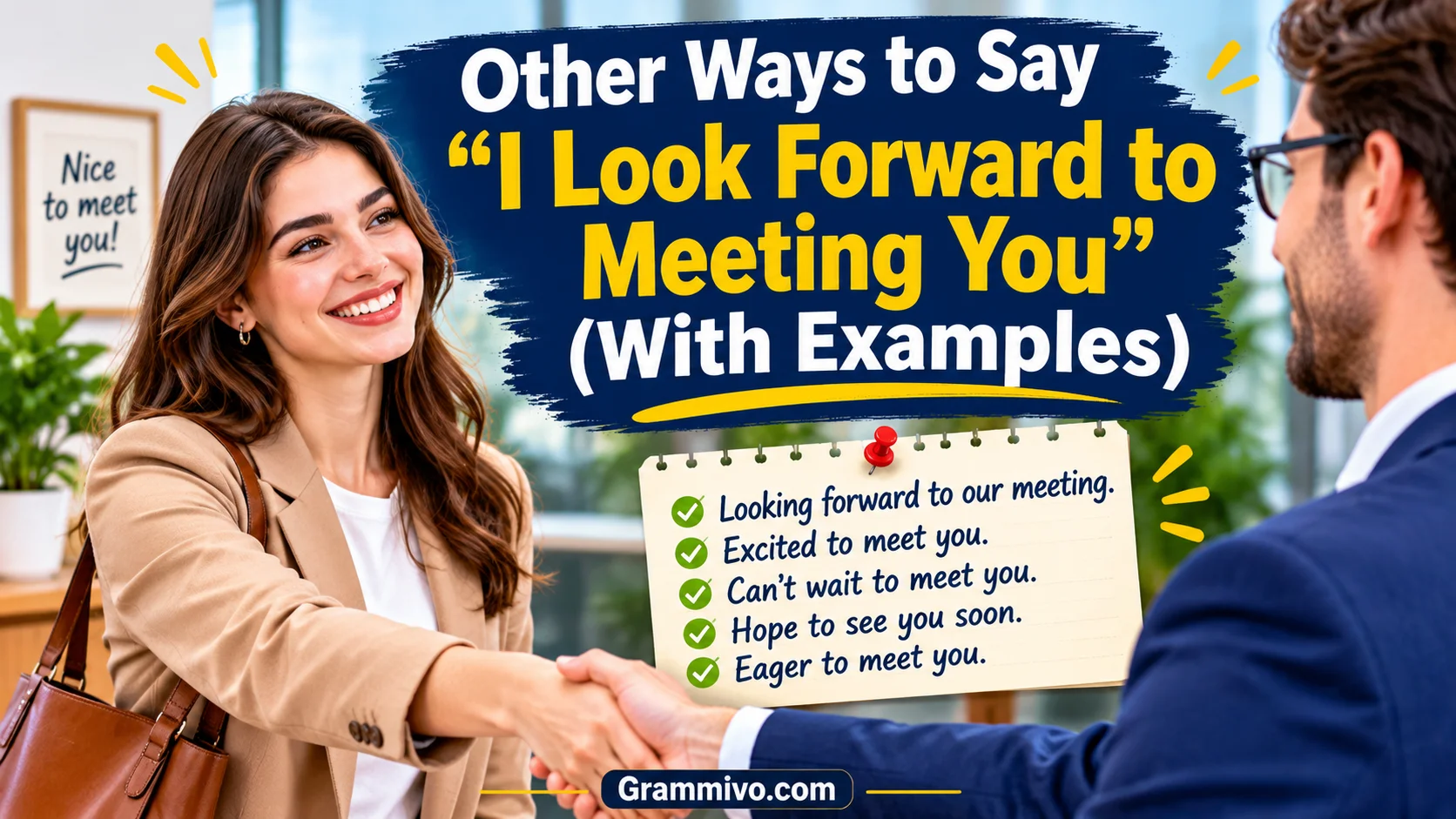
Meeting someone for the first time can be exciting, whether it happens during a business appointment, a job interview, a networking event, or a personal introduction. The phrase “I look forward to meeting you” is a polite and professional way to express anticipation. However, using the same expression in every email or conversation can make your writing feel repetitive.
Fortunately, several natural alternatives communicate the same enthusiasm while offering different tones. Below, you’ll discover 12 other ways to say “I look forward to meeting you,” along with their meanings, examples, and the situations where each expression works best.
Quick Answer:
Some of the best alternatives to “I look forward to meeting you” include:
- I’m excited to meet you.
- I look forward to our meeting.
- I’m eager to meet you.
- I’m looking forward to connecting with you.
- It will be a pleasure to meet you.
- I’m pleased we’ll have the opportunity to meet.
- I can’t wait to meet you.
These expressions work in different situations. Some sound professional and respectful, while others communicate warmth, excitement, or personal enthusiasm.
What Does “I Look Forward to Meeting You” Mean?
“I look forward to meeting you” is a polite expression that communicates anticipation about meeting someone in the future.
It tells the other person that you’re pleased about an upcoming introduction, appointment, or conversation.
The expression commonly appears in professional emails, business correspondence, interview confirmations, and personal messages.
Grammatically, it contains the verb phrase “look forward to”, followed by the gerund “meeting.” Here, to functions as a preposition, so the following verb takes the -ing form.
Examples:
- Thank you for arranging the interview. I look forward to meeting you on Monday.
- It was nice speaking with you over email. I look forward to meeting you in person.
When Do People Use “I Look Forward to Meeting You”?
People generally use this expression when a meeting has been arranged or is expected to happen.
Common situations include:
- Professional emails: Confirming an upcoming business meeting with a client or colleague.
- Job interviews: Expressing enthusiasm about meeting a recruiter or hiring manager.
- Networking: Showing interest in meeting a professional contact.
- Academic settings: Communicating with teachers, students, or university representatives.
- Personal communication: Expressing happiness about meeting a new friend or acquaintance.
Its neutral, courteous tone makes it suitable for most professional and everyday situations.
Pros and Cons of Using “I Look Forward to Meeting You”
Pros
- Polite and respectful: It communicates positive expectations without sounding overly familiar.
- Professionally appropriate: It works well in business emails, interviews, and formal correspondence.
- Easy to understand: Most English speakers recognize its meaning immediately.
- Positive impression: It shows interest in an upcoming interaction.
Cons
- Can sound repetitive: Using it in every professional email may make your writing feel predictable.
- Somewhat formal: It might sound unnecessarily stiff in casual conversations.
- Limited emotional expression: It communicates anticipation but may not fully express excitement or enthusiasm.
Best Synonyms and Alternatives for “I Look Forward to Meeting You”
Here are 12 useful alternatives. Some are close equivalents, while others are contextual expressions that work in particular situations.
- I’m Excited to Meet You
- I Look Forward to Our Meeting
- I’m Eager to Meet You
- I’m Looking Forward to Connecting With You
- It Will Be a Pleasure to Meet You
- I’m Pleased We’ll Have the Opportunity to Meet
- I Can’t Wait to Meet You
- I’m Looking Forward to Meeting With You
- I Welcome the Opportunity to Meet You
- I’m Glad We’ll Have a Chance to Meet
- I’m Looking Forward to Seeing You
- I’m Looking Forward to Speaking With You
12 Other Ways to Say “I Look Forward to Meeting You”
1. I’m Excited to Meet You
Meaning: This expression communicates genuine enthusiasm about an upcoming meeting. It sounds warmer and more energetic than the original phrase.
Example Sentences:
- I’m excited to meet you and discuss the project next week.
- Thank you for the invitation. I’m excited to meet you in person.
Best Use: Friendly professional emails, networking introductions, and personal messages.
Difference From “I Look Forward to Meeting You”: This alternative expresses stronger excitement and feels slightly more personal.
2. I Look Forward to Our Meeting
Meaning: This is a polished and professional expression that communicates anticipation about a scheduled meeting.
Example Sentences:
- Thank you for confirming the appointment. I look forward to our meeting.
- I’ve reviewed the proposal and look forward to our meeting tomorrow.
Best Use: Business emails, client communication, and workplace correspondence.
Difference From “I Look Forward to Meeting You”: It emphasizes the scheduled meeting rather than the experience of meeting the person. It’s particularly suitable when you’ve already met or communicated.
3. I’m Eager to Meet You
Meaning: This phrase expresses strong interest and enthusiasm about meeting someone. The word eager suggests that you’re genuinely interested in the upcoming introduction.
Example Sentences:
- I’ve heard wonderful things about your work, and I’m eager to meet you.
- I’m eager to meet you and learn more about your experience.
Best Use: Professional introductions, networking, interviews, and enthusiastic personal communication.
Difference From “I Look Forward to Meeting You”: It sounds more enthusiastic and direct, although it remains appropriate in professional settings.
4. I’m Looking Forward to Connecting With You
Meaning: This expression communicates interest in establishing a connection. The interaction could happen in person, over the phone, or through a video call.
Example Sentences:
- Thank you for reaching out. I’m looking forward to connecting with you.
- I’m looking forward to connecting with you and discussing potential opportunities.
Best Use: Networking emails, LinkedIn messages, business introductions, and virtual meetings.
Difference From “I Look Forward to Meeting You”: Connecting is broader than meeting. It can refer to building a professional relationship without necessarily meeting face-to-face.
5. It Will Be a Pleasure to Meet You
Meaning: This polite expression communicates that you’re happy about the opportunity to meet someone. It sounds courteous and slightly formal.
Example Sentences:
- It will be a pleasure to meet you at the conference.
- I’ve enjoyed our email conversations, and it will be a pleasure to meet you in person.
Best Use: Formal business emails, professional introductions, and communication with clients or senior colleagues.
Difference From “I Look Forward to Meeting You”: It emphasizes the pleasure of the future meeting rather than simply expressing anticipation.
6. I’m Pleased We’ll Have the Opportunity to Meet
Meaning: This expression communicates satisfaction about having the chance to meet someone. It sounds thoughtful, respectful, and professional.
Example Sentences:
- I’m pleased we’ll have the opportunity to meet and discuss the proposal.
- I’m pleased we’ll have the opportunity to meet during your upcoming visit.
Best Use: Formal correspondence, executive communication, and professional appointments.
Difference From “I Look Forward to Meeting You”: It places more emphasis on appreciating the opportunity than on personal excitement.
7. I Can’t Wait to Meet You
Meaning: This is an enthusiastic and informal expression that communicates strong excitement about an upcoming meeting.
Example Sentences:
- I’ve heard so much about you. I can’t wait to meet you!
- Your visit is coming up soon, and I can’t wait to meet you.
Best Use: Friendly messages, personal introductions, and relaxed professional conversations where enthusiasm is appropriate.
Difference From “I Look Forward to Meeting You”: It sounds much more casual and emotionally expressive. Avoid it in highly formal business correspondence.
8. I’m Looking Forward to Meeting With You
Meaning: This expression communicates anticipation about a planned meeting, usually involving a discussion, appointment, or professional interaction.
Example Sentences:
- I’m looking forward to meeting with you to review the project.
- Thank you for scheduling the appointment. I’m looking forward to meeting with you next Thursday.
Best Use: Business emails, consultations, interviews, and scheduled discussions.
Difference From “I Look Forward to Meeting You”: Both expressions are natural. Meeting with you often emphasizes a planned discussion or appointment, while meeting you can emphasize an introduction or first encounter.
9. I Welcome the Opportunity to Meet You
Meaning: This phrase expresses a positive attitude toward the possibility of meeting someone. It communicates openness and professional interest.
Example Sentences:
- I welcome the opportunity to meet you and discuss the position.
- I would welcome the opportunity to meet you and explore potential collaboration.
Best Use: Formal business emails, job applications, professional proposals, and networking correspondence.
Difference From “I Look Forward to Meeting You”: It emphasizes willingness and appreciation for the opportunity rather than assuming the meeting is already arranged.
10. I’m Glad We’ll Have a Chance to Meet
Meaning: This friendly expression communicates happiness about an upcoming meeting. It sounds natural without being overly formal.
Example Sentences:
- I’m glad we’ll have a chance to meet during the conference.
- I’m glad we’ll have a chance to meet and talk about your new project.
Best Use: Everyday professional communication, friendly emails, and informal introductions.
Difference From “I Look Forward to Meeting You”: It places more emphasis on happiness about the opportunity and creates a relaxed, conversational impression.
11. I’m Looking Forward to Seeing You
Meaning: This expression communicates anticipation about seeing someone in the future. It’s especially natural when you already know the person.
Example Sentences:
- I’m looking forward to seeing you at the annual conference.
- Thank you for making time for me. I’m looking forward to seeing you next week.
Best Use: Messages to friends, colleagues, clients, and people you’ve met before.
Difference From “I Look Forward to Meeting You”: Seeing you generally suggests an existing acquaintance or relationship. Use meeting you when introducing yourself to someone for the first time.
12. I’m Looking Forward to Speaking With You
Meaning: This expression communicates anticipation about having a conversation with someone. It focuses on communication rather than a face-to-face introduction.
Example Sentences:
- Thank you for scheduling the call. I’m looking forward to speaking with you.
- I’m looking forward to speaking with you about the position tomorrow.
Best Use: Phone interviews, virtual appointments, business calls, and professional emails.
Difference From “I Look Forward to Meeting You”: It specifically refers to a conversation and doesn’t necessarily imply an in-person meeting.
Formal and Informal Ways to Say “I Look Forward to Meeting You”
Choosing the right expression depends on your relationship with the recipient and the situation. Some alternatives are better suited to formal correspondence, while others feel more natural in everyday conversation.
| Formal | Neutral | Informal |
| I welcome the opportunity to meet you. | I look forward to our meeting. | I can’t wait to meet you! |
| It will be a pleasure to meet you. | I’m looking forward to meeting with you. | I’m excited to meet you! |
| I’m pleased we’ll have the opportunity to meet. | I’m looking forward to connecting with you. | I’m glad we’ll have a chance to meet. |
| I would appreciate the opportunity to meet you. | I’m eager to meet you. | Looking forward to meeting you! |
Professional tip: For a job interview or formal business email, choose a courteous expression such as “I look forward to our meeting.” For a friendly introduction, “I’m excited to meet you” sounds more natural.
“I Look Forward to Meeting You” vs. Similar Expressions
Some expressions sound interchangeable but have slightly different meanings. Understanding these differences helps you choose the right wording.
| Expression | Meaning | Main Difference | Example |
| I look forward to meeting you. | Anticipation about a future introduction. | Neutral and professional. | I look forward to meeting you on Friday. |
| I look forward to our meeting. | Anticipation about a scheduled meeting. | Emphasizes the appointment. | I look forward to our meeting tomorrow. |
| I’m excited to meet you. | Strong enthusiasm about meeting someone. | Warmer and more energetic. | I’m excited to meet you at the event. |
| I look forward to seeing you. | Anticipation about seeing someone. | Usually suggests an existing acquaintance. | I look forward to seeing you again. |
| I look forward to speaking with you. | Anticipation about a conversation. | Focuses on talking rather than meeting. | I look forward to speaking with you tomorrow. |
Common Mistakes When Using Alternatives to “I Look Forward to Meeting You”
Even familiar expressions can create grammatical or contextual problems. Watch out for these common mistakes.
1. Using the wrong verb form
Incorrect: I look forward to meet you.
Correct: I look forward to meeting you.
The word to is a preposition in this expression, so it takes a gerund (verb ending in -ing).
2. Confusing meeting someone with seeing someone
Incorrect in a first-introduction context: I’m looking forward to seeing you.
Better: I’m looking forward to meeting you.
Although the first sentence is grammatically correct, the second is more appropriate when you’ve never met the person.
3. Using overly casual language in formal emails
A sentence such as “I can’t wait to meet you!” may sound too enthusiastic for a formal business introduction.
Better: I look forward to meeting you and discussing the opportunity.
4. Assuming every alternative means exactly the same thing
Connecting, speaking, seeing, and meeting describe different kinds of interactions. Choose the expression that accurately reflects what will happen.
Frequently Asked Questions:
What is the closest synonym for “I Look Forward to Meeting You”?
“I’m looking forward to meeting you” is the closest alternative because it communicates exactly the same anticipation. Another natural option is “I’m excited to meet you,” although it expresses stronger enthusiasm.
What is a more professional way to say “I Look Forward to Meeting You”?
“I look forward to our meeting” is an excellent professional alternative. You can also use “It will be a pleasure to meet you” when you want to sound particularly courteous in formal correspondence.
Can I say “Looking Forward to Meeting You” in an email?
Yes. “Looking forward to meeting you” is a common and natural expression in professional emails. It omits the subject and auxiliary verb, but this shortened construction is widely accepted in conversational business writing.
Is “I Look Forward to Meeting You” formal or informal?
It is generally polite and neutral-professional. You can use it in business emails, job interviews, networking conversations, and personal introductions. It isn’t excessively formal, so it works in many everyday situations.
What is the difference between “Meeting You” and “Meeting With You”?
“Meeting you” often emphasizes getting introduced to someone, especially for the first time. “Meeting with you” commonly describes a planned appointment or discussion. Both are grammatically correct, and the best choice depends on the context.
Conclusion:
Choosing the right alternative to “I look forward to meeting you” can make your communication sound more natural, confident, and appropriate. Expressions such as “I’m excited to meet you” convey enthusiasm, while “It will be a pleasure to meet you” adds a courteous professional touch. Remember that meeting, seeing, connecting, and speaking aren’t always interchangeable. Consider your relationship with the recipient and the type of interaction before choosing an expression. A thoughtful word choice makes every introduction more meaningful.
