
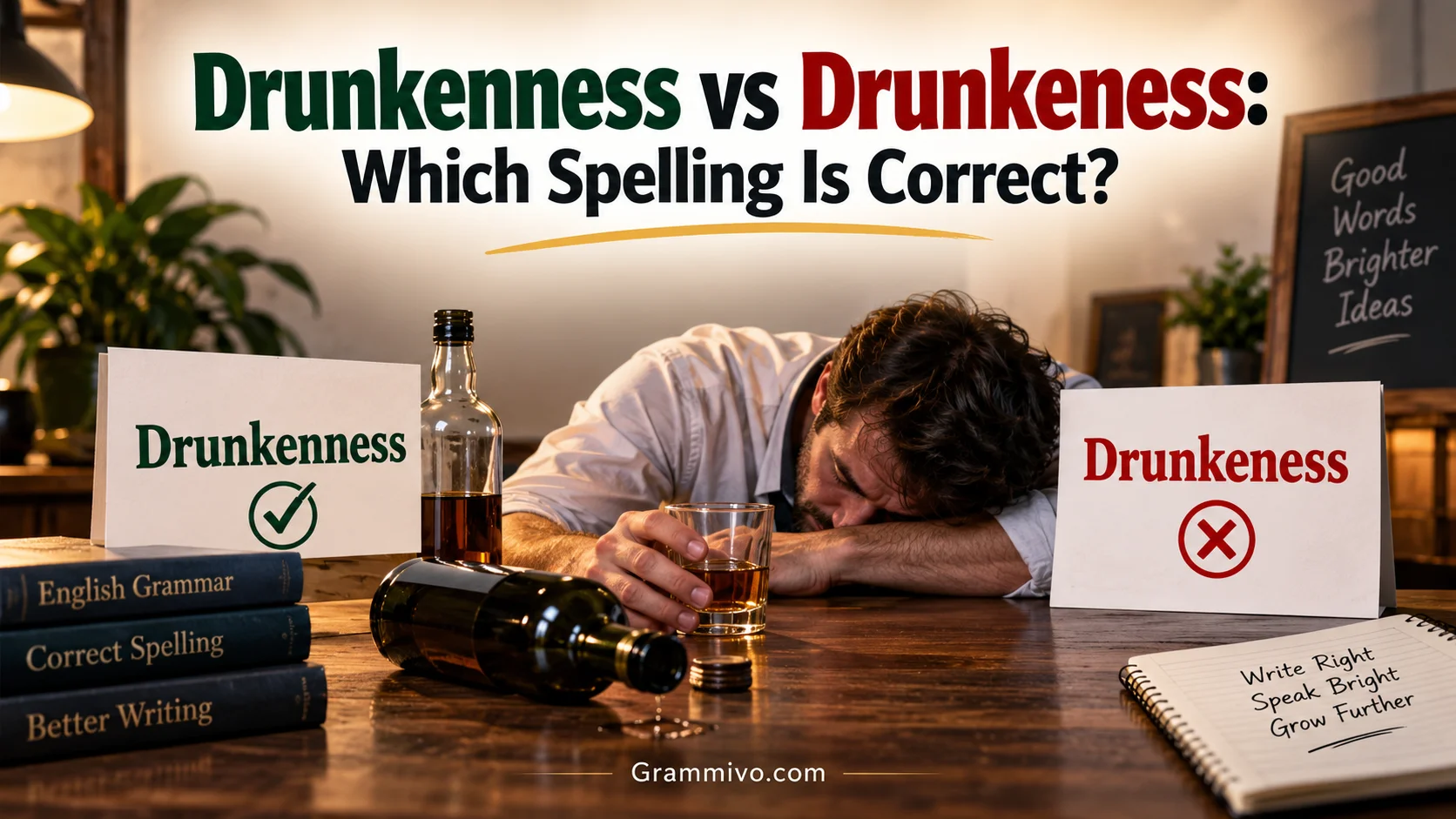
If you’ve ever paused while typing drunkenness, you may have wondered whether the word should contain one n or two. The confusion is understandable because drunkenness has an unusual-looking cluster of letters in the middle. That makes drunkenness vs drunkeness a common spelling question.
The correct spelling is drunkenness.
The spelling drunkeness is incorrect in standard English. The easiest way to understand the difference is to break the correct word into its parts: drunken + ness = drunkenness. The final n in drunken stays when the suffix -ness is added.
This small spelling detail matters because drunkenness is a standard English noun used in everyday, formal, legal, historical, and literary contexts. It describes the state or condition of being drunk.
Quick Answer:
Drunkenness is the correct spelling.
Drunkeness is a misspelling.
| Spelling | Correct? | Meaning |
| drunkenness | Yes | The state or condition of being drunk |
| drunkeness | No | A misspelling of drunkenness |
For example:
His drunkenness affected his judgment.
Here, drunkenness works as a noun because it names a condition.
The incorrect version should not appear in standard edited writing:
His drunkeness affected his judgment.
A reliable way to remember the spelling is to separate the word before writing it:
drunken + ness = drunkenness
Why Is Drunkenness the Correct Spelling?
The spelling becomes much easier once you look at how the word is formed.
Drunkenness comes from drunken plus the suffix -ness. The suffix -ness commonly turns an adjective into a noun that describes a state, quality, or condition.
The structure looks like this:
drunken + ness → drunkenness
The important detail is that the two words meet at the letter n. The word drunken ends in n, while -ness begins with another n. Both letters remain.
That gives you:
drunken + ness
Not:
druke + ness
And not:
drunken + ess
The result is:
drunkenness
This pattern appears in many familiar English words. Consider these examples:
| Base word | Suffix | Result |
| dark | -ness | darkness |
| kind | -ness | kindness |
| weak | -ness | weakness |
| happy | -ness | happiness |
| drunken | -ness | drunkenness |
The spelling can look strange at first glance, but there’s nothing irregular about keeping the two n’s when drunken joins -ness.
Why Is Drunkeness Incorrect?
Drunkeness is incorrect because it removes one of the two n’s required by the word’s formation.
The mistake usually happens when writers mentally treat the ending as though the word were spelled drunken + ess. However, the noun-forming suffix is -ness, not -ess.
Compare the two forms:
- drunken + ness = drunkenness
- drunken + ess = drunkeness
The second construction doesn’t produce the standard English word.
A useful visual check is to focus on the middle:
drun-ken-ness
The word contains the sequence n + n at the boundary between drunken and -ness.
This isn’t a matter of American English versus British English. Drunkenness is the standard spelling in both varieties. Drunkeness isn’t a legitimate regional alternative.
If you’re writing an essay, report, article, email, or professional document, use drunkenness.
What Does Drunkenness Mean?
Drunkenness means the state or condition of being drunk. In ordinary usage, the word generally relates to impairment caused by consuming alcohol.
The noun focuses on the condition itself, rather than simply describing a person.
For example:
The officer noticed signs of drunkenness.
Here, drunkenness names the condition being observed.
Compare that with:
The driver was drunk.
In the second sentence, drunk describes the driver.
That distinction becomes important when choosing the right grammatical form. Drunk commonly describes a person or state, while drunkenness gives you a noun for the condition.
The word can appear in several contexts:
- Medical or health discussions: discussions of alcohol-related impairment
- Legal contexts: references to intoxication or public behavior
- News writing: descriptions of incidents involving intoxication
- Historical writing: accounts of drinking habits or social behavior
- Literary writing: descriptions of characters and their conduct
- Everyday writing: discussion of someone’s state after drinking
Drunkenness Word Formation: Drunken + -ness
Understanding the word’s structure gives you the simplest spelling lesson.
Drunken is an adjective. It describes someone or something associated with being drunk or behaving as though intoxicated.
-ness is a noun-forming suffix. It often expresses a state, quality, or condition.
Put them together:
drunken + ness = drunkenness
The suffix -ness appears in many common English nouns:
- sad + ness = sadness
- ill + ness = illness
- dark + ness = darkness
- polite + ness = politeness
- aware + ness = awareness
The same basic idea applies to drunkenness.
One reason the word catches the eye is the double n. English spelling often preserves letters at the boundary between a base word and a suffix. You don’t need to remove one simply because two identical consonants appear together.
Think of the word as two pieces rather than one long spelling puzzle:
DRUNKEN | NESS
Once you see that structure, the correct spelling becomes considerably easier to remember.
Drunkenness vs Drunken: What’s the Difference?
Although drunkenness and drunken share the same root, they perform different grammatical jobs.
Drunken is an adjective.
Drunkenness is a noun.
An adjective describes a person, thing, action, or condition. A noun names a person, place, thing, idea, quality, or condition.
| Word | Part of speech | Example |
| drunken | Adjective | The drunken man stumbled outside. |
| drunkenness | Noun | His drunkenness caused concern. |
Consider the difference more closely.
The drunken passenger became disruptive.
Here, drunken describes the passenger.
Now compare:
The passenger’s drunkenness became disruptive.
Here, drunkenness identifies the condition associated with the passenger.
The words are related, but you can’t always swap them without changing the sentence’s grammar.
Drunk vs Drunkenness
Drunk and drunkenness are closely related, but they aren’t interchangeable in every sentence.
Drunk commonly functions as an adjective describing someone who has consumed enough alcohol to become intoxicated.
For example:
She was drunk after the party.
Drunkenness, on the other hand, functions as a noun:
Her drunkenness concerned her friends.
The difference becomes clearer when you substitute another condition.
You might say:
He was exhausted.
But if you’re naming the condition itself, you could say:
His exhaustion was obvious.
The same grammatical relationship appears with drunk and drunkenness.
| Expression | Function |
| He was drunk. | Drunk describes him. |
| His drunkenness was obvious. | Drunkenness names his condition. |
| They appeared drunk. | Drunk describes their state. |
| Their drunkenness caused problems. | Drunkenness functions as a noun. |
For casual conversation, being drunk often sounds more natural. In formal or descriptive writing, drunkenness can provide a more precise noun.
Drunkenness vs Intoxication
Drunkenness and intoxication overlap in meaning, but they’re not perfect synonyms.
Drunkenness generally refers specifically to being drunk, especially as a result of alcohol consumption.
Intoxication has a broader meaning. It can refer to impairment caused by alcohol, drugs, or other substances.
That makes intoxication useful when the specific substance isn’t known or isn’t important.
| Term | General meaning | Typical tone |
| Drunkenness | The state of being drunk | General to formal |
| Intoxication | A state of impairment caused by a substance | Formal/technical |
| Inebriation | The state of being intoxicated | Formal |
| Being drunk | Everyday description of intoxication | Informal |
For example:
The report discussed alcohol-related drunkenness.
This clearly points toward alcohol.
By contrast:
The test showed signs of intoxication.
That wording doesn’t necessarily tell the reader which substance caused the impairment.
This distinction matters in professional writing. If the exact cause matters, choose the term that communicates it accurately rather than treating every synonym as interchangeable.
How to Pronounce Drunkenness
The pronunciation of drunkenness is straightforward once the spelling stops looking intimidating.
A simple pronunciation guide is:
DRUNK-uhn-ness
The first syllable sounds like drunk. The final part resembles -ness, as in kindness or darkness.
The double n doesn’t mean you pronounce two separate n sounds. The letters occur together because of the way the word is formed.
Try saying it naturally:
drunk-uhn-ness
The spelling may look crowded, but the pronunciation flows normally.
Examples of Drunkenness in a Sentence
Seeing the word in real sentences makes its meaning and grammatical role easier to recognize.
- His drunkenness became obvious when he struggled to speak clearly.
- The article examined the social effects of chronic drunkenness.
- The law addresses certain forms of public drunkenness.
- Her drunkenness turned an ordinary disagreement into a serious argument.
- The witness described the man’s drunkenness before the incident.
- The novel uses drunkenness to reveal the character’s declining judgment.
- The manager had concerns about repeated drunkenness at company events.
- The discussion focused on alcohol misuse rather than occasional drunkenness.
- The historical account contains several references to drunkenness.
- His behavior suggested severe drunkenness rather than simple fatigue.
Notice how naturally the word functions as a noun. It can follow possessives, articles, adjectives, and prepositions.
For example:
- his drunkenness
- public drunkenness
- severe drunkenness
- repeated drunkenness
- the effects of drunkenness
That’s one of the easiest ways to recognize the word in a sentence.
Common Mistakes With Drunkenness
The most obvious mistake is drunkeness, but writers may make several other spelling errors.
| Incorrect spelling | Correct spelling |
| drunkeness | drunkenness |
| drunkennes | drunkenness |
| drunkenes | drunkenness |
| drunkenesss | drunkenness |
The central issue remains the same: drunkenness ends in -ness.
Don’t try to spell the word entirely from memory if you often hesitate. Break it apart instead:
drunken + ness
That small habit eliminates most spelling uncertainty.
Another common mistake involves confusing drunken with drunk. Both words relate to intoxication, but they aren’t always grammatically interchangeable.
For example:
A drunken argument broke out.
The adjective drunken modifies argument.
You wouldn’t normally replace it with:
A drunk argument broke out.
The meaning and naturalness change.
Read More: Disappoint vs. Disapoint: Which Spelling Is Correct?
Is Drunkenness Formal or Informal?
Drunkenness is a standard English word, but it can sound somewhat more formal than being drunk.
In casual conversation, someone might naturally say:
He was drunk last night.
In formal writing, you might encounter:
The report examined the effects of drunkenness.
Neither is inherently more correct. The better choice depends on the sentence and the tone you need.
The word appears comfortably in:
- Formal reports
- Academic discussions
- News articles
- Historical writing
- Legal discussions
- Literary descriptions
- General informational writing
For everyday conversation, shorter expressions often feel more natural.
For example:
| More conversational | More noun-focused/formal |
| He was drunk. | His drunkenness was apparent. |
| She had been drinking. | Her drunkenness affected her judgment. |
| They got drunk at the party. | The incident involved public drunkenness. |
The key isn’t to avoid drunkenness. It’s to use it when the noun form actually improves the sentence.
Synonyms for Drunkenness
Several words can express a similar idea, although their meanings and tones vary.
Intoxication
Intoxication is one of the closest alternatives. It can refer to impairment caused by alcohol or other substances.
Inebriation
Inebriation is a more formal term for a state of intoxication. It appears more often in formal or specialized writing than everyday conversation.
Inebriety
Inebriety is another formal term associated with habitual or excessive drinking and intoxication.
Insobriety
Insobriety describes a lack of sobriety and can also refer to drunkenness.
Being drunk
Being drunk is the most straightforward everyday expression. It sounds much more conversational than drunkenness.
A useful rule is simple: choose the synonym that matches your audience.
How to Remember the Spelling of Drunkenness
The best spelling trick doesn’t require a complicated mnemonic.
Remember:
DRUNKEN + NESS
The word drunken already ends with n.
The suffix -ness starts with n.
Therefore:
n + n = nn
So:
drunken + ness = drunkenness
You can apply the same visual strategy whenever a word contains an awkward letter combination. Instead of memorizing the entire word as one block, identify its meaningful parts.
Think:
DRUNKEN | NESS
rather than:
DRUNKENNESS
The first version exposes the reason for the double n.
A Quick Memory Test
Cover the second half of the word and ask:
What is the base word?
Answer:
drunken
Now add:
ness
The result is:
drunkenness
If you remember drunken + ness, the spelling becomes much harder to get wrong.
FAQs:
Is drunkenness or drunkeness correct?
Drunkenness is correct. Drunkeness is a misspelling.
How do you spell drunkenness?
Spell it:
D-R-U-N-K-E-N-N-E-S-S
An easier way to remember it is:
drunken + ness = drunkenness
Why does drunkenness have two n’s?
The word contains two n’s because drunken ends with n, while the suffix -ness begins with another n.
So:
drunken + ness → drunkenness
Is drunkeness a word?
No. Drunkeness is not the standard spelling of the English noun. The correct form is drunkenness.
What does drunkenness mean?
Drunkenness means the state or condition of being drunk or intoxicated.
Conclusion:
The spelling question has a clear answer: drunkenness is correct, while drunkeness is incorrect. The word itself is a noun meaning the state or condition of being drunk. It differs grammatically from drunken, which is an adjective, and from drunk, which commonly describes a person’s intoxicated state. Intoxication overlaps with drunkenness but has a broader meaning.
