Goodmorning or good morning? If you’ve ever wondered whether this common greeting should be written as one word or two, you’re not alone. The confusion usually comes from the fact that English contains many compound words, while other familiar expressions keep their words separate.
When you greet someone at the start of the day, the standard spelling is good morning. It contains two separate words: good and morning. The form goodmorning, written as one word, isn’t the standard spelling for the greeting in English.
That small space matters. In everyday conversation, people understand both forms easily when they’re spoken aloud. On the page, however, standard English expects the two-word form.
Quick Answer: Goodmorning or Good Morning?
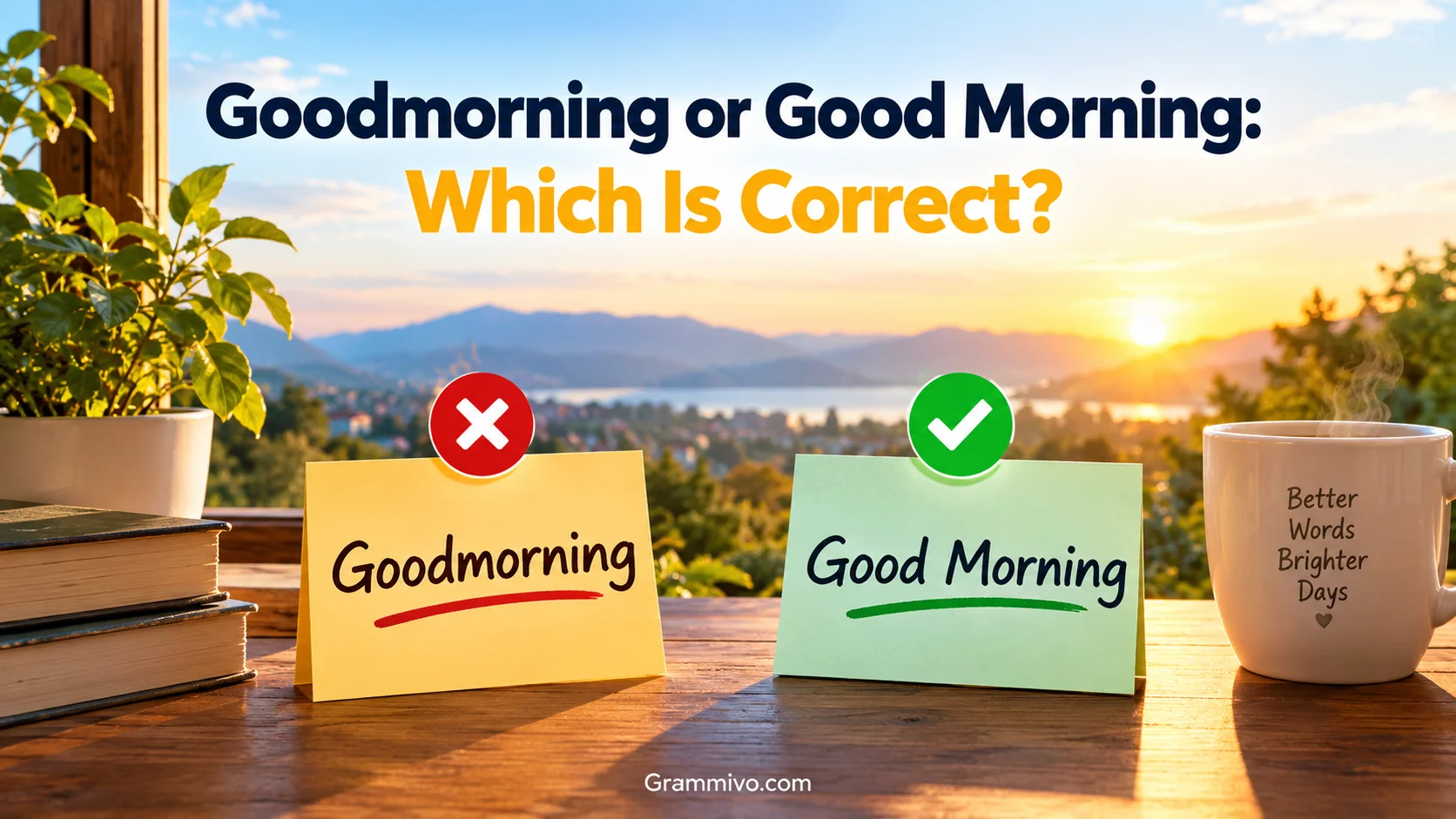
Good morning is correct. Goodmorning is not the standard spelling of the English greeting.
The expression consists of two words:
- Good — an adjective describing something as favorable, pleasant, or satisfactory.
- Morning — the part of the day between midnight and noon, especially the early part of the day in ordinary usage.
Together, good morning works as a conventional greeting. You use it to acknowledge someone or wish them a pleasant morning.
Correct
Good morning! How are you today?
Incorrect in standard English
Goodmorning! How are you today?
The difference is only a space, but that space separates two words that English normally writes independently.
So, if you’re choosing between goodmorning or good morning, use good morning.
Comparison Overview
| Form | Standard English? | Word Count | Common Use | Example |
| Good morning | Yes | 2 | Greeting | Good morning, everyone. |
| Goodmorning | No | 1 | Nonstandard spelling or stylized use | Goodmorning! |
| Good Morning | Yes, in certain contexts | 2 | Capitalized greeting or title-style writing | Good Morning, Professor. |
| Morning | Yes | 1 | Informal greeting | Morning! |
The important distinction is between standard spelling and creative or informal styling.
Someone might use Goodmorning in a username, business name, hashtag, graphic, or social-media design. That doesn’t make it the standard spelling of the greeting.
In ordinary writing, keep the words separate.
Main Differences Between Goodmorning and Good Morning
The biggest difference is simple: good morning is the standard two-word expression, while goodmorning is generally a nonstandard one-word spelling.
However, understanding why the difference exists can help you avoid similar mistakes.
| Feature | Good morning | Goodmorning |
| Spelling | Two words | One word |
| Standard usage | Yes | No |
| Grammatical form | Adjective + noun | Nonstandard combination |
| Used as a greeting | Yes | Not in standard writing |
| Suitable for formal writing | Yes | No |
| Suitable for ordinary emails | Yes | No |
| May appear as a brand or username | Yes | Yes |
| Recommended in normal writing | Yes | No |
Why the Space Matters
English doesn’t automatically combine words simply because they frequently appear together.
Consider these familiar expressions:
- good night
- good afternoon
- good evening
- good morning
They function as established greetings, but that doesn’t mean each one becomes a single word.
You wouldn’t normally write goodnight when using the expression as a greeting in every context. In fact, goodnight can appear as a single word in some uses, especially as a noun or adjective, while good night remains the conventional greeting.
This illustrates an important point about English spelling: frequent word combinations don’t automatically become compound words.
What Does “Good Morning” Mean?
Good morning is a greeting traditionally used during the morning.
The word good expresses a positive wish or sentiment. The word morning identifies the time of day. As a whole, the expression functions less like a literal description and more like a social greeting.
When you say:
Good morning!
you aren’t necessarily making a detailed claim that the morning itself is objectively good. You’re using a conventional expression to greet another person pleasantly.
That’s similar to other everyday greetings. Their purpose isn’t always literal. They’re part of the social machinery of conversation.
For example:
- Good morning, Lisa.
- Good morning, everyone.
- Good morning! Did you sleep well?
- Good morning, team.
- Good morning, Mr. Carter.
The exact tone depends on the situation, your relationship with the person, and the surrounding words.
Is “Good Morning” One Word or Two?
Good morning is normally written as two words.
The first word, good, is an adjective. The second word, morning, is a noun.
In the expression, good modifies morning, creating a familiar greeting.
This doesn’t mean the expression must always behave like an ordinary adjective-noun phrase. Over time, greetings can become conventional expressions with their own pragmatic function.
Think of it like a verbal handshake. You’re not stopping to analyze every word when you say it. You’re performing a familiar social action: acknowledging someone and wishing them a pleasant start to the day.
Examples
Correct:
- Good morning, Dad.
- Good morning, everyone.
- I said good morning to my neighbor.
- She wished her students good morning.
- Good morning is a polite way to start the conversation.
Nonstandard:
- Goodmorning, Dad.
- I said goodmorning to my neighbor.
- Goodmorning is a polite greeting.
The issue isn’t pronunciation. When spoken, the space disappears naturally. The distinction becomes visible when you write the expression.
Why Is “Goodmorning” Incorrect?
The spelling goodmorning combines two words that standard English normally keeps separate when used as this greeting.
English has many legitimate compound words, such as:
- notebook
- classroom
- sunlight
- toothbrush
- football
- bedroom
Those words developed conventional closed forms. You can’t simply take any frequently paired words and join them together.
For example, good morning doesn’t become goodmorning simply because people say the phrase frequently.
This is a common spelling trap. Spoken English gives you no visible clue about word boundaries. Writing does.
A Simple Test
If you’re unsure, mentally separate the expression:
good + morning
Both words have their own grammatical roles. In the standard greeting, they remain separate.
So remember:
Good morning = standard
Goodmorning = nonstandard
That’s the rule worth remembering.
How to Use “Good Morning” Correctly
The phrase appears in many situations, from casual conversations to professional meetings. Its spelling doesn’t change simply because the setting changes.
What changes is the tone, punctuation, and capitalization around it.
“Good Morning” as a Greeting
The most common use is as a direct greeting.
Good morning!
You can use this when you meet someone during the morning.
You can also add a person’s name:
Good morning, James.
Or address a group:
Good morning, everyone.
The greeting remains two words in each example.
“Good Morning” in Writing
Written communication gives you plenty of opportunities to use this phrase.
For example:
Good morning, Sarah. I wanted to confirm our meeting for 10 a.m.
Or:
Good morning, team. Please review the updated schedule before today’s meeting.
The expression works well in professional communication because it sounds courteous without being excessively formal.
“Good Morning” in Direct Address
When you use good morning directly before someone’s name, a comma commonly separates the greeting from the person’s name.
Good morning, Maria.
The same principle applies to groups:
Good morning, everyone.
And to titles:
Good morning, Professor.
The comma helps show that you’re addressing someone directly.
Compare:
Good morning, John.
with:
John said good morning.
In the first sentence, John is the person being addressed. In the second, John is the person performing the greeting.
That small punctuation difference can change the sentence structure.
Is “Good Morning” Capitalized?
Capitalization depends on where the expression appears.
At the beginning of a sentence, Good is capitalized because English capitalizes the first word of a sentence.
Good morning, everyone.
If the phrase appears in the middle of a sentence, lowercase is normally appropriate:
She said good morning before taking her seat.
However, greetings in letters, emails, headings, and visual designs can follow different capitalization conventions.
For example:
Good morning, Mr. Davis.
Here, Good is capitalized because it begins the greeting.
What About “Good Morning” in a Heading?
In title-style headings, you may see:
Good Morning: Meaning and Correct Usage
Both major words are capitalized because title case can capitalize important words.
That’s different from ordinary sentence usage.
So don’t confuse title capitalization with the standard spelling of the phrase.
Read More: What Kind of vs. What Kinds of: Meaning, and Correct Usage
“Good Morning” vs. “Morning”
Both expressions can work as greetings, but they don’t always sound the same.
Good morning is the fuller and more conventional greeting. It works comfortably in casual and professional situations.
Morning is shorter and more informal.
Compare:
Good morning, Alex. How are you?
with:
Morning, Alex!
The second version sounds more relaxed. You might use it with a friend, coworker, neighbor, or someone you know well.
Quick Comparison
| Greeting | Tone | Typical Situation |
| Good morning | Polite and neutral | Most situations |
| Morning | Casual | Friends, coworkers, familiar people |
| Morning! | Friendly and informal | Casual conversation |
| Good morning, everyone | Polite and inclusive | Meetings or groups |
Neither expression needs to become goodmorning.
The shortened form morning simply drops the word good. It doesn’t change the spelling of the original expression.
Goodmorning or Good Morning in Emails
Email greetings can create another layer of confusion because formatting varies between casual and professional messages.
For a professional email, you might write:
Good morning, Ms. Taylor,
Then continue with the purpose of the message.
For a less formal email:
Good morning, everyone.
Or:
Good morning, team.
The phrase remains good morning regardless of the level of formality.
Professional Examples
Example 1:
Good morning, Daniel.
Please find the revised schedule attached.
Example 2:
Good morning, team.
Today’s meeting will begin at 9:30 a.m.
Example 3:
Good morning, Dr. Wilson.
I have a question about tomorrow’s appointment.
In each example, the greeting contains two words.
Good Morning vs. Good Afternoon vs. Good Evening
English uses several familiar time-based greetings.
| Greeting | Typical Time | Standard Spelling |
| Good morning | Morning | Two words |
| Good afternoon | Afternoon | Two words |
| Good evening | Evening | Two words |
| Good night | Usually when leaving or going to sleep | Two words as a greeting/farewell |
These expressions follow a similar pattern.
You don’t normally write:
- Goodmorning
- Goodafternoon
- Goodevening
as standard English greetings.
The expressions retain their separate words.
Why “Good Night” Can Cause Confusion
Good night deserves special attention because goodnight also appears in English.
For example:
Good night! See you tomorrow.
As a greeting or farewell, good night is commonly written as two words.
However, goodnight can appear as a compound in other grammatical contexts or stylized expressions.
That doesn’t create a reason to spell good morning as goodmorning. Each expression has its own established usage.
Common “Good Morning” Mistakes
Most mistakes involving this expression are simple. Fortunately, they’re also easy to fix.
Writing “Goodmorning”
This is the biggest issue.
Incorrect:
Goodmorning, everyone.
Correct:
Good morning, everyone.
Treating It as a Single Noun
You may occasionally see someone write:
I sent him a goodmorning message.
In ordinary standard writing, it’s better to phrase this naturally as:
I sent him a good morning message.
Or, depending on the meaning:
I sent him a message wishing him a good morning.
Context matters, especially when compounds are involved.
Forgetting the Comma in Direct Address
When you’re directly addressing someone, a comma often helps separate the greeting from the person’s name.
Good morning, Emily.
rather than:
Good morning Emily.
The first version clearly marks Emily as the person being addressed.
Overcapitalizing the Phrase
This isn’t always wrong, but context matters.
In ordinary prose:
She said good morning to her neighbor.
There’s no reason to capitalize both words.
In a title:
Good Morning: Meaning and Usage
title capitalization can justify capitalizing both.
Examples of “Good Morning” in Sentences
Seeing the phrase in different contexts makes the rule easier to remember.
Everyday Conversation
- Good morning! How did you sleep?
- Good morning, Mom.
- Good morning, everyone.
- Good morning. It’s nice to see you.
Workplace Communication
- Good morning, team.
- Good morning, Sarah. Are we still meeting at ten?
- Good morning, everyone. Let’s get started.
- Good morning, Mr. Lee. Thank you for joining us.
School and Education
- Good morning, class.
- Good morning, Professor Adams.
- The teacher greeted the students with good morning.
Casual Messages
- Good morning! Hope you have a great day.
- Good morning! Don’t forget your coffee.
- Good morning, sleepyhead!
The tone can range from formal to playful while the spelling stays the same.
FAQs:
Is “goodmorning” one word?
No. Good morning is normally written as two words when used as the standard English greeting. Goodmorning is a nonstandard spelling in ordinary prose.
Is “good morning” always two words?
For the standard greeting, yes. Write good morning as two separate words.
Should “Good Morning” be capitalized?
At the beginning of a sentence or greeting, Good is capitalized:
Good morning, everyone.
In the middle of a normal sentence, lowercase is generally appropriate:
She said good morning to me.
In titles and headings, title-style capitalization may capitalize both words.
Do you put a comma after “good morning”?
When you directly address someone, a comma usually separates the greeting from the name or form of address:
Good morning, Sarah.
However, punctuation depends on the complete sentence and its structure.
Can you say “morning” instead of “good morning”?
Yes. Morning! is a common informal greeting. It’s shorter and generally more casual than good morning.
Conclusion:
When you’re deciding between goodmorning or good morning, the answer is straightforward: good morning is the standard form. The expression contains two separate words. Good modifies morning, and together they form a familiar greeting used throughout everyday and professional English. You might still see Goodmorning in usernames, branding, hashtags, or creative designs. Those are special stylistic cases. They don’t change the normal spelling rule.
