
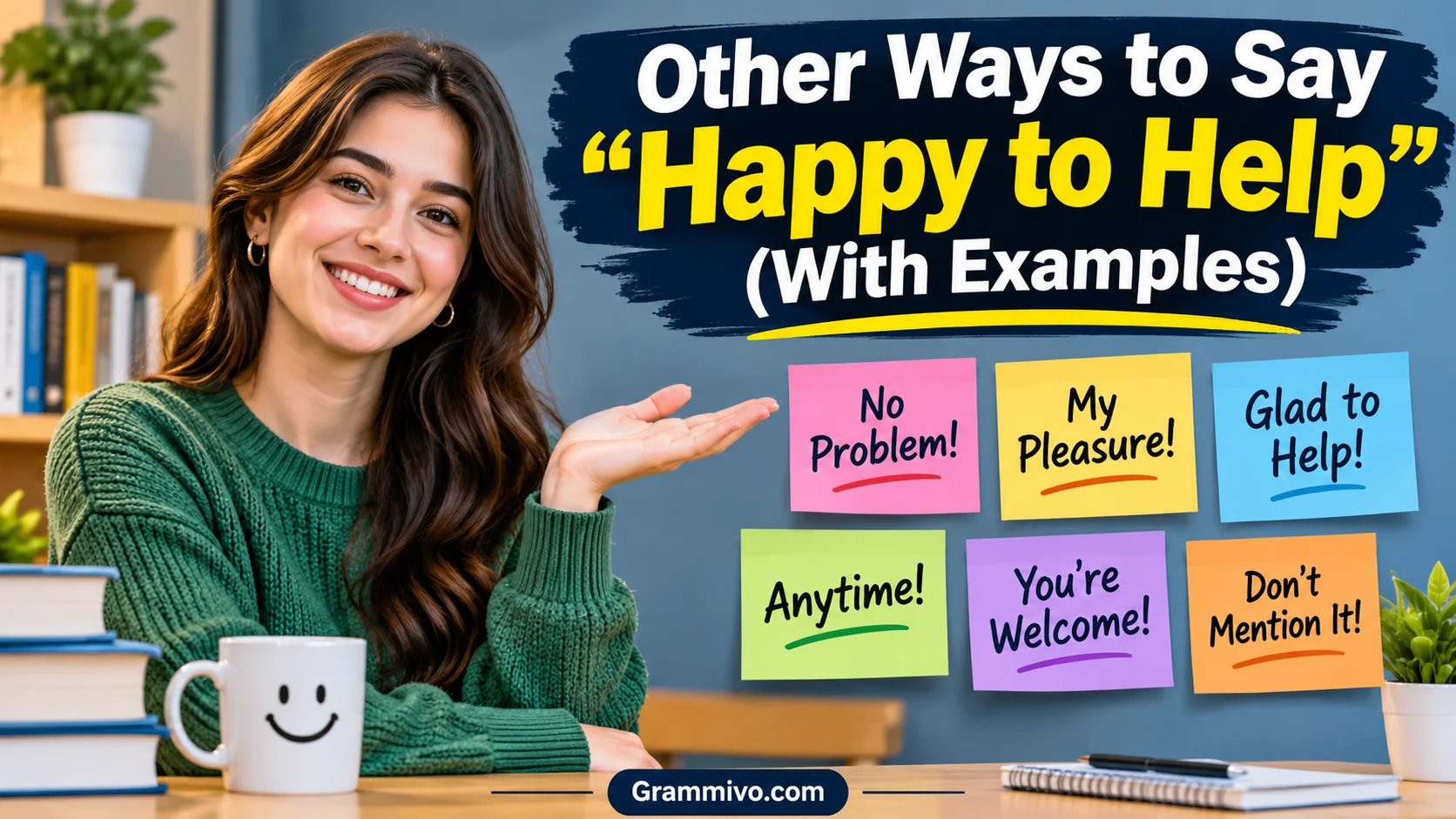
Whether you’re responding to a coworker’s question, helping a friend, or assisting a customer, “Happy to help” is a friendly way to show you’re willing to offer support. However, using the same expression repeatedly can make your conversations and emails sound predictable. Sometimes, you might want something more professional, while other situations call for a warmer or more personal response.
Fortunately, there are several natural other ways to say “Happy to Help” in American English. Some alternatives work particularly well in professional emails, while others sound more relaxed and conversational. This guide explores 15 useful expressions, explains their meanings, and provides realistic examples to help you choose the right wording for every situation.
Quick Answer:
If you’re looking for another way to say “Happy to Help,” these expressions are natural choices:
- Glad to help: A friendly, straightforward alternative.
- Happy to assist: A slightly more professional expression.
- My pleasure: A polite response when someone thanks you.
- I’d be glad to help: A warm way to offer assistance.
- Always happy to help: Shows continued willingness to support someone.
- Of course: A simple, reassuring response to a request.
- No problem: A relaxed response to someone’s thanks.
- Certainly: A polite and professional acknowledgment.
- I’m here for you: Communicates personal support and availability.
- Anytime: An informal way to show someone they can ask again.
Some expressions work best when offering assistance, while others are more appropriate after you’ve already helped someone.
Comparison Overview:
| Alternative | Best Used For | Tone |
| Glad to help | Everyday conversations and work | Friendly |
| Happy to assist | Professional communication | Professional |
| My pleasure | Responding to thanks | Polite |
| I’d be glad to help | Offering assistance | Warm and professional |
| Always happy to help | Ongoing support | Friendly |
| Of course | Responding to requests | Reassuring |
| No problem | Casual conversations | Relaxed |
| Certainly | Formal requests | Professional |
| I’m here for you | Personal support | Caring |
| Anytime | Friends and familiar coworkers | Casual |
| I’d be happy to | Future assistance | Courteous |
| Pleased to help | Professional interactions | Formal |
| Glad I could help | After completing a task | Friendly |
| Let me know if you need anything else | Follow-up communication | Helpful |
| I’m happy to lend a hand | Practical assistance | Approachable |
What Does “Happy to Help” Mean?
“Happy to help” means you’re willing and pleased to provide assistance to someone. It communicates a positive attitude toward helping without making the other person feel like they’re creating an inconvenience.
The expression combines the adjective happy with the infinitive phrase to help. It commonly functions as a short response to a request or an acknowledgment after someone expresses gratitude.
For example:
- “Thanks for explaining the new process.” “Happy to help!”
- “Could you review this document?” “Sure, happy to help.”
The phrase communicates more than simple agreement. It suggests that you’re comfortable providing assistance and don’t consider the request a burden.
In American English, it’s common in workplaces, customer service interactions, emails, and everyday conversations.
When Is “Happy to Help” Appropriate?
“Happy to help” is a versatile expression, but its suitability depends on your relationship with the recipient and the situation.
Workplace communication: It’s appropriate when assisting coworkers, answering questions, or offering support on a project. It sounds cooperative without being overly formal.
Professional emails: You can use it when responding to requests, acknowledging feedback, or following up after completing a task. It creates a friendly professional impression.
Customer service: The phrase works well when answering customer questions or resolving problems. It reassures customers that you’re willing to assist.
Conversations with friends and family: It’s perfectly natural when someone asks for a favor or appreciates something you’ve done. However, more personal expressions may feel warmer.
Formal writing: Although the expression isn’t inappropriate, highly formal correspondence may benefit from alternatives such as “I would be pleased to assist.”
Why Use Different Ways to Say “Happy to Help”?
Choosing different expressions can make your communication more natural and meaningful.
- Match your tone to the situation: A workplace email may require more polished wording than a conversation with a friend.
- Avoid repetitive language: Different expressions prevent your messages from sounding automated.
- Communicate genuine warmth: Personal alternatives can make someone feel appreciated and supported.
- Show professionalism: Appropriate wording helps you maintain a courteous and cooperative attitude.
- Improve clarity: Some expressions distinguish between offering assistance and responding after completing a task.
Final List of Alternatives
- Glad to Help
- My Pleasure
- No Problem
- Anytime
- Always Happy to Help
- Happy to Assist
- I’d Be Glad to Help
- Certainly
- Pleased to Help
- I’d Be Happy To
- Of Course
- I’m Here for You
- Glad I Could Help
- Let Me Know If You Need Anything Else
- I’m Happy to Lend a Hand
1. Glad to Help
Meaning and Usage: “Glad to help” is one of the closest alternatives to “Happy to Help.” Both communicate that you’re willing and pleased to assist someone. The wording is slightly shorter and works naturally in professional and personal conversations.
Examples:
- Thanks for showing me how the software works. I’m glad to help.
- If you need another pair of eyes on the presentation, I’m glad to help.
- “I appreciate your advice.” “Glad to help!”
Best Use For: Everyday conversations, coworker interactions, and friendly professional messages.
Tone: Friendly, approachable, and positive.
2. My Pleasure
Meaning and Usage: “My pleasure” is a polite response when someone thanks you for assistance. It suggests that helping them was enjoyable or welcome. Unlike “Happy to Help,” it usually acknowledges something you’ve already done rather than offering future assistance.
Examples:
- “Thank you for organizing everything.” “My pleasure!”
- It was my pleasure to help you prepare for the interview.
- “I really appreciate your time.” “My pleasure.”
Best Use For: Customer service, professional interactions, and polite everyday conversations.
Tone: Courteous, warm, and polished.
3. No Problem
Meaning and Usage: “No problem” reassures someone that their request or favor wasn’t an inconvenience. It’s particularly natural when responding to thanks. However, it emphasizes the absence of a problem rather than your happiness about helping.
Examples:
- “Thanks for picking up my package.” “No problem!”
- No problem at all. I can send you the updated document.
- “Sorry for asking so many questions.” “No problem.”
Best Use For: Casual conversations, friendly workplace interactions, and informal messages.
Tone: Relaxed, reassuring, and conversational.
4. Anytime
Meaning and Usage: “Anytime” suggests that someone can ask for your assistance again whenever necessary. It’s a natural response to gratitude, especially when you want to show continued willingness to help. It doesn’t necessarily mean you’re available at literally any hour.
Examples:
- “Thanks for helping me move.” “Anytime!”
- You can ask me about the assignment anytime.
- “I appreciate you staying late.” “Anytime. I’m glad we finished.”
Best Use For: Friends, family members, and familiar coworkers.
Tone: Casual, generous, and friendly.
5. Always Happy to Help
Meaning and Usage: This expression emphasizes your continued willingness to assist someone. It’s especially useful when you’ve helped the same person before or expect to work with them again. Adding “always” makes the message feel more reassuring than a simple offer.
Examples:
- Thanks for reaching out. I’m always happy to help.
- If you have questions about the next phase, we’re always happy to help.
- You’re welcome! Always happy to help whenever I can.
Best Use For: Ongoing professional relationships, customer support, and recurring assistance.
Tone: Warm, supportive, and reassuring.
Professional Alternatives
These expressions are particularly useful in business emails, workplace conversations, and customer-facing communication.
6. Happy to Assist
Meaning and Usage: “Happy to assist” communicates the same general idea as “Happy to Help,” but assist gives it a slightly more professional feel. It’s a natural choice when communicating with clients, colleagues, or customers in a business setting.
Examples:
- Please send me the details, and I’ll be happy to assist.
- Our support team is happy to assist with any technical questions.
- If you need help preparing the report, I’m happy to assist.
Best Use For: Business emails, customer service, workplace communication, and professional correspondence.
Tone: Professional, helpful, and courteous.
7. I’d Be Glad to Help
Meaning and Usage: “I’d be glad to help” is a courteous way to offer assistance. The conditional wording makes it especially suitable when someone hasn’t accepted your offer yet. It communicates willingness without sounding pushy or overly enthusiastic.
Examples:
- If you’d like me to review the proposal, I’d be glad to help.
- I’d be glad to walk you through the application process.
- Let me know what you need, and I’d be glad to help.
Best Use For: Professional emails, workplace requests, and polite conversations.
Tone: Warm, respectful, and professional.
8. Certainly
Meaning and Usage: “Certainly” expresses a positive and confident willingness to fulfill someone’s request. It’s more formal than “Happy to Help” and works particularly well when acknowledging a specific task. However, it doesn’t independently communicate the same emotional warmth.
Examples:
- “Could you forward me the meeting notes?” “Certainly.”
- Certainly, I’ll review the changes before sending the final version.
- “Would you be available to discuss the proposal?” “Certainly.”
Best Use For: Formal emails, business conversations, and professional requests.
Tone: Polite, confident, and formal.
9. Pleased to Help
Meaning and Usage: “Pleased to help” communicates genuine satisfaction in providing assistance. It sounds slightly more formal and polished than “Glad to Help.” You can use it when acknowledging a professional request or expressing appreciation for the opportunity to assist someone.
Examples:
- I was pleased to help your team complete the project.
- We’re pleased to help you find the right solution.
- It was a pleasure working with you, and I’m pleased to help with future questions.
Best Use For: Business correspondence, professional relationships, and customer communication.
Tone: Courteous, polished, and professional.
10. I’d Be Happy To
Meaning and Usage: “I’d be happy to” is a flexible expression for accepting an offer or agreeing to perform a specific task. It usually needs additional context or a verb to complete the thought. For example, you might say, “I’d be happy to review your application.”
Examples:
- “Can you explain the new procedure?” “I’d be happy to.”
- I’d be happy to schedule another meeting.
- If you need additional information, I’d be happy to provide it.
Best Use For: Professional emails, business conversations, and polite requests.
Tone: Courteous, cooperative, and professional.
Read More: 15 Other Ways to Say “Stay Tuned” (With Examples)
Contextual and Supportive Alternatives
These expressions work in particular situations. They communicate willingness, availability, or personal support rather than serving as exact replacements in every sentence.
11. Of Course
Meaning and Usage: “Of course” is a reassuring response when someone asks for assistance. It makes your agreement sound natural and effortless. Although it can replace “Happy to Help” in some conversations, it primarily communicates agreement rather than directly expressing enjoyment.
Examples:
- “Could you help me understand this question?” “Of course!”
- Of course, I’ll send you the information this afternoon.
- “Would you mind checking these figures?” “Of course.”
Best Use For: Everyday requests, friendly workplace conversations, and customer interactions.
Tone: Reassuring, confident, and approachable.
12. I’m Here for You
Meaning and Usage: “I’m here for you” expresses personal availability and emotional support. It’s different from ordinary assistance because it often communicates care, understanding, or encouragement. Use it when someone needs reassurance rather than help with a simple task.
Examples:
- I know this has been a difficult week. I’m here for you.
- If you need someone to talk to, I’m here for you.
- You don’t have to handle everything alone. I’m here for you.
Best Use For: Friends, family members, personal relationships, and emotionally difficult situations.
Tone: Caring, supportive, and heartfelt.
13. Glad I Could Help
Meaning and Usage: “Glad I could help” is particularly suitable after you’ve completed a task or solved someone’s problem. It acknowledges their gratitude while expressing satisfaction with the outcome. Unlike “Happy to Help,” it usually refers to assistance you’ve already provided.
Examples:
- “Your explanation made everything easier.” “Glad I could help.”
- I’m glad I could help you prepare for your presentation.
- “Thanks for fixing the issue so quickly.” “Glad I could help!”
Best Use For: Follow-up conversations, professional exchanges, and responses to appreciation.
Tone: Friendly, modest, and positive.
14. Let Me Know If You Need Anything Else
Meaning and Usage: This expression invites someone to request additional assistance. It’s especially useful after completing a task because it shows you’re available for follow-up questions. However, it offers continued support rather than directly stating that helping was enjoyable.
Examples:
- I’ve attached the revised proposal. Let me know if you need anything else.
- Your account has been updated. Please let me know if you need further assistance.
- I’ve answered your questions about the schedule. Let me know if anything else comes up.
Best Use For: Professional emails, customer support, project communication, and service-related interactions.
Tone: Helpful, professional, and considerate.
15. I’m Happy to Lend a Hand
Meaning and Usage: “I’m happy to lend a hand” is an informal expression meaning you’re willing to help with a task. It often suggests practical assistance, such as moving furniture, organizing an event, or completing a project. The phrase sounds more conversational than businesslike.
Examples:
- If you’re moving this weekend, I’m happy to lend a hand.
- We have several boxes to unpack, and I’m happy to lend a hand.
- Let me know if your team needs extra support. I’m happy to lend a hand.
Best Use For: Friends, family, casual workplace conversations, and practical tasks.
Tone: Friendly, generous, and approachable.
How to Replace “Happy to Help” in Real Sentences
Understanding alternatives is easier when you see how they work in complete sentences. The following transformations demonstrate different situations without changing the original intention unnecessarily.
Original: Thanks for reaching out. I’m happy to help with your questions.
Alternative: Thanks for reaching out. I’d be glad to help with your questions.
Why It Works: Both expressions communicate willingness to answer questions. The alternative sounds slightly more courteous.
Original: Happy to help you with the project whenever you need assistance.
Alternative: I’m always happy to help with the project whenever you need assistance.
Why It Works: Adding “always” emphasizes continued availability and support.
Original: I was happy to help you resolve the issue.
Alternative: I was pleased to help you resolve the issue.
Why It Works: “Pleased to help” creates a more polished tone suitable for professional communication.
Original: Happy to help! Let me know if you have more questions.
Alternative: Of course! Let me know if you have more questions.
Why It Works: “Of course” makes the response sound reassuring and natural, particularly after someone asks for assistance.
Original: Thanks for asking me to review your application. Happy to help!
Alternative: Thanks for asking me to review your application. I’d be happy to assist!
Why It Works: The revised sentence sounds professional while preserving the original willingness to help.
How to Choose the Right Alternative
Not every expression works equally well in every situation. Consider these practical tips before choosing your wording.
- Consider your relationship: Use “Anytime” with friends, but choose “Happy to Assist” when communicating with clients.
- Think about the timing: “I’d be glad to help” works before providing assistance, while “Glad I could help” fits afterward.
- Match the formality: Choose “Certainly” or “Pleased to Help” for more formal interactions.
- Consider emotional context: “I’m here for you” works better when someone needs personal support.
- Keep your message natural: Don’t choose a complicated expression when a simple “Glad to help” communicates your intention clearly.
Best Alternatives to “Happy to Help” for Professional Emails
When writing professional emails, your response should sound courteous without becoming unnecessarily formal. The best expression depends on whether you’re accepting a request, completing a task, or offering additional assistance.
| Situation | Recommended Expression | Example |
| Accepting a request | I’d be glad to help | I’d be glad to help you prepare the presentation. |
| Responding to a client | Happy to assist | I’m happy to assist with your account questions. |
| Completing a task | Glad I could help | I’m glad I could help resolve the issue. |
| Responding formally | Certainly | Certainly, I’ll send the revised document today. |
| Offering further support | Let me know if you need anything else | Let me know if you need anything else before the meeting. |
A few additional considerations can improve your email communication:
- Use “I’d be happy to” when agreeing to a specific request.
- Choose “My pleasure” when someone thanks you for your assistance.
- Use “Happy to assist” when communicating with customers or business contacts.
- Avoid overly casual expressions such as “Anytime” in highly formal correspondence unless you already have a friendly relationship.
Frequently Asked Questions
What is the most professional way to say “Happy to Help”?
“Happy to assist” is one of the most natural professional alternatives. It communicates willingness without sounding overly casual. “I’d be glad to help” is another excellent choice when offering assistance to a colleague, customer, or business contact.
What is a more polite way to say “Happy to Help”?
“My pleasure” and “I’d be pleased to help” are polite alternatives. Use “My pleasure” when responding to someone’s thanks. Choose “I’d be pleased to help” when offering assistance in a more formal situation.
Is “Happy to Help” appropriate in a business email?
Yes. “Happy to Help” sounds friendly, cooperative, and professional in most ordinary business emails. You can use it when accepting requests, answering questions, or offering assistance. For more formal communication, consider “I’d be glad to assist” instead.
Is “Glad to Help” better than “Happy to Help”?
Both expressions communicate nearly the same idea. “Glad to help” is slightly shorter and works naturally in casual and professional conversations. “Happy to help” can sound a little warmer. Neither expression is universally better; your preference and the situation matter.
Can I say “My Pleasure” instead of “Happy to Help”?
Yes, particularly when responding to gratitude. “My pleasure” acknowledges that you’ve already helped someone and suggests you were pleased to do so. However, it isn’t always a direct replacement when you’re offering assistance for the first time.
Conclusion:
Finding the right alternative to “Happy to Help” can make your communication sound more natural, thoughtful, and appropriate. Expressions such as “Glad to Help” and “My Pleasure” work well in everyday conversations, while “Happy to Assist” and “I’d Be Glad to Help” suit professional situations.
When someone needs emotional support, “I’m Here for You” communicates a more personal message. Ultimately, the best alternative depends on what you’re trying to express. Choose words that reflect your genuine willingness to help rather than simply replacing one familiar phrase with another.
