
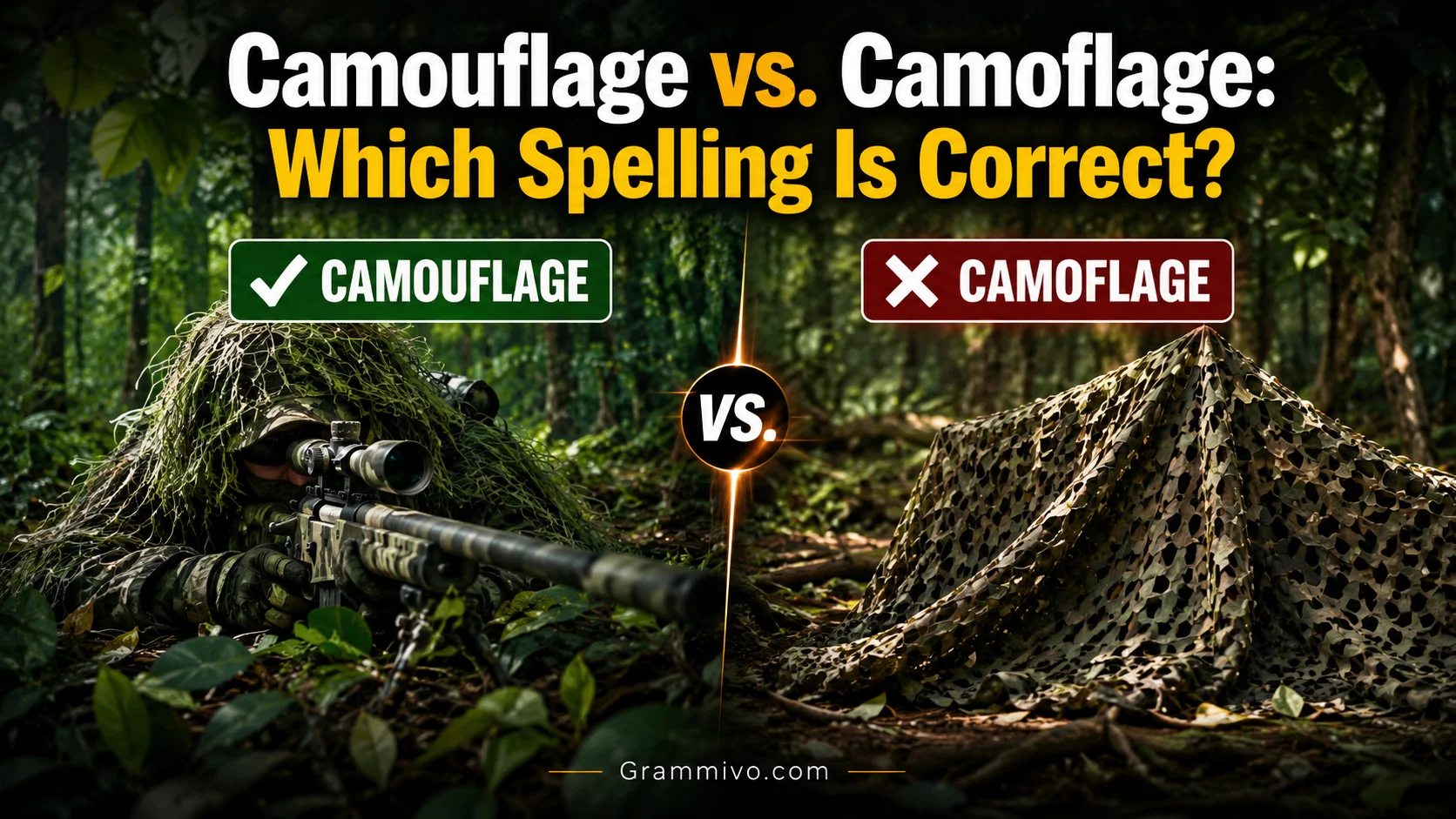
If you’ve ever typed camouflage and wondered whether the word should actually be spelled camoflage, you’re not alone. The two forms look remarkably similar, and the pronunciation doesn’t make every letter easy to hear. That makes this word a common spelling trap.
Here’s the important answer: camouflage is the correct spelling, while camoflage is a misspelling. There’s no separate English word camoflage with a different meaning. The standard word is camouflage, and it can function as a noun, verb, or modifier depending on the sentence.
The unusual spelling becomes easier to understand once you break the word apart. Think of it as camou + flage, rather than trying to spell it entirely from its pronunciation. That small u is the letter people most often leave out.
Quick Answer
Camouflage is correct.
Camoflage is incorrect.
| Spelling | Correct? | Meaning |
| camouflage | Yes | Concealment, disguise, or the act of concealing something |
| camoflage | No | Misspelling of camouflage |
| camo | Yes | Informal shortened form of camouflage |
The correct spelling is C-A-M-O-U-F-L-A-G-E.
The most useful spelling trick is to remember CAMOU + FLAGE. The ou sequence comes before flage, which prevents the common mistake of writing camoflage.
Why Is “Camouflage” the Correct Spelling?
Camouflage is the established English spelling of the word. It isn’t an American-versus-British spelling issue, either. Unlike words such as color and colour, English doesn’t have two standard national spellings here.
The problem comes from the word’s appearance and pronunciation. When you hear camouflage, the middle ou isn’t pronounced in a way that makes its spelling obvious. A person who relies heavily on sound may naturally write something closer to camoflage.
English has plenty of words like this. Their written forms preserve historical spellings that aren’t always obvious from modern pronunciation.
The spelling camouflage contains eight letters after the initial cam: o-u-f-l-a-g-e. Removing the u creates camoflage, but that form isn’t accepted as the standard spelling.
A useful way to see the difference is:
- camouflage → C-A-M-O-U-F-L-A-G-E
- camoflage → C-A-M-O-F-L-A-G-E
The incorrect version simply loses the u.
That one letter matters.
How Do You Spell Camouflage?
Spell the word as:
C-A-M-O-U-F-L-A-G-E
If the full spelling feels difficult to memorize, divide it into two visual chunks:
CAMOU + FLAGE
This approach works better than trying to memorize nine individual letters.
You can also connect the full word with its shortened form:
camouflage → camo
The word camo reminds you of the beginning, but don’t let the shortened form trick you into removing the u from the full spelling.
A Simple Spelling Memory Trick
Think:
CAMOUflage hides things.
The word camou contains the part that people most often forget.
Another useful trick is to remember that the correct word has “ou” before “flage.”
So when you’re writing quickly, stop for half a second and check:
camou + flage
Not:
camo + flage
That tiny mental pause can prevent the most common spelling error.
How Do You Pronounce “Camouflage”?
In American English, camouflage is generally pronounced something like kam-uh-FLAHZH. Dictionary pronunciation guides can represent the exact sounds differently because English pronunciation varies somewhat between speakers and regions.
The final sound resembles the sound in words such as massage and garage for many American speakers. The spelling, however, doesn’t follow a simple sound-by-sound pattern.
That’s one reason camouflage vs. camoflage causes confusion.
When people spell words entirely according to what they hear, they can accidentally leave out letters that aren’t strongly represented in speech. The u in camouflage is especially easy to overlook.
What Does “Camouflage” Mean?
Camouflage means concealment or disguise that helps something avoid being noticed or recognized.
The idea is straightforward: something becomes harder to see, identify, or distinguish from its surroundings.
A green military vehicle parked among dense vegetation may use camouflage to blend into the landscape. A moth with wing patterns that resemble tree bark can use camouflage to become less noticeable to predators.
The concept also works outside nature and military settings.
For example:
The dark paint helped camouflage the scratches on the wall.
Here, camouflage means to make the scratches less noticeable.
The word can describe both physical concealment and figurative concealment. Someone might camouflage a weakness with confident behavior, for example. In that case, nothing is literally hidden behind leaves or painted fabric. The person is masking something from observation.
Camouflage as a Noun
As a noun, camouflage refers to the method, appearance, material, or pattern used to conceal something.
Consider these examples:
- The soldiers wore camouflage in the forest.
- The insect’s camouflage made it difficult to spot.
- The vehicle was covered in camouflage.
- The jacket has a traditional camouflage pattern.
- The rocks provided natural camouflage for the lizard.
Notice that the noun can describe different things.
It might refer to a pattern, such as a military print. It might refer to a method of concealment. It can also describe the overall effect that makes an object or animal difficult to detect.
The surrounding sentence usually makes the intended meaning clear.
Camouflage as a Verb
Camouflage also works as a verb. In this form, it means to conceal, disguise, or make something less noticeable.
For example:
The leaves camouflaged the nest.
Here, camouflaged describes what the leaves did. They helped conceal the nest.
More examples include:
- The paint camouflaged the damaged section.
- The animal camouflages itself among the rocks.
- Branches helped camouflage the equipment.
- The dark clothing camouflaged him against the background.
- The designer used the pattern to camouflage the stain.
The common verb forms include:
| Verb form | Example |
| camouflage | They camouflage the equipment. |
| camouflages | The animal camouflages itself. |
| camouflaged | The branches camouflaged the nest. |
| camouflaging | They were camouflaging the structure. |
Merriam-Webster lists camouflage as both a noun and a verb, confirming that this isn’t merely the name of a pattern or type of clothing.
Can “Camouflage” Be Used Before a Noun?
Yes. Camouflage frequently appears before another noun to describe something associated with concealment or camouflage patterns.
For example:
- camouflage jacket
- camouflage pants
- camouflage netting
- camouflage pattern
- camouflage clothing
- camouflage paint
- camouflage fabric
In these phrases, camouflage functions as a noun modifier.
For example:
She bought a camouflage jacket for the outdoor trip.
The word camouflage identifies the type or pattern of jacket.
This everyday construction explains why you’ll often see the word in clothing, hunting, outdoor recreation, wildlife, and military contexts.
Camouflage vs. Camoflage: What’s the Difference?
The difference is purely one of correct versus incorrect spelling.
| Feature | Camouflage | Camoflage |
| Standard spelling | Yes | No |
| Dictionary word | Yes | No |
| Meaning | Concealment or disguise | None as a standard English word |
| Correct in formal writing | Yes | No |
| Contains ou | Yes | No |
| Common error | No | Yes |
There isn’t a semantic distinction between these two spellings.
In other words, you can’t use camoflage in one situation and camouflage in another. The shorter-looking version isn’t an alternative definition. It’s simply a misspelling.
If you’re writing an email, school assignment, article, report, résumé, or professional document, use camouflage.
Why Do People Spell Camouflage as “Camoflage”?
The spelling error makes sense once you consider how people encounter the word.
First, pronunciation doesn’t clearly reveal the written form. You don’t necessarily hear every letter when someone says camouflage. The written ou is particularly easy to miss.
Second, people often encounter the shortened form camo. That informal word is common in American English, especially when discussing clothing and patterns.
Someone who knows camo but hasn’t memorized camouflage may mentally reconstruct the full word as:
camo + flage
That produces:
camoflage
The correct spelling, however, is:
camou + flage
Third, the sequence -ouflage isn’t especially intuitive for English learners. English contains many words whose spellings preserve older linguistic forms, so pronunciation alone doesn’t always provide a reliable spelling guide.
The important point is that camoflage is an understandable mistake, but it’s still a mistake.
Camouflage vs. Camo
Don’t confuse camo with camoflage.
Camo is a legitimate informal shortened form of camouflage.
For example:
He bought a new camo jacket.
That’s perfectly natural in casual American English.
You can think of the three forms this way:
| Word | Status | Typical use |
| camouflage | Correct full form | Formal and general writing |
| camo | Correct informal shortening | Casual speech and writing |
| camoflage | Incorrect | Spelling error |
This distinction matters because camo can make the incorrect spelling seem logical.
If you start with camo, it may feel natural to add -flage. Yet the full word doesn’t work that way.
Camo is a shortened form. It isn’t a spelling blueprint for camouflage.
Common Misspellings of Camouflage
Camoflage isn’t the only incorrect form people produce. Several variations appear when writers try to reconstruct the word from memory.
Common mistakes include:
- camoflage
- camoflague
- camoflauge
- camoflaug
- camoflage
The exact errors vary, but they usually involve rearranging or dropping letters in the -ouflage portion.
The safest strategy isn’t to memorize every possible wrong version. Learn the correct one:
camouflage
Then remember:
CAMOU + FLAGE
Once that pattern becomes familiar, most variations become much easier to recognize as incorrect.
Read More: Conscious vs. Concious: Which Spelling Is Correct and Why?
How to Remember the Spelling of Camouflage
If you regularly confuse camouflage vs. camoflage, use a visual memory technique.
Remember “CAMOU”
The troublesome part is the middle.
Write:
CAMOU
Then add:
FLAGE
Together:
CAMOUFLAGE
This method gives you a recognizable pattern instead of a random string of letters.
Connect It to “Camo”
You already know camo is the shortened form.
Now add one reminder:
Camo needs a U when it grows up.
So:
- Casual short form: camo
- Full form: camouflage
That isn’t a formal spelling rule. It’s simply a useful memory device.
Write the Word in Context
Memory improves when you connect spelling to meaning.
For example:
The butterfly’s camouflage helped it blend into the flowers.
Or:
The soldiers used camouflage to blend into the forest.
Seeing the word attached to its actual meaning makes it easier to recall later.
Examples of “Camouflage” in Sentences
Here are examples showing the word in several contexts:
- The soldiers used camouflage to blend into the forest.
- The lizard’s natural camouflage made it difficult to see.
- She wore a camouflage jacket on the camping trip.
- The artist used color to camouflage the damaged area.
- The insect’s wings provide excellent camouflage against tree bark.
- Branches helped camouflage the observation post.
- The dark pattern camouflaged the equipment at night.
- The animal camouflages itself among the leaves.
- His confident attitude helped camouflage his nervousness.
- The vehicle was painted with a camouflage pattern.
These examples show why the word has a broader meaning than simply “military clothing.”
Camouflage in Nature
Nature provides some of the clearest examples of camouflage.
Animals use coloration, patterns, body shapes, textures, and behavior to become harder to detect. The goal isn’t necessarily to become completely invisible. Instead, camouflage can reduce the chance that a predator or prey animal notices the individual.
A stick insect, for example, can resemble a twig. Certain moths have patterns that resemble bark. Arctic animals may develop seasonal coloration that makes them less conspicuous against snow.
Camouflage can serve different purposes.
An animal might use it to:
- avoid predators
- approach prey
- protect eggs or young
- hide while resting
- blend into a particular habitat
- reduce visual detection
This biological meaning connects directly to the everyday definition of camouflage: making something less noticeable by helping it blend into its surroundings.
A Useful Biological Fact
Camouflage doesn’t always mean matching one background perfectly.
Some animals use disruptive coloration, where contrasting patterns break up the appearance of their body. Instead of making the animal look exactly like its surroundings, the pattern can make its outline harder to recognize.
That distinction matters because camouflage isn’t simply “green equals invisible.”
It’s a much broader survival strategy.
Camouflage in Military Use
Military camouflage has a practical purpose: reduce visual detection and make personnel or equipment harder to identify.
Military camouflage can involve clothing, vehicle paint, netting, shelters, equipment covers, and other materials.
The effectiveness of a camouflage pattern depends heavily on the environment.
A pattern designed for woodland terrain may not work well in a desert. A dark forest pattern could stand out against a snowy landscape. Modern camouflage therefore often considers colors, shapes, terrain, lighting, and viewing distance.
This gives the word a useful real-world lesson:
Camouflage works through context.
Something that blends perfectly into one environment may become conspicuous somewhere else.
The same principle appears in nature. An animal’s camouflage generally works best within the habitat for which its appearance evolved.
Camouflage in Everyday Language
You don’t need to be talking about animals or soldiers to use camouflage correctly.
English speakers also use the word figuratively when something hides, masks, or disguises another feature.
For example:
Humor can sometimes camouflage insecurity.
The sentence doesn’t describe physical concealment. Instead, humor makes the insecurity less obvious.
Another example:
The decorative trim camouflaged the uneven edge.
Here, the trim doesn’t make the edge disappear. It simply makes the flaw less noticeable.
Figurative camouflage can therefore describe:
- hiding a weakness
- masking an intention
- disguising a problem
- making an imperfection less obvious
- covering an uncomfortable truth
- distracting attention from something
This broader meaning is why camouflage remains useful far beyond military vocabulary.
FAQs:
Is camouflage the correct spelling?
Yes. Camouflage is the standard and correct spelling.
Is camoflage a word?
No. Camoflage is a common misspelling of camouflage. It isn’t a standard alternative spelling.
Why is there a “u” in camouflage?
The spelling reflects the word’s established form and its French origin. The u appears in the standard sequence -ouflage even though pronunciation doesn’t make it especially obvious.
How do you spell camouflage?
Spell it C-A-M-O-U-F-L-A-G-E.
A simple memory aid is CAMOU + FLAGE.
Is “camo” short for camouflage?
Yes. Camo is an established informal shortening of camouflage.
Conclusion:
When comparing camouflage vs. camoflage, there’s no real contest. The word itself has a broad and useful meaning. It can describe an animal blending into its environment, military equipment designed to avoid detection, a patterned jacket, or even a figurative attempt to hide a weakness. You can also use camouflage as a noun or verb, while camo works as a legitimate informal shortening.
