
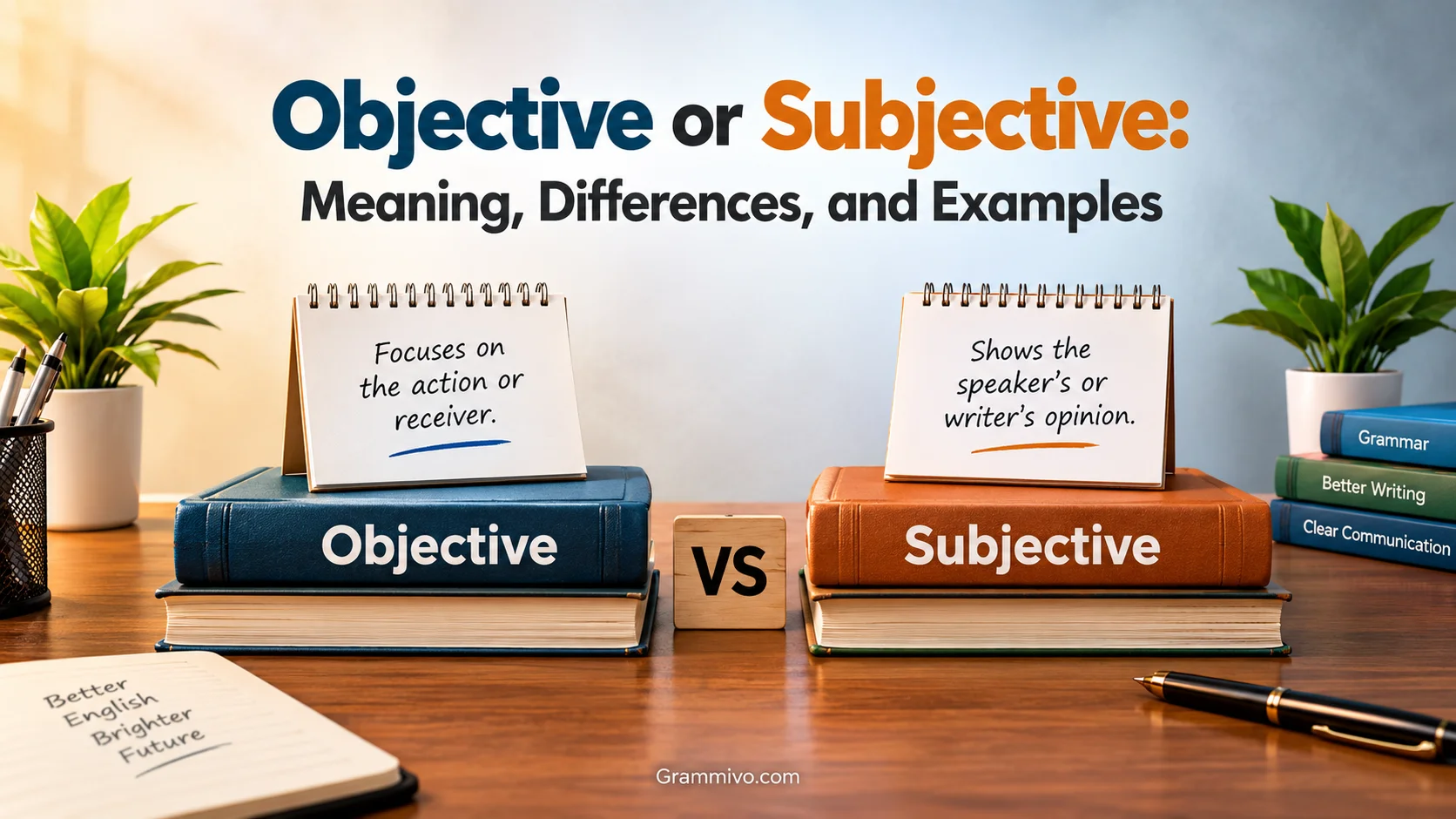
When you describe something, how do you know whether you’re stating a fact or sharing an opinion? That question sits at the heart of the difference between objective and subjective.
You encounter these two ideas almost everywhere. News reports use objective information. Movie reviews often include subjective opinions. Scientific studies rely heavily on observable evidence, while personal conversations naturally contain feelings and preferences. The tricky part is that the line isn’t always obvious.
A sentence can mention a real fact and still add a personal interpretation. For example, “The restaurant opened in 2018” is objective because the opening date can be verified. “The restaurant is fantastic” is subjective because “fantastic” expresses a personal judgment.
Quick Answer
Objective describes information based on facts, evidence, measurements, or observations that can generally be verified independently. Subjective describes personal opinions, feelings, preferences, interpretations, or experiences that depend on an individual’s perspective.
A simple way to remember the distinction is:
- Objective = based on verifiable information
- Subjective = based on personal perspective
For example:
Objective: “The book contains 320 pages.”
Subjective: “The book is fascinating.”
The number of pages can be checked by anyone with the book. Whether the book feels fascinating depends on the reader.
However, real-world communication can be more complicated than two neat categories. A statement may contain both factual information and subjective interpretation.
Comparison Overview
| Feature | Objective | Subjective |
| Basic meaning | Based on facts or observable evidence | Based on personal perspective |
| Main foundation | Evidence, measurements, records, observations | Opinions, feelings, preferences, experiences |
| Can it be verified? | Usually yes | Usually not in the same way |
| Depends on personal feelings? | Generally no | Often yes |
| Can people disagree? | Less likely when evidence is clear | Very common |
| Common in | Science, factual reporting, research | Reviews, opinions, personal writing |
| Typical language | Precise and measurable | Evaluative and personal |
| Example | “Water freezes at 32°F under standard atmospheric pressure.” | “Cold weather is unpleasant.” |
The key difference isn’t simply whether people agree. A large group can share a subjective opinion, while one person can make an objective statement.
Instead, focus on how the claim gets its support.
If evidence outside the speaker’s personal feelings can establish the claim, it leans toward objectivity. If the claim depends primarily on someone’s experience, taste, judgment, or emotional response, it leans toward subjectivity.
What Does Objective Mean?
Objective means based on information that doesn’t depend primarily on an individual’s personal feelings, preferences, or opinions.
Objective information often involves things you can observe, measure, document, count, or verify.
For example:
- “The meeting started at 9:00 a.m.”
- “The package weighs 4 pounds.”
- “The museum opened in 1995.”
- “The class has 24 students.”
- “The car has four doors.”
These statements make claims that can generally be checked against evidence.
If two people count 24 students in the same classroom, they should reach the same result under the same conditions. That’s a major feature of objective information.
Objective Definition in Simple English
Think of objective information as something that can stand on its own without requiring you to like it, dislike it, or personally believe it.
A temperature reading doesn’t become different because you dislike cold weather. A recorded date doesn’t change because someone prefers another date.
That’s the basic idea behind objectivity.
Examples of Objective Statements
Consider these examples:
“Mount Everest is 29,032 feet high.”
The statement concerns a measurable physical feature. Its accuracy depends on measurement and accepted geographic data, not personal preference.
“The store closes at 9 p.m.”
This is objective when the store’s published hours or actual operating schedule support the claim.
“The test contains 50 questions.”
You can count the questions. No personal judgment is required.
“The movie runs for 142 minutes.”
The runtime can be checked against the film or an authoritative record.
Objective statements often include numbers, dates, measurements, names, locations, records, and observable events. Those features don’t automatically make a sentence objective, but they often provide useful clues.
Objective Information in Different Contexts
Objectivity matters in many areas of life.
In journalism, objective reporting attempts to distinguish verified facts from commentary.
In science, researchers collect observations and measurements rather than treating personal impressions as evidence.
In academic writing, claims normally require support from credible evidence.
In business, objective data can include sales figures, production totals, revenue, costs, and customer counts.
In everyday life, objective details help people agree on what actually happened.
Suppose two friends argue about when they arrived at a restaurant. Instead of relying on memory, they check a timestamp on a message.
The timestamp provides an external piece of evidence. Memory may vary. The record doesn’t depend on either person’s preference.
What Does Subjective Mean?
Subjective refers to something influenced by personal feelings, opinions, experiences, tastes, interpretations, or perspectives.
Subjective statements aren’t necessarily wrong. That’s an important distinction.
If you say, “Chocolate ice cream tastes better than vanilla,” you’re expressing a preference. Someone else can prefer vanilla without either person making a factual error.
Subjective claims often answer questions such as:
- What do you like?
- How does something make you feel?
- What do you think?
- What do you consider attractive?
- What seems important to you?
- How do you interpret an experience?
Subjective Definition in Simple English
A useful way to understand subjective is to think about the word perspective.
Your perspective comes from your experiences, expectations, tastes, emotions, and circumstances.
That’s why two people can experience the same event and describe it differently.
Imagine two people watching a thunderstorm. One person might say:
“The storm is beautiful.”
Another might say:
“The storm is frightening.”
The weather event is the same. Their reactions aren’t.
Examples of Subjective Statements
Here are some straightforward examples:
- “This is the best restaurant in town.”
- “That painting is beautiful.”
- “The movie was boring.”
- “Spicy food tastes amazing.”
- “The new design looks better.”
- “That was the funniest scene.”
- “Winter is the worst season.”
Each statement communicates a personal evaluation.
Notice the words best, beautiful, boring, amazing, better, funniest, and worst. These terms often signal judgment rather than independently measurable facts.
That doesn’t mean every sentence containing an adjective is subjective. Context matters.
For example, “The box is heavy” could be subjective if someone simply expresses an impression. But “The box weighs 40 pounds” gives a measurable figure.
Read More: Feen or Fein: Which Spelling Is Correct?
Main Differences Between Objective or Subjective
The difference between objective or subjective becomes easier when you examine the source of the claim.
Objective information relies primarily on evidence that other people can independently examine. Subjective information relies primarily on an individual’s perspective.
Evidence vs. Personal Perspective
This is perhaps the most useful distinction.
An objective claim might say:
“The laptop weighs 3.2 pounds.”
A subjective claim might say:
“The laptop feels too heavy.”
The first statement gives a measurable property. The second describes someone’s experience of that property.
The two statements can exist together without contradiction.
A laptop can weigh 3.2 pounds objectively while feeling too heavy to one person and perfectly comfortable to another.
Fact vs. Opinion
People often use fact and opinion as synonyms for objective and subjective. They’re closely related, but the concepts aren’t identical.
A fact is a claim that can be supported through reliable evidence.
An opinion expresses a judgment, belief, preference, or interpretation.
For example:
Fact: “The novel was published in 1960.”
Opinion: “The novel is one of the greatest books ever written.”
The publication date can be established through bibliographic evidence. “Greatest” involves evaluation and depends on criteria.
Verifiable vs. Experiential
Objective information tends to be independently verifiable.
Subjective information often describes an experience that belongs to the person making the statement.
Consider:
“The coffee contains caffeine.”
That’s a claim about the drink’s composition.
Now compare:
“The coffee tastes bitter.”
Taste involves personal sensory perception. One person might describe the same coffee as bitter, while another might call it rich or smooth.
Neither person’s sensory response automatically becomes a universal fact.
Objective and Subjective Examples
Side-by-side examples make this distinction much easier to recognize.
| Objective Statement | Subjective Statement |
| “The shirt costs $40.” | “The shirt is expensive.” |
| “The movie lasts two hours.” | “The movie feels too long.” |
| “The building has 20 floors.” | “The building looks impressive.” |
| “The recipe uses three teaspoons of salt.” | “The recipe is too salty.” |
| “The book has 12 chapters.” | “The book is fascinating.” |
| “The temperature is 95°F.” | “The weather is unbearably hot.” |
| “The restaurant opened in 2020.” | “The restaurant is wonderful.” |
The right-hand statements aren’t necessarily useless or incorrect. They simply express judgment or perception.
That’s a crucial point.
Subjective doesn’t mean “false.” Objective doesn’t automatically mean “important.” The two categories describe different kinds of claims.
How to Tell Whether a Statement Is Objective or Subjective
When you’re unsure whether something is objective or subjective, don’t rely on one keyword. Examine the entire statement.
Ask Whether the Claim Can Be Verified
Start with a simple question:
Can reliable evidence independently confirm this claim?
Consider:
“The concert began at 8 p.m.”
You could check tickets, official records, recordings, or other reliable evidence.
Now consider:
“The concert was incredible.”
What evidence could prove that everyone should consider it incredible?
You might find reviews or survey results showing that many people enjoyed it. However, those sources document people’s opinions. They don’t turn the personal judgment itself into an objective fact.
Look for Personal Feelings
Subjective language often contains phrases such as:
- I think
- I feel
- In my opinion
- I prefer
- I believe
- It seems to me
- I love
- I hate
- beautiful
- boring
- exciting
- terrible
- wonderful
- delicious
- disappointing
These words don’t automatically make a sentence subjective in every possible context. Still, they’re strong clues.
For example:
“I think the restaurant closes at 10 p.m.”
The phrase “I think” makes the sentence sound uncertain and personal. The underlying claim about closing time, however, is potentially objective and can be verified.
Separate Facts From Interpretations
This skill becomes especially useful when reading articles, reviews, advertisements, or social media posts.
Suppose someone writes:
“The company released a new smartphone in September, and it’s clearly the best phone available.”
The first part contains a potentially verifiable event.
The second part is an evaluation.
A careful reader shouldn’t treat both statements as the same type of information.
Objective and Subjective Writing
Objective writing aims to present information with minimal personal bias. Subjective writing openly communicates a writer’s personal perspective, judgment, or experience.
Neither style is automatically appropriate for every situation.
The purpose determines the better approach.
What Is Objective Writing?
Objective writing emphasizes:
- Verifiable facts
- Specific evidence
- Precise descriptions
- Measurable information
- Neutral wording
- Clearly supported conclusions
For example:
“The restaurant has 80 seats and operates seven days a week.”
The sentence focuses on concrete information.
An objective writer generally avoids turning personal reactions into established facts.
Instead of:
“This restaurant serves the most delicious food in the city.”
An objective version might say:
“The restaurant specializes in Italian cuisine and offers 35 menu items.”
The second version doesn’t tell you what to think. It gives you information from which you can form your own opinion.
What Is Subjective Writing?
Subjective writing embraces personal perspective.
You see it frequently in:
- Personal essays
- Movie reviews
- Restaurant reviews
- Travel writing
- Opinion pieces
- Personal blogs
- Memoirs
- Creative writing
For example:
“The restaurant’s handmade pasta was the highlight of my evening.”
That’s subjective because the writer describes a personal evaluation.
In a restaurant review, that perspective isn’t a flaw. In fact, it’s often the point.
Readers want to know what the writer experienced.
Objective and Subjective Writing Example
Imagine you’re reviewing a hotel.
An objective description might say:
“The hotel has 150 rooms, a rooftop pool, two restaurants, and a fitness center.”
A subjective description might say:
“The rooftop pool creates a relaxing atmosphere, especially around sunset.”
A strong review can use both.
The objective details establish what the hotel offers. The subjective observations explain what the experience feels like.
That’s often more useful than relying exclusively on either approach.
Objective or Subjective in Different Fields
The distinction becomes even clearer when you look at different professional settings.
News and Journalism
News writing generally places substantial emphasis on verified facts.
A report might state:
“The city council approved the proposal by a vote of 8–3.”
That’s an objective account of a recorded vote.
An opinion column could then discuss whether the decision was wise.
Those are different forms of communication. Mixing them without signaling the difference can confuse readers.
Academic and Research Writing
Academic writing typically distinguishes between observations, evidence, analysis, and interpretation.
For example, researchers might observe a measurable change in a group and then interpret what that change could mean.
The observation and interpretation aren’t identical.
Good academic writing makes the reasoning visible rather than presenting an interpretation as though it were raw evidence.
Science
Science depends heavily on observations and measurements that other researchers can examine.
A thermometer provides a measurement. A personal feeling about whether the room is comfortable doesn’t.
However, scientific work still involves interpretation. Researchers analyze data and develop explanations based on evidence.
So, scientific writing isn’t simply “facts with no interpretation.” It combines measured observations with reasoned analysis.
Reviews and Recommendations
Reviews naturally contain subjective elements.
When someone says a movie is “funny,” “slow,” or “beautiful,” they’re offering an evaluation.
However, reviews become more informative when subjective opinions sit alongside concrete details.
For example:
“The movie runs for 150 minutes and spends nearly an hour developing its central mystery.”
Then:
“For me, that slow buildup made the middle section feel tedious.”
The first sentence provides context. The second provides personal judgment.
Everyday Conversations
Everyday speech mixes objective and subjective statements constantly.
Imagine someone describing a new restaurant:
“It opened last month. The dining room has 40 tables. I think the food is fantastic.”
The first two claims can be checked.
The final claim expresses personal taste.
Recognizing that distinction helps you understand what someone actually knows and what they personally believe.
FAQs:
Is a fact objective or subjective?
A fact is generally considered objective when reliable evidence can verify it independently of personal opinion. Facts can still be reported inaccurately, so verification matters.
Is an opinion objective or subjective?
An opinion is generally subjective because it expresses a person’s belief, preference, judgment, or interpretation.
Can an opinion be supported by facts?
Yes. A subjective opinion can have an objective factual basis.
For example, someone might say a movie feels too long because it runs for three hours. The runtime is factual, while the judgment about its length is subjective.
Is personal experience objective or subjective?
Personal experience is generally subjective because it reflects what an individual perceived, felt, or experienced.
That doesn’t make personal experience meaningless. It simply means the experience shouldn’t automatically be treated as a universal fact.
Can one sentence be both objective and subjective?
Yes. A sentence can combine verifiable information with personal interpretation.
For example:
“The restaurant charges $50 for its tasting menu, which is far too expensive.”
The price is objective. The judgment about whether that price is “far too expensive” is subjective.
Conclusion:
The difference between objective or subjective comes down largely to perspective and evidence. Objective information focuses on facts, measurements, observations, records, and evidence that can generally be checked independently. Subjective information reflects personal feelings, preferences, experiences, interpretations, or judgments.
