
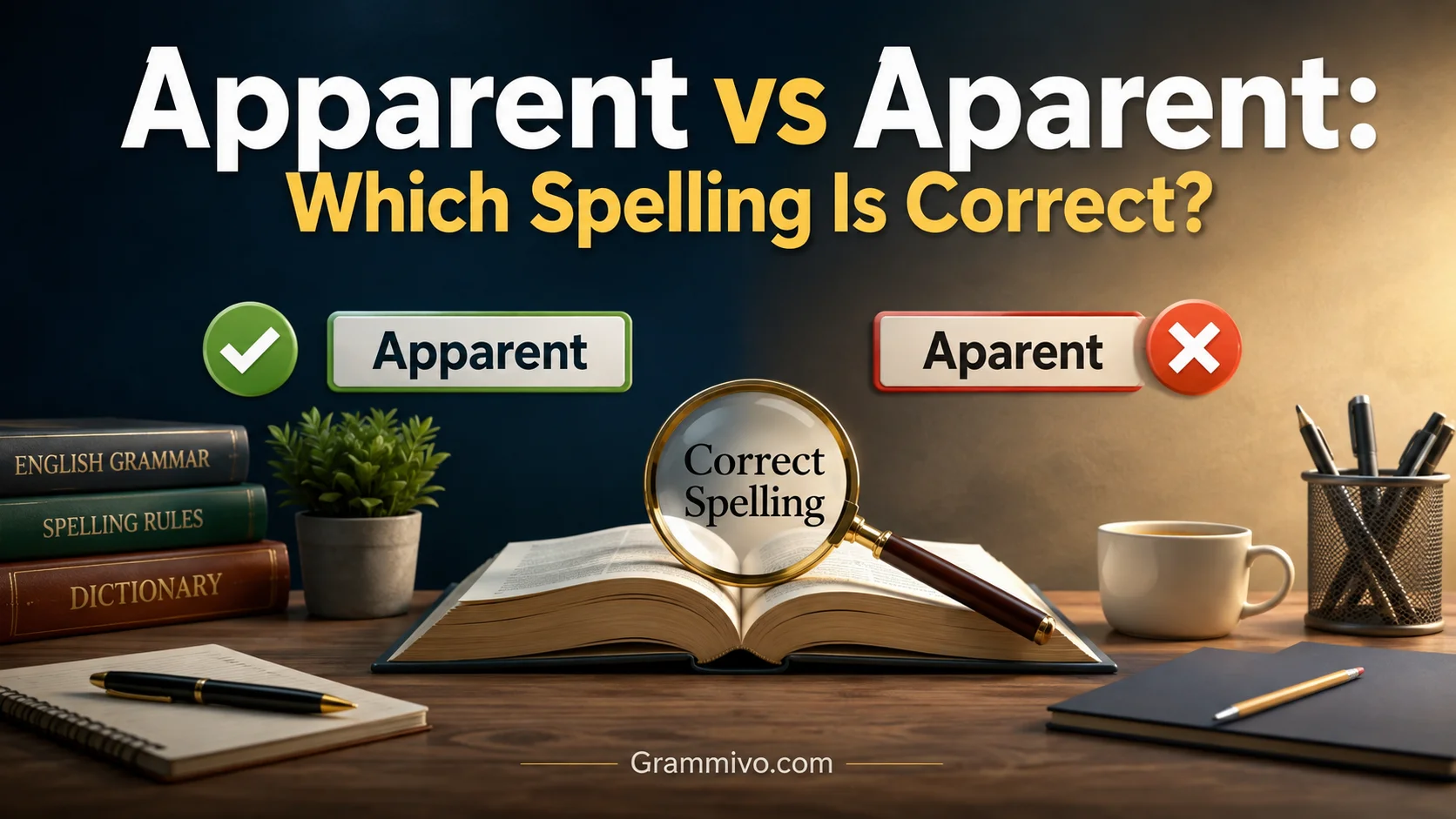
If you’ve ever hesitated between apparent vs aparent, you’re not alone. The two spellings look almost identical, and the word doesn’t sound different enough to make the correct spelling obvious. That missing p can easily slip through when you’re typing quickly, writing from memory, or learning English.
However, there’s a simple answer: apparent is the correct spelling. Aparent is a misspelling and isn’t a standard English spelling of the word.
The word apparent has several useful meanings. It can describe something that’s clearly visible or obvious, but it can also describe something that seems to be true based on the information available. That second meaning is important because apparent doesn’t always mean certain.
This guide explains the difference between apparent and aparent, the meaning and pronunciation of apparent, its history, common spelling mistakes, related words, and practical examples you can use in everyday writing.
Quick Answer
The correct spelling is apparent, with two p’s. Aparent is an incorrect spelling.
| Spelling | Correct? | Meaning | Example |
| apparent | Yes | Obvious, visible, or seeming to be true | The cause of the problem became apparent. |
| aparent | No | Misspelling of apparent | The word should be spelled apparent. |
A useful way to remember the spelling is to connect apparent with appear. Both words contain the double p:
- appear
- apparent
- apparently
- appearance
So, when you’re wondering whether to write aparent or apparent, keep the two p’s.
Correct: Her disappointment was apparent.
Incorrect: Her disappointment was aparent.
What Does Apparent Mean?
Apparent is an adjective with two closely related meanings. In one sense, it describes something that seems clear, obvious, or easy to notice. In another, it describes something that appears to be true, even though you may not have complete proof.
That distinction makes the word more interesting than a simple synonym for “obvious.”
For example, if someone walks into a room with a huge smile and says they’re excited, their happiness may be apparent. You can observe it directly.
But consider this sentence:
“The apparent cause of the accident was excessive speed.”
Here, apparent signals some caution. Excessive speed seems to be the cause based on the evidence, but the statement doesn’t necessarily claim that investigators have established it beyond doubt.
Meaning 1: Clearly Visible or Obvious
In its more direct sense, apparent means something can be readily seen, recognized, or understood.
Examples include:
- Her excitement was apparent from her expression.
- The damage to the building was apparent immediately.
- His lack of preparation became apparent during the interview.
- The difference between the two products was apparent.
- It was apparent that the team needed more time.
In these examples, the evidence is noticeable enough that the writer considers the situation clear.
Meaning 2: Seeming to Be True
The second meaning is more nuanced. Apparent can describe something that appears true based on what you currently know.
For example:
“There was an apparent conflict between the two reports.”
That doesn’t necessarily mean the reports genuinely contradicted each other. It means they seemed to conflict.
This is why apparent appears frequently in journalism, research, business writing, law, and formal discussions. It allows writers to describe what the evidence currently suggests without claiming more certainty than the evidence supports.
Why Is “Aparent” Incorrect?
Aparent is incorrect because standard English spells the word apparent, with a double p.
The error usually happens because the second p isn’t strongly noticeable when you pronounce the word. English spelling doesn’t always map neatly onto pronunciation. A sound can be simple while its written form contains repeated letters.
Compare these forms:
- aparent — incorrect
- apparent — correct
- apparant — incorrect
- aparrent — incorrect
- apparent — correct
The correct spelling is a-p-p-a-r-e-n-t.
If you’re writing an email, article, school paper, report, resume, or business document, use apparent.
A spell-checker will usually catch aparent, but you shouldn’t rely entirely on software. Knowing the correct pattern makes the mistake much less likely in the first place.
Why Does Apparent Have Two Ps?
The double p in apparent has a historical explanation. The word ultimately traces back to Latin apparēre, meaning “to appear,” “to come in sight,” or “be visible.”
English acquired the word through French, with its development connected to the Latin form. The historical spelling retained the doubled consonant pattern.
This also explains a helpful family connection:
appear → apparent → apparently → appearance
These words share related forms and historical roots.
The connection isn’t just a spelling trick. It reflects the meaning of the word family. Appear concerns becoming visible or seeming to be something. Apparent describes something that appears clear or seems to be true.
A Simple Spelling Memory Trick
Think:
APPEAR → APPARENT
Both begin with APP.
If you remember appear correctly, you can use it as an anchor for apparent.
Another useful visual pattern is:
AP + PARENT
That isn’t the actual modern morphological structure of the word, so don’t treat it as a linguistic breakdown. It’s simply a memory aid. The important point is that parent starts with “parent,” while apparent begins with app.
Apparent Pronunciation
In American English, apparent is commonly pronounced approximately:
uh-PAIR-uhnt
A pronunciation guide such as the Merriam-Webster entry provides the standard pronunciation and additional usage information.
The word contains two p’s, but you don’t pronounce them as two separate, exaggerated sounds. That’s one reason learners sometimes write aparent after hearing the word.
Pronunciation alone isn’t always a reliable spelling guide in English. Consider words such as:
- necessary
- successful
- accommodate
- embarrass
- apparent
Each contains spelling patterns that aren’t necessarily obvious from casual speech.
Apparent in a Sentence
The easiest way to understand apparent is to see how the word behaves in real sentences.
Here are examples covering both major meanings:
| Sentence | Meaning of “apparent” |
| Her disappointment was apparent. | Her disappointment was obvious or easy to see. |
| The cause of the failure became apparent. | The cause became clear. |
| His apparent confidence disappeared during the interview. | He seemed confident, although that impression changed. |
| There was an apparent mistake in the report. | The report seemed to contain a mistake. |
| The team’s advantage was apparent from the beginning. | The advantage was clearly visible. |
| The apparent contradiction required further investigation. | The contradiction seemed to exist but needed examination. |
| It soon became apparent that we had taken the wrong road. | It became clear that the road was wrong. |
Notice the subtle shift. Sometimes apparent means clearly observable. In other cases, it means seeming rather than definitively established.
Context tells you which meaning the writer intends.
Apparent vs Obvious: What’s the Difference?
Apparent and obvious overlap, but they aren’t perfect substitutes.
Obvious generally carries a stronger sense of certainty. If something is obvious, you normally don’t expect much disagreement about it.
Apparent, however, can be more cautious.
Compare these sentences:
“It was obvious that the machine had failed.”
This strongly suggests that the evidence was unmistakable.
Now consider:
“It was apparent that the machine had failed.”
This can also mean the failure was clear. However, depending on context, it can carry a slightly more measured or formal tone.
The distinction becomes even clearer with apparent cause:
“The obvious cause was a power failure.”
This sounds fairly definite.
“The apparent cause was a power failure.”
This leaves room for additional evidence to change the conclusion.
That’s why apparent works well when you want to avoid overstating a claim.
Apparent vs Evident
Apparent and evident both describe things that seem clear, but they have slightly different shades of meaning.
Evident often emphasizes that evidence or observable facts support the conclusion.
For example:
“The benefits of regular exercise were evident.”
The sentence suggests that the benefits could be recognized through evidence or observation.
Apparent can work similarly:
“The benefits of regular exercise were apparent.”
However, apparent can also introduce an element of uncertainty when it means “seeming.”
Consider:
“The apparent reason for his decision was financial.”
This doesn’t guarantee that financial concerns were the actual reason. It identifies the reason that appeared to be responsible.
A useful rule is:
- obvious = easy to recognize
- evident = supported or demonstrated by signs or evidence
- apparent = clear or seeming, depending on context
These distinctions aren’t absolute. Natural English often allows some overlap.
Common Misspellings of Apparent
Because apparent contains repeated letters, writers sometimes rearrange or omit them.
Here are several forms you may encounter:
| Misspelling | Correct form |
| aparent | apparent |
| apparant | apparent |
| aparrent | apparent |
| apparrent | apparent |
| apparant | apparent |
Among these, aparent is particularly easy to produce because the writer may remember the pronunciation but forget the second p.
The correct sequence is:
A P P A R E N T
A quick visual check can help. If you see APARENT, stop and ask yourself whether the word should begin APP-. It should.
How to Remember the Spelling of Apparent
Spelling becomes easier when you attach a difficult word to something familiar.
The strongest memory trick for apparent is:
APPEAR → APPARENT
Both start with APP.
You can also remember a short sentence:
“It’s apparent when it appears clear.”
The sentence links the spelling and meaning at the same time.
Another technique involves writing the word in chunks:
APP + ARENT
This isn’t a grammatical breakdown. It’s simply a visual strategy for remembering the letters.
You can also group related words:
- appear
- appearance
- apparent
- apparently
Once you recognize the APP pattern, aparent starts looking visibly incomplete.
Apparent vs Aparent: Common Usage Mistakes
The most common mistake is straightforward:
Incorrect: The problem became aparent.
Correct: The problem became apparent.
Another mistake involves using apparent when the writer actually means something completely certain.
For example:
“The apparent winner will receive the trophy.”
If the competition hasn’t officially confirmed the winner, apparent makes sense. It means the person seems to have won.
But if the official results have already confirmed the winner, you might simply write:
“The winner will receive the trophy.”
The word apparent can therefore affect the level of certainty in a sentence.
Read More: Conscious vs. Concious: Which Spelling Is Correct and Why?
Mistake: Confusing Apparent With Appearance
These words belong to the same family, but they serve different grammatical roles.
- apparent = adjective
- appearance = noun
- appear = verb
- apparently = adverb
For example:
The problem is apparent.
The problem became clear after his appearance on television.
The problem began to appear serious.
Apparently, nobody noticed the error.
Knowing the grammatical role prevents another layer of confusion.
Related Words: Apparently, Appearance, and Appear
The apparent word family includes several common English terms.
| Word | Part of speech | Meaning | Example |
| appear | Verb | To become visible or seem | Stars appear at night. |
| apparent | Adjective | Clear, visible, or seeming | The mistake was apparent. |
| apparently | Adverb | As far as appears or seems | Apparently, the meeting was canceled. |
| appearance | Noun | The act of appearing or the way something looks | Her appearance changed. |
These words are related, but you can’t swap them freely.
For example, you wouldn’t write:
“The mistake was apparently.”
You need an adjective:
“The mistake was apparent.”
Likewise, you wouldn’t write:
“His apparent was unexpected.”
You’d need the noun appearance:
“His appearance was unexpected.”
Grammar and spelling work together. Getting one right doesn’t automatically make the other correct.
Apparent vs Apparently
The difference between apparent and apparently comes down mainly to grammar.
Apparent is an adjective. It describes a noun.
The error was apparent.
Here, apparent describes error.
Apparently is an adverb. It modifies a verb, adjective, or entire statement.
Apparently, the error occurred during data entry.
Here, apparently signals that the information seems to be true based on what is known.
This distinction matters because apparently can also communicate that the speaker isn’t personally guaranteeing the information.
For example:
“Apparently, the store closes at 8 p.m.”
That suggests you’ve heard or inferred the information rather than personally verified it.
Is “Aparent” a Word?
Aparent is not the standard English spelling of the word intended by “apparent.”
If you’re writing standard American English, use apparent.
A misspelling can appear thousands of times online without becoming an accepted spelling. Search engines index typos, social media posts preserve them, and user-generated websites reproduce them. Frequency alone doesn’t make a spelling correct.
Is “Aparent” Ever an Alternative Spelling?
Not in standard modern English.
You may encounter aparent in informal online writing, user-generated content, or typing mistakes. That doesn’t make it a legitimate variant of apparent.
If you’re completing an assignment, preparing a report, writing professionally, or publishing online, choose apparent.
Apparent vs Aparent Examples
A side-by-side comparison makes the difference unmistakable.
| Incorrect | Correct |
| The difference was aparent. | The difference was apparent. |
| Her frustration became aparent. | Her frustration became apparent. |
| The error was immediately aparent. | The error was immediately apparent. |
| An aparent conflict existed between the statements. | An apparent conflict existed between the statements. |
| The reason soon became aparent. | The reason soon became apparent. |
The pattern stays the same every time. Aparent needs another p.
Examples Showing the Meaning of Apparent
Clearly visible:
The damage was apparent as soon as the inspector entered the building.
Clearly understandable:
It became apparent that the original plan wouldn’t work.
Seeming rather than proven:
The apparent cause of the outage was a faulty connection.
Based on available evidence:
There was an apparent decline in customer interest after the price increase.
In the last two examples, apparent doesn’t necessarily mean “certain.” It describes the conclusion suggested by what people can currently observe.
FAQs:
Is “aparent” correct?
No. Aparent is a misspelling. The correct spelling is apparent, with two p’s.
Is it apparent or aparent?
It’s apparent. Remember the opening APP-, as in appear.
What does apparent mean?
Apparent can mean clearly visible, obvious, or easy to understand. It can also mean something that seems to be true based on the evidence available.
Why does apparent have two Ps?
The spelling reflects the word’s historical development and its connection to Latin apparēre, meaning “to appear.” A useful modern spelling aid is the connection between appear and apparent.
Is apparent the same as obvious?
Not always. Both can describe something that seems clear, but apparent can also mean “seeming” rather than completely proven. Obvious usually carries a stronger sense of certainty.
Conclusion:
When you’re choosing between apparent vs aparent, the answer is clear: apparent is the correct spelling.The word has two p’s, and dropping one produces the misspelling aparent. More importantly, apparent has a useful range of meanings. It can describe something that’s obvious or clearly visible, but it can also describe something that merely seems true based on the evidence available.
