
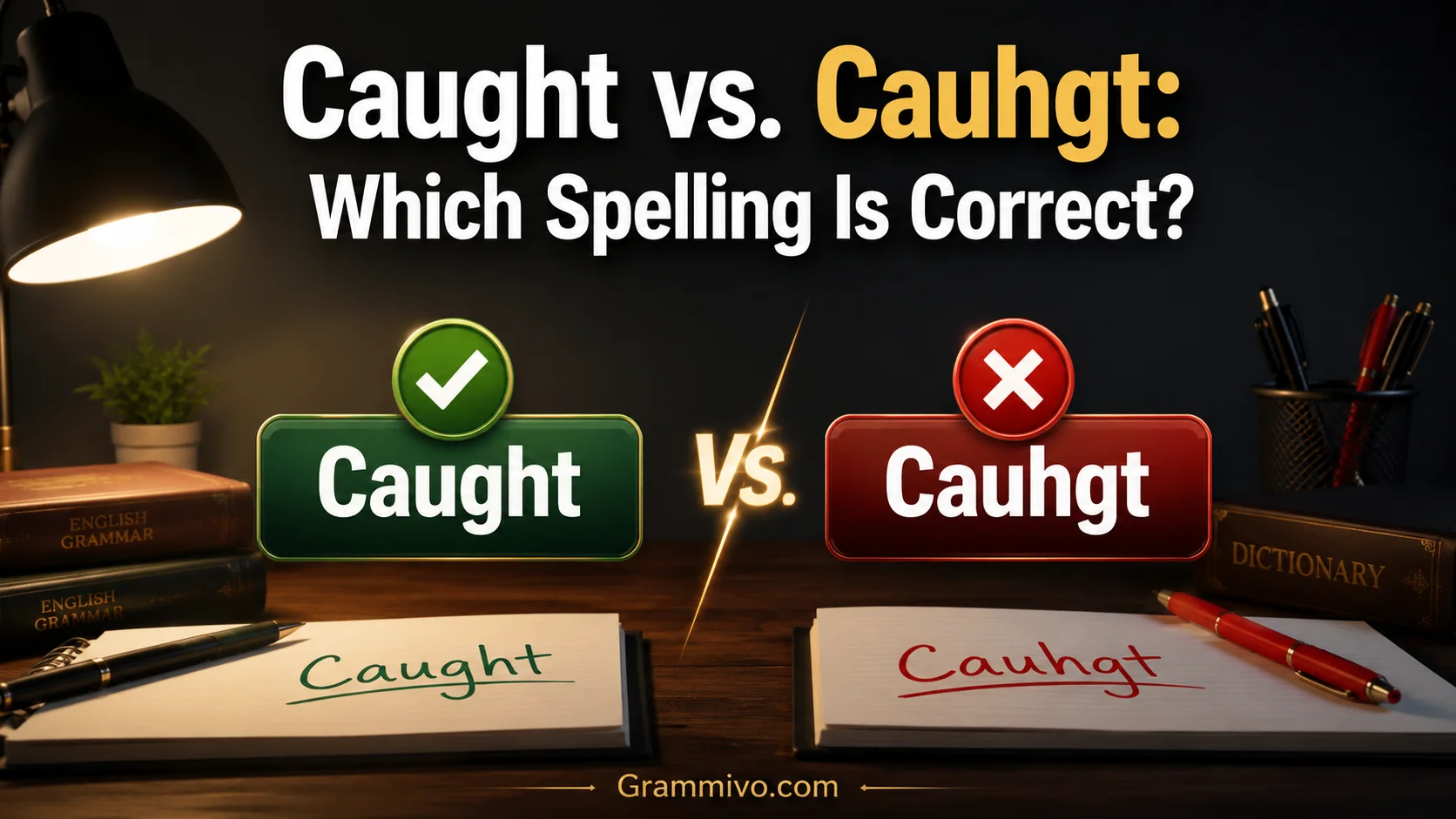
The difference between caught vs. cauhgt comes down to one simple issue: spelling. Caught is the correct standard English word, while cauhgt is a misspelling. Although the two forms contain the same letters, the letters appear in a different order.
This mistake is easy to make because caught has an unusual spelling and doesn’t sound exactly the way its letters might lead an English learner to expect. The sequence -aught can feel awkward, especially when you’re writing quickly or relying on memory.
The word caught has several common uses. You can catch a ball, catch a bus, catch someone’s attention, catch a thief, or catch a cold. Grammatically, caught serves as both the simple past tense and past participle of catch.
Understanding the difference isn’t just about memorizing six letters. Once you understand how caught relates to catch, the correct spelling becomes much easier to recognize and use.
Quick Answer:
Caught is the correct spelling. Cauhgt is incorrect and isn’t a standard English word.
The correct spelling is:
catch → caught → caught
For example:
- Correct: I caught the ball.
- Incorrect: I cauhgt the ball.
- Correct: She caught the early train.
- Incorrect: She cauhgt the early train.
The mistake in cauhgt comes from switching the positions of g and h. The correct sequence is A-U-G-H-T, not A-U-H-G-T.
So, if you’re writing an email, school assignment, article, text message, or professional document, use caught.
Caught vs. Cauhgt at a Glance
The easiest way to see the difference is to put the two spellings side by side.
| Spelling | Correct? | Meaning | Word Type | Example |
| Caught | Yes | Past or past participle of catch | Verb | I caught the ball. |
| Cauhgt | No | No standard English meaning | Misspelling | I cauhgt the ball. |
There’s no difference in meaning between the two forms because cauhgt isn’t a recognized standard form of catch.
If you encounter cauhgt online, in a message, or in an informal post, treat it as a typographical or spelling error rather than a separate English word.
What Does Caught Mean?
Caught is the past tense and past participle of the irregular verb catch. It describes something that happened in the past or appears in certain perfect and passive constructions.
The verb catch has a surprisingly broad range of meanings. Its basic sense involves taking hold of something that moves through the air, but English speakers use it in many figurative and practical expressions.
Here are some of the most common meanings.
Caught Means Took Hold of Something
When you physically grab something moving toward you, you catch it. The past form is caught.
For example:
- Maria caught the ball with one hand.
- He caught the keys before they hit the floor.
- The goalkeeper caught the shot.
- I caught the falling glass just in time.
In each sentence, caught describes an action that happened in the past.
Caught Means Captured or Stopped Someone
You can also use caught when someone captures or stops another person.
For example:
- The police caught the suspect.
- The security guard caught the shoplifter.
- The fisherman caught a large trout.
Here, the person doing the catching successfully stops or captures someone or something.
Caught Means Discovered Someone Doing Something
English speakers often use caught when someone discovers another person in the middle of an action.
For example:
- The teacher caught him cheating.
- She caught her brother eating the last cookie.
- I caught them talking about the surprise party.
The construction caught + someone + -ing verb is especially common in everyday English.
Caught Means Reached Transportation
You can also catch a bus, train, flight, or other form of transportation.
For example:
- I caught the 8:15 train.
- We caught the last bus home.
- She caught an earlier flight.
- They caught a taxi to the airport.
In these examples, caught doesn’t mean physically grabbing the vehicle. It means successfully getting onto or taking the transportation.
Caught Means Became Sick
English also uses catch for certain illnesses.
For example:
- I caught a cold last week.
- She caught the flu from her children.
- Several students caught the virus.
This is a figurative extension of the idea of something being transmitted from one person to another.
Caught Means Noticed or Understood Something
The word can also refer to noticing, hearing, or understanding something.
For example:
- I didn’t catch what you said.
- Did you catch that joke?
- She caught the mistake immediately.
When someone says, “I didn’t catch that,” they often mean they didn’t hear or understand something clearly.
What Does Cauhgt Mean?
Cauhgt isn’t a standard English word. It doesn’t have an accepted dictionary definition and doesn’t function as a different tense of catch.
In most cases, cauhgt results from accidentally rearranging the letters in caught.
Compare them closely:
Correct: C-A-U-G-H-T
Incorrect: C-A-U-H-G-T
Only two letters have changed position, but that small switch makes the spelling incorrect.
This is a useful example of why English spelling can be tricky. A word doesn’t become correct simply because every individual letter belongs in the word. The order matters just as much as the letters themselves.
You can see the same principle in ordinary typing mistakes. Writing freind instead of friend doesn’t create a new spelling of friend. It simply rearranges letters incorrectly.
The same thing happens with cauhgt.
Why Do People Spell Caught as Cauhgt?
The spelling caught creates a natural trap for anyone who hasn’t memorized the word.
The unusual sequence -aught doesn’t correspond neatly to its pronunciation. English has many historical spellings like this, which means you can’t always reconstruct the spelling simply by sounding out the word.
When someone remembers that caught contains a-u-g-h-t, they may accidentally reverse the middle letters and produce a-u-h-g-t.
A quick visual comparison makes the problem obvious:
| Correct sequence | Incorrect sequence |
| A-U-G-H-T | A-U-H-G-T |
| caught | cauhgt |
The error usually isn’t about misunderstanding the meaning of the word. It’s a letter-order mistake.
Pronunciation doesn’t help much, either. In many American accents, caught has a vowel sound that doesn’t clearly reveal the spelling. Some speakers also pronounce caught and cot similarly, depending on their regional accent.
That’s why visual memory matters.
Caught Grammar: Verb Forms of Catch
One of the most useful ways to understand caught is to learn its complete verb pattern.
| Verb form | Word | Example |
| Base form | catch | I catch the ball. |
| Third-person singular | catches | She catches the ball. |
| Simple past | caught | She caught the ball. |
| Past participle | caught | She has caught the ball. |
| Present participle | catching | She is catching the ball. |
The important detail is that catch is an irregular verb.
Regular verbs usually form the past tense by adding -ed. For example:
- walk → walked
- jump → jumped
- clean → cleaned
Catch doesn’t follow that pattern.
You don’t write catched in standard modern English when you mean the ordinary past tense. Instead, you write caught.
This irregular pattern is worth memorizing as a unit:
catch → caught → caught
Once that pattern becomes familiar, spelling caught correctly requires much less effort.
How to Use Caught in a Sentence
The word caught appears in several grammatical patterns. Learning those patterns can help you recognize when the word belongs in a sentence.
Simple Past
Use caught to describe a completed action in the past.
- I caught the ball.
- She caught the bus.
- We caught the thief.
- He caught the mistake.
The action occurred before the present moment.
Present Perfect
Use caught as the past participle after have, has, or have/has been in relevant constructions.
Examples include:
- I have caught three fish today.
- She has caught a cold.
- They have caught up with the other team.
Here, caught isn’t functioning as an ordinary simple past verb. The auxiliary verb carries the tense.
Past Perfect
You can also use caught after had.
- I had caught the bus before you called.
- She had caught the mistake before the report went out.
- They had caught the suspect by midnight.
The past perfect places one past event before another past event.
Passive Constructions
The past participle caught can also appear in passive structures.
For example:
- He was caught speeding.
- The thief was caught by police.
- She was caught in the rain.
The word remains caught. It doesn’t change to cauhgt or catched.
Common Uses and Expressions With Caught
Caught appears in many everyday expressions. These phrases make the word especially common in spoken American English.
| Expression | Meaning | Example |
| caught off guard | Surprised unexpectedly | The question caught me off guard. |
| caught in the act | Discovered while doing something | He was caught in the act. |
| caught red-handed | Discovered while committing wrongdoing | They caught him red-handed. |
| caught by surprise | Unexpectedly surprised | The announcement caught everyone by surprise. |
| caught someone’s attention | Made someone notice | The bright sign caught my attention. |
| caught your eye | Attracted your notice | That jacket caught my eye. |
| caught up in | Became deeply involved in something | She got caught up in the excitement. |
| caught between | Stuck between two choices or sides | He felt caught between his friends. |
These expressions show why caught can’t be understood only as “grabbed something.”
Its meaning changes with context.
For instance, “I caught the ball” involves physical movement. “The headline caught my attention” uses the same verb metaphorically. The underlying idea remains similar: something reaches you or successfully gets your notice.
Caught vs. Catch: What’s the Difference?
The difference between catch and caught is primarily grammatical.
Catch is the base form. Caught is its simple past and past participle form.
Compare these examples:
| Present | Past |
| I catch the bus every morning. | I caught the bus yesterday. |
| She catches mistakes quickly. | She caught the mistake yesterday. |
| We catch fish here. | We caught three fish here. |
The time reference determines which form you need.
If the action happens regularly or in the present, use catch or catches. If you’re talking about a completed past action, use caught.
For perfect constructions, use caught again:
- I have caught the bus.
- She has caught the flu.
- They had caught the mistake.
That repeated form can make caught easier to remember.
Caught vs. Catched: Is Catched Correct?
Catched isn’t the standard past tense of catch in modern US English.
The standard form is:
catch → caught
Not:
catch → catched
For example:
- Correct: I caught the ball.
- Incorrect in standard US English: I catched the ball.
Some dialects and historical varieties of English have used forms such as catched, and dictionaries may document nonstandard or regional usage. However, standard contemporary English uses caught for the ordinary past tense and past participle.
So if you’re writing for a broad American audience, stick with caught.
Caught vs. Cauhgt: Common Spelling Mistakes
The main error is cauhgt, but several other forms can appear when people try to spell caught from memory.
| Spelling | Standard? | Correction |
| caught | Yes | Keep it |
| cauhgt | No | caught |
| caugt | No | caught |
| cought | No | caught |
| catched | No for standard past tense | caught |
These mistakes don’t have equal causes.
Cauhgt and caugt are mainly letter-order or omission errors. Cought reflects confusion about the vowel sequence. Catched comes from treating catch like a regular verb.
Knowing the reason behind the error can make correction easier.
Read More: Category vs. Catagory: Which Spelling Is Correct and Why?
How to Remember the Spelling of Caught
The best memory trick is surprisingly simple: memorize the verb pair rather than the isolated word.
Think:
Catch → Caught
Then focus on the middle sequence:
A-U-G-H-T
The most important visual detail is that G comes before H.
A useful mental check is:
caught = C + AUGHT
Not:
cauhgt = C + AUHGT
You can also connect caught with other familiar words containing -aught, such as:
- taught
- bought
- fought
- sought
- thought
These words don’t all have the same pronunciation, but their spelling patterns can help reinforce the visual sequence.
Another practical trick involves saying the phrase aloud:
“I caught it.”
Then write caught rather than trying to spell the pronunciation letter by letter.
English spelling often rewards recognition more than phonetic guessing. Words such as caught, though, through, and enough demonstrate why pronunciation alone isn’t always a reliable spelling guide.
Correct vs. Incorrect Examples of Caught
Seeing the mistake in realistic sentences makes the distinction easier to remember.
| Incorrect | Correct | Reason |
| I cauhgt the ball. | I caught the ball. | Caught is the correct past form of catch. |
| She cauhgt the bus. | She caught the bus. | The letters G and H are reversed in cauhgt. |
| He cauhgt a cold. | He caught a cold. | Caught is the standard spelling. |
| We cauhgt the mistake. | We caught the mistake. | Cauhgt isn’t a standard English word. |
| They cauhgt the thief. | They caught the thief. | Use caught for the past tense of catch. |
Notice something important: the sentence structure doesn’t change.
Only the spelling changes.
That makes this a straightforward correction. You don’t need to learn a new grammatical construction every time you encounter cauhgt. You simply need to replace it with caught.
Pronunciation of Caught in American English
The pronunciation of caught can contribute to its spelling difficulty.
Cambridge Dictionary provides US pronunciation information for caught, including the pronunciation represented in the International Phonetic Alphabet as /kɔːt/ in its relevant pronunciation system. American pronunciation varies by region, however.
In some parts of the United States, speakers maintain a clear distinction between the vowel sounds in cot and caught. In regions with the cot-caught merger, speakers may pronounce the two words with the same vowel.
That regional variation doesn’t change the spelling.
Whether someone pronounces caught distinctly from cot or pronounces them similarly, the standard spelling remains:
caught
This is a useful lesson for English learners: pronunciation and spelling don’t always map neatly onto each other.
FAQs:
Is Caught the Correct Spelling?
Yes. Caught is the correct standard spelling. Cauhgt is a misspelling.
Is Cauhgt a Word?
No. Cauhgt isn’t a standard English word. It generally results from rearranging the letters in caught.
What Is the Past Tense of Catch?
The past tense of catch is caught.
Example:
I caught the ball yesterday.
What Is the Past Participle of Catch?
The past participle is also caught.
Examples include:
She has caught three fish.
He had caught the mistake earlier.
Is Catched Correct?
Caught is the standard past tense and past participle of catch in modern US English. Catched isn’t the standard form for ordinary usage.
Conclusion:
The answer to caught vs. cauhgt is clear: caught is the correct spelling, while cauhgt is a misspelling. The word caught functions as both the simple past tense and past participle of catch. Its uses extend far beyond physically grabbing something. You can catch a bus, catch a cold, catch someone’s attention, catch a mistake, or catch someone in the act.
