
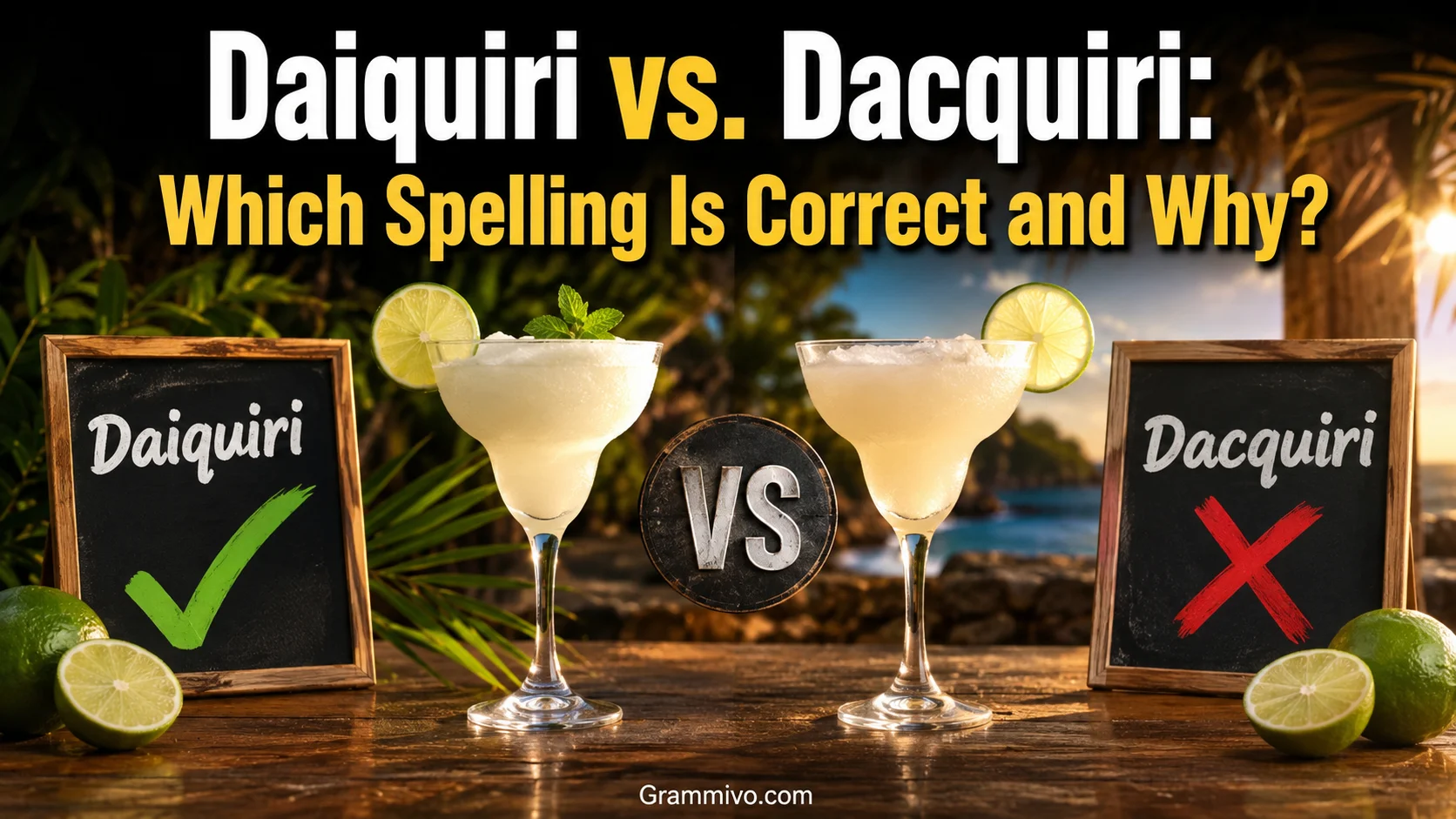
If you’ve ever typed “Dacquiri” and wondered whether it was the right spelling, you’re not alone. The word daiquiri looks unusual, especially if you’re hearing it before seeing it written. Its combination of letters doesn’t follow the spelling patterns many English speakers expect.
The confusion becomes even easier to understand when you consider pronunciation. Depending on the speaker and variety of English, daiquiri can sound roughly like “dah-kuh-ree” or “dye-kuh-ree.” Neither pronunciation makes the written form immediately obvious.
So, is it Daiquiri or Dacquiri?
The standard spelling is daiquiri. Dacquiri is a misspelling when you’re referring to the well-known cocktail. The word comes from Daiquirí, a place in Cuba, which helps explain why its spelling looks different from ordinary English words.
Quick Answer
The correct spelling is daiquiri, not dacquiri.
A daiquiri is a cocktail traditionally made with rum, lime juice, and sugar or another sweetener. The drink takes its name from Daiquirí, a locality in Cuba.
| Spelling | Correct? | Explanation |
| Daiquiri | Yes | Standard English spelling |
| Dacquiri | No | Common misspelling |
| Daquiri | Sometimes documented | A variant recorded in some dictionaries, particularly British English |
If you’re writing an article, menu, recipe, school assignment, or professional document, daiquiri is the safest standard form to use.
The easiest way to remember it is:
DAI + QUI + RI = DAIQUIRI
There’s no c after the first three letters.
Daiquiri vs. Dacquiri: What’s the Difference?
The difference between daiquiri and dacquiri is primarily a matter of spelling. They aren’t names for two different cocktails.
When someone writes dacquiri, they generally mean daiquiri. The extra c simply doesn’t belong in the standard spelling of the cocktail.
The established form is daiquiri, spelled:
D-A-I-Q-U-I-R-I
The unusual “qu” sequence can make the word tricky. English contains plenty of words beginning with qu, such as quick, quiet, and question. However, daiquiri doesn’t look like those familiar words because it comes from a Cuban place name rather than developing as an ordinary English word.
Daiquiri vs. Dacquiri Comparison
| Feature | Daiquiri | Dacquiri |
| Standard spelling | Yes | No |
| Refers to the classic cocktail | Yes | Usually intended to |
| Dictionary recognition | Widely recognized | Not the standard form |
| Historical connection | Daiquirí, Cuba | None |
| Recommended in formal writing | Yes | No |
| Common reason for use | Correct spelling | Phonetic or visual mistake |
This distinction matters because a misspelling can become surprisingly persistent. If you see Dacquiri on a website, social media post, or informal menu, repetition doesn’t turn it into the standard spelling.
Why Is Daiquiri the Correct Spelling?
The spelling daiquiri isn’t an arbitrary arrangement of letters. It reflects the name of Daiquirí, a locality in southeastern Cuba.
That geographical connection explains something important: the spelling doesn’t need to behave like an ordinary English word.
Think about place names borrowed from other languages. English often adopts them without reshaping every letter to fit familiar spelling patterns. Daiquiri follows the same general principle.
The word therefore shouldn’t be reconstructed from sound alone.
If you hear something like “dah-kuh-ree,” you might naturally imagine dacquiri. But pronunciation isn’t a reliable spelling guide here.
The Correct Letters Matter
The first part is particularly important:
DAI, not DAC.
The middle is:
QUI, not CQUI.
And the ending is:
RI.
Put those pieces together and you get:
DAI + QUI + RI = DAIQUIRI
Once you see the word in those three chunks, it becomes much easier to recognize.
What Does Daiquiri Mean?
A daiquiri is a rum-based cocktail traditionally associated with Cuba.
The classic version is remarkably simple. It generally combines:
- Rum
- Fresh lime juice
- Sugar or simple syrup
The ingredients get shaken with ice and strained into a glass in the traditional preparation.
Modern bars serve countless variations. Some use fruit, flavored syrups, or blended ice. Others retain the minimalist character of the original style.
That’s why the word daiquiri can describe both a classic cocktail and a broader family of drinks built around that basic idea.
Classic Daiquiri vs. Frozen Daiquiri
A traditional daiquiri shouldn’t automatically be confused with the brightly colored frozen drinks often associated with vacation resorts.
The classic cocktail is typically shaken, not blended. It has a clean combination of rum, citrus, and sweetness.
A frozen daiquiri, by contrast, usually incorporates ice into the blending process. Fruit versions can take the drink even farther from the classic formula.
The distinction matters because popular culture has broadened the meaning of daiquiri. The original drink was considerably simpler than many modern versions suggest.
Where Did the Word Daiquiri Come From?
The word daiquiri gets its name from Daiquirí, a locality in Cuba.
That geographic origin is one of the most useful facts for understanding the spelling. Rather than asking, “Why doesn’t daiquiri look like it sounds?” you can ask, “What place does this unusual word come from?”
That question leads directly to Cuba.
Daiquirí is associated with the area near Santiago de Cuba in the southeastern part of the country. The cocktail’s name became attached to the place and eventually entered English vocabulary.
Daiquirí vs. Daiquiri
These two forms look almost identical, but they serve different purposes.
Daiquirí refers to the Cuban place name, while daiquiri refers to the cocktail as an English common noun.
The accent mark on the final í belongs to the Spanish place name. English usage generally drops that accent when referring to the cocktail.
| Term | Meaning |
| Daiquirí | Cuban place name |
| daiquiri | Rum-based cocktail |
| Dacquiri | Nonstandard spelling of daiquiri |
This small distinction gives the spelling a much clearer historical context.
Why Do People Spell Daiquiri as Dacquiri?
The spelling dacquiri probably feels natural to some readers because the pronunciation can encourage them to insert a c.
English spelling often creates this kind of problem. Words don’t always tell you exactly how they sound, and sounds don’t always tell you exactly how words are spelled.
For example, if someone hears daiquiri without seeing it written, they might mentally construct:
Dacquiri
The k sound can make the letter c seem plausible. But the established spelling doesn’t follow that phonetic guess.
Another source of confusion is the unusual opening:
daiquiri
The sequence isn’t visually familiar to many English speakers. When a word looks strange, people often unconsciously replace unfamiliar letter patterns with combinations they already know.
Pronunciation Can Cause the Mistake
Pronunciation and spelling don’t always travel together.
That variation creates another layer of uncertainty.
If you hear “dye-kuh-ree,” the beginning may not immediately suggest dai.
If you hear “dah-kuh-ree,” the spelling becomes even less obvious.
Either way, the answer remains the same:
Daiquiri is the standard spelling.
How Do You Pronounce Daiquiri?
There isn’t just one pronunciation you’ll hear in English.
Common pronunciations include versions roughly represented as:
- dah-kuh-ree
- dye-kuh-ree
The exact pronunciation can vary by speaker, region, and language background.
This variation explains why some people struggle to connect the spoken word with the written form. A person who encounters the drink’s name only in conversation may have little reason to guess the spelling daiquiri correctly.
That’s especially true for English learners.
Don’t Use the Pronunciation as Your Spelling Shortcut
A useful rule is simple:
Hear the word, but remember the written form separately.
The same principle applies to countless English words. Pronunciation can provide clues, but it doesn’t always provide the complete spelling.
For daiquiri, memorizing the visual pattern DAI-QUI-RI works better than trying to derive the spelling from its sound.
Read More: Caught vs. Cauhgt: Which Spelling Is Correct?
How to Remember the Spelling Daiquiri
The easiest memory trick is to divide the word into three chunks:
DAI | QUI | RI
Now look at the confusing version:
DAC | QUI | RI
The difference jumps out immediately.
The correct word contains DAI, while the common misspelling substitutes DAC.
Another useful memory aid connects the spelling with the origin:
Daiquirí → daiQUIRI
The cocktail carries the name of a Cuban place. That connection gives the unusual spelling a reason to exist.
A Simple Daiquiri Spelling Trick
Remember this sentence:
“The Daiquiri starts with DAI, not DAC.”
That’s enough to prevent the most common mistake.
If you’re writing the word from memory, pause after DAI. Then add QUIRI.
DAI + QUIRI
Done.
Daiquiri in a Sentence
Seeing the word in real sentences can make the correct spelling easier to remember.
Here are several natural examples:
- We ordered a classic daiquiri with fresh lime juice.
- The bartender served the daiquiri in a chilled glass.
- She prefers a traditional daiquiri to a frozen version.
- The menu listed several fruit daiquiri variations.
- I wasn’t sure how to spell daiquiri until I looked it up.
- The word daiquiri comes from a place in Cuba.
Notice that the spelling stays the same whether you’re discussing the cocktail, its history, or a particular variation.
Incorrect vs. Correct Examples
| Incorrect | Correct |
| We ordered a dacquiri. | We ordered a daiquiri. |
| She made a strawberry dacquiri. | She made a strawberry daiquiri. |
| How do you spell dacquiri? | How do you spell daiquiri? |
| He prefers a frozen dacquiri. | He prefers a frozen daiquiri. |
The correction is straightforward: remove the mistaken c and restore ai.
Daiquiri, Daquiri, and Dacquiri: Are They All the Same?
This is where the spelling discussion gets slightly more interesting.
Daiquiri is the standard form used in American English and widely recognized English dictionaries.
Dacquiri is a misspelling.
That doesn’t make dacquiri equally acceptable.
The three forms therefore shouldn’t be treated as interchangeable.
| Form | Status | Best choice? |
| Daiquiri | Standard spelling | Yes |
| Daquiri | Documented variant in some sources | Usually use daiquiri |
| Dacquiri | Misspelling | No |
This distinction is useful for writers because language isn’t always as black-and-white as a spell-checker suggests.
A documented variant and a random misspelling aren’t the same thing.
Common Mistakes With the Word Daiquiri
Because daiquiri looks unusual, people create several predictable misspellings.
Common examples include:
- Dacquiri
- Daquiri
- Daiquary
- Daiquri
- Daiquiri with missing letters
- Dacquiry
- Daikiri
Among these, Dacquiri is particularly understandable because the pronunciation can encourage the writer to insert c.
Still, understandable doesn’t mean correct.
When you’re writing for a professional audience, use the established spelling daiquiri.
Why Spell-Check Isn’t Always Enough
Spell-check software can catch many obvious errors, but unusual words can still cause problems.
Proper names, borrowed words, regional variants, and specialized vocabulary don’t always behave like ordinary English words. That’s why dictionary verification remains useful when a word looks unfamiliar.
For daiquiri, checking a reputable dictionary gives a quick answer.
Is “Dacquiri” Ever Correct?
If you’re referring to the cocktail, dacquiri isn’t the standard spelling.
You may encounter it in informal writing, menus, social media, restaurant listings, or user-generated content. Those appearances don’t establish it as the accepted spelling.
There is one important writing principle to remember, though: quoted material should generally preserve the original wording.
For example, if you’re discussing an old document that actually spells the drink Dacquiri, you might reproduce that spelling when accurately quoting the source. The same applies to a business name or another proper name that intentionally uses an unusual spelling.
Outside those specific circumstances, daiquiri is the appropriate choice.
Is Daiquiri Capitalized?
In ordinary English, daiquiri is generally a common noun, so it doesn’t inherently require capitalization.
For example:
I ordered a daiquiri after dinner.
At the beginning of a sentence, capitalization naturally applies:
Daiquiri recipes vary considerably.
Menus may capitalize drink names for design or house style:
Classic Daiquiri
That stylistic capitalization doesn’t necessarily mean the word itself functions as a proper noun.
The Cuban place name Daiquirí, however, is a proper name and is capitalized.
| Context | Example |
| Cocktail in a sentence | I ordered a daiquiri. |
| Beginning of sentence | Daiquiri recipes vary widely. |
| Menu style | Daiquiri |
| Cuban place name | Daiquirí, Cuba |
The distinction is subtle but useful if you’re writing about the cocktail’s history.
What Makes the Classic Daiquiri Different?
Understanding the drink itself makes the word more memorable.
The classic daiquiri follows a simple structural idea:
Rum + citrus + sweetness
The balance matters. Rum provides the alcoholic base, lime adds sharp acidity, and sugar rounds out that acidity.
That combination is part of what makes the drink so recognizable. It doesn’t need a long list of ingredients to create a distinctive flavor.
Modern versions can add fruit, syrups, liqueurs, or other ingredients. Those variations may be delicious, but they shouldn’t obscure the historical simplicity of the classic drink.
The Daiquiri Isn’t Just a Frozen Fruit Drink
Popular culture often pictures a daiquiri as a colorful, blended cocktail.
That’s only one modern interpretation.
A traditional daiquiri is typically a shaken cocktail, and its core recipe is much leaner. The frozen versions became especially popular through modern cocktail culture and commercial bars.
So when researching the word’s meaning, don’t assume that every daiquiri looks like a frozen strawberry drink.
Why the Spelling Matters in Professional Writing
A spelling mistake in a casual text may not matter much. In published content, it can undermine credibility.
Imagine a cocktail website repeatedly using dacquiri throughout a recipe guide. Readers who know the correct spelling may immediately question the site’s editorial standards.
Correct spelling matters in:
- Blog posts
- Restaurant menus
- Cookbooks
- Recipes
- Product descriptions
- Academic writing
- Travel guides
- Journalism
- Search-optimized content
The good news is that this particular problem has a simple solution.
Remember DAIQUIRI.
Once the visual pattern becomes familiar, the word stops looking quite so strange.
A Short History of the Daiquiri
The drink’s exact early history has been discussed and retold in several forms, so it helps to distinguish well-supported facts from colorful cocktail lore.
The name connects the cocktail with Daiquirí in Cuba, and the drink became associated with American expatriate and military communities in Cuba around the turn of the twentieth century.
The daiquiri later became firmly established in American cocktail culture. Its reputation grew alongside the broader popularity of Cuban drinks and rum-based cocktails.
The important point for the spelling question is straightforward: the name’s Cuban geographic connection explains why daiquiri doesn’t resemble a typical English word.
Historical stories about individual creators and famous drinkers can be fascinating, but they shouldn’t replace the basic etymological fact.
FAQs:
Is it Daiquiri or Dacquiri?
Daiquiri is the standard spelling. Dacquiri is a misspelling of the cocktail’s name.
What is the correct spelling of Daiquiri?
The correct standard spelling is daiquiri: D-A-I-Q-U-I-R-I.
Is Dacquiri a word?
Dacquiri isn’t the standard English spelling for the cocktail. When you see it used that way, it generally represents a misspelling of daiquiri.
Is Daquiri a correct spelling?
Daquiri appears as a documented variant in some dictionary sources, particularly British English. For standard American English writing, daiquiri is the preferred form.
How do you pronounce Daiquiri?
English pronunciations vary. Common forms approximate “dah-kuh-ree” and “dye-kuh-ree.”
Conclusion:
When choosing between Daiquiri vs. Dacquiri, the answer is clear: daiquiri is the standard spelling. The extra c in dacquiri is a common spelling mistake, probably encouraged by the word’s unfamiliar pronunciation and unusual appearance. It doesn’t identify a separate cocktail.
The spelling becomes easier to understand once you know the history behind it. Daiquiri takes its name from Daiquirí, a locality in Cuba. The cocktail traditionally combines rum, citrus, and sweetness, while modern versions range from classic shaken drinks to frozen fruit variations.
