
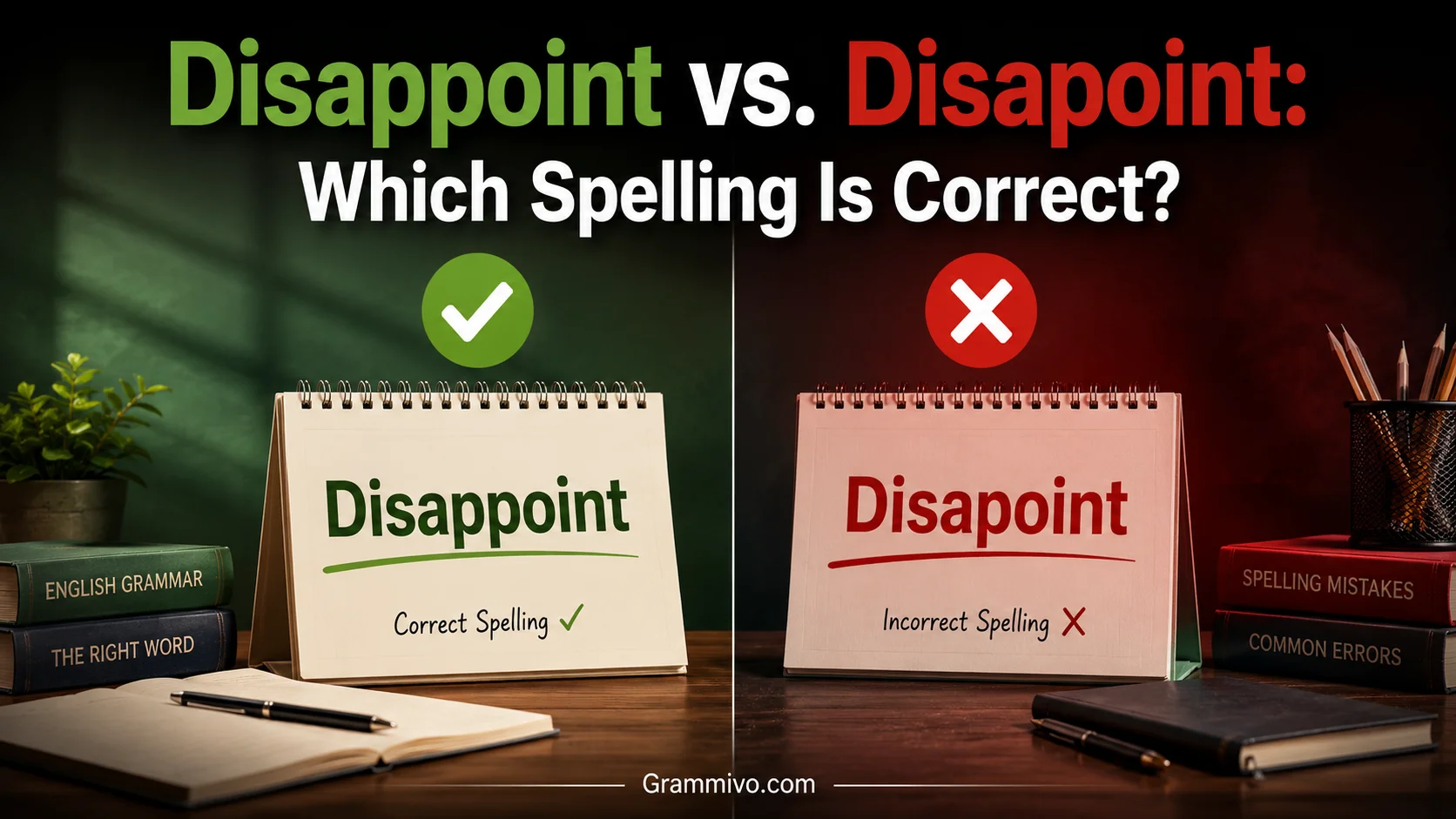
English spelling can be surprisingly tricky, especially when a word contains letters that don’t sound obvious when you say it aloud. “Disappoint” and “disapoint” are a good example. They look almost identical, yet only one is the standard English spelling.
If you’ve ever paused while writing a sentence such as “I don’t want to disappoint you,” you’re not alone. The confusion usually comes from forgetting the second p. The correct spelling is disappoint, with one s and two p’s.
The incorrect form disapoint doesn’t belong in standard English writing. It is simply a misspelling of disappoint.
This distinction matters in school assignments, emails, business writing, applications, articles, and everyday messages. A single missing letter can make otherwise polished writing look careless.
Quick Answer
Disappoint is the correct spelling.
Disapoint is incorrect.
The correct word contains two p’s:
disappoint
A useful way to remember it is to notice the word appoint inside disappoint:
dis + appoint = disappoint
Since appoint has two p’s, disappoint keeps both of them.
| Spelling | Correct? | Meaning |
| disappoint | Yes | To fail to meet someone’s expectations |
| disapoint | No | Misspelling of disappoint |
For example:
- Correct: I don’t want to disappoint my parents.
- Incorrect: I don’t want to disapoint my parents.
What Does Disappoint Mean?
Disappoint means to fail to satisfy someone’s hopes, expectations, wishes, or plans.
It usually describes a situation where someone expected one result but received something less satisfying. The word can describe what a person does to someone else or what an event or result does emotionally.
For example:
The canceled concert disappointed thousands of fans.
Here, the cancellation failed to meet the fans’ expectations.
You can also use disappoint in personal situations:
I don’t want to disappoint you.
That sentence means the speaker doesn’t want to do something that causes the other person to feel let down.
The word can apply to surprisingly ordinary situations, too:
- A poor test result can disappoint a student.
- A missed deadline can disappoint a client.
- A weak performance can disappoint fans.
- A broken promise can disappoint a friend.
- An underwhelming movie can disappoint viewers.
- A failed plan can disappoint a family.
The core idea remains the same: an expectation existed, and reality didn’t live up to it.
Why Is “Disapoint” Incorrect?
The spelling disapoint is incorrect because the standard English word is spelled disappoint, with two p’s.
The easiest way to understand the spelling is to separate the word visually:
dis + appoint = disappoint
The base word appoint already contains two p’s. Adding the prefix dis- doesn’t remove one.
Compare these forms:
- appoint
- appointed
- appointment
- disappoint
- disappointed
- disappointing
- disappointment
The double p remains visible throughout these related words.
This is also why disapoint can feel tempting. When people pronounce the word, the double consonant doesn’t sound like two separate p sounds. English spelling often contains letters that aren’t obvious from pronunciation.
That creates a classic spelling trap: you hear one sound and accidentally write one letter.
Disappoint vs. Disapoint Spelling
The difference between the two spellings comes down to one letter.
| Version | Spelling | Status |
| disappoint | d-i-s-a-p-p-o-i-n-t | Correct |
| disapoint | d-i-s-a-p-o-i-n-t | Incorrect |
The important sequence is:
app
Not:
ap
A quick visual comparison makes the distinction easier:
disappoint
disapoint
The correct version has “pp” immediately after the first a.
If you’re proofreading your writing, that’s the part worth checking.
How Do You Spell Disappoint?
The correct spelling is:
D-I-S-A-P-P-O-I-N-T
Break it into two recognizable parts:
DIS + APPOINT
This approach works better than trying to memorize every letter individually.
The word appoint is already familiar to most English speakers. You might write:
The manager will appoint a new supervisor.
Add dis-:
The manager’s decision may disappoint some employees.
The spelling becomes easier when you recognize the smaller word inside the larger one.
A Simple Spelling Trick
Remember this sentence:
Don’t disappoint the second P.
It’s a playful reminder that the word needs two p’s.
Another useful method is to memorize this small chain:
appoint → disappoint → disappointed → disappointing → disappointment
Every form keeps the double p.
How Do You Pronounce Disappoint?
In US English, disappoint is commonly pronounced approximately like:
dis-uh-POINT
Cambridge gives the US pronunciation as /ˌdɪs.əˈpɔɪnt/.
The main stress falls on point, which makes the ending particularly noticeable when spoken.
The pronunciation doesn’t clearly reveal the spelling of the double p. That’s one reason writers sometimes produce disapoint.
Think of other English words where spelling contains repeated consonants that don’t create two clearly separate sounds. English spelling often preserves the structure of related words even when pronunciation doesn’t make every letter obvious.
Disappoint in Example Sentences
Seeing the word in context makes its meaning and grammar much easier to understand.
Here are natural examples from different situations:
- I don’t want to disappoint my family.
- The final score disappointed the home crowd.
- She was afraid that her decision would disappoint her friends.
- The new restaurant didn’t disappoint.
- His performance disappointed the coach.
- The results disappointed investors.
- We hope the product doesn’t disappoint customers.
- Missing the deadline could disappoint your manager.
- The ending disappointed many viewers.
- I know you’ll never disappoint me.
Notice how disappoint normally takes an object when it means causing someone to feel let down.
For example:
The movie disappointed me.
The movie is the cause. Me is the person experiencing the disappointment.
You can also use the word in a broader sense:
The movie disappointed.
This construction appears in informal and promotional writing, especially when the implied meaning is that something met expectations.
For example:
The new restaurant didn’t disappoint.
That means the restaurant performed as well as expected or better.
Disappoint, Disappointed, and Disappointing
These three forms look similar, but they don’t perform the same job in a sentence.
| Word | Common function | Meaning | Example |
| disappoint | Verb | To cause someone to feel let down | Don’t disappoint me. |
| disappointed | Adjective | Feeling let down | I feel disappointed. |
| disappointing | Adjective | Causing disappointment | The result was disappointing. |
The distinction becomes much easier with a simple rule.
A person is usually disappointed. Something is disappointing.
For example:
I was disappointed by the result.
The person experiences the emotion.
The result was disappointing.
The result caused the emotion.
And:
The result disappointed me.
The result caused the person to feel disappointed.
These three sentences describe essentially the same situation from different grammatical angles.
What Is the Past Tense of Disappoint?
The past tense is:
disappointed
For example:
The announcement disappointed everyone.
The past participle also uses disappointed:
We were disappointed by the decision.
The spelling still contains the double p.
This gives you another useful spelling pattern:
- disappoint
- disappointed
- disappointing
- disappointment
The double p remains in every form.
What Is the Noun Form of Disappoint?
The noun form is disappointment.
For example:
The cancellation was a huge disappointment.
The word describes the feeling or experience that results when expectations aren’t met.
Compare these sentences:
- Verb: The cancellation disappointed us.
- Adjective: We were disappointed.
- Adjective: The cancellation was disappointing.
- Noun: The cancellation was a disappointment.
These words belong to the same family, which makes learning them together more efficient.
Read More: Coming vs. Comming: Which Spelling Is Correct?
Disappointed In, With, By, or About
Once you know how to spell disappoint, another common question involves the related adjective disappointed.
English uses several prepositions with disappointed, and the best choice depends on what you’re discussing.
Disappointed in
Use disappointed in commonly when talking about a person, especially their behavior or choices.
I’m disappointed in you.
She was disappointed in her teammate.
This construction often carries a personal or moral judgment.
Disappointed with
Disappointed with commonly introduces a person, thing, product, service, or situation.
We were disappointed with the hotel.
He was disappointed with his performance.
Disappointed by
Disappointed by emphasizes the thing that caused the feeling.
She was disappointed by the decision.
Fans were disappointed by the team’s performance.
Disappointed about
Disappointed about can introduce an event, fact, or situation.
They were disappointed about the cancellation.
I’m disappointed about what happened.
These patterns overlap in real-world English. Context determines which one sounds most natural.
Common Expressions With Disappoint
Some phrases appear frequently in everyday English.
“Don’t disappoint me”
This phrase can sound serious, playful, encouraging, or even teasing depending on context.
You promised you’d help. Don’t disappoint me.
“I don’t want to disappoint you”
This expression often shows concern about another person’s expectations.
I don’t want to disappoint you, but I can’t attend the event.
“You won’t disappoint”
This phrase suggests confidence that someone or something will meet expectations.
If you enjoy mystery novels, this book won’t disappoint.
“It didn’t disappoint”
This expression commonly appears in reviews and casual conversation.
The concert was incredible. It didn’t disappoint.
Here, disappoint doesn’t mean the event literally had feelings. The event is described as failing or succeeding in meeting the speaker’s expectations.
Disappoint vs. Let Down
Disappoint and let down often communicate a similar idea, but their tone can differ.
I don’t want to disappoint you.
I don’t want to let you down.
Both sentences express a desire to avoid failing someone’s expectations.
Let down often sounds more conversational and personal. Disappoint works comfortably in both casual and formal contexts.
Consider a workplace example:
The missed deadline disappointed the client.
That’s fairly professional.
A colleague might say:
I really don’t want to let the team down.
The second version sounds more personal and conversational.
Neither expression is automatically better. Choose according to the tone you need.
Common Misspellings of Disappoint
Disapoint isn’t the only spelling mistake people make.
Common incorrect forms include:
- disapoint
- dissapoint
- dissappoint
- disappiont
- disapponit
The correct spelling is:
- disappoint
There are two things worth remembering:
One s. Two p’s.
The middle of the word looks like this:
dis-a-ppoint
That simple visual pattern eliminates many common errors.
Why Do People Spell Disappoint as “Disapoint”?
The mistake usually makes sense from a sound-to-spelling perspective.
When you pronounce disappoint, you don’t normally pause between the two p’s. The consonants don’t sound like two separate, exaggerated letters.
As a result, someone writing quickly may spell the word according to how it sounds:
dis + a + point
That can lead to:
disapoint
However, English spelling often preserves relationships between words rather than representing every sound exactly.
The word appoint provides the clue. Since appoint contains pp, disappoint retains that spelling.
This is a useful general lesson: when a word looks like it contains a familiar smaller word, checking that root can help you spell the larger word correctly.
Disappoint in Different Contexts
The word works across many areas of everyday life.
School
The low grade disappointed him.
A student may have expected a higher score.
Work
The missed deadline disappointed the client.
The client expected the work on time.
Sports
The loss disappointed the team’s supporters.
Fans expected a better result.
Entertainment
The weak ending disappointed viewers.
The audience expected a stronger conclusion.
Relationships
Breaking the promise disappointed her.
She expected the promise to be kept.
Shopping
The poor customer service disappointed me.
The customer expected better service.
Across all these examples, the underlying idea stays consistent: expectation meets an unwanted result.
FAQs:
Is “disapoint” a word?
No. Disapoint is a misspelling of the standard English word disappoint.
Is disappoint spelled with one P or two?
Disappoint is spelled with two p’s.
The correct spelling is:
d-i-s-a-p-p-o-i-n-t
What is the correct spelling: disappoint or disapoint?
Disappoint is correct.
Disapoint is incorrect.
What does disappoint mean?
Disappoint means to fail to meet someone’s expectations, hopes, wishes, or plans.
For example:
I don’t want to disappoint my family.
How do you pronounce disappoint?
In US English, it is commonly pronounced approximately dis-uh-POINT. Cambridge gives the US pronunciation as /ˌdɪs.əˈpɔɪnt/.
Conclusion:
When choosing between disappoint vs. disapoint, there’s no complicated rule to memorize. Disappoint is the correct spelling. Disapoint is a misspelling. The same spelling appears in related forms such as disappointed, disappointing, and disappointment. Once you connect these words as a family, the spelling becomes much easier to remember.
