
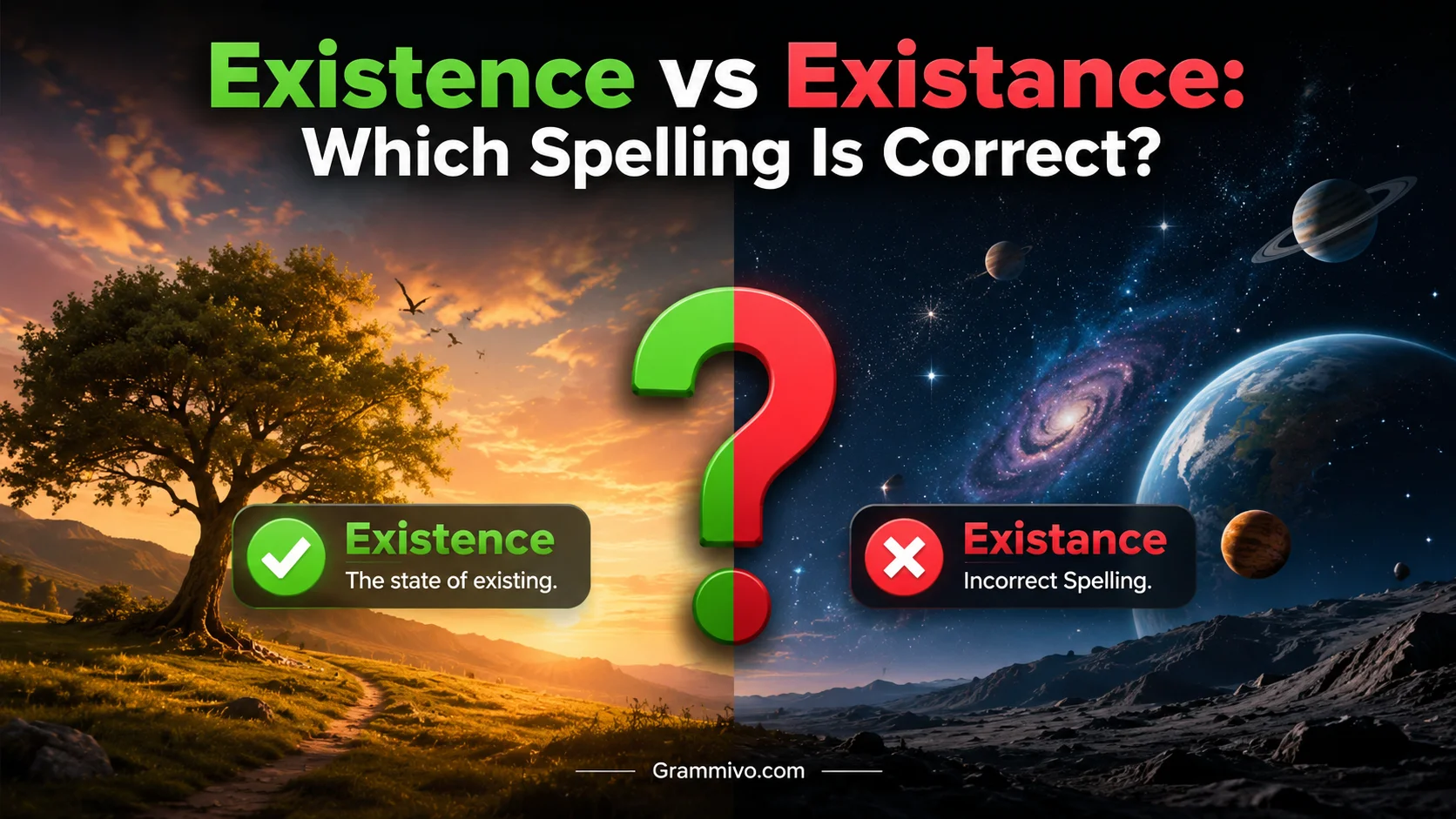
If you’ve ever hesitated between existence and existance, you’re not alone. The two spellings look almost identical, and the ending can easily cause a moment of doubt. However, there’s a clear answer: existence is the correct spelling in standard English. Existance is a misspelling.
The confusion usually comes from the pronunciation and from the fact that many English nouns end in -ance, such as importance, attendance, and appearance. That pattern can make existance look perfectly reasonable at first glance.
But English spelling doesn’t always follow the pattern that seems most logical. In this case, the correct form comes from the verb exist and uses the ending -ence: exist + ence = existence.
Quick Answer:
Existence is the correct spelling.
Existance is a common misspelling and should not be used in standard English writing.
| Spelling | Correct? | Meaning |
| Existence | Yes | The state or fact of existing |
| Existance | No | A misspelling of existence |
For example:
The discovery provided evidence of the species’ existence.
Not:
The discovery provided evidence of the species’ existance.
The easiest way to remember the correct spelling is to connect it directly to exist:
exist + ence = existence
That small spelling pattern solves the whole dilemma.
Why Is “Existence” the Correct Spelling?
The spelling existence follows the established English form of the noun derived from exist.
The base word is exist, which functions as a verb. When you turn that idea into a noun describing the state or fact of existing, you get existence.
The important part is the ending:
exist + ence → existence
The word does not become existance simply because -ance appears in many other English nouns.
Consider these examples:
- exist → existence
- persist → persistence
- insist → insistence
- resist → resistance
- consist → consistence
English word formation has several related patterns, but individual words still have established spellings that you need to learn.
Merriam-Webster defines existence as the state or fact of having being, while Cambridge Dictionary describes it as the state of existing. These definitions reinforce the same basic idea: existence refers to the fact that something exists or is real.
Why Do People Spell “Existence” as “Existance”?
The misspelling existance makes sense visually, even though it isn’t correct.
One reason involves the endings -ence and -ance. English has thousands of words using both endings, and their pronunciation doesn’t always make the difference obvious.
For example, you may already know words such as:
- attendance
- importance
- resistance
- appearance
- acceptance
- performance
- existence
- persistence
When you hear existence, the final vowel sound may not strongly remind you whether the word ends in -ence or -ance.
There’s another problem, too. The spelling existance looks as if it follows a familiar English pattern. Your brain recognizes exist and then naturally reaches for -ance.
That’s why this mistake is understandable.
Still, existance isn’t the accepted standard spelling. If you’re writing an email, essay, report, article, résumé, academic paper, or professional document, use existence.
What Does “Existence” Mean?
Existence means the state, condition, or fact of existing.
In simple terms, if something has existence, it exists or is considered to be real.
The word can describe physical things, ideas, conditions, organizations, living beings, and even abstract concepts.
For example:
Scientists searched for evidence of life beyond Earth.
You could also say:
Scientists searched for evidence of the existence of life beyond Earth.
The noun often appears when the writer wants to focus on the fact of existing rather than simply saying that something exists.
The Main Meanings of Existence
Existence can refer to several closely related ideas:
- The state of being real
- The fact that something exists
- The continued presence of something
- A particular way or condition of living
- Life or being itself, especially in philosophical discussions
Consider these sentences:
The building’s existence dates back more than a century.
Here, existence refers to the fact that the building has continued to be present.
The researchers questioned the existence of the alleged phenomenon.
Here, the word concerns whether something is actually real.
He lived a quiet existence in the countryside.
Here, existence describes a person’s way of living.
So, the exact meaning depends on context, but the central idea remains the same: being or continuing to be.
Existence vs Exist: What’s the Difference?
The easiest way to separate existence and exist is to identify their parts of speech.
| Word | Part of Speech | Meaning | Example |
| Exist | Verb | To be real or have being | Does life exist elsewhere? |
| Existence | Noun | The state or fact of existing | Scientists studied the existence of life. |
A verb describes an action, occurrence, or state. A noun names a person, place, thing, idea, or concept.
That’s why these sentences work differently:
Does this species exist?
Here, exist is the verb.
Scientists confirmed the existence of this species.
Here, existence is the noun.
A useful mental shortcut is:
Something exists. The fact that it exists is its existence.
That distinction will help you choose the right form when writing.
Existence vs Existent
Existence and existent share the same basic idea, but they don’t perform the same grammatical job.
Existence is a noun.
Existent is an adjective.
Compare these sentences:
The study provided evidence of its existence.
The species is still existent in that region.
The first sentence uses a noun to identify the fact of existing. The second uses an adjective to describe something that exists.
| Word | Part of Speech | Example |
| Exist | Verb | The tradition still exists. |
| Existence | Noun | The tradition’s existence is well documented. |
| Existent | Adjective | The tradition remains existent in some communities. |
| Nonexistence | Noun | The evidence suggests its nonexistence. |
In everyday English, existence and exist are far more common than existent.
Existence vs Nonexistence
If existence refers to the state of existing, nonexistence refers to the absence of existence.
The prefix non- changes the meaning to its opposite.
| Word | Meaning |
| Existence | The state of existing |
| Nonexistence | The state of not existing |
For example:
The evidence supports the existence of the ancient settlement.
The opposite idea would be:
The evidence supports the nonexistence of the settlement.
In ordinary conversation, however, people often use simpler constructions such as doesn’t exist rather than nonexistence.
For example:
There is no evidence that the creature exists.
That sentence sounds more natural in many everyday contexts than:
There is evidence supporting the nonexistence of the creature.
The more formal noun becomes useful when discussing philosophy, science, law, academic research, or abstract ideas.
How to Pronounce “Existence”
The American English pronunciation of existence is commonly represented as:
/ɪɡˈzɪstəns/
A simple pronunciation guide is:
ig-ZIS-tuhns
The stress falls on the second syllable.
The pronunciation explains part of the spelling confusion. When spoken naturally, the ending doesn’t always make the spelling immediately obvious.
That’s why relying only on sound can lead you toward existance.
When spelling the word, rely on its structure instead:
exist + ence
Think of the familiar verb first. Then attach -ence.
Examples of “Existence” in Sentences
Seeing the word in different contexts makes its meaning and spelling easier to remember.
Everyday Examples
- The old bridge is still in existence.
- Nobody questioned the existence of the problem.
- The organization has been in existence for many years.
- Her quiet existence suited her perfectly.
- The village’s existence depends heavily on tourism.
Academic Examples
- The researchers examined evidence supporting the existence of the phenomenon.
- The study challenges the assumed existence of a connection between the variables.
- Historical records confirm the existence of the settlement.
- The researchers found no evidence for the existence of the proposed effect.
Scientific Examples
- Scientists continue to investigate the possible existence of life elsewhere in the universe.
- The discovery provided evidence for the existence of the previously unknown species.
- Researchers searched for evidence of the particle’s existence.
- The experiment raised new questions about the existence of the proposed mechanism.
Philosophical Examples
- Philosophers have debated the nature of human existence for centuries.
- The question concerns the relationship between consciousness and existence.
- The argument examines whether physical reality is necessary for conscious existence.
These examples show why existence works across many fields. It can describe something concrete, such as a species, or something highly abstract, such as consciousness.
Common Phrases With “Existence”
Some combinations with existence appear frequently in English. Learning them can improve both spelling and vocabulary.
“Come Into Existence”
This means to begin to exist.
The company came into existence in the early twentieth century.
It often appears in historical or formal writing.
“In Existence”
This means currently existing or continuing to exist.
Only a few original copies remain in existence.
“The Existence of”
This construction introduces the fact that something exists.
The evidence confirmed the existence of an ancient settlement.
It’s especially common in academic and formal writing.
“Bring Into Existence”
This means to cause something to exist or begin.
The agreement helped bring a new organization into existence.
“During Its Existence”
This phrase focuses on the period during which something existed.
During its existence, the company expanded into several markets.
“Question the Existence of”
This means to doubt whether something exists.
The researchers questioned the existence of a meaningful relationship between the two variables.
“Prove the Existence of”
This means to establish that something exists through evidence or reasoning.
The experiment was designed to test the existence of the proposed effect.
Read More: Drunkenness vs Drunkeness: Which Spelling Is Correct?
Is “Existance” Ever Correct?
In standard modern English, existance is not the correct spelling.
You may still encounter it online, in informal posts, user-generated content, old documents, or ordinary typing mistakes. Its appearance doesn’t make it an accepted alternative spelling.
The standard form remains:
existence
This distinction matters because a misspelling can look especially noticeable in professional writing.
For example:
The report examines the existence of several environmental risks.
Correct.
The report examines the existance of several environmental risks.
Incorrect.
If a spell-checker underlines existance, it isn’t being overly picky. It is identifying a genuine spelling error.
Common Mistakes With Existence
The most obvious mistake is replacing -ence with -ance.
| Incorrect | Correct |
| existance | existence |
| existense | existence |
| existince | existence |
| existance of | existence of |
The first version, existance, is by far the most recognizable form of the error because it preserves the rest of the word correctly.
Another common mistake involves confusing the noun with the verb.
Incorrect:
The evidence proves that the existence.
Correct:
The evidence proves that it exists.
Or:
The evidence proves its existence.
The first corrected sentence uses a verb. The second uses a noun.
How to Remember the Spelling of Existence
A good spelling trick should be simple enough to recall when you’re writing quickly.
The most useful method is to start with exist.
Use the “Exist + Ence” Trick
Break the word into two parts:
EXIST + ENCE = EXISTENCE
The beginning stays exactly like the verb exist.
This gives you a reliable visual pattern:
exist → existence
Not:
exist → existance
If you remember the noun as exist + ence, the troublesome vowel becomes much easier to manage.
Connect Existence With Related Words
Another useful strategy involves the word family.
- exist
- exists
- existed
- existing
- existence
- existent
The shared exist- beginning gives you an anchor.
When you reach the ending, remember:
existence ends in -ence.
Think “Evidence” and “Existence”
A useful memory association is the pair:
evidence → existence
Both words end with -ence.
You don’t need to memorize a complicated spelling rule. You simply need a reliable visual cue.
Existence in Academic and Professional Writing
The word existence appears frequently in formal writing because it allows writers to discuss whether something is present, real, established, or supported by evidence.
For example:
The study investigated the existence of a relationship between sleep and performance.
This construction is grammatically correct. However, good writing doesn’t always require the noun existence.
A shorter version may be clearer:
The study investigated whether sleep affects performance.
That’s an important writing lesson. Correct vocabulary isn’t automatically the best vocabulary.
Use existence when the idea of something existing matters. If a direct verb communicates the same idea more efficiently, use it.
Wordy vs Direct
| Wordy | More Direct |
| The study investigated the existence of a relationship. | The study investigated whether a relationship exists. |
| The report provides evidence of the existence of fraud. | The report provides evidence that fraud occurred. |
| Researchers examined the existence of differences between groups. | Researchers examined whether the groups differed. |
The noun existence remains useful, especially when the fact of being present is the central subject.
FAQs:
Is “existance” a real word?
Existance is not the standard English spelling. It is generally treated as a misspelling of existence.
Which is correct: existence or existance?
Existence is correct.
How do you spell existence?
The spelling is:
E-X-I-S-T-E-N-C-E
A useful breakdown is:
exist + ence = existence
What does existence mean?
Existence means the state or fact of existing or being real.
Is existence a noun?
Yes. Existence is a noun.
Conclusion:
The word existence is a noun meaning the state or fact of existing. It connects directly to the verb exist, which makes the spelling easier to remember. The difference is only one letter, but that letter matters. Whether you’re writing a school assignment, professional report, blog post, email, or academic paper, existence is the spelling to choose.
