
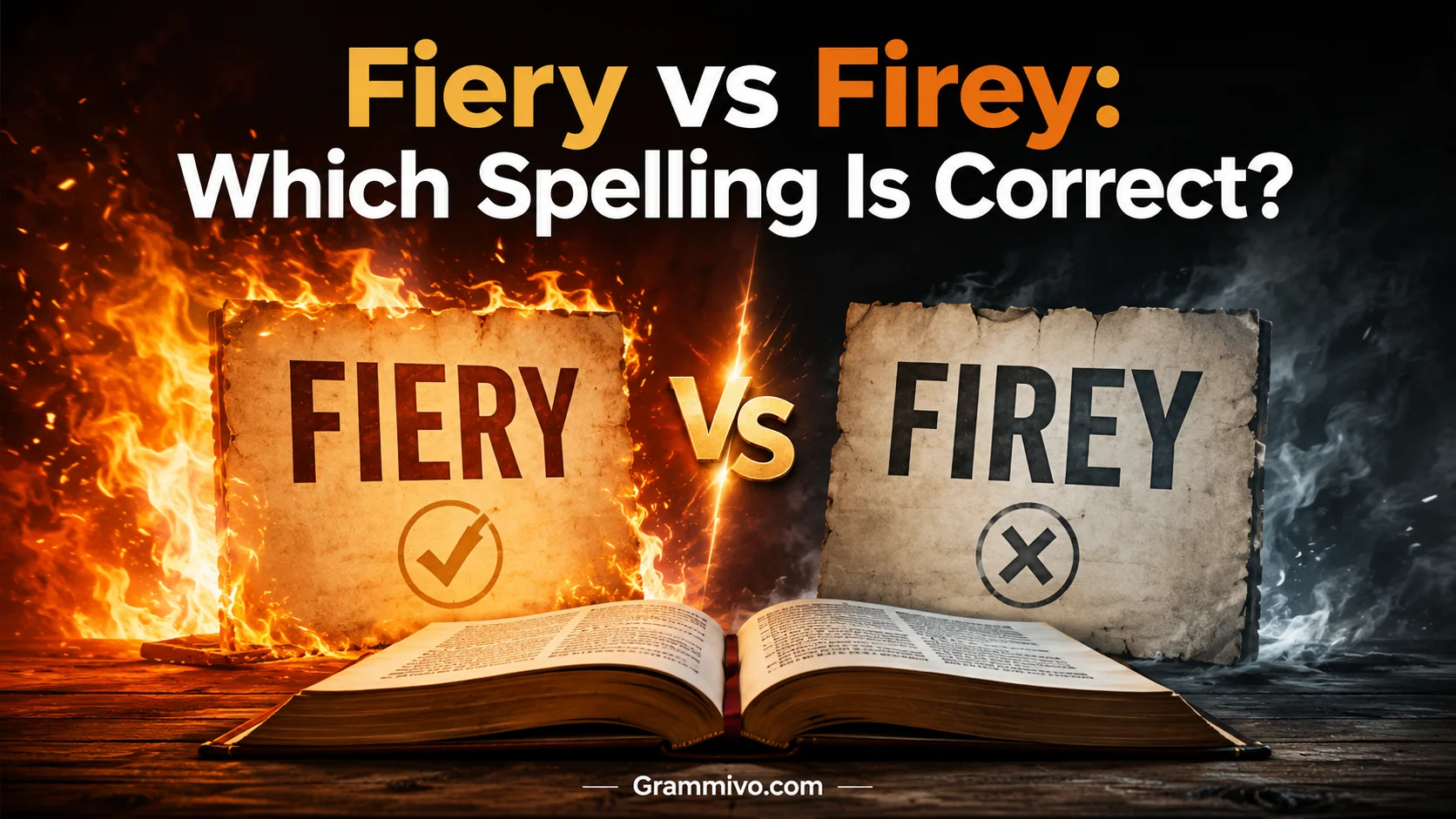
English spelling can be surprisingly tricky. Sometimes a word looks like it should follow a simple pattern, yet the accepted spelling takes a different path. Fiery vs firey is a perfect example.
If you’ve ever wondered whether to write fiery or firey, you’re not alone. The word comes from fire, so writing firey may seem perfectly logical. However, standard English uses fiery as the adjective.
The difference matters when you’re writing an email, school assignment, article, story, or professional document. A spell checker may flag firey, but understanding why can help you remember the correct form rather than simply memorizing it.
This guide explains fiery vs firey in detail. You’ll learn which spelling is correct, what fiery means, why firey causes confusion, how to pronounce the word, and how to use it naturally in different contexts.
Quick Answer
Fiery is the standard English spelling.
Firey is generally a misspelling when you’re trying to use the adjective meaning “like fire,” “very hot,” “passionate,” or “intense.”
| Spelling | Standard adjective? | Meaning |
| Fiery | Yes | Related to fire, hot, glowing, passionate, intense, or spirited |
| Firey | No | Usually a misspelling of fiery |
For example:
- Correct: She gave a fiery speech.
- Incorrect: She gave a firey speech.
- Correct: The sunset had a fiery orange glow.
- Incorrect: The sunset had a firey orange glow.
There is one important qualification. Firey can appear as a deliberately chosen proper name, username, fictional character name, or other title. In that situation, it isn’t necessarily a spelling error. In ordinary English writing, however, fiery is the form to use.
Fiery vs Firey: What Is the Difference?
The simplest distinction is grammatical and conventional.
Fiery is an established English adjective. It describes something connected with fire or something that resembles the qualities associated with fire.
Firey, on the other hand, isn’t the standard spelling of that adjective. Writers often produce it because they naturally see the word as fire + y. That visual logic makes sense at first glance, but English spelling doesn’t always work by simply adding a suffix to the modern form of a word.
Consider these examples:
- a fiery furnace
- a fiery sunset
- a fiery personality
- a fiery argument
- a fiery red dress
- a fiery bowl of chili
In each case, fiery is the standard spelling.
The distinction becomes especially important because firey can look familiar. A familiar-looking spelling isn’t automatically a correct one. English contains many words whose conventional forms don’t perfectly match the spelling pattern a learner might expect.
Why Is Fiery the Correct Spelling?
The spelling fiery has a historical explanation that goes beyond the simple rule “drop the e and add y.”
Modern English speakers naturally start with fire. From there, it seems reasonable to create:
fire + y = firey
That would produce a visually predictable form. Yet the standard adjective developed through the historical forms of the word rather than through a simple modern spelling exercise.
Merriam-Webster explains that fiery is connected with older forms of fire, including fier. That historical development helps explain why the adjective settled into the spelling fiery rather than firey.
This is one reason English spelling can frustrate learners. Modern spelling often preserves traces of earlier forms even after pronunciation and vocabulary have changed.
A useful way to remember the word is:
fier + y = fiery
That isn’t meant to replace the actual historical explanation. It’s simply a practical memory trick.
Why “fire + y” Is Misleading
The mistake becomes easier to understand when you look at other adjectives.
| Base word | Adjective |
| ice | icy |
| spice | spicy |
| noise | noisy |
| shine | shiny |
| fire | fiery |
The first few examples may encourage you to expect firey. English doesn’t guarantee that every related word will follow exactly the same spelling pattern.
That’s why treating English spelling as a collection of rigid formulas can create problems. Word history, pronunciation, suffixes, and older forms all influence modern spelling.
What Does Fiery Mean?
Fiery has several related meanings. Its central idea is fire or the qualities associated with fire, but the word can move from literal heat to figurative passion.
Fiery as Something Related to Fire
The most literal meaning describes something connected with flames, burning, or fire.
For example:
The building was surrounded by a fiery glow.
Here, fiery describes an appearance associated with flames.
You might also encounter phrases such as:
- fiery flames
- fiery furnace
- fiery explosion
- fiery glow
- fiery eruption
In these examples, the connection with actual fire remains strong.
Fiery as Extremely Hot
The word can also describe intense heat.
For example:
The afternoon sun felt fiery against the pavement.
Here, fiery doesn’t mean that the pavement is literally burning. Instead, it creates an image of intense heat.
This figurative use gives the word more emotional and descriptive power than simply saying hot.
Fiery as Bright or Glowing
Fiery can describe something with a bright, flame-like appearance.
For example:
The clouds turned fiery orange as the sun disappeared.
This usage is especially common when describing sunsets, autumn colors, paintings, clothing, hair, and other visually striking subjects.
Fiery as Passionate
The word can describe someone who shows strong emotion, enthusiasm, determination, or passion.
For example:
She delivered a fiery speech about education.
The speaker isn’t literally on fire. Instead, the speech carries energy, conviction, and emotional force.
You might describe these as fiery:
- a speech
- a debate
- a performance
- a protest
- a response
- a defense
- an argument
- a personality
Fiery as Easily Angered
Fiery can also describe a person with a strong or hot temper.
For example:
His fiery temper sometimes caused unnecessary arguments.
In this context, fiery suggests intensity and quick emotional reactions.
The meaning depends heavily on context. A fiery personality can sound complimentary when it means energetic and passionate. A fiery temper often suggests irritability or anger.
What Does Firey Mean?
When someone writes firey as an ordinary adjective, they usually mean fiery.
For example:
She has a firey personality.
The intended meaning is clear. However, the standard spelling is:
She has a fiery personality.
This distinction matters because communication involves more than being understood. Standard spelling helps readers recognize your meaning immediately and makes your writing look polished.
Can Firey Ever Be Correct?
Yes, but context matters.
Firey can function as a deliberate name or label. A fictional character, username, brand, online identity, or other proper name may intentionally use that spelling.
For example, Firey is the name of a character associated with Battle for Dream Island. In that context, the spelling is part of the character’s name rather than an attempt to spell the ordinary adjective fiery.
So it would be inaccurate to claim that the letter sequence firey can never appear in English.
The better rule is:
Use “fiery” for the ordinary adjective. Treat “Firey” as a proper name only when the context specifically establishes that spelling.
Fiery vs Firey Examples
Seeing the words in context makes the difference much easier to remember.
| Incorrect in standard adjective use | Correct |
| The dragon breathed firey flames. | The dragon breathed fiery flames. |
| She gave a firey speech. | She gave a fiery speech. |
| The sky looked firey at sunset. | The sky looked fiery at sunset. |
| He has a firey temper. | He has a fiery temper. |
| The curry has a firey kick. | The curry has a fiery kick. |
| They had a firey debate. | They had a fiery debate. |
| Her hair was a firey red. | Her hair was a fiery red. |
| The volcano produced a firey glow. | The volcano produced a fiery glow. |
The pattern is consistent. When the adjective means something like burning, passionate, hot, intense, or flame-colored, choose fiery.
How to Use Fiery in a Sentence
One reason fiery remains useful is its flexibility. You can use it for physical descriptions, emotions, colors, food, personalities, and dramatic situations.
Fiery for Fire and Heat
- The fireplace created a fiery glow across the room.
- The volcano released a fiery stream of lava.
- The blacksmith worked beside a fiery furnace.
- The campfire sent fiery sparks into the night.
Fiery for Food
Food writers often use fiery to describe strong heat or spice.
- This salsa has a fiery kick.
- The restaurant serves a fiery chicken curry.
- Add the peppers if you want a fiery flavor.
- The sauce starts sweet and finishes with a fiery heat.
Here, fiery doesn’t mean the food contains literal flames. It communicates intensity.
Fiery for Personality
- Maya has a fiery personality.
- His fiery determination impressed the entire team.
- Her fiery spirit helped her handle the challenge.
- The coach is known for his fiery leadership style.
Fiery for Arguments and Speeches
- The candidates had a fiery debate.
- He delivered a fiery defense of the proposal.
- Her fiery response surprised everyone.
- The meeting ended after a fiery exchange.
Fiery for Colors
- The sky became fiery orange at sunset.
- She chose a fiery red for the walls.
- The artist used fiery shades of red and gold.
- Autumn leaves covered the hillside in fiery colors.
Read More: Fascinating vs Facinating: Which Spelling Is Correct?
Is Fiery an Adjective?
Yes. Fiery is an adjective.
An adjective modifies or describes a noun. Fiery can tell you what something looks like, feels like, or how someone behaves.
Consider these examples:
- a fiery speech
- a fiery sunset
- a fiery sauce
- a fiery personality
- a fiery argument
- a fiery furnace
In each phrase, fiery provides information about the noun.
It can also appear after a linking verb:
The sunset looked fiery.
His temper became fiery.
The grammatical role remains adjectival.
Related Words
Several words are connected with the same general idea but don’t have identical meanings.
| Word | Part of speech | Typical meaning |
| fire | Noun/verb | A burning process or to set something alight |
| fiery | Adjective | Like fire, hot, passionate, or intense |
| fierce | Adjective | Aggressive, powerful, intense, or determined |
| flaming | Adjective/participle | Burning or appearing to burn |
| burning | Adjective/participle | On fire, extremely hot, or urgent |
| passionate | Adjective | Showing strong emotion or enthusiasm |
Understanding these differences prevents you from treating related words as exact substitutes.
How Do You Pronounce Fiery?
Fiery is commonly pronounced approximately like:
FYE-uh-ree
Pronunciation can vary somewhat among speakers. In ordinary conversation, the middle vowel sounds may become less distinct because English speakers often reduce unstressed syllables.
The spelling can therefore feel disconnected from the pronunciation.
That’s another reason people may write firey. When you hear the word, you don’t necessarily see its unusual historical spelling in your mind.
A good strategy is to connect the pronunciation with the written form:
fiery = FYE-uh-ree
Once you’ve encountered the word repeatedly in writing, the spelling becomes much more familiar.
Why Do People Spell Fiery as Firey?
The fiery vs firey confusion isn’t random. There are several understandable reasons behind it.
The Base Word Is Fire
The strongest reason is visual.
Readers see:
fire
Then they want to create an adjective:
fire + y
That produces firey in their minds.
It’s a logical guess. Unfortunately, standard English doesn’t use that spelling.
English Spelling Isn’t Always Phonetic
English has accumulated words from several languages and historical stages. Pronunciation and spelling have changed over time, while many written forms have remained relatively stable.
As a result, modern spelling sometimes preserves patterns that aren’t obvious from today’s pronunciation.
Fiery is one of those words where history helps explain the modern form.
The Word Looks Like It Should Follow Another Pattern
Words such as icy, spicy, and noisy may reinforce the expectation that fire should become firey.
That expectation isn’t unreasonable. It’s simply not the standard spelling of this particular adjective.
Familiarity Can Reinforce Errors
If you repeatedly see a misspelling online, it can start to look normal.
This happens with many commonly confused words. A spelling can become visually familiar without becoming grammatically or lexically standard.
That’s why dictionaries and established usage are more reliable than frequency alone.
Fiery vs Firey in American and British English
The spelling difference isn’t an American-versus-British English issue.
Fiery is the standard spelling in both American and British English.
| English variety | Standard spelling |
| American English | fiery |
| British English | fiery |
| Canadian English | fiery |
| Australian English | fiery |
This makes the distinction different from familiar regional pairs such as:
- color / colour
- center / centre
- traveled / travelled
You shouldn’t switch from fiery to firey based on the English variety you’re using.
If you’re writing for an American audience, use fiery. If you’re writing for a British audience, use fiery as well.
Fiery vs Firey: Common Mistakes to Avoid
The most common mistake is simply writing firey because it looks like the natural combination of fire and -y.
Other errors can happen when writers confuse meaning or related vocabulary.
Mistake: Assuming Firey Is a Regional Variant
It isn’t the standard British spelling or an alternative American spelling.
Use fiery in both varieties.
Mistake: Thinking Firey Is More Logical
It may look more logical based on the modern spelling of fire. Standard spelling, however, comes from established usage and historical development rather than pure visual logic.
Mistake: Using Fiery Only for Actual Flames
The word has a much wider range.
A person can have a fiery personality. A politician can give a fiery speech. A sunset can look fiery. A sauce can have a fiery taste.
Mistake: Treating Fiery and Fierce as Identical
The words overlap when describing intensity, but their meanings aren’t interchangeable.
A fiery speech emphasizes passion or emotional force.
A fierce speech can emphasize aggression, forcefulness, or intensity.
The surrounding context determines which word works best.
FAQs:
Is it fiery or firey?
Fiery is the correct standard spelling when you’re using the adjective related to fire, heat, passion, intensity, or flame-like color.
Is firey a word?
Firey isn’t the standard spelling of the ordinary adjective fiery. It can still appear as a deliberately chosen proper name or fictional character name.
Why is fiery spelled with “ie”?
The spelling reflects the historical development of the word. Merriam-Webster notes the connection between fiery and older forms of fire, including fier. The modern spelling therefore isn’t simply a matter of adding -y to today’s spelling of fire.
What does fiery mean?
Fiery can mean related to fire or flames. It can also describe intense heat, vivid flame-like colors, passion, strong emotion, spirited behavior, or an easily angered temperament.
Is fiery an adjective?
Yes. Fiery is an adjective that modifies nouns or functions as a subject complement.
Conclusion:
When comparing fiery vs firey, the answer is clear: fiery is the standard spelling for the adjective. The confusion makes sense because firey looks like a straightforward combination of fire and -y. However, the accepted English form developed through the history of the word and uses the spelling fiery.
