
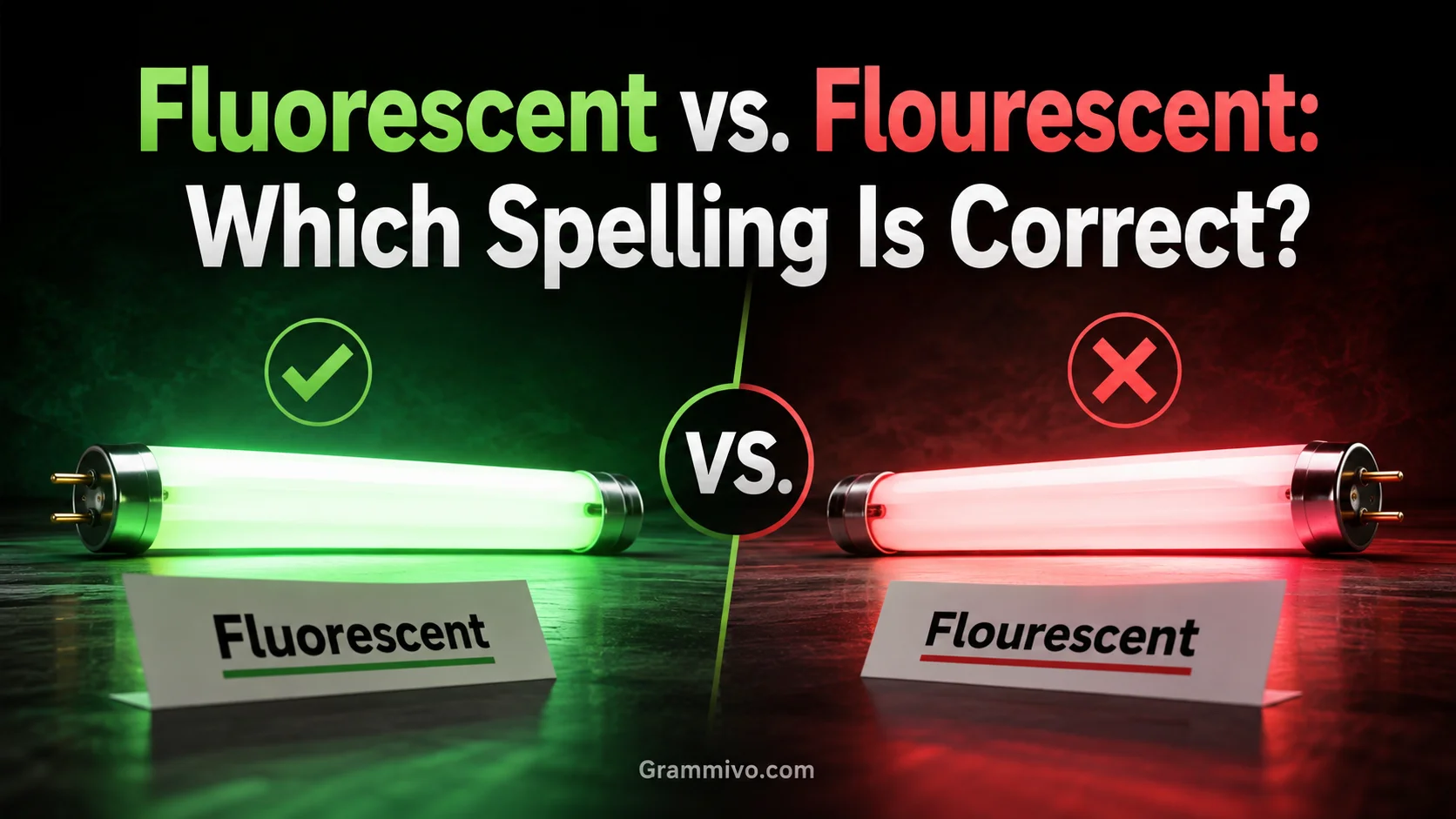
If you’ve ever paused over fluorescent vs. flourescent, you’re not alone. This word has an awkward-looking sequence of letters that can easily trip up even careful writers. The problem becomes especially common when you hear the word aloud and try to spell it from memory. So, which spelling should you use? Fluorescent is the correct spelling. Flourescent is a misspelling.
The correct form contains fluor near the beginning: f-l-u-o-r-e-s-c-e-n-t. The incorrect version rearranges those early letters and drops the proper spelling pattern. You’ll encounter fluorescent when talking about certain types of light, materials that emit visible light under particular conditions, and extremely bright colors.
Understanding the word becomes easier when you connect it with related terms such as fluorescence and fluorescently. Once you recognize the pattern, the spelling becomes much less mysterious.
Quick Answer:
Fluorescent is the correct spelling.
Flourescent is a common misspelling and shouldn’t be used in standard English.
| Spelling | Correct? | Meaning |
| fluorescent | Yes | Relating to fluorescence or producing an especially bright visual effect |
| flourescent | No | Common misspelling of fluorescent |
| florescent | Yes, but different | Relating to flowering or florescence |
For example:
The fluorescent lights made the office unusually bright.
You can also use the word to describe color:
She wore a fluorescent yellow jacket while riding her bike.
The spelling to remember is FLUORESCENT.
What Does Fluorescent Mean?
Fluorescent is an adjective associated with fluorescence, a phenomenon in which a substance absorbs electromagnetic radiation and then emits light. In everyday English, the word commonly appears in discussions about lighting, science, materials, paint, clothing, and vivid colors.
The scientific meaning is more specific than simply saying something “glows.” Fluorescence involves the emission of light following the absorption of energy, often involving ultraviolet radiation or another source of excitation.
The word also has a broader everyday use. Something described as fluorescent may have an extremely vivid, almost glowing appearance.
Consider these examples:
- fluorescent lighting
- fluorescent bulbs
- fluorescent paint
- fluorescent markers
- fluorescent yellow
- fluorescent green
- fluorescent orange
In each case, the surrounding noun helps reveal the intended meaning.
When someone says fluorescent marker, for instance, they’re usually talking about a marker containing vivid ink designed to stand out. When a scientist describes a fluorescent protein, the term has a more technical meaning related to light emission.
Why Is Flourescent Incorrect?
The spelling flourescent looks plausible because the pronunciation doesn’t make every letter obvious. However, standard English spells the word fluorescent, with fluor appearing at the beginning.
Compare the two forms:
Correct: fluorescent
Incorrect: flourescent
The mistake usually happens because writers remember the general sound of the word rather than its written structure. The letters can feel as though they belong in a different order.
There’s another reason the error survives: flourescent looks close enough to the correct word that spell-checking or proofreading may not always catch it in every context. A reader can also understand what the writer intended without noticing the error immediately.
The safest approach is to remember the related noun:
fluorescence → fluorescent
That connection gives you a reliable spelling anchor.
Fluorescent vs. Flourescent at a Glance
A quick comparison makes the difference easier to see.
| Feature | Fluorescent | Flourescent |
| Standard spelling | Yes | No |
| Dictionary-standard adjective | Yes | No |
| Related noun | fluorescence | — |
| Common use | Light, materials, vivid colors | Misspelling |
| Correct for formal writing | Yes | No |
| Example | fluorescent paint | flourescent paint |
The crucial difference sits near the beginning of the word.
FLUO is part of the correct spelling.
The incorrect version tends to scramble this sequence into FLOU.
That tiny difference changes a correctly spelled technical and everyday English word into a spelling error.
How to Spell Fluorescent Correctly
The full spelling is:
F-L-U-O-R-E-S-C-E-N-T
A useful way to break it down is:
FLUOR + ESCENT
The fluor portion is especially important because it connects the word with fluorescence and fluor- terminology.
You don’t need to memorize every letter individually. Instead, remember the opening pattern:
FLUOR comes first in fluorescent.
Then attach -escent:
FLUOR + ESCENT = FLUORESCENT
This approach works better than trying to reproduce the pronunciation letter by letter.
The Correct Spelling Pattern
Look at these related words:
- fluorescence
- fluorescent
- fluorescently
They all preserve the same basic fluor- beginning.
Once you remember that pattern, you’re less likely to write flourescent by accident.
A Simple Trick to Remember Fluorescent
Here’s an easy memory trick:
Think “fluor” before “escent.”
Write it mentally as:
FLUOR + ESCENT
The first four letters are the part worth memorizing. If you start with FLUO, you’re already much closer to the correct spelling.
Another useful strategy involves the noun fluorescence. If you’re unsure whether the adjective contains fluo or flou, think of the noun first:
fluorescence → fluorescent
For example:
The material shows fluorescence under ultraviolet light.
The material is fluorescent.
The two words belong to the same family. Their shared beginning helps keep the spelling consistent.
Why Does Fluorescent Have “Fluo” in It?
The unusual spelling makes more sense when you look at the word’s history.
The term is connected to fluorescence, which is associated with fluorspar, a mineral historically important in the development of the concept, combined with the word opalescence. Merriam-Webster dates the first known use of fluorescence to the 19th century.
The adjective fluorescent developed from that terminology.
This history explains why the opening letters aren’t arranged according to what might feel like the most natural pronunciation-based spelling. English scientific vocabulary often preserves pieces of older terminology even when those combinations look unusual.
The important takeaway isn’t the etymology itself. It’s the spelling connection:
fluor → fluorescence → fluorescent
That family resemblance gives you a practical way to remember the word.
Fluorescent Pronunciation
Pronunciation can contribute to the spelling problem.
In American English, fluorescent is commonly pronounced with the main stress on the second syllable. Dictionary pronunciation guides show variations in how the opening portion is realized.
Cambridge Dictionary provides US pronunciations for fluorescent, including forms represented in IPA as /flɔːˈres.ənt/ and /flʊˈres.ənt/.
The important point for spelling is simple: the spoken form doesn’t make the written “fluor” sequence obvious to every listener.
That’s why spelling from sound alone can lead to flourescent.
When you’re writing the word, rely on the visual pattern instead:
fluor + escent
rather than trying to reconstruct every letter from its pronunciation.
Fluorescent in Sentences
Seeing the word in real sentences makes its usage easier to understand.
- The fluorescent lights illuminated the entire classroom.
- He bought a fluorescent yellow safety vest.
- The laboratory used fluorescent dyes to examine the sample.
- The poster featured fluorescent green lettering.
- Some materials become fluorescent when exposed to ultraviolet radiation.
- She highlighted the sentence with a fluorescent marker.
- The store’s fluorescent lighting made the colors look unusually harsh.
- The scientist studied the fluorescent properties of the material.
Notice how the word changes meaning slightly depending on context.
In fluorescent lighting, it refers to a type of lighting technology.
In fluorescent green, it describes an intensely vivid color.
In fluorescent material, it can describe a scientific property involving fluorescence.
The spelling stays exactly the same.
Fluorescent Light vs. Fluorescent Color
The word fluorescent appears frequently in everyday descriptions of both lighting and color. Those uses are related, but they’re not identical.
Fluorescent Light
A fluorescent light traditionally refers to a type of electric lamp that produces visible light through a discharge in a gas and a fluorescent coating inside the lamp.
You’ll commonly see phrases such as:
- fluorescent light
- fluorescent lamp
- fluorescent bulb
- fluorescent tube
- fluorescent lighting
For example:
The office replaced its old fluorescent tubes with newer lighting.
The word doesn’t simply mean “bright.” It identifies a particular lighting technology in this context.
Fluorescent Color
In another context, fluorescent describes an exceptionally vivid color.
Examples include:
- fluorescent yellow
- fluorescent pink
- fluorescent orange
- fluorescent green
- fluorescent blue
These colors are often designed to attract attention. You’ll see them on safety clothing, signs, art materials, sports equipment, packaging, and highlighters.
A fluorescent yellow vest, for example, stands out strongly against many ordinary surroundings.
Fluorescent vs. Florescent
This comparison deserves attention because florescent is different from flourescent.
While flourescent is a misspelling of fluorescent, florescent is an actual word with a different meaning.
Florescent relates to florescence, which concerns flowering or coming into bloom.
The distinction becomes much clearer in a table:
| Word | Correct? | Meaning |
| fluorescent | Yes | Related to fluorescence or exceptionally vivid |
| flourescent | No | Misspelling of fluorescent |
| florescent | Yes | Relating to flowering or florescence |
For example:
The fluorescent paint glowed vividly under the appropriate light.
That has nothing to do with flowers.
By contrast:
The plant had reached a florescent stage.
Here, florescent relates to flowering.
This distinction matters because replacing fluorescent with florescent can change the meaning of a sentence rather than merely creating a spelling error.
Fluorescent vs. Fluorescence
Another useful comparison is fluorescent vs. fluorescence.
The two words belong to the same word family but perform different grammatical jobs.
Fluorescent is generally an adjective.
Fluorescence is a noun.
Compare:
The material is fluorescent.
Here, fluorescent describes the material.
The material exhibits fluorescence.
Here, fluorescence names the phenomenon.
| Word | Part of speech | Example |
| fluorescent | Adjective | The material is fluorescent. |
| fluorescence | Noun | The material exhibits fluorescence. |
| fluorescently | Adverb | The compound fluoresces under the test conditions. |
Learning the noun can make the adjective easier to spell. Both begin with fluor-.
Read More: Fiery vs Firey: Which Spelling Is Correct?
Fluorescent vs. Phosphorescent
Fluorescent and phosphorescent sometimes appear together because both terms involve the emission of light. However, they describe different physical processes.
In simple terms, fluorescence generally involves rapid light emission while the material is being excited. Once the excitation source stops, the fluorescent emission typically stops very quickly.
Phosphorescence involves a longer-lived afterglow. A phosphorescent material can continue emitting light after the excitation source has been removed.
A familiar example is a glow-in-the-dark product.
The distinction can be summarized like this:
| Term | Basic idea |
| Fluorescent | Light emission occurs during excitation and usually stops very quickly afterward |
| Phosphorescent | Light emission can persist after excitation ends |
The exact physics involves electronic states, energy transitions, and timescales. For ordinary writing, however, remembering the difference between immediate fluorescence and persistent phosphorescence is usually enough.
Common Fluorescent Spelling Mistakes
The most common error is straightforward:
flourescent
fluorescent
However, other variations can appear when someone tries to spell the word from memory.
| Common error | Correct form |
| flourescent | fluorescent |
| fluroscent | fluorescent |
| flouresence | fluorescence |
| fluoresense | fluorescence |
| flurescent | fluorescent |
These errors usually involve dropping, moving, or replacing letters.
The best defense is to remember the word family instead of memorizing isolated spellings.
fluor → fluorescence → fluorescent
That pattern gives you a much stronger mental reference.
Is “Flourescent” Ever Correct?
No. Flourescent isn’t the standard spelling of the adjective meaning related to fluorescence.
If you see the spelling in an email, social media post, article, product description, or informal message, it’s generally a typographical or spelling error.
For formal writing, academic work, professional communication, product copy, and edited publications, use:
fluorescent
Don’t treat flourescent as an acceptable alternative simply because it appears online.
The internet contains countless spelling mistakes. Frequency doesn’t automatically make a spelling standard.
How to Use Fluorescent Correctly
The word works naturally in several sentence structures.
Fluorescent Before a Noun
This is probably the most common pattern.
Examples include:
- fluorescent lighting
- fluorescent paint
- fluorescent marker
- fluorescent dye
- fluorescent protein
- fluorescent material
- fluorescent color
For example:
The artist used fluorescent paint to make the lettering stand out.
Fluorescent After a Linking Verb
You can also use it as a predicate adjective.
The material is fluorescent.
The colors appeared fluorescent under the special lighting.
This structure emphasizes the property rather than simply labeling an object.
Fluorescent in Scientific Writing
Scientific contexts often use the term more precisely.
For example:
Researchers used a fluorescent compound to track the target molecules.
Here, fluorescent describes a property that researchers can use for observation or measurement.
That technical use differs from casual descriptions such as fluorescent pink shoes, but both use the same correctly spelled word.
Fluorescent vs. Flourescent Examples
If you’re editing a document, these quick corrections can help.
| Incorrect | Correct |
| The room had flourescent lights. | The room had fluorescent lights. |
| She wore a flourescent vest. | She wore a fluorescent vest. |
| Use a flourescent marker. | Use a fluorescent marker. |
| The sign was flourescent green. | The sign was fluorescent green. |
| Scientists studied the flourescent material. | Scientists studied the fluorescent material. |
| The dye showed flourescence. | The dye showed fluorescence. |
The correction doesn’t require changing the sentence structure. In most cases, you simply need to replace the misspelled form.
FAQs:
Is fluorescent or flourescent correct?
Fluorescent is correct. Flourescent is a misspelling.
How do you spell fluorescent?
The correct spelling is F-L-U-O-R-E-S-C-E-N-T.
A useful breakdown is:
FLUOR + ESCENT
Is flourescent a word?
Flourescent isn’t the standard English spelling of fluorescent. Use fluorescent instead.
Why do people spell fluorescent as flourescent?
The mistake likely comes from the unusual fluor sequence and the fact that pronunciation doesn’t clearly reveal every written letter. The incorrect form looks plausible, which makes it easy to overlook.
What does fluorescent mean?
Fluorescent can describe something related to fluorescence. In everyday usage, it can also describe extremely vivid colors or certain types of lighting.
Conclusion:
The answer is clear: fluorescent is the correct spelling. Flourescent is a misspelling that commonly occurs because the word has an unusual letter sequence and doesn’t spell exactly as it sounds. So when you’re writing about fluorescent lights, fluorescent colors, fluorescent paint, or a scientific property involving fluorescence, use fluorescent every time.
