
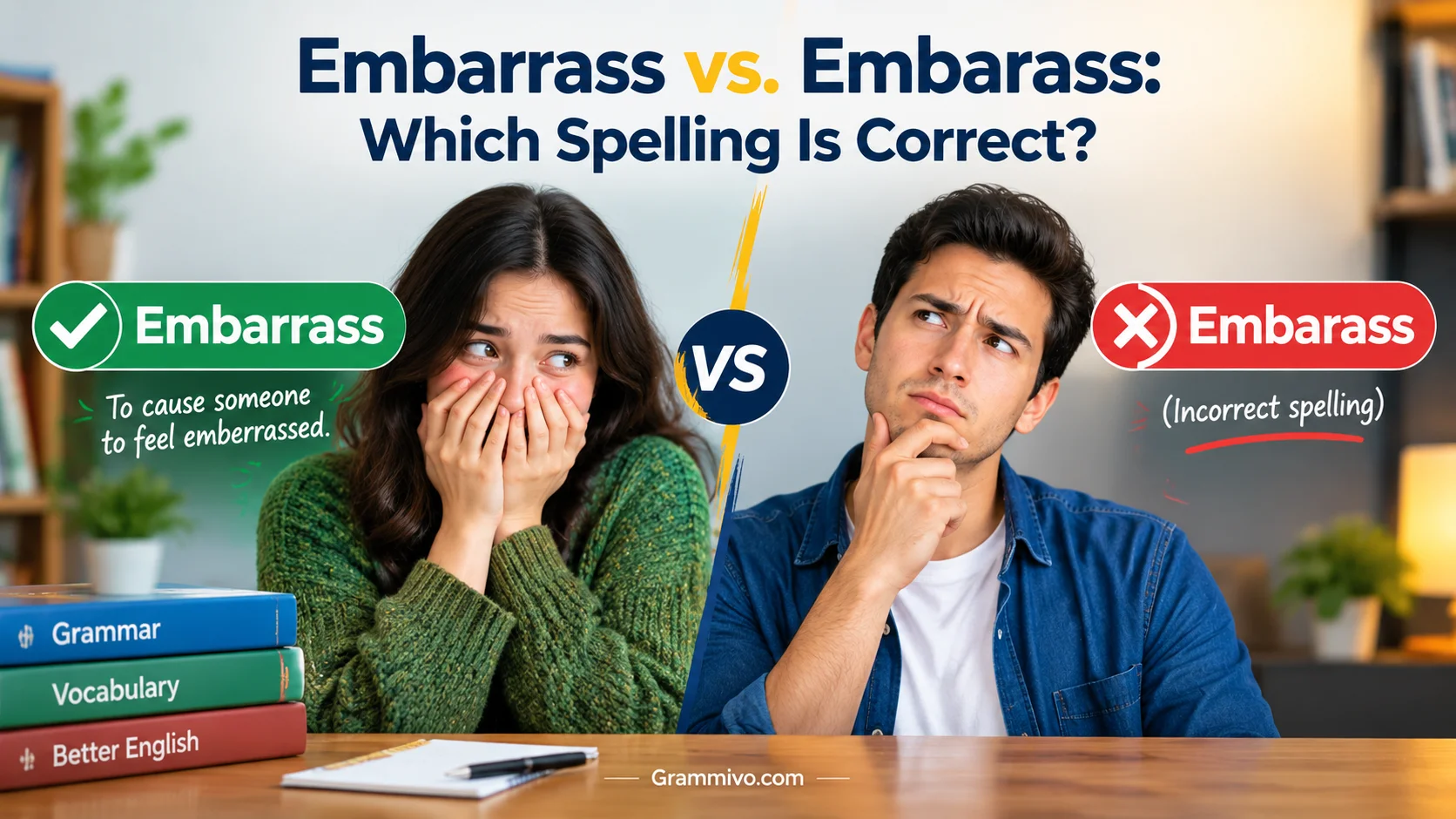
Have you ever typed “embarass” and wondered whether something looked wrong? You’re not alone. The word embarrass creates a surprisingly common spelling trap because its pronunciation doesn’t clearly reveal all the letters hiding inside it. The good news is that the correct spelling is easy to remember once you break it apart.
Embarrass is the correct English spelling. Embarass is a misspelling. The correct word contains two r’s and two s’s: e-m-b-a-r-r-a-s-s.
That small difference matters in school assignments, emails, professional writing, social posts, and everyday communication. A missing r can make an otherwise polished sentence look careless.
Quick Answer
Embarrass is correct, while embarass is incorrect.
The correct spelling is:
embarrass = e-m-b-a-r-r-a-s-s
The easiest spelling trick is to remember double R + double S.
| Spelling | Correct? | Example |
| embarrass | Yes | “I didn’t mean to embarrass you.” |
| embarass | No | “I didn’t mean to embarass you.” |
| embarras | No | “Don’t embarras me.” |
| embarrass | Yes | “That could embarrass him.” |
The verb embarrass means to make someone feel awkward, self-conscious, ashamed, or uncomfortable. Major English dictionaries recognize embarrass as the standard spelling.
Embarrass vs. Embarass: Which Is Correct?
When comparing embarrass vs. embarass, there isn’t really a contest. Embarrass is the correct spelling, and embarass is a spelling error.
The confusion usually comes from the middle of the word. When people say embarrass aloud, the two r’s don’t sound like two separate letters. English spelling doesn’t always match pronunciation neatly, which makes words like this easy to mistype.
Look closely at the correct form:
embaRR aSS
The word contains:
- Two r’s: rr
- Two s’s: ss
- One a between the double-r and double-s patterns
- The full spelling: embarrass
For example:
“I didn’t want to embarrass my friend in front of everyone.”
Writing “I didn’t want to embarass my friend” would be incorrect because it drops one r.
The same spelling matters when you add endings to the word. That’s why knowing the base form embarrass helps you spell embarrassed, embarrassing, and embarrassment correctly too.
Embarrass vs. Embarass at a Glance
A quick comparison makes the difference obvious.
| Feature | Embarrass | Embarass |
| Standard spelling | Yes | No |
| Part of speech | Verb | Misspelling |
| Contains double R | Yes | No |
| Contains double S | Yes | Yes |
| Standard dictionary form | Yes | No |
| Meaning | To cause embarrassment | None as a standard English word |
| Correct example | “Don’t embarrass me.” | Incorrect |
One useful point stands out immediately: both versions contain “ss,” but only embarrass contains “rr.”
That missing r causes the entire problem.
If you’re unsure while writing, don’t rely on how the word sounds. Check the visual pattern instead:
em + ba + rr + a + ss = embarrass
What Does Embarrass Mean?
Embarrass is a verb. It describes the act of causing someone to feel awkward, uncomfortable, self-conscious, or ashamed.
For example, imagine giving a presentation at work and accidentally calling your manager by the wrong name. You might feel embarrassed. If someone loudly points out the mistake in front of the entire room, they might embarrass you.
The word commonly appears when an action creates an uncomfortable social situation.
Examples include:
- “Please don’t embarrass me in front of my family.”
- “His joke embarrassed her.”
- “I didn’t mean to embarrass anyone.”
- “She embarrassed herself during the interview.”
- “That question might embarrass him.”
The word can also have broader meanings. Historically and in less common modern usage, embarrass can describe something that hinders, obstructs, or creates difficulty.
Why Is Embarrass So Easy to Misspell?
The spelling embarrass looks more complicated than its everyday meaning suggests. That’s one reason writers often drop a letter.
First, pronunciation doesn’t strongly advertise the double r. When you hear the word, you don’t naturally think, “There must be two r’s in there.”
Second, the sequence rrass looks unusual. English has plenty of words with doubled consonants, yet this particular combination can make your brain hesitate.
Third, people often spell words according to memory rather than structure. If you remember the word as something close to embarass, your fingers can reproduce the mistake automatically.
Typing quickly makes the problem worse.
A useful way to avoid the error is to stop thinking of embarrass as one long word. Divide it into recognizable pieces:
em + ba + rr + a + ss
That gives you two obvious spelling checkpoints:
RR
and
SS
The double letters become the memory anchors.
How to Remember the Spelling of Embarrass
The simplest memory trick is:
Embarrass has double R and double S.
You can remember it visually as:
embaRR aSS
The capitalized letters aren’t part of the official spelling. They’re simply a visual reminder.
Another approach is to connect the word with its related forms:
- embarrass
- embarrassed
- embarrassing
- embarrassment
Once you recognize the rr pattern in the base word, the related spellings become much easier to manage.
Here’s another quick test. Ask yourself:
“Does embarrass have one R or two?”
The answer is two.
Then ask:
“Does embarrass have one S or two?”
The answer is two again.
So:
RR + SS = embarrass
That little pattern is more reliable than trying to memorize the whole word letter by letter.
Embarrass, Embarrassed, or Embarrassing?
The base word often causes trouble because several related forms look similar.
Embarrass
Embarrass is the verb.
“Don’t embarrass your brother.”
It describes the action of causing embarrassment.
Embarrassed
Embarrassed describes a person who feels embarrassed. It can also function as the past tense of embarrass.
“I felt embarrassed after making the mistake.”
Notice that the double r and double s remain.
Embarrassing
Embarrassing describes something that causes embarrassment.
“That was an embarrassing moment.”
The spelling changes when -ing is added, but the double r remains.
Embarrassment
Embarrassment is the noun.
“He tried to hide his embarrassment.”
This form keeps the double r and double s pattern.
| Word | Type | Example |
| embarrass | Verb | “Don’t embarrass me.” |
| embarrassed | Adjective / past-tense form | “She felt embarrassed.” |
| embarrassing | Adjective / participle | “That was embarrassing.” |
| embarrassment | Noun | “He couldn’t hide his embarrassment.” |
These forms are worth learning together because confusing one often leads to mistakes in another.
How to Use Embarrass in a Sentence
The most common structure is embarrass + person.
For example:
“Don’t embarrass your sister.”
Here, embarrass is the action and your sister is the person affected by it.
You can also use the reflexive form embarrass yourself.
“I didn’t want to embarrass myself during the presentation.”
That construction is especially common because people frequently describe their own awkward moments.
Another useful pattern involves a specific setting:
“He embarrassed me in front of my coworkers.”
The phrase in front of makes the social context clear.
You might also describe something that causes embarrassment:
“That photo could embarrass her.”
Here, the photo becomes the thing that causes the uncomfortable feeling.
More natural examples
- “Please don’t embarrass me at dinner.”
- “His parents embarrassed him by telling childhood stories.”
- “I accidentally embarrassed myself during the meeting.”
- “She didn’t want to embarrass her friend.”
- “That question could embarrass some people.”
- “He tried not to embarrass his teammate.”
- “The mistake embarrassed the entire group.”
The exact wording changes with the situation, but the spelling stays the same: embarrass.
Common Misspellings of Embarrass
The most important incorrect form is embarass, but it’s not the only spelling error people make.
| Incorrect spelling | Correct spelling | Main problem |
| embarass | embarrass | Missing an R |
| embarras | embarrass | Missing an S |
| embaras | embarrass | Missing an R and S |
| embbarass | embarrass | Extra B |
| emberrass | embarrass | Incorrect vowel |
| embarrasment | embarrassment | Incorrect ending |
| embarassing | embarrassing | Missing an R |
| embarassed | embarrassed | Missing an R |
The most useful thing to notice is that many errors involve dropping one of the repeated letters.
That makes the spelling rule simple:
Don’t forget the RR. Don’t forget the SS.
Embarrass vs. Embarrassed: What’s the Difference?
Although embarrass and embarrassed share the same root, they don’t perform the same grammatical job.
Embarrass is an action.
“You will embarrass him.”
Someone performs an action that causes another person to feel uncomfortable.
Embarrassed describes the resulting feeling or state.
“He is embarrassed.”
Think of it as a simple sequence:
Action → feeling
embarrass → embarrassed
For example:
“The teacher’s joke embarrassed Mark, so Mark felt embarrassed.”
The first embarrassed-related idea describes what happened to Mark. The second describes Mark’s resulting emotional state.
This distinction becomes especially useful when you’re deciding which word belongs in a sentence.
Read More: Accommodate vs. Accomodate: Which Spelling Is Correct?
Embarrass vs. Humiliate: Are They the Same?
Embarrass and humiliate overlap, but they aren’t perfect synonyms.
To embarrass someone generally means to make them feel awkward, uncomfortable, or self-conscious.
To humiliate someone usually suggests a more severe attack on their dignity or self-respect.
Consider these two situations.
“My friend embarrassed me by showing everyone an old photo.”
That could be awkward and annoying without being deeply degrading.
Now consider:
“The manager humiliated the employee in front of the entire team.”
The second sentence carries a much stronger sense of public degradation.
In everyday speech, embarrass is often the milder choice. Humiliate tends to suggest something more serious.
Embarrass vs. Shame: What’s the Difference?
Embarrass and shame can also overlap, but they emphasize different experiences.
Embarrassment often comes from an awkward social situation. Maybe you trip in front of a crowd, say something inappropriate, or receive unexpected attention.
Shame can reach deeper. It may involve a strong sense that something about your behavior, actions, or character was wrong or disgraceful.
For example:
“I was embarrassed when I forgot her name.”
This describes an awkward moment.
Compare it with:
“He felt shame after realizing how badly he had treated someone.”
The second sentence carries a heavier moral and emotional meaning.
Context matters. Sometimes an event can cause both embarrassment and shame, but the words aren’t interchangeable in every situation.
What Is the Origin of Embarrass?
The spelling becomes a little easier to appreciate when you look at the word’s history.
Embarrass entered English through French and ultimately traces back to Iberian language roots. Merriam-Webster connects the history to Portuguese embaraçar, with an older connection to a word meaning a noose or rope.
That historical idea helps explain an older sense of embarrass: being hindered, entangled, or obstructed.
Over time, the word developed the familiar social meaning associated with making someone uncomfortable or self-conscious.
So the modern meaning isn’t completely disconnected from its older history. The idea of being entangled or hindered provides a useful conceptual link to feeling awkward or caught in an uncomfortable situation.
Is “Embarass” a Word?
No. Embarass is not the standard spelling of the English verb.
If you see embarass in a text, it should normally be corrected to embarrass.
For example:
Incorrect:
“I didn’t mean to embarass you.”
Correct:
“I didn’t mean to embarrass you.”
The mistake doesn’t change the intended meaning because readers can usually recognize what the writer meant. However, that doesn’t make the spelling acceptable in polished writing.
Use embarrass in:
- School assignments
- College papers
- Work emails
- Reports
- Articles
- Resumes
- Professional documents
- Social media posts
- Formal correspondence
A spelling checker may catch embarass, but learning the correct pattern is better than relying on software every time.
Correct vs. Incorrect Examples
Seeing the word in complete sentences makes the distinction easier to remember.
| Incorrect | Correct |
| “I don’t want to embarass you.” | “I don’t want to embarrass you.” |
| “Don’t embarass him in public.” | “Don’t embarrass him in public.” |
| “She didn’t mean to embarass her friend.” | “She didn’t mean to embarrass her friend.” |
| “That could embarass your parents.” | “That could embarrass your parents.” |
| “He might embarass himself.” | “He might embarrass himself.” |
| “Why are you trying to embarass me?” | “Why are you trying to embarrass me?” |
The pattern never changes in the base verb.
Embarrass = RR + SS.
FAQs:
Is it embarrass or embarass?
Embarrass is correct. Embarass is a misspelling.
Is embarass a real word?
No. Embarass isn’t the standard English spelling. The correct word is embarrass.
Does embarrass have two R’s?
Yes. Embarrass contains two r’s.
Does embarrass have two S’s?
Yes. It contains two s’s as well.
How do you spell embarrass?
The correct spelling is:
E-M-B-A-R-R-A-S-S
A useful shortcut is double R, double S.
Conclusion:
When choosing between embarrass vs. embarass, choose embarrass every time. Once you learn that pattern, several related words become easier too: embarrassed, embarrassing, and embarrassment. So the next time you’re writing “I don’t want to embarrass you,” don’t second-guess the spelling. Give that second r its rightful place.
