
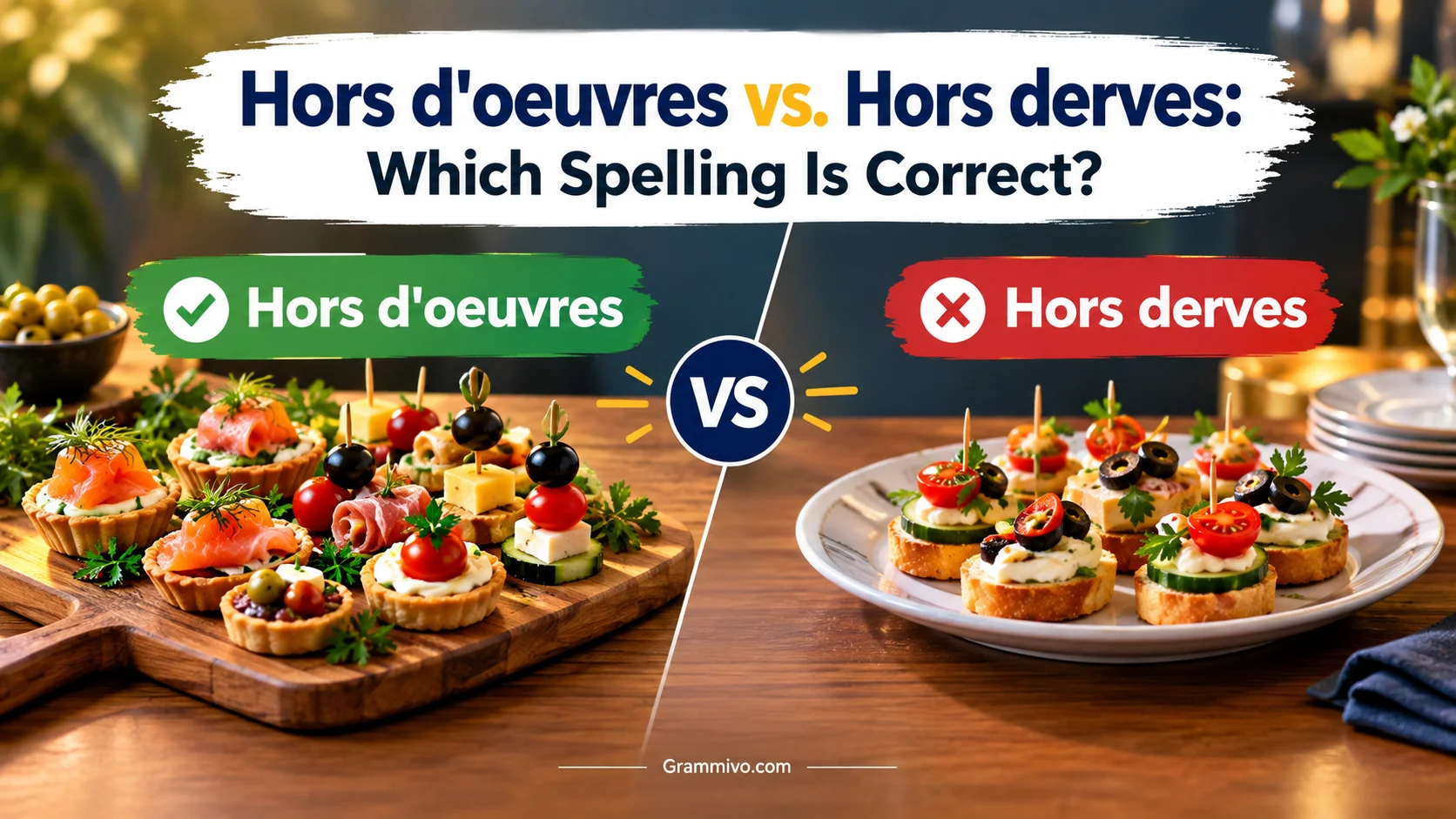
If you’ve ever tried to write hors d’oeuvres on a menu, invitation, or event announcement, you may have wondered whether the spelling is actually correct. The word looks unusual, and its pronunciation doesn’t give you many clues. That’s why forms such as “hors derves” show up so often.
The good news is simple: hors d’oeuvres is the correct spelling. Hors derves is a misspelling and doesn’t function as a standard English word. The confusion mainly comes from the French origin of hors d’oeuvre and the big difference between its spelling and its common English pronunciation.
In this guide, you’ll learn exactly what hors d’oeuvres means, how to spell and pronounce it, when to use the singular and plural forms, and how it differs from related terms such as appetizer and canapé.
Quick Answer
Hors d’oeuvres is the correct spelling. Hors derves is incorrect. The singular form is hors d’oeuvre, while the plural form is hors d’oeuvres. The term refers to small portions of food served before a meal or separately from the main course.
| Word | Correct Spelling? | Meaning |
| Hors d’oeuvres | Correct | Small foods served before or outside the main meal |
| Hors d’oeuvre | Correct | Singular form of hors d’oeuvres |
| Hors derves | Incorrect | Common misspelling |
| Horse d’oeuvres | Incorrect | Misheard or humorous misspelling |
| Hors deuvres | Incorrect | Misspelling that drops the apostrophe and changes the word |
If you’re writing about several small dishes at a reception or dinner, use hors d’oeuvres.
Comparison Overview
The difference between hors d’oeuvres vs. hors derves is straightforward once you separate the correct French-derived spelling from the common phonetic mistake. Hors d’oeuvres retains the spelling of the French expression from which English borrowed it. Hors derves attempts to represent the sound of the word rather than its established spelling.
| Feature | Hors d’oeuvres | Hors derves |
| Standard English spelling | Yes | No |
| French-derived expression | Yes | No |
| Meaning | Small dishes or bites served before or outside a main meal | No standard meaning |
| Singular form | Hors d’oeuvre | — |
| Plural form | Hors d’oeuvres | — |
| Suitable for formal writing | Yes | No |
| Suitable for menus | Yes | No |
| Commonly caused by pronunciation | No | Yes |
Think of it this way: hors d’oeuvres is the word you see in dictionaries and polished writing. Hors derves is what you might accidentally write after hearing the word spoken aloud.
Main Differences Between Hors d’oeuvres vs. Hors derves
The main difference is correctness. Hors d’oeuvres is an established English expression borrowed from French. Hors derves is simply a misspelling.
Hors d’oeuvres Is the Correct Form
Hors d’oeuvres is the standard plural spelling. It refers to small servings of food that people eat before a meal or during a social gathering.
For example:
- The caterer prepared several hors d’oeuvres for the wedding reception.
- Guests enjoyed hors d’oeuvres while waiting for dinner.
- The restaurant served complimentary hors d’oeuvres before the main course.
- We offered hot and cold hors d’oeuvres at the party.
The word can describe a wide range of foods. These might include tiny sandwiches, stuffed vegetables, seafood, cheese-based bites, savory pastries, or other small portions.
Hors derves Is a Misspelling
Hors derves isn’t an alternative spelling. It doesn’t have a separate culinary meaning.
People often create this spelling because the spoken word sounds quite different from the written form. In ordinary American English, hors d’oeuvres is commonly pronounced something like “or-DURVZ.”
That pronunciation can make the spelling feel almost disconnected from the sound.
For example, someone who has only heard the word might reasonably guess:
“hors derves”
The guess sounds plausible. The spelling isn’t correct, though.
The Singular and Plural Forms Matter
Another common source of confusion involves number.
Hors d’oeuvre is singular.
Hors d’oeuvres is plural.
Compare these examples:
- Singular: The chef served one elegant hors d’oeuvre.
- Plural: The chef served several hors d’oeuvres.
The final s belongs to the plural form. You don’t need to add another plural ending.
What Does Hors d’oeuvres Mean?
Hors d’oeuvres refers to small portions of food served before a meal or separately from the main course. These foods are usually designed to be eaten in small quantities.
At a formal reception, for example, servers might walk around with trays of bite-sized foods. Guests can take a small portion while they socialize. Those foods may be called hors d’oeuvres.
The term can also appear on restaurant menus. A menu might list several small dishes under a section labeled Hors d’oeuvres.
Common examples include:
- Stuffed mushrooms
- Mini quiches
- Shrimp cocktails
- Bruschetta
- Cheese and crackers
- Deviled eggs
- Small meat skewers
- Savory pastries
- Crostini
- Spring rolls
- Smoked salmon bites
- Small sandwiches
Not every hors d’oeuvre needs to be tiny enough for one bite. The defining idea is the small, introductory, or separately served nature of the food rather than one exact size.
What Is the Meaning of Hors d’oeuvre in French?
The expression hors d’oeuvre comes from French. Its literal sense is roughly “outside the work.”
In the culinary context, oeuvre relates to a work or main undertaking. Hors means “outside” or “apart from.”
The culinary meaning developed from the idea of something placed outside the main course or principal part of a meal.
This French origin explains why the word looks so unfamiliar to many English speakers. English has borrowed thousands of words from other languages. Some retain spellings that don’t follow normal English spelling patterns.
Hors d’oeuvre is one of those borrowed expressions.
How Do You Spell Hors d’oeuvres?
The correct spelling is:
H-O-R-S D-‘O-E-U-V-R-E-S
Written normally, it appears as:
hors d’oeuvres
The spelling contains several features that make it easy to mistype.
Remember the “oeuvres” Portion
The final part is oeuvres, not derves.
That’s the biggest spelling hurdle.
If you tend to write hors derves, focus on remembering the full ending:
d’oeuvres
rather than trying to reproduce the pronunciation.
Don’t Turn “Hors” Into “Horse”
The first word is hors, not horse.
Therefore:
horse d’oeuvres
hors d’oeuvres
The incorrect version can look funny because horse is an ordinary English word. It has nothing to do with the culinary expression.
Don’t Drop the Apostrophe
The standard spelling contains an apostrophe:
hors d’oeuvres
The apostrophe is part of the French expression. In careful writing, menus, invitations, and other formal material should use the established spelling.
How Do You Pronounce Hors d’oeuvres?
In American English, hors d’oeuvres is commonly pronounced approximately:
or-DURVZ
The exact pronunciation can vary slightly between speakers. The spelling doesn’t closely resemble the pronunciation.
That mismatch explains much of the spelling confusion.
Imagine hearing someone say:
“Please enjoy the hors d’oeuvres.”
If you’ve never seen the word written, hors derves might seem like a logical guess.
This is a classic example of why English spelling can’t always be predicted from pronunciation. The word entered English from French and retained its unusual written form.
Why Is Hors d’oeuvres So Hard to Spell?
Several factors work together to make this expression tricky.
French Spelling
The word comes from French rather than developing from ordinary English spelling patterns. Its letter combinations therefore look unfamiliar to many English readers.
Pronunciation Doesn’t Match the Letters
English speakers generally don’t pronounce every visible letter in hors d’oeuvres. The spoken form is much shorter and smoother.
The Apostrophe Looks Unusual
The apostrophe in d’oeuvres adds another detail that writers may forget.
The Word Is Often Learned by Ear
People frequently encounter hors d’oeuvres at parties, weddings, restaurants, and formal events. Someone may hear the word many times before ever seeing it printed.
That creates the perfect conditions for a phonetic misspelling.
Hors d’oeuvre vs. Hors d’oeuvres
The difference between hors d’oeuvre and hors d’oeuvres is mainly grammatical.
| Form | Number | Example |
| hors d’oeuvre | Singular | We served one hors d’oeuvre. |
| hors d’oeuvres | Plural | We served several hors d’oeuvres. |
Use hors d’oeuvre when you’re referring to one item.
The chef created an unusual hors d’oeuvre with smoked salmon.
Use hors d’oeuvres when you’re referring to multiple items or a selection.
The guests sampled several hors d’oeuvres before dinner.
This distinction is especially useful when writing menus or describing catered events.
Read More: Height vs. Heighth: Which One Is Correct?
Hors d’oeuvres vs. Appetizers: What’s the Difference?
Hors d’oeuvres and appetizers overlap considerably in modern American English. In many everyday situations, you can use appetizers as the simpler alternative.
However, the terms aren’t always identical in tone or traditional usage.
An appetizer generally refers to a dish served before the main course. It may be a small plate, soup, salad, or another preparatory course.
An hors d’oeuvre often suggests a smaller item served separately from the main meal. It can be passed around at a reception or displayed for guests to select themselves.
For example, consider a wedding reception.
Servers may circulate with trays containing tiny crab cakes, stuffed mushrooms, and crostini. Those foods can be described as hors d’oeuvres.
At a sit-down restaurant, diners might order a plate of fried calamari before their entrée. Calling it an appetizer sounds especially natural in American English.
The distinction isn’t rigid. Modern usage often allows the terms to overlap.
Hors d’oeuvres vs. Canapés
A canapé is a particular type of small appetizer or hors d’oeuvre.
Traditionally, a canapé consists of a small edible base topped with other ingredients. Common bases include bread, crackers, pastry, or similar foods.
For example:
- A crostini topped with goat cheese and vegetables can function as a canapé.
- A tiny piece of toast topped with smoked salmon can be a canapé.
- A pastry base topped with a savory filling may also serve as a canapé.
However, not every hors d’oeuvre is a canapé.
A stuffed mushroom can be an hors d’oeuvre without being a canapé. The same applies to a shrimp skewer or a small meatball.
So the relationship looks like this:
Canapés → a type of small food → may be served as hors d’oeuvres
Examples of Hors d’oeuvres in Sentences
Seeing the word in context makes its usage much easier to remember.
Formal Examples
- The hotel prepared an impressive selection of hors d’oeuvres for the reception.
- Guests enjoyed several hors d’oeuvres before the awards ceremony.
- The menu included hot and cold hors d’oeuvres.
- The chef presented each hors d’oeuvre with careful attention to detail.
Casual Examples
- We grabbed a few hors d’oeuvres before heading to dinner.
- There were plenty of hors d’oeuvres at the party.
- I tried the spinach pastries and two other hors d’oeuvres.
- The host put out some simple hors d’oeuvres for everyone to share.
Singular Examples
- A single hors d’oeuvre sat beside each guest’s place setting.
- The chef served one unusual hors d’oeuvre made with roasted vegetables.
Common Misspellings of Hors d’oeuvres
Hors derves isn’t the only mistake people make. Several variations appear because writers try to spell the expression according to its sound.
| Incorrect Form | Correct Form | Why It’s Wrong |
| hors derves | hors d’oeuvres | Changes the established spelling |
| horse d’oeuvres | hors d’oeuvres | Adds an unrelated English word |
| hors deuvres | hors d’oeuvres | Omits the apostrophe and alters the spelling |
| hors d’oeuvre | hors d’oeuvres | Correct only when referring to one item |
| hors d’oeuvr | hors d’oeuvres | Drops letters from the plural form |
“Horse d’oeuvres”
This version deserves special attention because it’s sometimes used humorously.
Horse d’oeuvres is not correct. The word horse has nothing to do with the French expression.
You might see it in a joke or pun. It doesn’t belong in a formal menu or article.
“Hors deuvres”
This version comes closer to the correct spelling but still misses an important part of the expression.
The standard form is:
hors d’oeuvres
Don’t simplify it to hors deuvres when you’re aiming for standard formal usage.
A Simple Way to Remember the Correct Spelling
Trying to spell hors d’oeuvres entirely from pronunciation is a losing battle.
Instead, remember the expression visually:
hors + d’oeuvres
The key part to memorize is d’oeuvres.
A useful mental trick is to picture the word on a restaurant menu. Rather than sounding it out, recognize its written shape.
You can also remember the three most important details:
- hors, not horse
- d’oeuvres, not derves
- hors d’oeuvre for one and hors d’oeuvres for more than one
Once you recognize those pieces, the spelling becomes much easier.
FAQs:
Is “hors derves” a correct spelling?
No. Hors derves is a misspelling. The correct spelling is hors d’oeuvres.
What is the correct spelling of hors d’oeuvres?
The standard spelling is hors d’oeuvres. It includes hors, an apostrophe in d’oeuvres, and the final s for the plural form.
Is “hors d’oeuvre” singular or plural?
Hors d’oeuvre is singular. Hors d’oeuvres is plural.
For example, “The chef prepared one hors d’oeuvre” refers to one item. “The chef prepared several hors d’oeuvres” refers to multiple items.
How do you pronounce hors d’oeuvres?
American English commonly pronounces hors d’oeuvres approximately as “or-DURVZ.” The pronunciation can vary somewhat between speakers.
Why do people spell it “hors derves”?
The spelling usually comes from pronunciation. Since the spoken form doesn’t closely resemble the written French-derived form, people may write what they think they hear.
Conclusion:
When it comes to hors d’oeuvres vs. hors derves, the answer is clear: hors d’oeuvres is the correct spelling. Hors derves is simply a common misspelling caused by the word’s unusual pronunciation and French origin.
Remember the basic forms: hors d’oeuvre refers to one item, while hors d’oeuvres refers to several. These small dishes often appear at receptions, parties, weddings, restaurants, and other social gatherings.
