
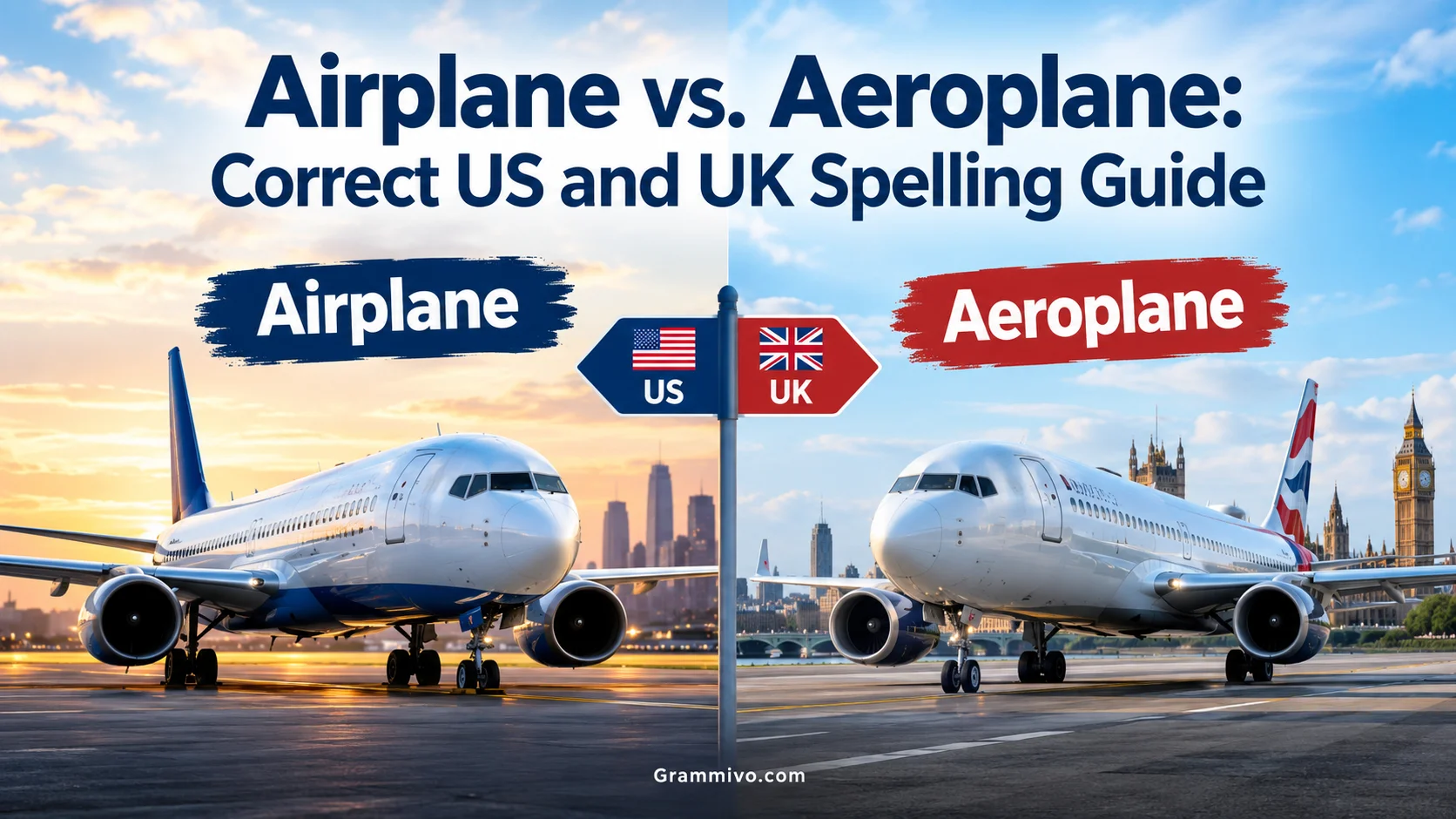
If you’ve ever wondered whether airplane or aeroplane is the correct spelling, you’re dealing with a difference between varieties of English rather than a simple spelling mistake. Both words describe the same kind of flying machine. The main difference comes down to where the English is used.
In American English, airplane is the standard spelling. In British English, aeroplane is the traditional standard form. The shorter word plane is also widely used in both varieties, especially in everyday conversation.
This distinction matters when you’re writing an essay, article, business document, travel guide, or other formal content. Choosing the spelling that matches your audience makes your writing more consistent and natural.
Quick Answer
Airplane is the standard spelling in US English, while aeroplane is the traditional spelling in UK English. Both words have the same basic meaning and refer to a powered, fixed-wing aircraft. Neither spelling is inherently wrong.
| Word | Preferred variety | Meaning |
| Airplane | American English | A powered fixed-wing aircraft |
| Aeroplane | British English | A powered fixed-wing aircraft |
| Plane | US and UK English | Common shortened form of airplane/aeroplane |
So, if you’re writing for readers in the United States, choose airplane. If you’re following traditional British English, choose aeroplane.
Comparison Overview
The difference between airplane vs. aeroplane is primarily a spelling and regional-language difference. The two words don’t describe different machines.
| Feature | Airplane | Aeroplane |
| English variety | US English | UK English |
| Meaning | Powered fixed-wing aircraft | Powered fixed-wing aircraft |
| Pronunciation | Essentially the same | Essentially the same |
| Formal usage | Standard in American English | Standard in British English |
| Common shortened form | Plane | Plane |
| Example | The airplane landed safely. | The aeroplane landed safely. |
The difference becomes especially noticeable when comparing American and British publications. An American newspaper will normally use airplane, while a British publication traditionally uses aeroplane.
It’s similar to other regional spelling differences such as color/colour, center/centre, and theater/theatre. The underlying word remains the same even though the spelling follows a different convention.
Main Differences Between Airplane vs. Aeroplane
The biggest difference between airplane and aeroplane is regional preference. American English generally favors the shorter air- form, while British English retains aero-.
Airplane Is the US English Spelling
Airplane is the standard spelling in American English. You’ll see it throughout US aviation writing, travel information, newspapers, textbooks, airport materials, and everyday conversation.
For example:
- The airplane arrived twenty minutes late.
- She looked out of the airplane window.
- The airplane took off shortly after sunrise.
- We boarded the airplane at Gate 12.
- The pilot landed the airplane safely.
For an American audience, airplane will usually look more natural.
Aeroplane Is the UK English Spelling
Aeroplane is the traditional British English spelling. It also appears in other English varieties that have historically followed British spelling conventions.
Examples include:
- The aeroplane landed safely.
- They boarded the aeroplane at Heathrow.
- The aeroplane disappeared behind the clouds.
- She watched the aeroplane take off.
- The pilot guided the aeroplane toward the runway.
British speakers also commonly use plane in ordinary conversation. The longer form aeroplane tends to sound more formal or deliberate in some contexts.
What Does Airplane Mean?
An airplane is a powered aircraft designed to fly through the air using aerodynamic lift generated by its wings.
Unlike helicopters, airplanes normally rely on forward movement and fixed wings to produce lift. Engines provide the thrust needed to move the aircraft through the air.
The word can refer to everything from a small private aircraft to a large commercial passenger jet.
For example, a two-seat training aircraft and a Boeing 787 are both airplanes, even though their size, design, range, and purpose differ greatly.
Key Characteristics of an Airplane
Most conventional airplanes have several major components:
- Wings that generate lift.
- Engines that provide thrust.
- A fuselage that houses passengers, crew, cargo, or equipment.
- A cockpit where pilots operate the aircraft.
- A tail assembly that helps provide stability and control.
- Landing gear used during takeoff, landing, and ground operations.
Modern aircraft can vary enormously. Some carry only a few passengers, while large commercial aircraft can carry hundreds.
What Does Aeroplane Mean?
Aeroplane has the same basic meaning as airplane. It refers to a powered, fixed-wing aircraft capable of sustained flight.
The spelling doesn’t indicate a different aircraft design. A British writer discussing a Boeing 747 and an American writer discussing the same aircraft can use aeroplane and airplane, respectively.
The object doesn’t change. The spelling does.
This is an important point because many spelling questions make regional variants seem like competing definitions. Here, they aren’t. Airplane and aeroplane are regional forms of the same word.
Why Are Airplane and Aeroplane Spelled Differently?
The history of the two spellings is tied to the development of aviation terminology and differences between American and British English.
The word aeroplane developed from the term aëroplane, which was formed from aero-, relating to air, and plane, referring to a surface or wing structure associated with flight.
As aviation terminology developed in the late nineteenth and early twentieth centuries, aeroplane became established in British English.
American English eventually favored airplane. The spelling became firmly established in the United States and remains the standard American form.
A Brief Historical Timeline
| Period | Development |
| Late 19th century | Terms related to aerodynamic flight begin appearing in English |
| Around the early 20th century | Aeroplane becomes established as a British form |
| Early 20th century | Airplane gains ground in American English |
| 20th century onward | US and UK usage increasingly settle on their respective forms |
| Today | Airplane is standard US English; aeroplane remains standard traditional UK English |
The spelling difference therefore developed alongside the broader separation of American and British vocabulary and spelling conventions.
Airplane in American English
In the United States, airplane is overwhelmingly the expected spelling in standard writing.
If you’re preparing an American English school assignment, writing a US-focused article, or producing content for an American company, airplane is generally the appropriate choice.
Consider this sentence:
The airplane landed at Chicago O’Hare International Airport shortly after noon.
The spelling fits standard American English.
You’ll also encounter airplane in common American compounds and expressions.
Common American Expressions With Airplane
- airplane ticket
- airplane seat
- airplane mode
- airplane wing
- airplane engine
- airplane cabin
- airplane window
- airplane pilot
- airplane crash
- commercial airplane
One particularly familiar expression is airplane mode, the setting found on smartphones and other electronic devices. The word airplane in this expression reflects American spelling.
Aeroplane in British English
In British English, aeroplane is the traditional standard spelling.
For example:
The aeroplane landed at London Heathrow Airport shortly after noon.
The sentence follows British spelling conventions.
However, don’t assume that British speakers use aeroplane every time they talk about air travel. Plane is extremely common in casual British English.
Someone in the UK might naturally say:
“What time does your plane leave?”
rather than:
“What time does your aeroplane leave?”
Both are understandable. The shorter form simply sounds more natural in everyday speech.
Airplane vs. Aeroplane in Other Countries
The US-versus-UK distinction gives you a useful starting point, but English around the world isn’t divided into two perfectly sealed boxes.
Countries such as Australia, New Zealand, India, and South Africa have strong historical connections to British English. As a result, aeroplane can be found in their English usage.
At the same time, international media, American entertainment, technology, aviation, and global business have increased exposure to American English.
That means actual usage can vary according to the country, institution, publication, and context.
What Should You Use for an International Audience?
If your readers come from many countries, choose one spelling system and use it consistently.
For example, if the rest of your article uses American spellings such as:
- color
- center
- favorite
- organize
then airplane fits that style.
If the article follows British spelling with:
- colour
- centre
- favourite
- organise
then aeroplane is the more natural choice.
Consistency matters more than trying to mix regional forms.
Read More: Color vs. Colour: US and UK Spelling Guide With Examples
Airplane vs. Aeroplane in Formal Writing
Formal writing doesn’t make one spelling universally correct. Instead, formal writing makes consistency more important.
Suppose an American university student writes:
The aeroplane industry has expanded rapidly. The airplane manufacturer opened a new facility.
The reader can understand the sentence, but the mixed spelling may look careless if there’s no reason for the change.
A consistent American version would use airplane throughout.
A consistent British version would use aeroplane.
Follow the Required Style
When writing professionally or academically, check the style requirements first.
Use airplane when:
- Your institution requires American English.
- Your publication follows US English.
- Your target audience is primarily American.
- Your company uses an American English style guide.
Use aeroplane when:
- You’re following traditional British English.
- Your publication specifically requires British spelling.
- Your educational institution expects British English.
- Your target audience and editorial style favor British conventions.
There is no advantage in changing between the two simply to sound sophisticated. A clear and consistent style is usually stronger.
Airplane vs. Aeroplane vs. Aircraft
Another useful distinction involves the word aircraft.
Airplane and aeroplane generally refer to powered fixed-wing aircraft. Aircraft is a broader term.
An aircraft can include different kinds of machines designed to operate in flight. Depending on the context, the category can include airplanes, helicopters, gliders, and other types of flying vehicles.
Think of it this way:
Aircraft
→ Airplanes / Aeroplanes
→ Commercial jets, private planes, cargo planes, military aircraft, and other fixed-wing designs
This distinction becomes important in technical writing. Calling every aircraft an airplane isn’t always accurate.
A helicopter is an aircraft, but it isn’t normally called an airplane or aeroplane.
Airplane vs. Aeroplane vs. Plane
Plane is the everyday short form used in both American and British English.
For example:
- The plane is boarding now.
- We caught the plane to Boston.
- Her plane arrived early.
- The plane flew above the clouds.
In casual conversation, plane often sounds more natural than either longer form.
However, plane can have other meanings. It can refer to a flat surface, a woodworking tool, or a geometric concept. Context usually makes the intended meaning obvious.
In an aviation context, however, “plane” is usually understood as an airplane or aeroplane.
Common Phrases With Airplane and Aeroplane
Regional spelling can carry over into compounds and phrases.
| US English | UK English |
| airplane ticket | aeroplane ticket |
| airplane seat | aeroplane seat |
| airplane window | aeroplane window |
| airplane engine | aeroplane engine |
| airplane wing | aeroplane wing |
| commercial airplane | commercial aeroplane |
| airplane pilot | aeroplane pilot |
| airplane cabin | aeroplane cabin |
Some expressions don’t always follow a simple substitution rule because established terminology can vary.
For example, aircraft, flight, airline, and airport remain the normal words in both American and British English. The regional distinction isn’t applied to every aviation term.
Common Spelling Mistakes
Because the two forms look so similar, writers sometimes create unnecessary variations.
Mistake: Treating Aeroplane as an American Spelling
In standard American English, airplane is the expected form.
Mistake: Assuming Airplane Is Always Incorrect
That’s equally misleading. Airplane is completely standard in US English.
Mistake: Mixing Styles Without a Reason
Switching between American and British spellings can make an article inconsistent.
Mistake: Thinking the Words Have Different Meanings
They don’t. The spelling doesn’t indicate different aircraft.
Mistake: Confusing Aircraft With Airplane
An aircraft is a broader category. An airplane is one type of aircraft.
How to Remember Airplane vs. Aeroplane
A simple memory trick can save you from second-guessing the spelling.
Airplane → American English
Aeroplane → British English
Think of airplane as the streamlined American form and aeroplane as the traditional British form.
If you’re writing for a US audience, the shorter air- spelling is your safe choice.
If you’re following British English, keep the aero- spelling.
Real-World US vs. UK Examples
Seeing the two forms side by side makes the difference much easier to recognize.
| American English | British English |
| The airplane is ready for boarding. | The aeroplane is ready for boarding. |
| The airplane took off at 8 a.m. | The aeroplane took off at 8 a.m. |
| She sat near the airplane window. | She sat near the aeroplane window. |
| The airplane landed during heavy rain. | The aeroplane landed during heavy rain. |
| He watched the airplane disappear into the clouds. | He watched the aeroplane disappear into the clouds. |
Notice something important: the grammar and meaning remain the same. Only the regional spelling changes.
FAQs:
Is airplane or aeroplane correct?
Both are correct. Airplane is standard in US English, while aeroplane is the traditional standard form in UK English.
Is airplane American or British?
Airplane is American English. It is the standard spelling used in the United States.
Is aeroplane British English?
Yes. Aeroplane is the traditional British English spelling.
Do airplane and aeroplane mean the same thing?
Yes. Both words refer to a powered, fixed-wing aircraft designed for flight.
Which spelling should I use in an American English essay?
Use airplane if your essay follows American English conventions.
Conclusion:
When it comes to airplane vs. aeroplane, both spellings are correct. The difference lies in regional English rather than meaning. Airplane is the standard spelling in American English, while aeroplane is the traditional spelling in British English.
If you’re writing for a US audience, choose airplane. For British English, aeroplane is the natural choice. Most importantly, keep your spelling consistent throughout the article, essay, or other piece of writing. And when the context is casual, plane works perfectly well in both varieties.
