
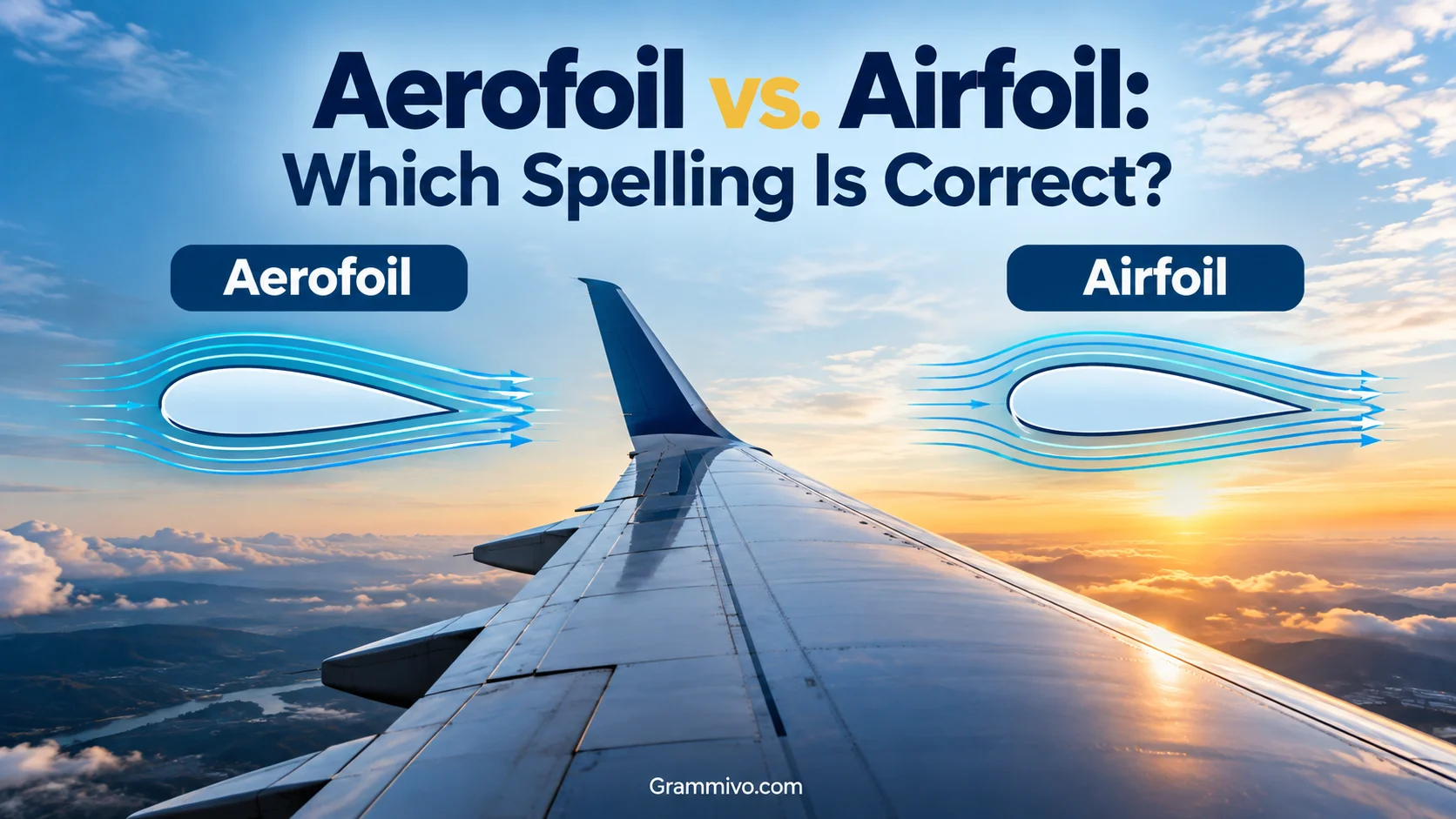
If you’ve ever read an aviation or engineering article, you may have seen both aerofoil and airfoil. At first glance, the two words look like they describe different things. They don’t. In most contexts, they refer to the same type of aerodynamic shape.
The confusion mainly comes from British and American English spelling. American English generally uses airfoil, while British English traditionally uses aerofoil. The underlying concept remains the same: an aerodynamic profile designed to interact with moving air and produce useful aerodynamic forces.
That distinction matters when you’re writing for a particular audience. An American engineering textbook will normally use airfoil. A British aviation publication may use aerofoil. Neither spelling changes the science.
The term also covers more than aircraft wings. Airfoils appear in propellers, helicopter rotor blades, wind turbine blades, and various types of turbomachinery. Their shape has a major influence on lift, drag, efficiency, and overall performance.
Understanding the difference between aerofoil vs. airfoil therefore requires looking at both language and aerodynamics.
Quick Answer
Aerofoil and airfoil generally mean the same thing. The primary difference is regional spelling.
- Airfoil is the standard spelling in American English.
- Aerofoil is the traditional spelling in British English and is also used in other varieties of English.
- Both describe an aerodynamic profile that interacts with airflow.
- An aircraft wing can contain an airfoil or aerofoil profile, but the terms aren’t always synonymous with the entire wing.
- The pronunciation is essentially the same.
- If you’re writing for a US audience, use airfoil. For a British audience, aerofoil is usually the better choice.
For example:
American English: Engineers tested the new airfoil in a wind tunnel.
British English: Engineers tested the new aerofoil in a wind tunnel.
The engineering principle behind both sentences is identical.
Comparison Overview
| Feature | Aerofoil | Airfoil |
| Meaning | An aerodynamic profile that interacts with moving air | Same |
| Main English variety | British English | American English |
| Part of speech | Noun | Noun |
| Basic pronunciation | Essentially the same | Essentially the same |
| Common applications | Wings, rotors, propellers, turbines | Wings, rotors, propellers, turbines |
| Refers exclusively to aircraft? | No | No |
| Scientific concept | Same | Same |
| Preferred US spelling | No | Yes |
| Preferred UK spelling | Yes | Less common |
The easiest way to remember the distinction is simple: airfoil is the American spelling, while aerofoil is the British spelling.
The difference is similar to other regional spelling variations. The spelling changes, but the meaning doesn’t.
Main Differences Between Aerofoil vs. Airfoil
The biggest difference between aerofoil vs. airfoil isn’t aerodynamic at all. It’s linguistic.
Aerofoil Is Primarily a British English Spelling
Aerofoil uses the combining form aero-, which relates to air or flight. British technical writing commonly retains this spelling.
You’ll encounter aerofoil in British aviation, engineering, educational, and scientific material. It also appears in technical writing from countries and institutions that follow British English conventions.
For example:
The aircraft uses a specially designed aerofoil to improve low-speed performance.
Here, aerofoil refers to the aerodynamic profile used by the aircraft.
Airfoil Is the American English Spelling
Airfoil is the preferred form in American English.
US textbooks, aerospace publications, engineering documents, and educational resources generally use airfoil when discussing aerodynamic profiles.
For example:
The engineers modified the airfoil to reduce drag at cruising speed.
The technical meaning remains exactly the same as in the British version.
The Meaning Does Not Change
This point is worth emphasizing because it’s the source of much confusion.
An aerofoil isn’t a British version of a different aerodynamic object. Likewise, an airfoil isn’t a simplified American version of a different design.
They are alternative spellings for the same general concept.
Think of the two spellings as different labels on the same toolbox. The label changes depending on the variety of English, but what’s inside remains the same.
What Does Aerofoil Mean?
An aerofoil is a shaped surface or profile designed to produce aerodynamic forces when air moves around it.
The word often appears in discussions of aircraft and aerodynamic design. However, its application extends well beyond conventional airplane wings.
When air flows around an aerofoil, pressure and velocity vary across its surface. These changes contribute to aerodynamic forces such as lift and drag.
The exact behavior depends on many factors, including:
- Aerofoil shape
- Airspeed
- Air density
- Angle of attack
- Surface condition
- Reynolds number
- Mach number
- Flow conditions
A designer doesn’t simply draw a curved shape and expect it to work efficiently. Airfoil geometry requires careful analysis and testing.
Where Are Aerofoils Used?
Aerofoils appear in many systems that rely on aerodynamic forces.
Common examples include:
- Aircraft wings
- Propeller blades
- Helicopter rotor blades
- Wind turbine blades
- Compressor blades
- Turbine blades
- Certain marine hydrofoil systems, although these operate in water rather than air
In each application, engineers tailor the profile to the operating environment.
A wind turbine, for example, needs blade sections that work efficiently across changing wind conditions. An aircraft wing has different requirements because it must operate through takeoff, climb, cruise, descent, and landing.
What Does Airfoil Mean?
An airfoil is the American English term for an aerodynamic profile that produces or controls aerodynamic forces as air flows around it.
The term commonly appears in aerospace engineering, aerodynamics, aviation, and mechanical engineering.
A typical airfoil has a recognizable cross-sectional shape. It includes a leading edge, a trailing edge, and a region between them that forms the aerodynamic surface.
However, not every airfoil looks dramatically curved. Some are symmetrical or have relatively subtle curvature.
The shape depends on what the designer wants the airfoil to accomplish.
For instance, one profile may prioritize high lift. Another may aim to minimize drag during cruise. A third may need to work efficiently at high speeds.
How Do Airfoils and Aerofoils Work?
An airfoil works by changing how air flows around a shaped surface.
When air moves relative to the airfoil, the flow interacts with its upper and lower surfaces. The resulting pressure distribution and momentum changes create aerodynamic forces.
Lift and Drag
Two of the most important aerodynamic forces are lift and drag.
Lift acts perpendicular to the relative airflow. For an aircraft wing in normal flight, lift generally acts upward.
Drag acts opposite the direction of relative motion through the air.
Engineers aim to create the required amount of lift while controlling drag.
A simplified lift relationship is often expressed as:
L = ½ρV²SCₗ
Where:
- L = lift
- ρ = air density
- V = airspeed
- S = reference area
- Cₗ = lift coefficient
This equation shows why airspeed matters so much. Because velocity is squared, changes in airspeed can have a substantial effect on aerodynamic force when other factors remain constant.
Angle of Attack
The angle of attack is another critical factor.
It describes the angle between the airfoil’s chord line and the incoming airflow.
Increasing the angle of attack generally increases lift over a useful range. Eventually, however, the airflow can separate significantly from the surface.
That condition can cause a stall.
A stall doesn’t mean the engine has stopped. It means the wing or airfoil has exceeded an aerodynamic angle of attack at which it can maintain attached flow and produce the expected lift.
Important Parts of an Airfoil
Understanding airfoil terminology makes technical descriptions much easier to follow.
Leading Edge
The leading edge is the front portion of the airfoil that meets the incoming airflow first.
Its curvature strongly affects how air initially moves around the profile.
A rounded leading edge is common in many subsonic airfoils because it helps produce favorable airflow characteristics over a range of operating conditions.
Trailing Edge
The trailing edge is the rear portion where airflow leaves the airfoil.
Airfoil trailing edges are generally much thinner than their central sections. Their geometry influences airflow leaving the surface and can affect aerodynamic efficiency.
Chord Line
The chord line is an imaginary straight line connecting the leading edge and trailing edge.
It provides an important reference for describing airfoil geometry.
Chord Length
The distance from the leading edge to the trailing edge along the chord line is called the chord length.
Engineers use chord length when describing the dimensions and proportions of an airfoil.
Camber
Camber describes the curvature of an airfoil’s mean camber line.
A cambered airfoil isn’t symmetrical between its upper and lower surfaces. Its geometry can allow it to generate useful lift characteristics at relatively small angles of attack.
Thickness
Airfoil thickness describes the distance between its upper and lower surfaces.
Thickness affects structural strength, aerodynamic behavior, internal volume, and other design considerations.
Types of Airfoils and Aerofoils
Not all airfoils are designed for the same job. Different shapes produce different aerodynamic characteristics.
Symmetrical Airfoils
A symmetrical airfoil has matching upper and lower geometry around its centerline.
These profiles are useful in applications where similar aerodynamic behavior is desirable when the flow direction changes relative to the profile.
Some rotorcraft control surfaces and other aerodynamic components can use symmetrical profiles.
Cambered Airfoils
A cambered airfoil has a curved mean line.
Camber can help an airfoil generate lift efficiently under appropriate operating conditions.
Many aircraft wings use cambered sections because designers often need strong lift performance at practical operating speeds.
Laminar-Flow Airfoils
Laminar-flow airfoils are designed to encourage smoother airflow over a substantial portion of the surface under suitable conditions.
Reducing skin-friction drag can improve aerodynamic efficiency. However, maintaining laminar flow in real-world conditions is challenging.
Surface roughness, contamination, turbulence, pressure gradients, and operating conditions can all affect the result.
High-Lift Airfoils
High-lift designs focus on producing substantial lift, particularly at lower speeds.
Aircraft often combine aerodynamic profiles with devices such as flaps and slats to increase lift during takeoff and landing.
These systems allow an aircraft to operate efficiently across a much wider speed range than a fixed clean wing could provide.
Supersonic Airfoils
High-speed aircraft require very different aerodynamic considerations.
At transonic and supersonic speeds, compressibility and shock waves become increasingly important. Airfoil geometry therefore changes to manage wave drag and other high-speed aerodynamic effects.
A profile optimized for a slow aircraft wouldn’t automatically make a good supersonic design.
Read More: Airplane vs. Aeroplane: Correct US and UK Spelling Guide
Aerofoil vs. Airfoil in Aircraft Design
An aircraft wing and an airfoil aren’t exactly the same thing.
An airfoil is usually discussed as a two-dimensional cross-sectional profile, while a complete wing is a three-dimensional structure.
Imagine slicing through an aircraft wing perpendicular to its span. The resulting shape can resemble an airfoil profile.
Real wings introduce additional features such as:
- Wing span
- Wing area
- Sweep
- Taper
- Twist
- Dihedral
- Winglets
- Control surfaces
Engineers consider the airfoil section alongside the complete three-dimensional wing.
Why Airfoil Selection Matters
Airfoil selection affects several aspects of aircraft performance.
Designers may consider:
- Lift capability
- Drag
- Stall behavior
- Maximum operating speed
- Cruise efficiency
- Structural requirements
- Stability
- Control
- Manufacturing constraints
- Operating altitude
There is rarely one perfect airfoil for every aircraft.
A training aircraft, commercial airliner, fighter aircraft, and glider have very different performance goals. Their aerodynamic designs reflect those differences.
Aerofoil vs. Airfoil in Propellers
Propeller blades also rely on aerodynamic profiles.
A propeller blade isn’t simply a rotating paddle. Its cross-sectional geometry is carefully designed so that it can generate aerodynamic forces as it moves through the air.
Different sections of a propeller blade can experience different local airflow conditions. Designers therefore consider the changing aerodynamic environment from the hub toward the tip.
The result is a sophisticated rotating aerodynamic system.
Aerofoil vs. Airfoil in Helicopter Rotors
Helicopter rotor blades work on similar aerodynamic principles.
As rotor blades rotate, they generate aerodynamic forces that support the helicopter and allow it to maneuver.
Rotor blade profiles must account for factors such as:
- Rotational speed
- Forward flight
- Blade loading
- Angle of attack
- Compressibility
- Vibration
- Efficiency
The term airfoil remains appropriate in American technical writing even when the profile appears on a helicopter rotor rather than a conventional airplane wing.
Aerofoil vs. Airfoil in Wind Turbines
Wind turbine blades also use aerodynamic profiles.
Instead of using aerodynamic forces to support an aircraft, turbine blades extract useful energy from moving air.
The blade’s shape influences how efficiently it converts wind energy into rotational motion.
Engineers carefully design blade geometry to manage:
- Lift
- Drag
- Tip-speed ratio
- Wind speed
- Turbulence
- Structural loads
- Noise
- Overall efficiency
This is another reminder that airfoil doesn’t mean “airplane wing.” The concept is much broader.
Aerofoil vs. Airfoil: Example Sentences
Seeing both spellings in context makes the difference easier to remember.
Aerofoil Examples
The British engineering team developed a new aerofoil for the aircraft wing.
The helicopter rotor uses an efficient aerofoil profile.
Engineers tested the aerofoil in a wind tunnel.
The wind turbine blade incorporates a carefully optimized aerofoil section.
Airfoil Examples
The American engineers designed a new airfoil for the aircraft.
The researchers measured the airfoil’s lift and drag characteristics.
The propeller uses an airfoil section designed for efficient operation.
Wind-tunnel testing revealed how the airfoil behaved at different angles of attack.
The important point is that the technical meaning doesn’t change.
Are Aerofoil and Airfoil Different Things?
No. In standard usage, aerofoil and airfoil refer to the same general aerodynamic concept.
The spelling mainly reflects regional English conventions.
If an American engineer writes airfoil and a British engineer writes aerofoil, they aren’t necessarily discussing different designs. They may simply be following different spelling standards.
Is Aerofoil British or American?
Aerofoil is primarily associated with British English.
It’s commonly encountered in British technical and educational writing. Other English-speaking regions may also use it depending on their linguistic and institutional conventions.
For US-focused writing, airfoil is the safer standard choice.
Is Airfoil British English?
Airfoil is strongly associated with American English.
British English traditionally favors aerofoil. However, technical terminology can vary between organizations and international publications.
When writing professionally, the best approach is to follow the spelling convention used by your target publication or institution.
Do Aerofoil and Airfoil Have Different Pronunciations?
Not in any meaningful way.
Although the spelling differs, aerofoil and airfoil are pronounced essentially alike in normal English usage.
The difference is much more noticeable on the page than in conversation.
That’s another reason the distinction can cause confusion when readers encounter the terms for the first time.
Is a Wing an Airfoil?
A wing contains an airfoil shape, but calling the entire wing an airfoil can oversimplify the terminology.
An airfoil usually describes a cross-sectional aerodynamic profile. A complete aircraft wing has three-dimensional geometry.
For example, a wing can have:
- Different airfoil sections along its span
- Taper
- Sweep
- Twist
- Control surfaces
- Structural components
So while people sometimes use airfoil and wing loosely, they aren’t strictly identical terms.
FAQs:
Is aerofoil the same as airfoil?
Yes. Aerofoil and airfoil generally refer to the same aerodynamic concept. The primary difference is regional spelling. Aerofoil is mainly associated with British English, while airfoil is the standard American English form.
Which is correct, aerofoil or airfoil?
Both are correct. Use airfoil for American English and aerofoil for British English. The choice depends on your audience and the style convention you’re following.
Is airfoil American or British English?
Airfoil is the preferred American English spelling. It is widely used in US aviation, aerospace, engineering, and educational writing.
Is aerofoil British English?
Yes. Aerofoil is primarily the British English form. It’s also used in other English-speaking regions that follow British spelling conventions.
How do you pronounce aerofoil and airfoil?
The two terms have essentially the same pronunciation in ordinary English. The main difference appears in their written forms rather than their spoken forms.
Conclusion:
The difference between aerofoil vs. airfoil is straightforward once the regional spelling is clear. Airfoil is the preferred American English spelling. Aerofoil is primarily the British English spelling. Both terms describe the same general aerodynamic concept: a shaped profile that interacts with moving air to produce useful aerodynamic forces.
