
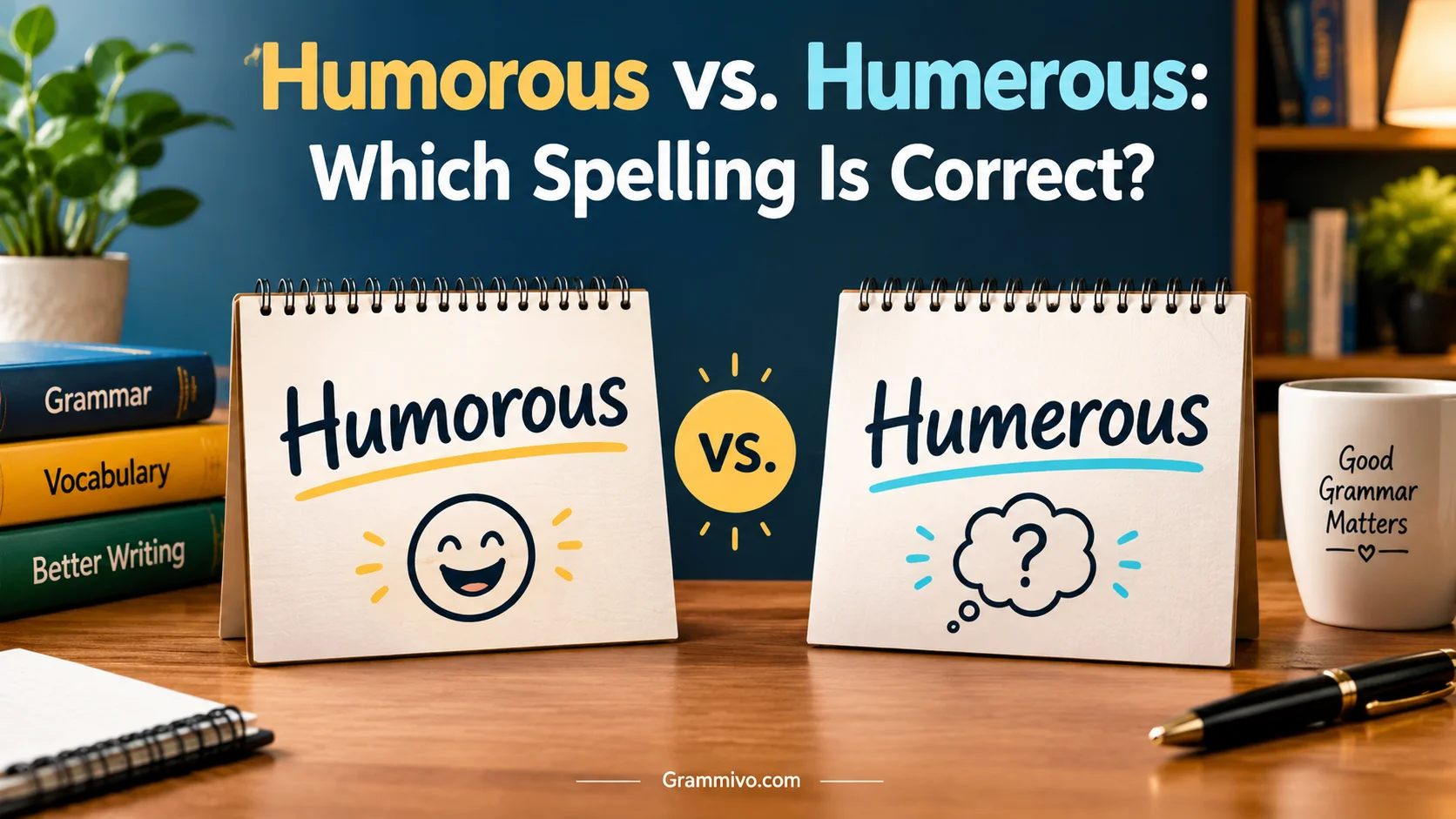
If you’ve ever hesitated between humorous and humerous, you’re not alone. The two spellings look almost identical, and their pronunciation can make the difference even harder to notice. One small letter, however, separates the correct spelling from a common mistake.
When you want to describe something funny, amusing, or likely to make people laugh, the correct word is humorous. The spelling humerous is generally a misspelling of humorous in standard English.
That distinction matters in everything from school assignments and professional emails to articles, books, and everyday messages. A spelling checker might catch the mistake, but understanding why the correct form is humorous makes it much easier to remember.
Quick Answer
Humorous is the correct spelling when you mean funny, amusing, or related to humor.
Humerous is generally an incorrect spelling of humorous in standard English.
| Spelling | Status | Meaning | Example |
| Humorous | Correct | Funny or amusing | She wrote a humorous story. |
| Humerous | Incorrect in this context | Usually a misspelling of humorous | She wrote a humerous story. |
The easiest way to remember the spelling is to start with humor:
humor + ous = humorous
Notice the o before us. The word contains the sequence humor-ous, not humer-ous.
So if you’re writing about something that makes people smile or laugh, choose humorous.
Comparison Overview
The difference between humorous vs. humerous is straightforward once you look at the words closely. Humorous is the established adjective, while humerous usually results from a spelling mistake.
| Feature | Humorous | Humerous |
| Standard spelling | Yes | No |
| Part of speech | Adjective | Not the standard adjective intended here |
| Meaning | Funny, amusing, or characterized by humor | Usually an incorrect spelling of humorous |
| Related noun | Humor | — |
| Common use | Describing jokes, stories, people, writing, situations, etc. | Generally avoided |
| Example | The speech was humorous. | The speech was humerous. ❌ |
There’s an important detail here: humorous doesn’t necessarily mean hilarious. Something can be humorous because it contains a clever observation, a playful remark, an amusing situation, or subtle wit.
For example:
The author’s humorous description made the serious topic easier to understand.
The sentence doesn’t necessarily suggest that readers were laughing uncontrollably. It simply says that the writing contained humor.
Main Differences Between Humorous vs. Humerous
The biggest difference is spelling, but understanding the word behind the spelling makes the distinction much clearer.
Humorous Is the Correct Word
Humorous is an adjective derived from humor. It describes something that contains, expresses, or produces amusement.
For example:
- He made a humorous comment.
- The movie has several humorous scenes.
- She has a humorous personality.
- The teacher gave a humorous example.
- His article uses a humorous tone.
In each sentence, humorous tells you that something has a connection to humor.
Humerous Is Usually a Misspelling
Humerous is commonly written when someone remembers the pronunciation of humorous but doesn’t remember its exact spelling.
For example:
The comedian gave a humerous performance.
The sentence should be:
The comedian gave a humorous performance.
The incorrect version changes the spelling of the word’s root. Because humor is spelled with an o, the related adjective keeps that spelling.
The Difference Is Easy to Miss
The confusion makes sense because humorous doesn’t always sound exactly the way its spelling suggests. English contains many words whose pronunciation doesn’t provide a perfect roadmap for spelling.
Think of it like recognizing a familiar face in a crowd. You know who the person is, but a quick glance can make you doubt yourself. The same thing happens with humorous.
Once you connect it to humor, the spelling becomes much easier to recognize.
What Does Humorous Mean?
Humorous means funny, amusing, playful, or characterized by humor.
It can describe something that deliberately makes people laugh. It can also describe something that simply has an amusing quality.
For example:
The speaker gave a humorous explanation of a complicated subject.
Here, humorous describes the speaker’s approach. The explanation may contain jokes, witty comparisons, or amusing examples.
The word can describe many different things.
Humorous Can Describe a Person
When you call someone humorous, you’re saying that the person has a natural ability or tendency to create amusement.
For example:
Marcus is a humorous storyteller who can make ordinary events sound entertaining.
This doesn’t necessarily mean Marcus tells jokes professionally. He may simply have a funny way of telling stories.
Humorous Can Describe Writing
Writers often use humor to make difficult or serious subjects more approachable.
For example:
The article takes a humorous look at common workplace mistakes.
The article isn’t necessarily a comedy piece. Instead, the writer uses wit or amusing observations to discuss the topic.
Humorous Can Describe a Situation
Sometimes the situation itself becomes amusing.
There was something humorous about watching three people search for the glasses that were already on the table.
The situation isn’t necessarily a deliberate joke. Its circumstances make it amusing.
Humorous Can Describe a Remark
A clever comment can also be humorous.
Her humorous remark lightened the mood during the meeting.
The remark may have been brief, but it added some levity to an otherwise serious moment.
Why Is Humorous the Correct Spelling?
The spelling becomes easier when you look at the word’s structure.
The noun is:
humor
The adjective is:
humorous
The spelling keeps the o from humor.
A useful pattern is:
humor → humorous → humorously
That connection gives you a reliable spelling anchor.
Consider these examples:
- humor can make a serious conversation more relaxed.
- A humorous comment can make people smile.
- Someone can speak humorously about an ordinary event.
The root remains recognizable throughout the word family.
Humor + Ous
The suffix -ous appears in many English adjectives.
For example:
- danger → dangerous
- fame → famous
- mystery → mysterious
- humor → humorous
In humorous, the spelling preserves the root humor before adding the adjective ending.
That’s why humerous isn’t the correct formation. It doesn’t properly preserve the spelling of the root.
Why Do People Spell It Humerous?
The mistake usually comes from a combination of pronunciation, visual similarity, and memory.
When people hear humorous, they may not clearly perceive every vowel in the word. As a result, they sometimes reconstruct the spelling as humerous.
English makes this problem particularly common because spelling and pronunciation don’t always line up neatly.
Pronunciation Can Cause Confusion
Depending on accent and speaking speed, humorous may sound like it has fewer clearly pronounced vowel sounds than its written form suggests.
That can lead someone to think the middle portion is humer- rather than humor-.
However, pronunciation shouldn’t determine the spelling here.
The safest strategy is to connect the adjective directly to the noun:
humor → humorous
The Words Look Almost Identical
Visually, the difference is tiny:
humorous
humerous
Only one vowel changes. Yet that single letter determines whether you’re using the standard spelling.
This is similar to many English spelling traps where a familiar word gets altered because another vowel seems more natural.
The Root Provides the Answer
When you’re uncertain, don’t try to spell humorous entirely from memory.
Instead, think:
What is the noun?
Humor.
Then build the adjective:
Humor + ous = humorous
That simple method is more dependable than guessing from pronunciation.
Humorous Meaning, Pronunciation, and Word Forms
Understanding the word’s grammar helps you use it correctly.
Pronunciation of Humorous
In American English, humorous is commonly pronounced approximately as HYOO-muh-rus or HYOO-mər-əs, depending on the speaker and context.
The exact sound can vary slightly with accent and speaking speed.
What’s important for spelling is that the pronunciation doesn’t change the written root:
humor remains visible in humorous.
Part of Speech
Humorous is an adjective.
That means it describes a noun.
For example:
- a humorous story
- a humorous character
- a humorous speech
- a humorous observation
- a humorous advertisement
You wouldn’t normally use humorous as a noun.
Instead, you’d use humor when referring to the quality itself.
Compare:
His humor impressed the audience.
His humorous stories impressed the audience.
The first sentence names the quality. The second uses an adjective to describe the stories.
Related Word Forms
Several words belong to the same family.
| Word | Part of Speech | Meaning |
| Humor | Noun/verb | Amusement or the quality of being funny; to amuse |
| Humorous | Adjective | Funny or amusing |
| Humorously | Adverb | In a humorous manner |
| Humorist | Noun | A person who creates or uses humor |
| Humorless | Adjective | Lacking humor |
Seeing the whole word family makes the spelling pattern easier to remember.
Read More: Guarantee vs. Guarentee: Which Spelling Is Correct?
Humorous vs. Funny: Are They the Same?
Humorous and funny overlap in meaning, but they aren’t always interchangeable.
Funny is the more common everyday word. It’s broad and flexible.
Humorous sounds slightly more descriptive and can feel more polished or formal.
Compare these sentences:
That’s a funny story.
That’s a humorous story.
Both are correct. The first sounds casual. The second emphasizes the story’s use or presence of humor.
There’s another important distinction. Funny can have meanings beyond amusement.
For example:
I feel funny today.
This can mean that the person feels strange or unusual.
You generally wouldn’t replace funny with humorous:
I feel humorous today.
That sentence changes the meaning considerably.
So although the words overlap, humorous specifically points toward humor and amusement.
Common Mistakes With Humorous
Spelling isn’t the only potential problem. Writers sometimes use the word incorrectly or choose it when another expression would be more precise.
Writing Humerous
This is the most common spelling mistake.
Incorrect:
The book contains several humerous stories.
Correct:
The book contains several humorous stories.
Forgetting the Root
Some writers remember the ending but lose the spelling of the base word.
The correct structure is:
humor + ous
Not:
humer + ous
Confusing Humorous With Humerus
There’s another word worth knowing: humerus.
The humerus is the long bone in your upper arm.
That’s a completely different word.
| Word | Meaning |
| Humorous | Funny or amusing |
| Humerus | The upper-arm bone |
| Humerous | Usually a misspelling of humorous |
This distinction is especially useful because humerous visually resembles humerus.
For example:
The comedian gave a humorous speech.
But:
The doctor examined the patient’s humerus.
One describes humor. The other belongs to anatomy.
How to Remember the Correct Spelling of Humorous
A good spelling trick should be simple enough to recall when you’re writing quickly.
The best method is:
Remember “Humor + Ous”
Break the word into two pieces:
HUMOR + OUS = HUMOROUS
The important part is humor.
If you can spell humor, you already have most of humorous.
Use the Double-O Reminder
Look at the transition:
humor → humorous
The word contains the sequence o-u after the m:
h-u-m-o-r-o-u-s
That can help prevent the mistaken e in humerous.
Think “Funny Starts With Humor”
When you want to describe something funny, think:
funny → humor → humorous
That mental chain leads you to the correct spelling.
Humorous in American English
For US English, the noun is spelled humor.
The adjective is:
humorous
American English generally uses humor, while British English often uses humour.
However, the adjective humorous is spelled the same in both varieties.
| Variety | Noun | Adjective |
| American English | humor | humorous |
| British English | humour | humorous |
This creates an interesting spelling point. The noun changes between American and British English, but the adjective does not follow the same visible change.
So American writers should use:
humor
and:
humorous
Not:
humerous
FAQs:
Is humorous or humerous correct?
Humorous is correct when you mean funny or amusing. Humerous is generally a misspelling.
What does humorous mean?
Humorous means funny, amusing, witty, or characterized by humor.
Is humerous a word?
In standard English, humerous isn’t the accepted spelling for the adjective meaning funny. It’s usually a misspelling of humorous.
How do you spell humorous?
The correct spelling is:
H-U-M-O-R-O-U-S
A useful breakdown is:
humor + ous = humorous
How do you pronounce humorous?
In American English, humorous is commonly pronounced roughly like HYOO-muh-rus, although pronunciation varies somewhat by accent and speech style.
Conclusion:
The difference between humorous vs. humerous is simple once you connect the correct spelling to its root word. Humorous is the correct spelling when you mean funny, amusing, or related to humor. Humerous is generally a misspelling and shouldn’t be used in standard English writing. A quick way to remember it is humor + ous = humorous. The word keeps the o from humor, which makes the correct spelling easier to recall.
