
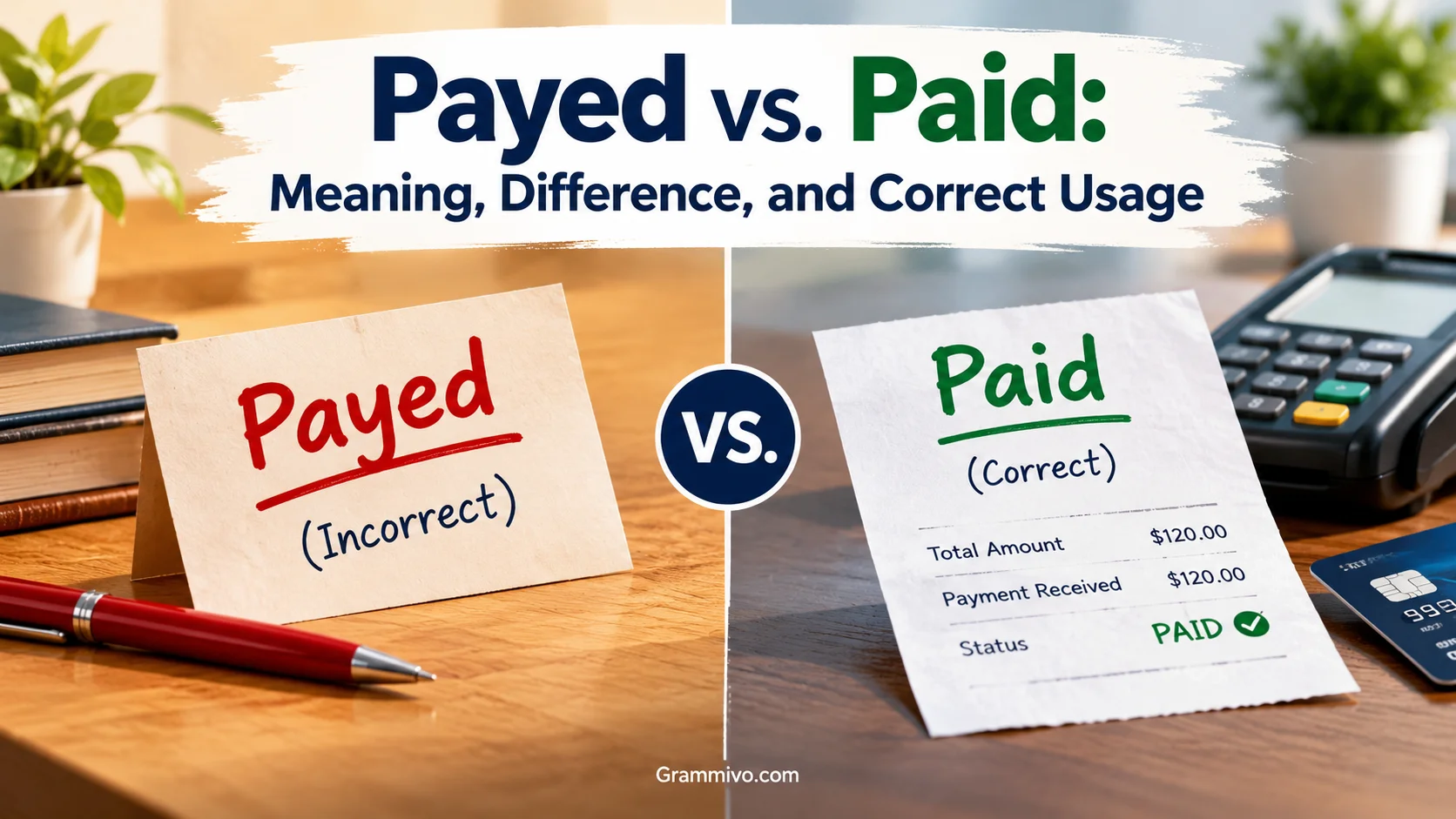
With Payed vs. Paid, English learners can avoid spelling confusion by using paid for ordinary money and transactions every day. Students, writers, and professionals may find these words similar, especially because many English verbs are regular verbs that follow the -ed pattern.
For example, play becomes played, while stay becomes stayed, so people may assume that pay should become payed. However, pay is an irregular verb, and its correct past tense and past participle are paid in almost all situations. The natural sentence is “I paid the bill”, not “I payed the bill.”
These words are used differently, and this spelling difference can lead to mistakes in emails, business writing, social media posts, school assignments, professional documents, blog posts, social media captions, academic papers, and business communication.
Quick Answer
Paid is the standard past tense and past participle of pay when you’re talking about money, compensation, debts, purchases, or most figurative expressions.
- Correct: I paid the bill.
- Correct: She paid for the tickets.
- Correct: The company paid its employees.
- Incorrect: I payed the bill.
- Incorrect: She payed for the tickets.
Payed is also a legitimate word, but it has a much narrower use. It can appear in specialized nautical language where pay refers to applying material such as tar or pitch to seams or surfaces to make them watertight.
So, the easiest rule is:
If you’re talking about money, use “paid.”
If you’re reading technical or historical material about ships, you may encounter payed.
Comparison Overview
| Word | Meaning | Typical Context | Example |
| Paid | Past tense/past participle of pay | Money, debts, wages, purchases | I paid the bill. |
| Payed | Specialized past form of pay | Mainly nautical or technical contexts | The crew payed the seams. |
The important point is that paid and payed aren’t interchangeable spellings.
In normal modern English, paid dominates. If you write about paying rent, buying coffee, settling an invoice, receiving wages, or covering a debt, paid is the correct choice.
Payed survives because English has another specialized use of pay. In nautical terminology, pay can refer to working material into or onto something, particularly to seal seams. That meaning has its own past form, payed.
This distinction explains why dictionaries may list both words even though one appears much more frequently in ordinary writing.
Main Differences Between Payed vs. Paid
The biggest difference between payed vs. paid comes down to meaning and context.
Paid Refers to Money in Everyday English
When pay means giving money in exchange for something, paid is the correct past tense.
- I paid the cashier.
- We paid $40 for lunch.
- She paid her rent early.
- They paid the invoice yesterday.
- He paid his credit card balance.
The same rule applies when someone receives compensation.
- The company paid its employees.
- The contractor was paid after completing the job.
- She paid the freelancer for the work.
Here, payed would be a spelling error.
Payed Has a Specialized Meaning
Payed appears in specialized language, especially nautical terminology.
In this context, pay can refer to covering or sealing a ship’s seams with a substance such as tar or pitch. The purpose is to help prevent water from entering through gaps or joints.
For example:
The crew payed the seams with tar before the vessel went to sea.
That sentence doesn’t describe a financial transaction. It describes a specialized physical process.
This is why simply memorizing “payed is wrong” isn’t quite accurate. Payed is a real word, but its legitimate use is far narrower than paid.
Paid Is Vastly More Common
In contemporary everyday writing, paid is the form you’ll encounter overwhelmingly often.
Think about the situations where you normally use pay:
- Paying rent
- Paying a mortgage
- Paying a bill
- Paying taxes
- Paying a salary
- Paying for food
- Paying for services
- Paying a debt
- Paying a fee
- Paying attention
All of these use paid when you’re talking about the past.
Payed generally enters the picture only when the context is specialized.
What Does “Paid” Mean?
Paid is the standard past tense and past participle of the verb pay.
The verb pay has several related meanings. Money is the most familiar one, but English also uses pay in various expressions that don’t involve directly handing over cash.
Paid for Something
When you purchase something, you paid for it.
- I paid for the groceries.
- Maria paid for the hotel room.
- We paid $25 for the tickets.
- He paid for the repair.
The construction paid for is especially common.
Notice that the object can be a physical product, service, experience, or expense.
Paid a Bill
When you settle an amount that you owe, use paid.
- I paid the electricity bill.
- She paid the invoice.
- They paid the restaurant bill.
- We paid the outstanding balance.
A sentence such as “I payed my phone bill” should therefore be corrected to:
“I paid my phone bill.”
Paid Someone
Paid can also describe giving someone money for their work.
- The company paid its employees on Friday.
- He paid the plumber after the repair.
- She paid the designer for the project.
The same form works whether the payment is small or substantial.
Paid Attention
Here’s an interesting example because pay attention doesn’t mean handing someone money.
When you say:
I paid attention during the meeting.
Paid means that you gave your attention or focused on something.
Other established expressions work similarly.
- paid attention
- paid a visit
- paid respect
- paid tribute
- paid the price
These expressions use paid, not payed.
Paid the Price
The expression paid the price can be literal or figurative.
Literally, it can describe an actual cost:
We paid the price listed on the invoice.
Figuratively, it means suffering a consequence.
He ignored the warnings and eventually paid the price.
Neither example calls for payed.
What Does “Payed” Mean?
Payed is a legitimate but specialized past-tense form of pay.
Its most recognizable use occurs in nautical terminology. In this context, pay can mean to apply material such as tar or pitch to a ship’s seams or another surface.
Historically, wooden ships depended heavily on materials and techniques that helped keep water out. Seams between wooden components needed careful treatment because even small openings could allow water to penetrate the hull.
A specialized sentence might read:
The shipwright payed the seams with pitch.
Here, payed doesn’t mean anyone gave money to the shipwright. It describes a technical process.
Why Is “Payed” So Uncommon?
Modern readers rarely encounter the specialized nautical sense of pay. Modern ships use very different construction methods and materials compared with traditional wooden vessels.
As a result, the specialized vocabulary associated with older shipbuilding appears much less often in ordinary writing.
You’ll generally see payed in contexts such as:
- Nautical writing
- Historical descriptions
- Maritime terminology
- Technical dictionaries
- Older literature
- Specialized discussions of ship construction
That’s why seeing payed can feel strange even though the word is legitimate.
When to Use “Paid”
Use paid whenever pay has its normal modern meaning.
Paying for Goods or Services
We paid for the meal before leaving.
Settling a Debt
She paid the loan in full.
Paying an Invoice
The customer paid the invoice yesterday.
Paying Employees
The company paid its staff on Friday.
Paying a Fee
He paid the application fee.
Paying Taxes
They paid their taxes before the deadline.
Paying Attention
You should have paid attention to the instructions.
Paying Respect
The visitors paid their respects.
In all of these examples, paid is the natural and standard choice.
When to Use “Payed”
Use payed only when the specialized meaning of pay requires it.
The most important distinction is this:
Payed does not mean “paid incorrectly.”
It has its own historical and technical use.
For example:
The sailors payed the seams with tar.
The verb describes sealing or treating seams rather than making a financial payment.
If you’re writing an ordinary email, essay, article, school assignment, business report, or social media post, you’ll almost certainly need paid instead.
Why Do People Confuse Paid and Payed?
The spelling becomes easier to understand when you look at the structure of English verbs.
“Payed” Looks Like a Regular Verb Form
Many English verbs form their past tense by adding -ed.
For example:
- walk → walked
- talk → talked
- work → worked
- clean → cleaned
- play → played
Because of this pattern, pay → payed looks perfectly reasonable at first glance.
There’s just one problem: the ordinary past tense of pay is paid.
English contains many irregular verbs that don’t follow the simple -ed pattern.
Consider:
| Present | Past |
| go | went |
| buy | bought |
| bring | brought |
| teach | taught |
| think | thought |
| take | took |
| pay | paid |
These forms have developed through the history of English rather than following one simple spelling formula.
The Existence of “Payed” Adds to the Confusion
The situation becomes unusual because payed isn’t completely nonexistent.
A learner may encounter payed in a dictionary or specialized text. That can create the impression that paid and payed are simply two acceptable versions of the same word.
They aren’t.
The meanings differ.
Paid vs. Payed Examples
Seeing the words side by side makes the distinction much clearer.
| Sentence | Correct? | Explanation |
| I paid the bill. | ✅ | Financial payment |
| She paid for dinner. | ✅ | Paying for a service |
| He paid his employees. | ✅ | Giving wages |
| We paid the fee. | ✅ | Settling a charge |
| I payed the bill. | ❌ | Ordinary financial meaning requires paid |
| She payed for dinner. | ❌ | Ordinary financial meaning requires paid |
| The crew payed the seams. | ✅ | Specialized nautical usage |
| They payed for the tickets. | ❌ | Financial meaning requires paid |
The pattern is consistent. Money means paid. Specialized nautical terminology may mean payed.
Read More: Verbage or Verbiage: Which Spelling Is Correct?
Paid and Payed in Different Forms of English
The distinction doesn’t change simply because the variety of English changes.
American English
In American English, paid is the standard past tense for ordinary uses of pay.
You would write:
She paid the rent.
You would not normally write:
She payed the rent.
Specialized technical terminology can still use payed, however.
British English
British English follows the same basic distinction.
- paid for ordinary financial meanings
- payed for certain specialized uses
So this isn’t a case where Americans prefer one spelling while British speakers prefer another.
The difference is primarily semantic, not regional.
Pay, Paid, and Payed: Verb Forms Compared
Understanding the whole verb family makes the spelling easier to remember.
| Form | Function | Example |
| Pay | Present/base form | I pay the bill. |
| Paid | Past tense | I paid the bill. |
| Paid | Past participle | I have paid the bill. |
| Paying | Present participle/gerund | I am paying the bill. |
| Payed | Specialized past form | The crew payed the seams. |
Notice that paid serves two grammatical roles.
It works as the simple past:
I paid yesterday.
It also works as a past participle:
I have paid already.
Payed doesn’t replace paid in those everyday constructions.
Is “Payed” a Word?
Yes. Payed is a real English word.
However, its existence doesn’t make it a standard alternative to paid.
That’s an important distinction. English contains many words that are valid only in specific contexts. A word can be grammatically legitimate while remaining extremely uncommon in ordinary conversation.
Payed falls into that category.
If a dictionary lists payed, that doesn’t mean you can freely substitute it for paid.
For example:
I paid my rent.
is correct.
I payed my rent.
is not correct simply because payed exists.
The second sentence uses payed with the wrong sense of the verb.
Is “Payed” Ever Correct?
Yes, but only in specialized contexts where its meaning applies.
The classic example involves nautical terminology:
The shipwright payed the seams with pitch.
The sentence describes a technical process associated with sealing or treating a ship.
That’s very different from:
The customer paid the shipwright.
The first sentence describes a specialized physical process. The second describes a financial transaction.
This distinction gives you a reliable way to understand the two forms.
Is “Paid” Always Correct?
For ordinary uses of pay, paid is the correct form.
However, saying “paid is always correct” would be too broad because specialized nautical terminology gives payed a legitimate place in English.
Think of it this way:
Paid is the default. Payed is the specialist.
When you’re writing about money, choose paid without hesitation.
When you’re reading an old maritime text and encounter payed, don’t automatically assume it’s a typo. Look at the surrounding context.
FAQs:
Is “paid” or “payed” correct?
Paid is the correct past tense and past participle of pay in almost all everyday situations. Use paid when talking about money, bills, salaries, purchases, or other ordinary payments.
Is “payed” ever a correct word?
Yes. Payed is a real but rare word used mainly in nautical contexts. It can describe letting out a rope or cable, or an older process involving coating a ship or part of a ship with waterproof material.
Is “I paid the bill” correct?
Yes. “I paid the bill” is the correct sentence. “I payed the bill” is incorrect because the ordinary past tense of pay is paid.
Why do people confuse paid and payed?
The confusion comes from the common -ed pattern used with regular English verbs. For example, play becomes played, and stay becomes stayed. Because pay looks similar, people may assume its past form is payed, but pay is an irregular verb.
How can I remember paid vs. payed?
A simple rule is to connect paid with everyday money and transactions. If you are talking about paying a bill, salary, purchase, or debt, choose paid. Think of payed as a specialized nautical term.
Conclusion:
Paid is the form you should use in almost every everyday situation. It is the correct past tense and past participle of pay, whether you are discussing money, bills, salaries, purchases, or something owed. Payed exists, but its use is limited mainly to nautical and older technical contexts. Remembering this distinction will help you avoid a common spelling mistake and make your writing clearer and more professional.
