
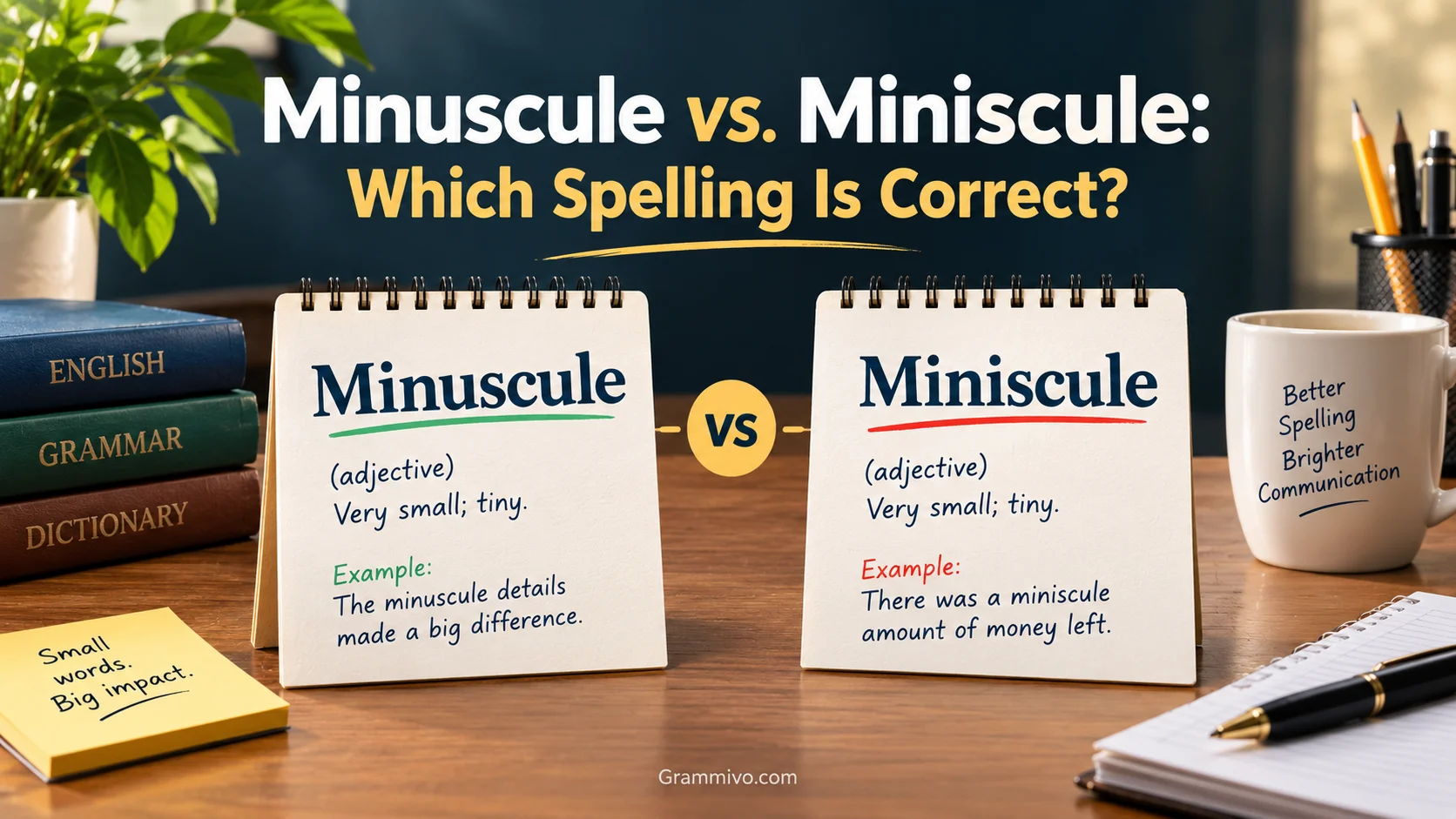
Minuscule vs. Miniscule often causes spelling confusion because minuscule sounds like mini, but only minuscule is the correct standard spelling. When typing the word, miniscule may seem natural because mini- is a familiar prefix in miniature, minibus, and miniskirt.
However, the incorrect version is a common misspelling, while minuscule is the standard form in English. The difference may look tiny, but standard English follows the correct pattern. The word describes something tiny, small, or extremely small, such as a very limited amount, size, or insignificant detail.
A useful simple trick is to remember the -uscule ending instead of following how the word sounds. This approach can help prevent common mistakes and keep your spelling accurate.The word history explains the real difference between these two spellings. Minuscule comes from the Latin word minusculus, meaning rather small or somewhat smaller.
Quick Answer
Minuscule is the correct standard spelling. Miniscule is generally considered a misspelling of minuscule.
The word minuscule means extremely small or tiny. It can describe physical objects, quantities, differences, changes, or effects.
Correct: The difference between the two measurements was minuscule.
Incorrect: The difference between the two measurements was miniscule.
A simple memory trick is to connect minuscule with minus. Both begin with minu-, which can help you remember that the correct spelling contains u.
Comparison Overview
| Word | Standard English Spelling | Meaning | Recommended Usage |
| Minuscule | Yes | Extremely small or tiny | Use this spelling |
| Miniscule | No, generally treated as a misspelling | Usually intended to mean extremely small | Avoid in formal writing |
| Miniature | Yes | A smaller representation or version of something | Use when referring to scale or a model |
| Minute | Yes | Extremely small; also a unit of time | Use according to context |
The important point is that minuscule and miniscule don’t represent two different meanings. In most cases, someone who writes miniscule simply intends the standard word minuscule.
Main Differences Between Minuscule vs. Miniscule
The central difference between minuscule vs. miniscule is spelling rather than meaning. Minuscule is the established standard form, while miniscule is a common erroneous spelling.
Minuscule Is the Correct Spelling
Minuscule is the spelling you should use in standard English.
For example:
- The insect was minuscule.
- She noticed a minuscule crack in the glass.
- The company reported a minuscule increase in revenue.
- There was only a minuscule difference between the results.
- The text was so minuscule that I could barely read it.
The word works naturally in both everyday and formal writing.
Miniscule Is Generally a Misspelling
Miniscule frequently appears in online articles, emails, social media posts, and other informal writing. Its widespread appearance can make it look legitimate.
However, frequency doesn’t automatically make a spelling standard.
The form miniscule is generally treated by major English dictionaries as a misspelling or erroneous variant of minuscule. If you’re writing something that needs conventional spelling, use minuscule.
The Meaning Is Usually the Same
Someone writing miniscule normally means minuscule.
For example:
The difference was miniscule.
The writer almost certainly means:
The difference was minuscule.
Therefore, the problem isn’t usually one of interpretation. Most readers will understand the intended meaning. The issue is simply that the spelling doesn’t follow the standard form.
What Does Minuscule Mean?
Minuscule is an adjective that means extremely small or very tiny.
It can refer to something’s physical dimensions. It can also describe an amount, difference, change, or effect that is extremely small.
Consider these examples:
- A minuscule piece of dust landed on the table.
- The laboratory detected a minuscule amount of the substance.
- The two measurements showed a minuscule difference.
- The policy produced a minuscule change in operating costs.
The word often carries a stronger sense than simply small. Calling something minuscule suggests that its size or amount is so small that it barely seems significant.
Minuscule as an Adjective
The most common modern use of minuscule is as an adjective.
You can place it directly before a noun:
- minuscule amount
- minuscule detail
- minuscule crack
- minuscule insect
- minuscule difference
- minuscule increase
You can also use it after a linking verb:
- The error was minuscule.
- The amount seemed minuscule.
- The difference became minuscule after rounding.
This flexibility makes the word useful in many kinds of writing.
Minuscule Can Describe Physical Size
When minuscule describes a physical object, it emphasizes how tiny that object is.
For example:
A minuscule spider crawled across the corner of the window.
The sentence doesn’t merely say that the spider was small. It stresses that the creature was exceptionally tiny.
Another example:
The watch contained several minuscule components.
Here, minuscule highlights the tiny physical dimensions of the components.
Minuscule Can Describe Amounts
You don’t have to use minuscule for physical objects.
It can also describe quantities that are extremely small.
For example:
Only a minuscule amount of sugar remained in the container.
The sugar itself might consist of ordinary-sized grains. The adjective refers to the amount, not necessarily the individual grains.
This distinction matters because minuscule often works metaphorically.
Minuscule Can Describe Differences
One particularly common use involves differences.
For example:
The researchers found a minuscule difference between the two samples.
Here, minuscule means the difference was extremely small.
You’ll often encounter combinations such as:
- minuscule difference
- minuscule variation
- minuscule change
- minuscule improvement
- minuscule increase
- minuscule decrease
The word can therefore fit naturally into scientific, financial, technical, and analytical writing.
What Does Miniscule Mean?
Miniscule is the spelling people commonly use when they intend to write minuscule.
For example:
The difference was miniscule.
In standard English, this should generally be written:
The difference was minuscule.
The mistaken spelling probably feels natural because English contains many words beginning with mini-. Once your brain recognizes the idea of something being very small, mini- seems like an obvious spelling choice.
That’s a classic spelling trap. The pronunciation and meaning point toward one pattern while the word’s historical origin follows another.
Why Is Minuscule Spelled With “U”?
The spelling becomes much easier to remember when you know its origin.
Minuscule comes from the Latin word minusculus, which means “rather small” or “somewhat smaller.” It is related to the Latin minor, meaning “smaller.”
That history explains the unusual -uscule sequence.
The word wasn’t created by combining the modern English mini- with another element. Consequently, spelling it miniscule based on the idea of mini changes its historical structure.
The Historical Connection
The Latin root gives you a useful spelling clue:
minusculus → minuscule
The connection to minus isn’t an exact modern English word-building rule, but it’s an effective memory aid.
Think of it this way:
Minus → minuscule → very small
If something is minuscule, you can imagine its size being reduced to almost “minus” something.
It isn’t a formal etymological definition. It’s simply a handy way to keep the spelling straight.
Minuscule as a Noun
Although most people encounter minuscule as an adjective, the word also has a specialized historical meaning as a noun.
In paleography and the history of writing, minuscule refers to a style of small-letter handwriting or script.
Medieval scribes developed various forms of minuscule handwriting. These scripts differed from earlier large-letter writing styles and played an important role in the development of European manuscript traditions.
You may encounter terms such as:
- Carolingian minuscule
- Caroline minuscule
- medieval minuscule
- manuscript minuscule
This specialized sense is quite different from saying that something is physically tiny.
For example:
The manuscript was written in Carolingian minuscule.
Here, minuscule refers to a historical writing style rather than something being extremely small.
Read More: Totalling vs. Totaling: Which Spelling Is Correct?
Minuscule vs. Miniature: Are They the Same?
Minuscule and miniature overlap because both can relate to smallness. However, they aren’t interchangeable in every context.
Minuscule generally emphasizes that something is extremely small.
Miniature often means something deliberately made or represented on a smaller scale.
Compare these examples:
The scientist examined a minuscule particle.
The particle is extremely small.
The museum displayed a miniature model of the building.
The model represents a larger building at a reduced scale.
A miniature object can be small without being minuscule. A minuscule object doesn’t necessarily represent something larger.
A Simple Comparison
| Word | Main Idea | Example |
| Minuscule | Extremely small | A minuscule crack appeared in the glass. |
| Miniature | Small-scale version or representation | She bought a miniature model of the car. |
| Tiny | Very small in ordinary language | A tiny bird sat on the branch. |
| Minute | Extremely small | A minute amount remained. |
This distinction helps you choose the right word rather than simply choosing whichever sounds smaller.
Minuscule vs. Minute
Another useful comparison is minuscule vs. minute.
When pronounced my-NOOT, minute can mean extremely small.
For example:
The instrument detected minute changes in temperature.
In this context, minute doesn’t refer to sixty seconds. It describes changes that are extremely small.
Minuscule has a similar meaning:
The instrument detected minuscule changes in temperature.
Both sentences work. However, minute has an additional meaning as a unit of time.
| Word | Meaning | Example |
| Minuscule | Extremely small | The error was minuscule. |
| Minute | Extremely small | The measurement showed minute changes. |
| Minute | 60 seconds | Wait one minute. |
Context determines which meaning of minute applies.
How to Use Minuscule in a Sentence
The easiest way to understand minuscule is to see it in different contexts.
Examples About Physical Size
- The laboratory used a minuscule sensor.
- A minuscule insect landed on the leaf.
- She found a minuscule hole in her pocket.
- The machine contains several minuscule gears.
- He noticed a minuscule scratch on the screen.
Each example focuses on physical size.
Examples About Amounts
- Only a minuscule amount of water remained.
- The recipe requires a minuscule quantity of salt.
- The treatment produced a minuscule reduction in symptoms.
- The company received a minuscule portion of the available funding.
Here, the word describes quantity rather than dimensions.
Examples About Differences
- The two colors have a minuscule difference in shade.
- There was a minuscule gap between the measurements.
- The final scores showed a minuscule variation.
- The revised version offers only a minuscule improvement.
This usage is especially common in analytical writing.
Examples in Everyday Writing
- The text on the label was minuscule.
- A minuscule detail changed the appearance of the painting.
- The typo was minuscule, but everyone noticed it.
- The price difference was minuscule.
The word can sound slightly more emphatic than small, which makes it useful when you want to stress just how little something is.
Minuscule vs. Miniscule Examples
The following examples show exactly where the spelling mistake occurs.
| Incorrect Form | Correct Form |
| The difference was miniscule. | The difference was minuscule. |
| She found a miniscule crack. | She found a minuscule crack. |
| The increase was miniscule. | The increase was minuscule. |
| The text was miniscule. | The text was minuscule. |
| Only a miniscule amount remained. | Only a minuscule amount remained. |
| The insect was miniscule. | The insect was minuscule. |
Notice the key difference:
minuSCUle ✅
miniSCUle ❌
The middle vowel matters.
Common Mistakes With Minuscule
Spelling minuscule correctly becomes easier when you understand why people get it wrong.
Mistake: Adding “i” Because of “Mini”
The most obvious trap is the spelling miniscule.
Words such as miniature, minivan, and miniskirt make mini- look like the natural beginning for anything related to smallness.
However, minuscule has a different origin.
Mistake: Assuming Pronunciation Reveals the Spelling
English pronunciation rarely provides a perfect spelling guide.
When you hear minuscule, the pronunciation doesn’t clearly tell you whether the middle vowel should be u or i.
That’s why relying on sound alone can lead to miniscule.
Mistake: Assuming Frequent Usage Means Correct Usage
You may encounter miniscule often, especially in informal digital writing.
That doesn’t make it the preferred standard spelling.
Search engines, social media, user-generated content, and casual writing contain countless spelling errors. A familiar mistake can eventually look strangely legitimate.
Easy Ways to Remember Minuscule
A good spelling trick should be quick enough to use when you’re writing.
Remember “Minus”
The simplest mnemonic is:
MINUS → MINUSCULE
Both start with minu-.
If something is minuscule, think of it as being reduced to almost nothing.
Remember the “U”
Write the word slowly:
MIN-U-SCULE
The U comes after min.
Then compare:
MINUSCULE ✅
MINISCULE ❌
This small visual distinction can save you from repeatedly making the same spelling error.
Use a Memory Sentence
Try remembering:
A minuscule thing is almost minus something in size.
Again, this is a memory device rather than the literal definition. Its job is to make the spelling stick.
Minuscule in American English
In American English, minuscule is the standard spelling.
You can use it in:
- Academic writing
- Business communication
- News writing
- Technical documents
- School assignments
- Professional reports
- Everyday conversation
- Creative writing
There is no need to replace it with miniscule in informal writing simply because the latter appears frequently.
For formal work, minuscule is the safer and standard choice.
FAQs:
Is Minuscule or Miniscule Correct?
Minuscule is the correct standard spelling. Miniscule is commonly seen, but major dictionaries generally treat it as a misspelling.
What Does Minuscule Mean?
Minuscule means extremely small, tiny, or very insignificant in size or amount. For example, “The difference was minuscule.”
Why Do People Spell Minuscule as Miniscule?
The confusion often comes from the familiar mini- pattern in words such as miniature, minibus, and miniskirt. However, minuscule comes from the Latin minusculus.
How Can You Remember the Spelling of Minuscule?
Remember the unusual -uscule ending. Thinking of minuscule as “mini + uscule” can help you avoid the common miniscule mistake.
Is Minuscule Used in Formal Writing?
Yes. Minuscule is appropriate in an email, academic paper, blog post, report, or other forms of standard English writing.
Conclusion:
Minuscule is the correct spelling, while miniscule is a common misspelling. Although the incorrect form seems logical because of mini- words, the word comes from Latin minusculus. Remember the -uscule ending, and you’ll have a simple way to choose minuscule correctly.
