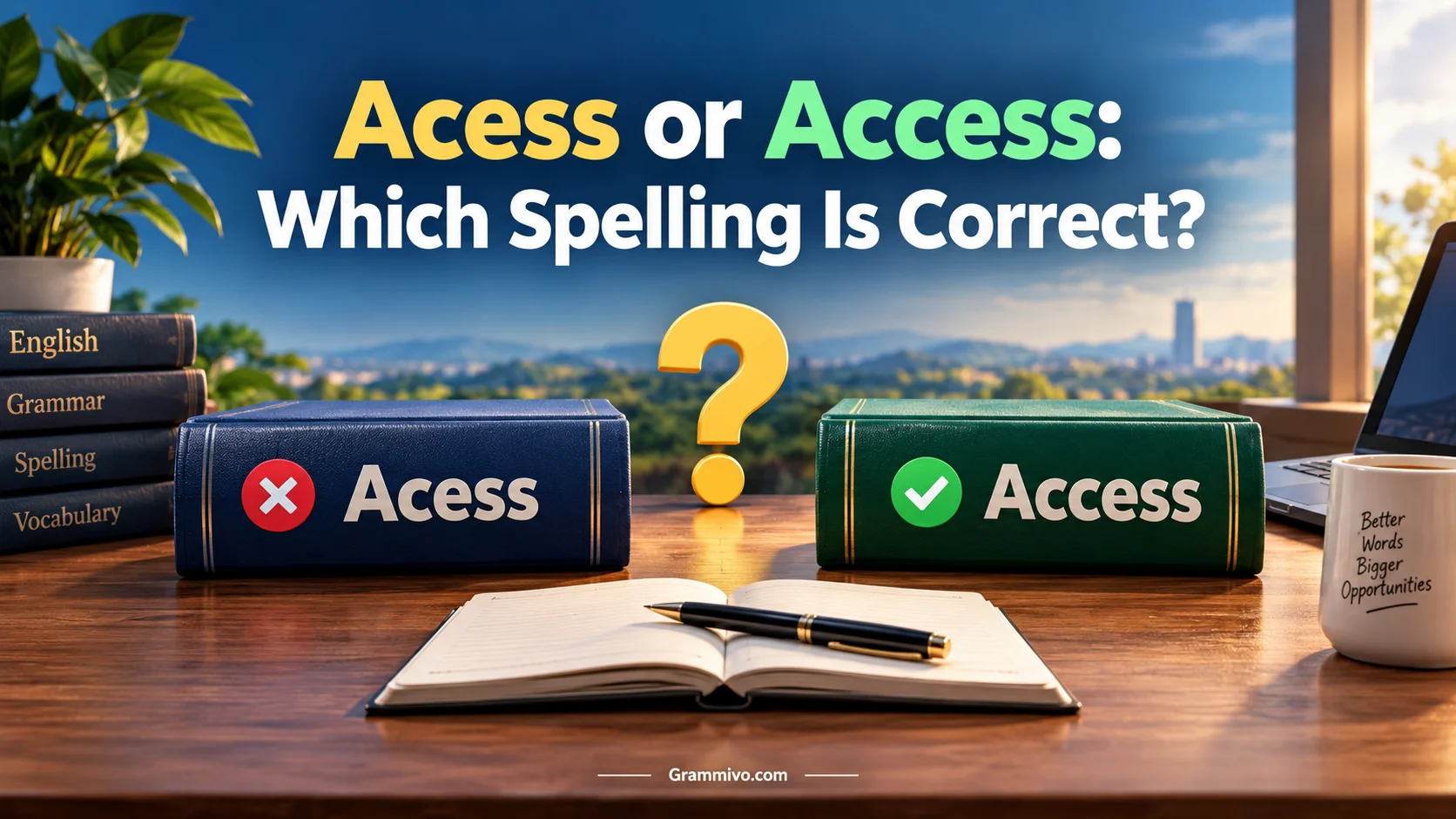
When checking Acess or Access, remember that access is the correct spelling, while acess is an incorrect spelling caused by missing repeated letters. This common mistake often creates confusion because the two forms sounds nearly the same in pronunciation. The correct English word uses two c’s and two s’s, written as A-C-C-E-S-S.
This spelling pattern is worth remembering when writing or typing, especially in emails, exams, and professional writing. In standard American English, access is the accepted form, and you may see it used in a website, bank account, or other everyday situations.
An easy way to check the word is to look for the double c and double s before you finish typing. Access works as both a noun and verb, with clear grammar patterns and common forms. If acess looks almost right, remember that one missing letter creates the difference.
Quick Answer
Access is the correct spelling. Acess is incorrect and should not be used in standard American English.
- Correct: access
- Incorrect: acess
- Meaning: the ability or opportunity to enter, reach, use, or obtain something
- As a noun: You have access to the database.
- As a verb: You can access the database online.
A simple way to remember the spelling is ACC + ESS. The word begins with acc, not ac.
Comparison Overview
| Word | Correct Spelling? | Part of Speech | Meaning | Example |
| Access | Yes | Noun | The ability or opportunity to enter, reach, or use something | Students have access to the library. |
| Access | Yes | Verb | To enter, reach, retrieve, or use something | You can access your account online. |
| Acess | No | — | Misspelling of access | Acess is not the standard spelling. |
The important point is straightforward: access is always spelled with two c’s.
Main Differences Between Acess or Access
The biggest difference between acess and access is correctness. Access is the established English word, while acess is simply a spelling error.
| Feature | Access | Acess |
| Standard English word | Yes | No |
| Correct spelling | Yes | No |
| Contains two c’s | Yes | No |
| Contains two s’s | Yes | Yes |
| Can be a noun | Yes | No |
| Can be a verb | Yes | No |
| Used in standard American English | Yes | No |
If you’re writing an email, school assignment, article, report, or professional document, choose access.
What Does Access Mean?
Access has several closely related meanings. At its core, the word describes the ability, opportunity, or means to reach, enter, use, or obtain something.
Think of access as a doorway. If the door is open to you, you have access. If someone locks it and doesn’t give you permission to enter, your access is restricted.
The word appears in everyday conversations as well as technical, academic, business, and legal writing.
For example:
- You need access to the building.
- Employees have access to company files.
- The website provides access to educational resources.
- She couldn’t access her email account.
- The hospital restricts access to certain areas.
Access as a Noun
As a noun, access refers to the opportunity or ability to reach, enter, use, or obtain something.
Consider this sentence:
Employees have access to the company’s internal database.
Here, access describes the employees’ ability to use the database. It doesn’t describe the physical act of opening or using it.
You can use access for physical places:
Visitors have limited access to the laboratory.
You can also use it for digital resources:
Students receive access to the online learning platform.
The same basic idea connects both examples. Someone has the ability or permission to reach something.
Access as a Verb
As a verb, access means to reach, enter, retrieve, or use something.
For example:
You can access your account from any device.
Here, access describes an action. The person actively reaches or uses the account.
More examples include:
- I accessed the document yesterday.
- She accessed the website from her phone.
- We need to access the archived records.
- The technician accessed the system remotely.
- You can access the files after signing in.
The noun and verb forms look exactly alike. Context tells you which grammatical role the word plays.
What Does Acess Mean?
Acess is not the correct spelling of the English word access.
It usually appears when someone accidentally leaves out one of the two c’s. Because the pronunciation doesn’t clearly signal the second c, the error can be surprisingly easy to make.
For example:
Incorrect: Please acess your account.
Correct: Please access your account.
The meaning doesn’t change. The problem is simply spelling.
You may encounter acess in informal online writing, user-generated content, or typing mistakes. Its appearance in those places doesn’t make it an accepted alternative spelling.
Why Do People Write Acess Instead of Access?
Several factors can lead to this mistake.
First, access contains a sequence that isn’t always intuitive. The middle of the word looks like cc, while the pronunciation doesn’t emphasize the letters individually.
Second, people often spell words according to how they sound. Since the second c doesn’t create a separate spoken syllable, it can be forgotten.
Finally, fast typing can produce simple omissions. One missing letter is enough to turn access into acess.
The solution is simple: remember the visual pattern ACC-ESS.
Why Is Access Spelled With Two Cs?
The spelling access contains two consecutive c’s because that is the established spelling of the word in English.
Break it into two useful parts:
ACC + ESS
This gives you:
A-C-C-E-S-S
The first two letters aren’t enough. You need the second c.
A useful memory trick is to imagine the two c’s as two doors standing beside each other:
A C C E S S
Two C’s, one word: access.
This kind of visual association can help when you’re writing quickly.
How to Use Access in a Sentence
Because access works as both a noun and a verb, you can use it in many sentence patterns.
The most common noun structure is:
access to + noun
For example:
- I have access to the report.
- She has access to the building.
- Students need access to reliable information.
- The employee requested access to the database.
When access works as a verb, it usually takes a direct object.
For example:
- Access the report.
- Access your account.
- Access the website.
- Access the records.
Access as a Noun
Here are several natural examples:
The library gives students access to thousands of books.
Only authorized employees have access to the server.
Reliable internet access is essential for many online services.
Notice that the noun often appears with to.
Access as a Verb
Now compare those sentences with the verb form:
Students can access thousands of books through the library’s digital system.
Authorized employees can access the server.
You can access the service through the mobile application.
Here, access directly connects to the thing being reached or used.
Read More: Anyway vs. Anyways: Meaning, Differences, and Correct Usage
Common Phrases With Access
The word access appears in many fixed or common expressions. Learning these phrases can make your writing more natural.
Access to
This is one of the most common patterns.
Everyone should have access to clean water.
The course provides access to additional resources.
Have Access to
This phrase describes possession of the ability or opportunity to use something.
I have access to the company’s research database.
Gain Access to
This means obtaining the ability or permission to reach something.
Users must verify their identity to gain access to the account.
Provide Access to
This means making something available to someone.
The school provides students with access to digital resources.
Deny Access to
This means preventing someone from entering or using something.
Security staff may deny access to unauthorized visitors.
Restrict Access to
This means limiting who can enter, view, or use something.
The administrator restricted access to confidential files.
Remote Access
Remote access means reaching a system, device, or network from another location.
The company allows remote access to its internal network.
Easy Access
This phrase describes something that can be reached or obtained without much difficulty.
The hotel offers easy access to public transportation.
Access vs. Entry
Access and entry overlap, but they aren’t always interchangeable.
Entry usually focuses on the act or opportunity of going into a place. Access has a broader meaning and can involve entering, using, reaching, or obtaining something.
Compare these examples:
Entry to the museum ends at 5 p.m.
Access to the museum’s archives requires special permission.
The first sentence focuses on entering the museum. The second focuses on the ability to use a particular resource.
You can also have access to information, but you wouldn’t normally describe that situation simply as entry to information.
Access vs. Permission
These words are related but carry different meanings.
Permission means approval or authorization to do something. Access refers to the ability or opportunity to reach or use something.
For example:
I have permission to enter the building.
This means someone authorized the action.
I have access to the building.
This means I can enter or use it.
Sometimes both concepts appear together:
You need permission to gain access to the restricted area.
In this sentence, permission enables access.
Access vs. Excess
Don’t confuse access with excess. They look and sound somewhat similar, but their meanings are completely different.
Access means the ability or opportunity to reach or use something.
She has access to the files.
Excess means more than what is needed, expected, or appropriate.
The recipe contains an excess of sugar.
A quick comparison makes the distinction clearer:
| Word | Meaning | Example |
| Access | Ability or opportunity to reach or use something | I have access to the records. |
| Excess | An amount greater than necessary | The excess water damaged the crops. |
One letter changes the word, but the meaning changes completely.
Common Mistakes With Access
Even experienced writers occasionally make mistakes with access. Most errors involve spelling, word choice, or sentence structure.
Writing Acess Instead of Access
This is the most obvious spelling mistake.
Incorrect: You need acess to the system.
Correct: You need access to the system.
Remember the two c’s.
Confusing Access With Excess
The two words are easy to mix up when typing quickly.
Access relates to reaching or using something.
Excess relates to having too much of something.
Misusing Access to
When access functions as a noun, access to is a common construction.
She has access to the files.
However, when access functions as a verb, you normally don’t need to before the object.
She accessed the files.
Not:
She accessed to the files.
This distinction is worth remembering because the noun and verb forms look identical.
Forgetting the Second C
This mistake often happens because the second c isn’t obvious from pronunciation.
Write the word slowly:
A-C-C-E-S-S
Then say it naturally.
After a little practice, the double c becomes easier to remember.
How to Remember the Spelling of Access
A good spelling trick should be quick enough to use while you’re writing.
Try this:
Remember “ACC + ESS”
Think of access as two chunks:
ACC + ESS
The first chunk contains two c’s. The second contains two s’s.
So:
ACC + ESS = ACCESS
Another useful reminder is:
Access has two C’s because you need both C’s to get through the word’s “door.”
It sounds playful, but memorable spelling tricks often work better than dry memorization.
Practice With Related Forms
Writing related forms can reinforce the spelling:
- access
- accessed
- accessing
- accessible
- accessibility
The same spelling family appears across many common words.
For example:
Users can access the system.
The system was accessed yesterday.
Employees are accessing the database.
Seeing the pattern repeatedly makes the correct spelling more automatic.
Access in American English
In American English, the standard spelling is access.
There is no standard American English variant spelled acess. If you encounter that form, treat it as a spelling error.
The correct form appears across many fields, including:
- Technology
- Education
- Business
- Healthcare
- Government
- Banking
- Transportation
- Academic writing
- Everyday communication
Whether you’re writing a casual message or a formal report, access remains the correct spelling.
Access: Pronunciation and Word Forms
The spelling becomes easier to remember when you understand the word family.
Access is commonly pronounced with two syllables:
AK-sess
Its common forms include:
| Form | Word | Example |
| Base form | access | Users can access the account. |
| Past tense | accessed | She accessed the file yesterday. |
| Present participle | accessing | He is accessing the database. |
| Adjective | accessible | The building is accessible to visitors. |
| Noun | accessibility | Accessibility improves digital experiences. |
Notice that the spelling changes slightly when suffixes are added. However, the core access spelling remains recognizable.
Accessed
The past tense is accessed.
The technician accessed the system remotely.
You don’t remove a c when forming the past tense.
Accessing
The present participle is accessing.
The employee is accessing the records.
The spelling retains the double c.
Accessible
The adjective accessible means easy to reach, enter, use, understand, or obtain.
The website is accessible on mobile devices.
This related word is especially common in discussions about buildings, technology, information, and disability access.
FAQs:
1. Is “Acess” or “Access” correct?
Access is the correct spelling. Acess is a common misspelling because the word requires two c’s and two s’s.
2. What does “access” mean?
Access means the ability or permission to enter, use, reach, or obtain something. For example, you can gain access to a website or building.
3. Is “access” a noun or a verb?
Access can be both a noun and a verb. As a noun, it refers to entry or permission. As a verb, it means to enter, reach, or use something.
4. Why do people spell “access” as “acess”?
People often make this spelling mistake because acess and access have nearly the same pronunciation. Remembering the double c and double s helps prevent the error.
5. How can I remember the spelling of “access”?
Use the simple pattern A-C-C-E-S-S. Think of two c’s followed by two s’s. This makes the correct spelling easier to recall when writing quickly.
Conclusion:
Access is the correct spelling, while acess is incorrect. Remember the simple A-C-C-E-S-S pattern, and you can confidently use the word in everyday and professional writing.
