
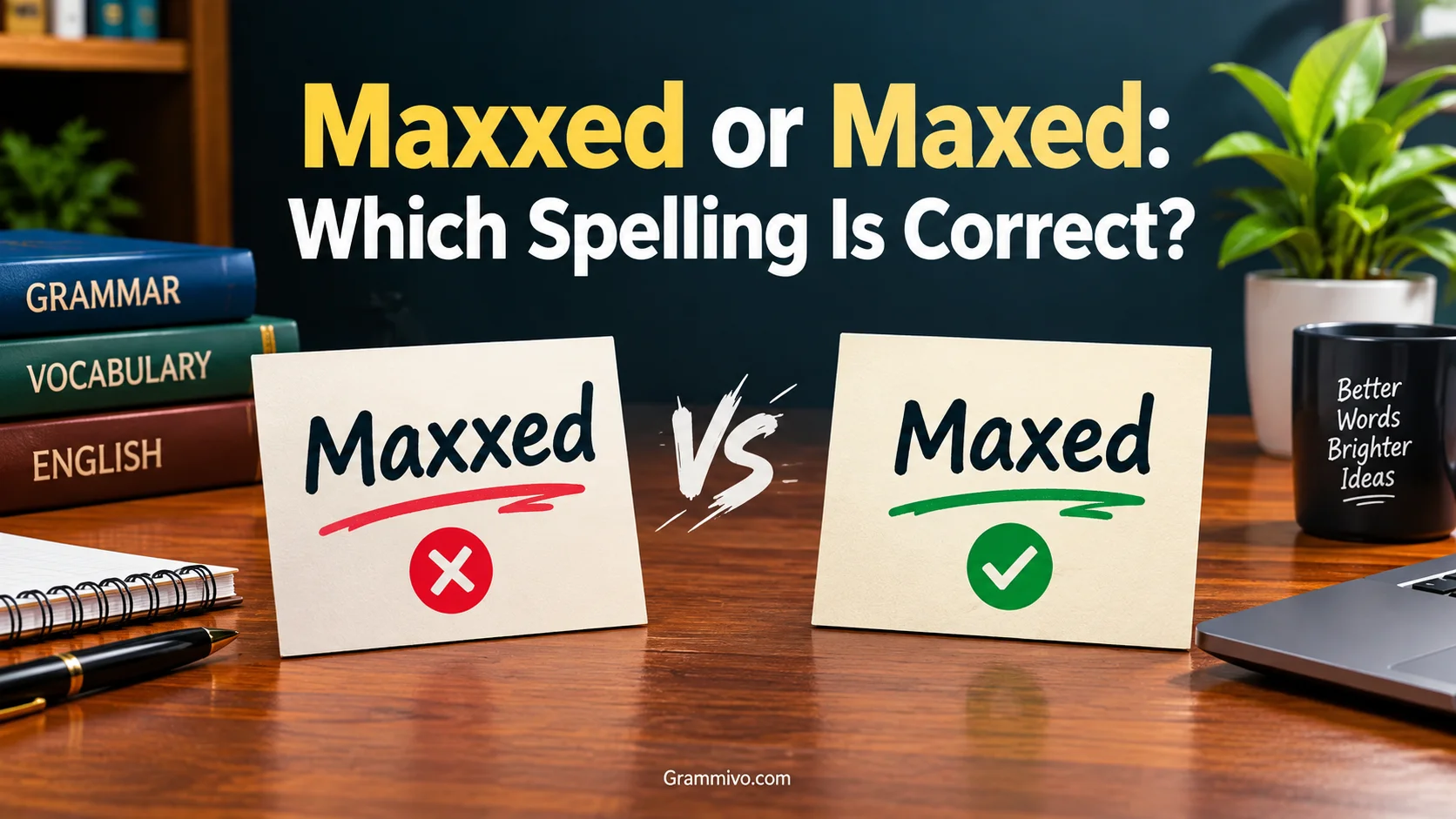
Maxxed or Maxed can confuse readers because both forms look similar, but standard English uses maxed as the correct spelling in formal writing. If you’re confused, think of this as a spelling puzzle rather than a difficult grammar rule.
Maxed is the standard spelling of the verb max, and it works as the simple past tense and past participle. English can be tricky with letters, especially when a word seems to need a double letter. However, this guide clears the confusion fast with simple examples.
You can use this form when you write correctly for school, work, an email, an article, a report, a school assignment, or other edited content. A dictionary supports maxed as the approved version, making it the conventional spelling for formal writing.
Quick Answer
Maxed is the standard and preferred spelling in American English. It is the past tense and past participle of max, meaning to reach, use, or push something to its maximum.
Maxxed is an informal variant that appears mainly in internet slang, gaming communities, fitness discussions, and other casual settings. It generally carries the same meaning as maxed, but the extra x isn’t necessary in standard English.
For example:
- Correct standard spelling: “I maxed out my credit card.”
- Correct standard spelling: “She maxed her character’s stats.”
- Informal variant: “My character is maxxed.”
- Standard form for formal writing: “The system is maxed out.”
A simple rule will keep you on solid ground: Use “maxed” in standard writing.
Comparison Overview
| Word | Standard Spelling | Meaning | Typical Usage |
| Maxed | Yes | Reached or used the maximum | Standard, professional, casual |
| Maxxed | Informal variant | Usually the same as maxed | Internet slang, gaming, casual writing |
| Maxed out | Yes | Reached the full limit or capacity | Very common expression |
| Max | Yes | The maximum or to reach the maximum | Noun, adjective, verb |
The important distinction isn’t usually meaning. Instead, it involves spelling and register.
If you encounter maxxed in a gaming post, social media comment, or casual message, the intended meaning will usually be clear. Still, familiarity doesn’t automatically make a spelling the preferred form for formal English.
Main Differences Between Maxxed or Maxed
The biggest difference between maxxed and maxed is their spelling and level of formality. Both forms can describe something that has reached its maximum, but maxed is the conventional form in standard English.
Maxed Is the Standard Spelling
Maxed is formed by adding -ed to the verb max.
The pattern is straightforward:
max + ed = maxed
For example:
- “He maxed the volume.”
- “I maxed out my credit card.”
- “She maxed her character’s abilities.”
- “The computer’s memory is maxed.”
The word can function as a simple past-tense verb or as a past participle.
Maxxed Is an Informal Variant
Maxxed uses a doubled x:
max + x + ed = maxxed
You may see this spelling in informal online communities. Gaming culture is particularly likely to produce creative spellings because players often develop their own shorthand and terminology.
For example:
“My character is completely maxxed.”
The reader can understand the sentence immediately. However, in edited standard English, maxed remains the conventional choice.
The Meaning Usually Stays the Same
The spelling difference doesn’t normally create a different definition.
Consider these sentences:
- “I maxed my character.”
- “I maxxed my character.”
Both generally mean that the character reached the maximum available level, stats, or upgrades.
The second sentence simply uses an informal spelling.
That’s an important distinction. Maxxed isn’t normally a different word with a separate meaning. It’s an alternate spelling used in particular contexts.
What Does “Maxed” Mean?
The verb max has several closely related meanings. In general, it means to reach, use, or increase something to its maximum level or limit.
The maximum could involve money, physical effort, performance, capacity, progress, or another measurable limit.
For example:
“She maxed out the machine’s capacity.”
Here, maxed out means she reached the machine’s full capacity.
The word can also describe reaching a personal or practical limit:
“He maxed out at 250 pounds on the bench press.”
In gaming, the meaning changes slightly depending on the system:
“I finally maxed my character.”
That could mean reaching the highest level or fully upgrading the character.
Maxed as a Past-Tense Verb
When max describes an action that happened in the past, use maxed.
Examples include:
- “I maxed the volume during the concert.”
- “They maxed their budget.”
- “She maxed her character’s skill tree.”
- “We maxed the available storage.”
- “He maxed out his credit card.”
The ending -ed marks the past tense.
Maxed as a Past Participle
Maxed can also work as a past participle.
For example:
- “The account is maxed out.”
- “The character has been maxed.”
- “The available capacity has been maxed out.”
In these constructions, maxed describes a completed state or action.
What Does “Maxxed” Mean?
Maxxed generally means the same thing as maxed. The difference comes from spelling rather than basic meaning.
The doubled x gives the word a more informal appearance. It can also make the spelling feel more emphatic or deliberately slangy.
You’ll most often encounter maxxed in places such as:
- Gaming forums
- Social media
- Online chats
- Fitness communities
- Informal blogs
- Memes
- Fan communities
- Casual text messages
For example:
“His build is totally maxxed.”
In a gaming conversation, nobody will likely wonder what the writer means. The context makes it obvious.
However, the spelling becomes less suitable when you’re writing for a formal audience.
Why Is It “Maxed” Instead of “Maxxed”?
The answer comes down to standard English spelling conventions.
The verb is max. Its regular past-tense form is maxed.
English doesn’t automatically double the final consonant whenever a word receives an -ed ending. Different spelling rules apply depending on the structure and pronunciation of the base word.
For max, the established standard form is simply:
max → maxed
The additional x in maxxed isn’t needed to preserve the pronunciation.
Compare:
- max → maxed
- mix → mixed
- fix → fixed
- tax → taxed
- wax → waxed
These examples show a useful pattern. Words ending in x don’t normally need another x before -ed.
That’s why maxed looks consistent with other common English verbs ending in x.
Is “Maxxed” a Word?
Maxxed is recognizable and widely understandable in informal usage. However, that doesn’t make it the preferred spelling in standard edited English.
English contains many informal variants that develop through communities, slang, advertising, social media, and online culture. Some eventually become established standard words. Others remain informal alternatives.
Maxxed generally belongs to the latter category.
This distinction matters because “people use it” and “it is the standard spelling” aren’t always the same thing.
For instance, if you’re quoting a social media post, preserving maxxed might make sense. If you’re writing a professional article, maxed is the safer choice.
Why People Write “Maxxed”
Several factors may encourage the double-x spelling:
- The base word already ends in x.
- Writers may want visual emphasis.
- Internet communities often create informal spellings.
- The spelling may resemble other words with doubled consonants.
- Gaming slang frequently favors expressive or unconventional language.
In other words, maxxed can be understood as a stylistic spelling rather than a necessary grammatical form.
Maxed Out vs. Maxed
One of the most common expressions involving maxed is maxed out.
The phrase means that something has reached its maximum available level, capacity, amount, or limit.
For example:
“My credit card is maxed out.”
This means the available credit has been fully used or the account has reached its credit limit.
Another example:
“The storage drive is maxed out.”
Here, the available storage has essentially reached capacity.
The phrase can also describe physical or personal limits:
“She maxed out during the final set.”
The exact meaning depends on context.
When to Use “Maxed”
Use maxed when the sentence naturally focuses on reaching a maximum.
- “He maxed the score.”
- “She maxed her character.”
- “The machine is maxed.”
- “I maxed the available storage.”
When to Use “Maxed Out”
Use maxed out when you want to emphasize that the limit has been completely reached or used.
- “I maxed out my credit card.”
- “The server is maxed out.”
- “The gym was maxed out with members.”
- “She maxed out her retirement contribution.”
Maxed out is especially common in everyday American English.
Read More: Acess or Access: Which Spelling Is Correct?
Maxed and Maxxed in Gaming
Gaming is one of the clearest places where you’ll encounter maxxed.
A game might have levels, attributes, weapons, abilities, equipment, or skill trees that can be upgraded. Once something reaches its highest available state, players often describe it as maxed.
For example:
- “My character is maxed.”
- “I finally maxed all my skills.”
- “That weapon is fully maxed.”
- “His armor is maxed out.”
In informal gaming communities, you may also see:
- “My build is maxxed.”
- “I maxxed the weapon.”
- “The stats are completely maxxed.”
The meaning remains clear in both cases.
Gaming Example
Imagine a game where a character can reach level 100.
A player reaches level 100 and upgrades every available ability. Another player might say:
“Your character is maxed.”
Someone writing casually online might instead type:
“Your character is maxxed.”
Both statements communicate the same basic idea. The first uses the standard spelling.
Maxed and Maxxed in Fitness
Fitness language provides another common setting for maxed.
Athletes and gym-goers often talk about reaching their maximum weight, effort, repetitions, or performance.
For example:
- “He maxed out at 315 pounds.”
- “I maxed my deadlift today.”
- “She maxed out on the final set.”
- “The athlete reached his max.”
In this context, maxed out can describe an attempt to reach a personal limit.
The informal spelling maxxed can appear in social media captions and fitness communities. However, maxed remains the conventional spelling.
Maxed Doesn’t Always Mean “Best”
A subtle point matters here.
If someone says:
“I maxed out at 200 pounds.”
That doesn’t necessarily mean 200 pounds represents an absolute human maximum. It usually means 200 pounds was that person’s maximum under the particular circumstances.
The same principle applies elsewhere. A max can be a system limit, a personal limit, or a temporary limit.
Maxed in Finance
Financial language provides another familiar use.
A credit card can have a fixed credit limit. If someone uses the entire available amount, the card is commonly described as maxed out.
For example:
“He maxed out his credit card.”
The sentence means that he used the available credit up to its limit.
This doesn’t mean the card itself stopped functioning forever. It describes the account’s available credit at that point.
Other examples include:
- “She maxed out her credit limit.”
- “The card is completely maxed out.”
- “They don’t want to max out their available credit.”
Because financial writing often requires precision, maxed is preferable to the informal maxxed.
Maxed in Technology
Technology creates countless situations where something can reach capacity.
You might max out:
- Storage
- Memory
- CPU usage
- Server capacity
- Bandwidth
- Device settings
- Processing resources
For example:
“The laptop’s memory is maxed out.”
This indicates that available memory has reached a very high or full level.
Another example:
“The server maxed out during the traffic spike.”
Here, the verb describes the system reaching its available capacity.
Again, maxed works naturally in technical writing.
Maxed or Maxxed in American English
In US English, maxed is the standard spelling.
You’ll encounter it in ordinary conversation, edited publications, professional writing, and technical contexts.
Maxxed is more likely to appear in informal communication.
The distinction can be summarized this way:
| Writing Situation | Preferred Form |
| Academic writing | Maxed |
| Professional writing | Maxed |
| News or edited content | Maxed |
| Technical documentation | Maxed |
| Everyday conversation | Maxed |
| Gaming chat | Maxed or informal maxxed |
| Social media slang | Maxed or informal maxxed |
| Casual internet posts | Maxed or informal maxxed |
If you’re unsure, choose maxed.
Maxed or Maxxed in British English
British English also commonly uses maxed for the past tense of max.
The spelling maxxed doesn’t represent a standard British alternative in the way some genuine US-British spelling pairs do.
For example, color and colour are established regional spelling differences. Maxed and maxxed aren’t comparable in that way.
The double-x form is better understood as an informal spelling variant rather than a standard British spelling.
Common Mistakes With Maxed and Maxxed
The most common mistake is treating maxxed as though the extra x were required.
It isn’t.
Mistake: Writing “Maxxed” in Formal Content
If you’re preparing a report, article, application, or academic assignment, use maxed.
Better:
“The available budget was maxed.”
Mistake: Assuming Double X Changes the Meaning
It normally doesn’t.
Maxed and maxxed generally refer to the same underlying idea when maxxed appears as an informal variant.
Mistake: Confusing “Max” With “Maximum”
Max can work as both a noun and a verb.
For example:
- “That’s the max.”
- “We need to max the available space.”
Maximum is a more formal noun or adjective:
- “The maximum capacity is 500 people.”
- “Do not exceed the maximum limit.”
The words are related, but they don’t function identically in every sentence.
Mistake: Overusing “Maxed Out”
Sometimes maxed is enough.
For example:
“The character is maxed.”
You don’t always need:
“The character is maxed out.”
Both can work, but context determines which sounds more natural.
Maxed vs. Maxxed: Examples in Sentences
| Context | Standard Example | Informal Variant |
| Gaming | “My character is maxed.” | “My character is maxxed.” |
| Fitness | “I maxed out at 300 pounds.” | “I maxxed out at 300 pounds.” |
| Finance | “She maxed out her credit card.” | Rarely used in formal financial writing |
| Technology | “The storage is maxed.” | “The storage is maxxed.” |
| Casual conversation | “We’ve maxed the budget.” | “We’ve maxxed the budget.” |
| Online slang | “His build is maxed.” | “His build is maxxed.” |
The table highlights an important pattern: maxed works across virtually every context, while maxxed is much more dependent on informal style.
FAQs:
1. Is “maxed” or “maxxed” correct?
Maxed is the standard spelling in English. Maxxed is an informal variant that you may see online, especially in gaming and casual writing.
2. Is “maxxed” a real word?
Yes, maxxed exists in informal usage. However, it is not the usual standard spelling, so maxed is preferable in formal and edited writing.
3. What does “maxed” mean?
Maxed is the past tense and past participle of max. It means reaching or using the maximum amount, level, or limit of something.
4. Can I use “maxxed” in gaming?
You may see maxxed in gaming chats and other casual online spaces. For standard writing, however, maxed is the safer choice.
5. Should I use “maxed” in formal writing?
Yes. Use maxed in emails, articles, reports, school assignments, and other formal or edited content.
Conclusion:
The difference between maxxed or maxed is mainly about standard spelling and informal usage. Maxed is the conventional form and works well in formal writing, while maxxed appears mostly in casual online language. When you need clear, polished English, choose maxed.
