
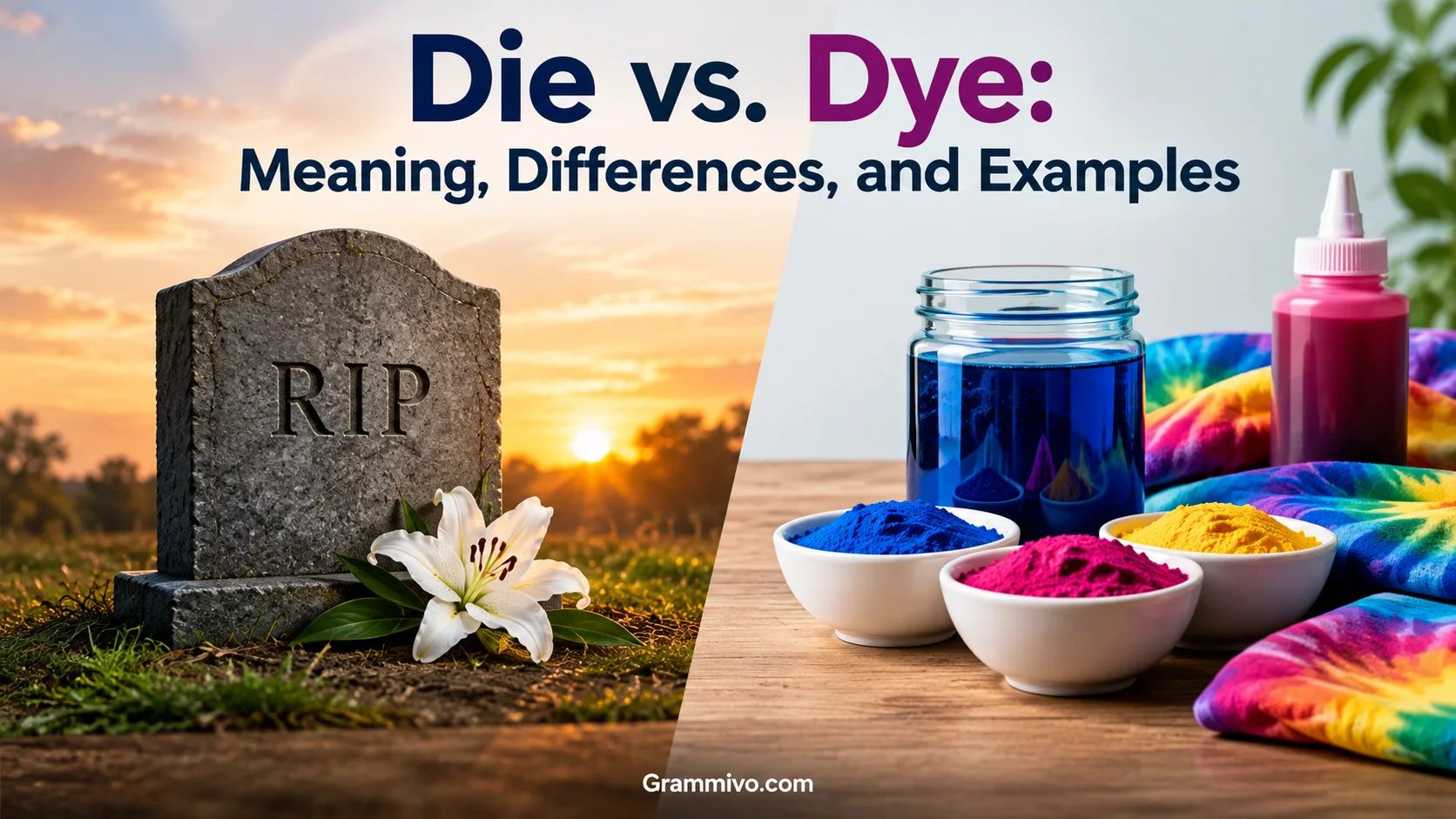
The English language contains many words that sound alike but have completely different meanings. A common example is die or dye. Both are pronounced the same way and sound exactly alike, but their definitions and uses are not the same.
Die is a verb that means to stop living or become dead, and it relates to death, life, or the stopping function of something. Dye, however, can be a noun for a substance used to add color, or a verb meaning to change the color of something.
These homophones have identical pronunciation, which makes them easy to mix up in writing, especially when writers accidentally confuse them in emails, essays, social media posts, or everyday conversations. When searching for dye or die, the words may look and sound similar, but the difference becomes clear once you understand their meaning and function.
Quick Answer
Die and dye are both correct English words, but they have different meanings.
- Die usually means to stop living. It can also refer to a single gaming cube or a manufacturing tool.
- Dye means to add or change color, either as a verb or a noun.
- Die and dye are pronounced the same in standard English.
- Dying means approaching or experiencing death.
- Dyeing means changing the color of something.
- If you’re talking about death, use die.
- If you’re talking about color, use dye.
A simple memory trick works well: dye has a “y” for yarn, which you can dye.
Comparison Overview
| Word | Part of Speech | Main Meaning | Example |
| Die | Verb | To stop living | Plants die without water. |
| Die | Noun | A single gaming cube | Roll the die. |
| Die | Noun | A tool used to shape or cut material | The machine uses a metal die. |
| Dye | Verb | To change the color of something | She wants to dye her hair. |
| Dye | Noun | A substance that colors something | The blue dye stained the fabric. |
| Dying | Verb form | Approaching or experiencing death | The old tree is dying. |
| Dyeing | Verb form | Changing something’s color | They are dyeing the fabric. |
Main Differences Between Die vs. Dye
The biggest difference between die and dye is their meaning. Although they sound identical, they don’t perform the same job in a sentence.
Die most commonly describes the end of life. It can also function as a noun in gaming and technical manufacturing contexts.
Dye, on the other hand, concerns color. As a verb, it means to change the color of something. As a noun, it means the substance used to create that color.
| Difference | Die | Dye |
| Core meaning | Stop living | Add or change color |
| Pronunciation | /daɪ/ | /daɪ/ |
| Verb | Yes | Yes |
| Noun | Yes | Yes |
| Common context | Life, games, manufacturing | Hair, fabric, textiles, coloring |
| Example | The plant may die. | She will dye the fabric. |
The spelling difference is small, but the semantic difference is enormous. One misplaced letter can turn a harmless sentence about hair into an entirely different statement.
What Does “Die” Mean?
The word die has several established meanings in English. Its most familiar meaning functions as a verb related to life and death.
Die as a Verb
As a verb, die means to stop living. You can use it for humans, animals, plants, and other living organisms.
For example:
- The flowers will die without water.
- Many insects die during the winter.
- The plant started to die after its roots were damaged.
- No living creature can avoid death forever.
The word can also appear in figurative expressions. Something that isn’t literally alive can metaphorically die when it loses activity, popularity, energy, or relevance.
For example:
- The conversation suddenly died.
- The music gradually died away.
- Interest in the product began to die down.
Here, die doesn’t necessarily describe biological death. English frequently uses life-and-death vocabulary metaphorically.
Grammatical Forms of “Die”
The verb changes depending on tense and grammatical structure.
| Form | Example |
| Die | Plants die without water. |
| Dies | The flower dies quickly in extreme heat. |
| Died | The plant died last summer. |
| Dying | The tree is dying. |
One important spelling point appears in the present participle. When you add -ing to die, the result is dying, not dieing.
That distinction matters because dying and dyeing have completely different meanings.
Die as a Noun
Die can also function as a noun. In gaming, a die is a single cube marked with numbers or symbols.
For example:
Roll the die and see what number comes up.
The familiar word dice usually refers to more than one such object in modern everyday English.
So you can remember:
- One die
- Two dice
For example:
- She rolled one die.
- They rolled two dice.
In everyday speech, however, people sometimes use dice for both singular and plural. In formal writing, die remains the traditional singular form.
Die in Manufacturing
The noun die has another specialized meaning in manufacturing and engineering.
A die is a tool or device used to cut, shape, form, draw, or otherwise work material. Depending on the manufacturing process, dies can work with metals, plastics, wires, and other materials.
For example:
- The factory uses a metal die to shape the parts.
- A stamping die creates precise forms from sheet metal.
- The wire passes through a die to reduce its diameter.
This technical meaning has nothing to do with death. Context tells you which sense of die applies.
What Does “Dye” Mean?
Dye relates to color. It can function as both a verb and a noun.
If you change the color of hair, fabric, yarn, or another material using a coloring substance, you dye it.
Dye as a Verb
As a verb, dye means to change the color of something.
For example:
- She plans to dye her hair brown.
- They dyed the fabric blue.
- He wants to dye the shirt black.
- The artist dyed the yarn several bright colors.
The object receiving the color comes after the verb.
Subject + dye + object
For example:
Maria dyed her hair red.
Here, Maria performs the action. Hair receives the action, and red describes the resulting color.
Dye as a Noun
As a noun, dye refers to a substance used to color something.
For example:
- The fabric absorbed the dye quickly.
- The manufacturer used a natural dye.
- This dye produces a deep purple color.
- The blue dye left a stain on the table.
The noun doesn’t describe the action. It identifies the coloring substance itself.
This gives you an easy distinction:
Dye = the substance or the action related to coloring.
Where Is Dye Used?
Dyes appear in many everyday and industrial settings.
Common examples include:
- Hair coloring
- Clothing
- Cotton
- Wool
- Silk
- Yarn
- Leather
- Paper
- Decorative crafts
- Industrial materials
Different materials require different dyeing methods. A dye that works effectively on one fiber might not produce the same result on another.
Die vs. Dye: Examples in Sentences
Context makes the distinction much easier once you see these words in action.
Examples With “Die”
- Some plants die when temperatures become extremely cold.
- The battery may die before the trip ends.
- The flowers died after several days without water.
- The conversation slowly died down.
- Roll the die to determine who goes first.
- The machine uses a specialized die to shape the metal.
Notice that die can appear in completely different contexts.
Examples With “Dye”
- I want to dye my hair.
- She decided to dye the dress green.
- They used natural dye to color the wool.
- The red dye spread through the fabric.
- This product contains a blue dye.
- She is learning how to dye yarn.
Every example involves color in some way.
Die and Dye in the Same Sentence
You can use both words in one sentence when their meanings call for it.
For example:
If the plant doesn’t receive water, it may die, but you can dye its pot any color you like.
The words sound the same when spoken. Their meanings become clear from the surrounding words.
Another example:
The artist didn’t let the colorful fabric die visually because she used a bright dye.
Here, die is being used figuratively while dye refers to coloring.
Read More: Inact or Enact: Which Spelling Is Correct?
Die vs. Dye in Different Contexts
Context often acts like a signpost. When you identify the subject of the sentence, the correct word becomes much easier to choose.
Death and Life
Use die when discussing the end of life.
Many plants die without enough sunlight.
You can also use die metaphorically when something loses activity or disappears.
The excitement began to die after the delay.
Hair and Beauty
Use dye when changing hair color.
She wants to dye her hair blonde.
The noun also appears in this context:
The salon selected a permanent dye.
Clothing and Fabric
Use dye when changing the color of fabric.
They dyed the cotton fabric purple.
You can also refer to the coloring substance:
The fabric absorbed the dye evenly.
Games
Use die when referring to one traditional gaming cube.
Roll the die again.
If you’re talking about multiple cubes, dice is the traditional plural.
The player rolled two dice.
Manufacturing
Use die for the specialized tool used to shape or process materials.
The technician replaced the damaged die.
This meaning appears more often in technical, engineering, and manufacturing writing than in everyday conversation.
Common Mistakes With Die and Dye
The most common mistake happens when someone writes about changing color.
Incorrect:
I want to die my hair.
Correct:
I want to dye my hair.
The first sentence uses a word associated with death. The second correctly describes changing hair color.
Another common error occurs in the opposite direction:
The flowers will dye without water.
That spelling is incorrect if the intended meaning is that the flowers will stop living.
Correct:
The flowers will die without water.
Why Do People Confuse Them?
The main culprit is pronunciation.
Die and dye are homophones. That means they have the same pronunciation but different meanings and spellings.
When you hear the sentence rather than see it, there is no audible clue telling you which spelling belongs there.
For example:
She wants to dye her hair.
and
The plant may die.
The key words sound identical.
Written English has to carry the distinction through spelling and context.
Dying vs. Dyeing
This is where the confusion gets particularly sneaky.
Dying and dyeing look similar, sound similar, and contain almost the same letters. Yet their meanings differ completely.
What Does “Dying” Mean?
Dying is the present participle of die.
It can describe someone or something approaching death.
Examples:
- The tree is dying.
- The animal appears to be dying.
- The flowers are dying from lack of water.
It can also appear in figurative expressions:
The old tradition is dying out.
Here, the tradition isn’t a living organism. The word describes its gradual disappearance.
What Does “Dyeing” Mean?
Dyeing is the present participle of dye.
It means changing the color of something.
Examples:
- She is dyeing her hair.
- They are dyeing the fabric.
- He spent the afternoon dyeing yarn.
The extra e helps preserve the connection to dye.
Compare:
The plant is dying.
She is dyeing the fabric.
The first involves death. The second involves color.
Dying vs. Dyeing Examples
| Word | Base Word | Meaning | Example |
| Dying | Die | Approaching death | The plant is dying. |
| Dyeing | Dye | Changing color | She is dyeing the fabric. |
A useful memory trick is simple:
Dying = die + ing
Dyeing = dye + ing
The words preserve their original meanings when you look closely.
Die vs. Dye vs. Dying vs. Dyeing
These four words form a useful little spelling family, but each one has a specific job.
| Word | Meaning | Example |
| Die | Stop living | Some plants die without water. |
| Dye | Change color | We will dye the fabric blue. |
| Dying | Approaching or experiencing death | The tree is dying. |
| Dyeing | Changing color | She is dyeing her hair. |
When you’re unsure, ask one question:
Is the sentence about death or color?
If it’s about death, choose die or dying.
If it’s about color, choose dye or dyeing.
That quick check solves most everyday confusion.
How to Remember the Difference Between Die and Dye
A good memory trick should be short enough to use when you’re writing quickly.
Try this:
Die = death. Dye = color.
You can also associate dye with dyed fabric.
Think about a white T-shirt being transformed into a blue one. You dye the shirt.
Another useful connection is dye + yarn. Yarn is commonly dyed in different colors for knitting, weaving, and crafts.
For die, connect the word with phrases such as:
- die of old age
- die from an illness
- die out
- die down
For dye, think:
- dye hair
- dye clothes
- dye fabric
- dye yarn
The trick isn’t fancy. That’s exactly why it works.
FAQs:
1. What is the difference between die and dye?
Die means to stop living or become dead. Dye means a substance used to add color or the act of changing something’s color.
2. Is “dye” the correct word for coloring hair?
Yes. Use dye when you mean changing the color of hair. For example, “She wants to dye her hair brown.”
3. Why are die and dye confusing?
Die and dye are homophones. They have the same pronunciation but different spellings, meanings, and uses.
4. Is “I want to die my hair” correct?
No, not if you mean coloring your hair. The correct sentence is, “I want to dye my hair.” Using die changes the meaning completely.
5. How can you remember die vs. dye?
Connect die with death and dye with color. When you write about coloring hair, fabric, or clothing, choose dye.
Conclusion:
Understanding die vs. dye becomes easy when you remember their basic meanings. Die relates to death or stopping life, while dye relates to changing color. Although these words sound the same, their spelling and meanings are completely different. Using the correct word helps you write clearly and avoid confusing or embarrassing mistakes.
