
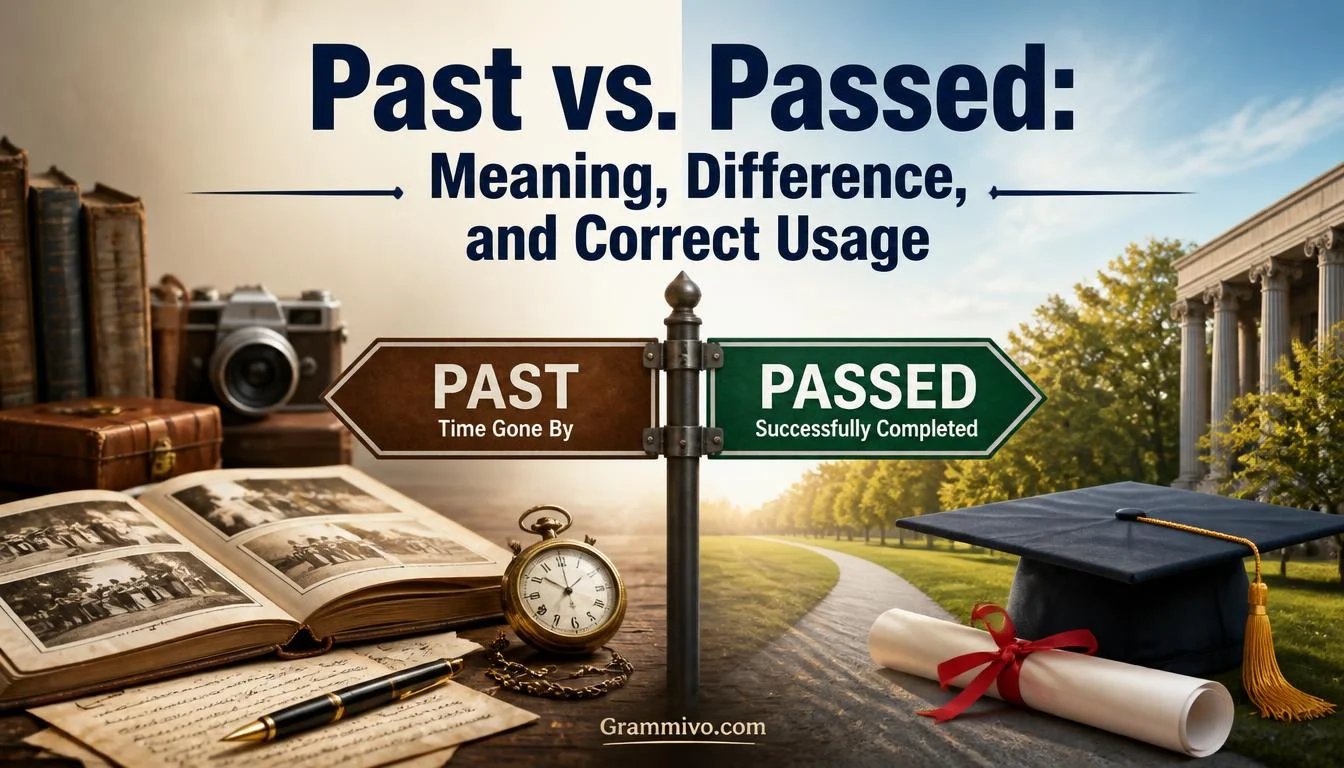
Past vs. passed is a classic English word pair that can trip you up because both words sound almost identical in everyday speech. They look similar, too, but they don’t perform the same job in a sentence. The easiest distinction is this: past usually relates to an earlier time, a position beyond something, or something previous. Passed is a form of the verb pass and describes an action that already happened.
For example, you can say, “We walked past the library,” because past describes movement beyond a place. You can also say, “We passed the library,” because passed describes the completed action of passing it.That small difference creates plenty of confusion. The problem becomes even trickier when both words appear in sentences about time, movement, or change.
Quick Answer
Past and passed have different meanings and grammatical functions.
- Past can be a noun, adjective, adverb, or preposition.
- Passed is the past tense and past participle of the verb “pass.”
- Use past when referring to previous time, something former, or movement beyond a point.
- Use passed when describing the completed action of passing, completing, handing, or moving through something.
Quick examples
- Past: We learned from our past mistakes.
- Past: She walked past the bank.
- Past: It is half past six.
- Passed: She passed the bank on her way home.
- Passed: He passed the driving test.
- Passed: Three hours passed quickly.
A useful memory trick is:
Past describes a time, position, or state. Passed describes an action.
That rule won’t cover every possible sentence, but it works remarkably well in everyday writing.
Comparison Overview
| Word | Part of Speech | Main Meaning | Example |
| Past | Noun | Previous time or events | We can’t change the past. |
| Past | Adjective | Former or previous | She learned from past mistakes. |
| Past | Adverb | Beyond a point | The car drove past. |
| Past | Preposition | Beyond a person, place, or point | He walked past the school. |
| Past | Preposition | After a particular time | It is ten minutes past noon. |
| Passed | Verb | Completed action of passing | The car passed us. |
| Passed | Verb | Successfully completed something | She passed the exam. |
| Passed | Verb | Handed or transferred something | He passed me the salt. |
| Passed | Verb | Time moved forward | Several hours passed. |
The key distinction isn’t spelling alone. Past has several grammatical roles, while passed functions as a verb form.
That difference explains why these words can appear in similar sentences without being interchangeable.
Main Differences Between Past and Passed
The biggest difference between past and passed comes down to meaning and grammatical function.
Past often points to something that exists beyond the present. It can describe an earlier period, a previous event, a position beyond something, or a time after a particular hour.
Passed, on the other hand, tells you that someone or something performed the action of passing. It is the simple past and past participle form of pass.
Consider these two sentences:
- The runner moved past the finish line.
- The runner passed the finish line.
Both can be grammatical, but they emphasize the idea differently. In the first sentence, past functions as a preposition showing position or movement beyond the finish line. In the second, passed is the verb describing what the runner did.
This distinction becomes much clearer when you look at each word separately.
What Does “Past” Mean?
Past generally refers to something that came before the present or lies beyond a particular point.
Its meaning changes slightly depending on its grammatical role. That’s why dictionaries give several definitions for past rather than treating it as a single-purpose word.
You can use past to talk about history:
- The past can teach us useful lessons.
- She doesn’t like discussing her past.
- People often remember the past differently.
You can also use it to describe something previous:
- He has past experience in marketing.
- Her past mistakes helped her become more careful.
- The past president attended the ceremony.
Then there’s physical movement:
- We walked past the restaurant.
- The dog ran past me.
- Drive past the school and turn left.
Finally, past commonly appears in time expressions:
- It is ten minutes past four.
- The meeting continued past noon.
- They stayed awake past midnight.
So, past isn’t simply another form of pass. It has its own meanings and grammatical functions.
What Does “Passed” Mean?
Passed is the past tense and past participle of pass.
The verb pass has many meanings, so passed can appear in several different situations.
It can describe physical movement:
- The car passed our house.
- She passed the cyclist on the left.
- We passed several small towns.
It can describe successfully completing an examination or requirement:
- He passed his final exam.
- She passed the driving test on her second attempt.
- They passed the safety inspection.
It can describe handing something to another person:
- Please pass the bread.
- She passed me her phone.
- He passed the ball to his teammate.
It can also describe time moving forward:
- The afternoon passed quickly.
- Several months passed before they met again.
In every case, passed connects back to the verb pass.
Past as a Noun
When past functions as a noun, it usually means a previous period of time or the events that happened before now.
The expression the past is especially common.
For example:
- You can’t change the past.
- The past still influences the present.
- They talked about their past.
- History helps us understand the past.
Here, past doesn’t describe an action. It names a period or collection of previous events.
This is one of the easiest uses to recognize.
If you can replace past with something like previous time, earlier years, or previous events, you’re probably using the noun correctly.
Common Expressions With “Past”
Several everyday expressions use past as a noun or part of a noun phrase:
- in the past
- the distant past
- the recent past
- from the past
- a troubled past
- leave the past behind
- learn from the past
- forget the past
For example, “Technology has changed dramatically in the recent past” refers to a period that occurred before the present.
You wouldn’t write passed in these expressions because passed is a verb.
Past as an Adjective
Past also works as an adjective when it describes something that happened earlier or something that is no longer current.
Consider:
- We discussed past mistakes.
- She has learned from past experiences.
- The past president gave a speech.
- Several past employees attended the reunion.
Here, past modifies another noun.
The phrase past mistakes, for instance, means mistakes made previously. Likewise, past experiences means experiences that happened earlier.
A useful test is to ask:
Does “past” describe a noun that happened or existed earlier?
If so, past is likely functioning as an adjective.
Past as a Preposition
One of the most important uses of past involves movement or position.
When past works as a preposition, it generally means beyond a person, place, object, or point.
For example:
- She walked past the store.
- The child ran past his mother.
- We drove past the stadium.
- The train moved past the platform.
In these sentences, past introduces the object that comes after it.
Look closely at this sentence:
The cyclist rode past the parked cars.
The cyclist moved beyond the location of the parked cars. Past tells you about that spatial relationship.
Past for Time
The same word can also describe time beyond a particular point.
For example:
- It is five minutes past three.
- The meeting continued past noon.
- He stayed awake past midnight.
- The store remains open past eight.
This use sometimes causes confusion because passed also appears in sentences about time.
Compare:
- It is ten minutes past six.
- Ten minutes passed before she arrived.
The first sentence identifies a time relative to six o’clock. The second describes time moving forward.
That’s a crucial difference.
Past as an Adverb
Past can also function as an adverb when it describes movement beyond a point without directly introducing an object.
For example:
- The car drove past.
- She walked past without stopping.
- The runner went past quickly.
In these sentences, past tells you that someone or something moved beyond a particular location or point.
Compare:
- The car drove past the house.
- The car drove past.
In the first sentence, past is followed by the object the house. In the second, the object is understood from context.
Passed as the Past Tense of “Pass”
The word passed becomes much easier to understand when you remember its base verb.
Pass → passed
For example:
- I pass the store every morning.
- I passed the store yesterday.
The first sentence uses the present tense. The second uses the past tense.
This simple verb relationship explains many common sentences:
- She passes the building every day.
- She passed the building yesterday.
If you’re describing an action that happened before now, passed may be the correct form of pass.
Read More: Freshman vs. Freshmen: Meaning, Difference, and Correct Usage
Passed for Physical Movement
When someone or something moves beyond another person, vehicle, object, or location, passed can describe that completed movement.
For example:
- The truck passed us on the highway.
- She passed several houses during her walk.
- The train passed the station without stopping.
- The athlete passed two competitors near the finish.
Notice that passed acts as the main verb in each sentence.
This creates a useful contrast:
The runner walked past me.
Here, walked is the main verb and past describes where the runner moved.
The runner passed me.
Here, passed itself is the main verb.
Both sentences can describe similar events. Their grammar differs.
Passed for Tests, Exams, and Requirements
One of the most familiar uses of passed involves tests.
When someone successfully completes an examination or meets a required standard, you use passed.
Examples include:
- She passed her math exam.
- He passed the driving test.
- They passed the certification exam.
- The building passed the safety inspection.
The opposite is failed:
- She passed the test.
- She failed the test.
You wouldn’t use past in this construction.
Incorrect:
She past the exam.
Correct:
She passed the exam.
The reason is straightforward. Passed is the verb describing the completed action.
Passed for Giving or Handing Something
Passed can also mean gave or handed something to someone.
For example:
- He passed me the salt.
- She passed the document to her manager.
- The teacher passed the papers around the classroom.
- Please pass the remote.
Here, passed doesn’t involve moving past a physical location. Instead, it describes transferring something from one person to another.
That meaning still comes from the verb pass.
Passed for Time
English frequently uses passed to describe time moving forward.
Examples include:
- Two hours passed quickly.
- Several years passed before they met again.
- The afternoon passed without incident.
- A few minutes passed before the doctor arrived.
This construction is particularly important because past also appears in time-related sentences.
Compare these carefully:
Past:
It is twenty minutes past five.
Passed:
Twenty minutes passed while we waited.
The first sentence tells you when it is. The second tells you what happened to time.
That’s the distinction in a nutshell.
Past vs. Passed: Side-by-Side Examples
| Sentence | Correct Word | Explanation |
| We walked ___ the school. | past | It shows movement beyond a place. |
| We ___ the school on our way home. | passed | It describes the completed action of passing. |
| I can’t change the ___. | past | It refers to previous time. |
| She ___ the exam. | passed | It describes successful completion. |
| It is ten minutes ___ noon. | past | It indicates a time after noon. |
| Ten minutes ___. | passed | It describes time moving forward. |
| He has learned from his ___. | past | It means previous experiences or events. |
| The car ___ us on the highway. | passed | It describes an action. |
| They drove ___ the museum. | past | It shows movement beyond the museum. |
| Several years ___. | passed | It describes the passage of time. |
How to Choose Between Past and Passed
When you’re unsure, don’t rely on how the word sounds. Ask what role it plays.
Use “Past” When You Mean:
- A previous period of time
- Previous events or experiences
- Something former
- Movement beyond a point
- A position beyond something
- A time after a particular hour
Examples:
- In the past, people traveled differently.
- She walked past the office.
- It is five minutes past nine.
- He regrets some past decisions.
Use “Passed” When You Mean:
- The completed action of pass
- Moving beyond someone or something
- Successfully completing a test
- Handing something to another person
- Time moving forward
Examples:
- She passed the other runner.
- He passed the exam.
- Please pass the butter.
- Three hours passed.
Past vs. Passed in Common Sentences
Some constructions deserve extra attention because both words can appear in closely related sentences.
“I Walked Past the House” vs. “I Passed the House”
Both sentences can be correct.
I walked past the house.
Here, walked is the verb. Past describes the direction or position of the movement.
I passed the house.
Here, passed is the verb. It tells you that the speaker moved beyond the house.
The first sentence emphasizes walking. The second emphasizes the act of passing the house.
This is a useful grammatical pattern:
Verb + past + object
She walked past the library.
Passed + object
She passed the library.
FAQs:
Is it “past” or “passed the house”?
Both can be correct depending on the sentence.
She walked past the house uses past as a preposition. She passed the house uses passed as the main verb.
Is it “passed time” or “past time”?
Both expressions exist, but they mean different things.
Passed time can describe time that has moved forward, as in “The time passed quickly.” Past time can mean a previous period or a time beyond a particular point, depending on context.
Is “past” a verb?
In standard modern English, past generally isn’t used as the ordinary past-tense form of pass. The verb form is passed.
For example:
- Correct: She passed the store.
- Incorrect: She past the store.
Is “passed” always a verb?
Passed is a verb form. It can function as the simple past or past participle of pass.
Examples include:
- She passed the test.
- The car passed us.
- The deadline has passed.
What is an easy way to remember past vs. passed?
Think of past as previous or beyond and passed as an action.
If you’re talking about something that happened earlier, use past. If you’re describing someone or something that performed the action of pass, use passed.
Conclusion:
The difference between past and passed becomes much simpler once you stop treating them as interchangeable sound-alikes. Use past for previous time, former situations, movement beyond a point, and expressions such as past noon or past midnight. Use passed when you’re describing the completed action of pass, whether that means moving beyond something, succeeding on a test, handing something over, or describing time moving forward.
