
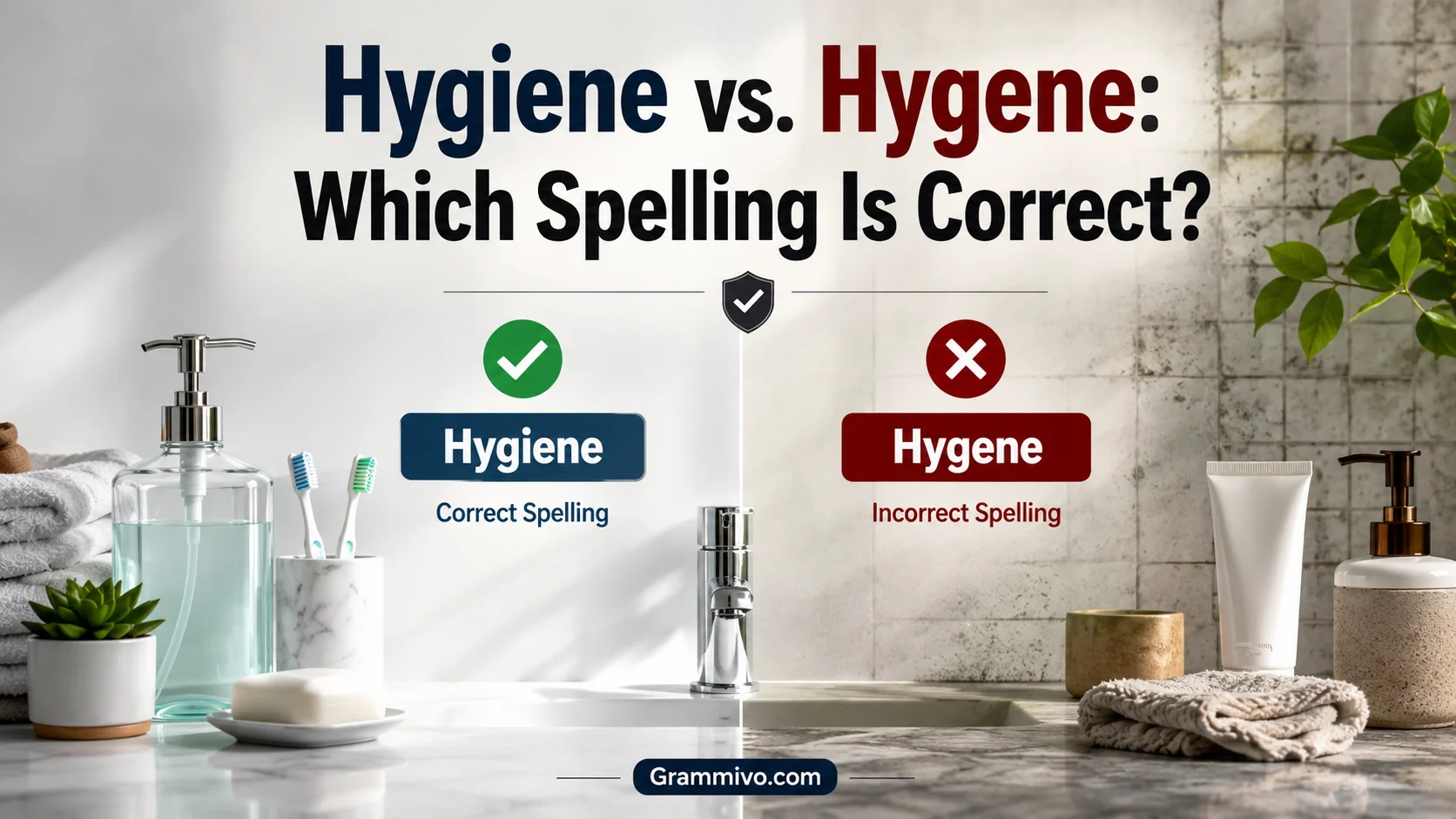
Have you ever wondered whether the correct spelling is hygiene or hygene? You’re not alone. This word often causes confusion because its pronunciation doesn’t make every letter obvious. When you’re writing about cleanliness, personal care, or health, even a small spelling mistake can make your work look less polished.
The correct spelling in American English is hygiene. The spelling hygene is a common misspelling and isn’t accepted as a standard alternative. Hygiene refers to practices and conditions that help maintain health, prevent illness, and promote cleanliness.
Although the difference between these two spellings seems small, remembering the correct form matters in school assignments, workplace documents, healthcare information, and everyday communication. Once you understand the spelling pattern and meaning, you’ll find it much easier to use the word correctly.
Quick Answer
Hygiene is the correct spelling in American English. Hygene is a misspelling and should be avoided in standard writing.
Hygiene is the practice of maintaining cleanliness to protect health and prevent the spread of disease. It includes activities such as washing your hands, brushing your teeth, bathing regularly, and handling food safely.
Example: Good personal hygiene helps reduce the spread of germs and supports overall health.
Remember the spelling: H-Y-G-I-E-N-E. The letter i after g is the detail that people often forget.
Comparison Overview
The following table highlights the main differences between hygiene and hygene.
| Feature | Hygiene | Hygene |
| Spelling status | Correct | Incorrect in standard English |
| Meaning | Practices that maintain cleanliness and health | No recognized standard meaning as an English word |
| Part of speech | Noun | Not a standard English noun |
| Pronunciation | HY-jeen | Intended pronunciation usually matches hygiene |
| American English usage | Standard | Misspelling |
| British English usage | Standard | Misspelling |
| Example | Good hygiene protects your health. | Good hygene protects your health. |
| Recommended use | Use in all appropriate contexts | Correct it to hygiene |
The key difference is straightforward: hygiene is the established English word, while hygene is a spelling error. English spelling can be tricky, but this distinction has a simple solution. Include the missing i whenever you write the word.
Main Differences Between Hygiene vs. Hygene
The difference between hygiene and hygene goes beyond one missing letter. Only one spelling represents the standard word used in dictionaries, educational materials, and professional communication.
Meaning of Hygiene
Hygiene refers to practices, habits, and conditions that help preserve health by maintaining cleanliness and reducing exposure to harmful microorganisms.
The word covers more than taking a shower or keeping your surroundings tidy. It also includes proper food handling, safe sanitation, oral care, and other measures that reduce the risk of infection.
For example, washing your hands before preparing dinner is a hygiene practice. Cleaning kitchen surfaces and storing perishable food at safe temperatures are also part of maintaining good hygiene.
Hygiene plays an important role in individual health and public safety. When people follow appropriate hygiene practices, they can reduce the spread of many infectious diseases.
Common types of hygiene include:
- Personal hygiene: Bathing, washing your hands, changing clothes, and keeping your body clean.
- Oral hygiene: Brushing your teeth, cleaning between your teeth, and caring for your gums.
- Food hygiene: Handling, preparing, cooking, and storing food safely.
- Hand hygiene: Washing your hands with soap and water or using an appropriate alcohol-based hand sanitizer.
- Environmental hygiene: Keeping homes, workplaces, and shared spaces clean and sanitary.
- Public hygiene: Maintaining sanitation systems, safe water supplies, and clean community environments.
Each category addresses different health risks. For instance, brushing your teeth helps control plaque, while proper food handling helps prevent foodborne illness.
Example sentences:
- Good hygiene helps protect children from many preventable infections.
- Regular brushing and flossing support proper oral hygiene.
- Restaurant employees must follow appropriate food hygiene practices.
- Washing your hands before eating is a simple but effective hygiene habit.
- Schools can promote better personal hygiene by providing access to clean water and handwashing facilities.
In each sentence, hygiene refers to cleanliness-related practices or conditions that support health.
Is Hygene a Correct Spelling?
No. Hygene is not the standard spelling of the English word hygiene.
Although you might encounter hygene in online posts, informal messages, search queries, or poorly proofread documents, those appearances don’t make it an accepted spelling variant.
The correct form is hygiene, with an i between the letters g and e.
Consider these examples:
- Incorrect: Children should learn good personal hygene.
- Correct: Children should learn good personal hygiene.
Here’s another example:
- Incorrect: Proper oral hygene helps maintain healthy teeth.
- Correct: Proper oral hygiene helps maintain healthy teeth.
The meaning remains understandable when someone writes hygene, but the spelling is still incorrect. In academic, professional, and health-related writing, use the standard form.
It’s also helpful to distinguish a misspelling from a legitimate regional variant. Some English words have different accepted spellings in American and British English. For example, Americans usually write color, while British writers often use colour. However, hygiene is the standard spelling in both varieties.
You don’t need to choose between an American and British version. Simply write hygiene.
Read More: Organizing vs. Organising: Which Spelling Is Correct?
Hygiene vs. Hygene: Spelling Breakdown
One of the easiest ways to avoid this mistake is to examine the letters individually.
The correct spelling contains seven letters:
H – Y – G – I – E – N – E
The incorrect spelling hygene contains six:
H – Y – G – E – N – E
Notice the difference? The incorrect version leaves out the i immediately after g.
| Correct spelling | Incorrect spelling |
| H | H |
| Y | Y |
| G | G |
| I | Missing |
| E | E |
| N | N |
| E | E |
This small difference explains the confusion. Writers may remember the overall sound of the word but overlook a letter that doesn’t stand out when they pronounce it.
A useful way to remember the correct form is to divide it into smaller visual groups:
HY + GI + ENE = HYGIENE
This isn’t an official linguistic division. It’s simply a memory aid that helps you notice the i.
Another practical technique is to type the word slowly once, paying attention to the middle letters. After you’ve written hygiene correctly several times, the pattern may become easier to recognize automatically.
How to Pronounce Hygiene
The standard pronunciation of hygiene is /ˈhaɪ.dʒiːn/.
An easy approximation is HY-jeen.
The first part sounds like high, while the second part sounds like jean without changing the vowel to match every pronunciation of that name. The stress falls on the first syllable.
For example:
- HY-jeen
- Personal HY-jeen
- Oral HY-jeen
Pronunciation can contribute to spelling mistakes because the word’s sound doesn’t clearly reveal every letter. You hear the word as a short, two-syllable expression, yet its written form contains seven letters.
This difference between sound and spelling is common in English. Words don’t always follow simple letter-to-sound patterns, and familiar vocabulary can still trip up experienced writers.
Example sentence: Good hygiene is essential when preparing food for other people.
Read the sentence aloud, then look at the spelling. You’ll notice that the spoken word doesn’t tell you to omit the i. You must learn and recognize the complete written form.
Examples of Hygiene in Sentences
Seeing a word in different contexts makes its meaning easier to understand. The following examples demonstrate how hygiene appears in everyday communication.
Everyday life
- Good personal hygiene includes bathing regularly and wearing clean clothes.
- Washing your hands after using the restroom is an important hygiene practice.
- Keeping your nails clean can support personal hygiene.
Healthcare
- Healthcare workers follow strict hand hygiene procedures to reduce infection risks.
- Patients may receive instructions about wound hygiene after certain medical procedures.
- Proper oral hygiene can help reduce plaque buildup and gum inflammation.
Education
- Teachers can explain the importance of hygiene to young students.
- Schools need clean restrooms and accessible handwashing facilities to support student hygiene.
- Parents can help children develop healthy hygiene habits at home.
Food preparation
- Food hygiene includes washing produce and preventing cross-contamination between raw meat and ready-to-eat foods.
- Restaurant workers should follow established hygiene procedures when handling ingredients.
- Refrigerating perishable foods promptly is an important part of food safety.
Workplaces and public spaces
- Employers should provide suitable facilities for maintaining workplace hygiene.
- Public hygiene improves when communities have reliable sanitation systems.
- Clean shared equipment can help reduce certain hygiene-related risks.
These examples show that hygiene is a flexible noun. It can describe personal habits, professional procedures, or broader conditions that protect public health.
However, good hygiene doesn’t mean sterilizing everything around you. Effective hygiene involves sensible, evidence-based practices rather than eliminating every microorganism from your environment.
Common Phrases and Expressions With Hygiene
The word hygiene frequently appears alongside other words to describe a particular area of cleanliness or health protection.
| Phrase | Meaning | Example |
| Personal hygiene | Habits that maintain individual cleanliness | Personal hygiene includes regular bathing and clean clothing. |
| Oral hygiene | Practices that support the health of your mouth | Brushing twice daily supports oral hygiene. |
| Dental hygiene | Care and practices related to healthy teeth and gums | Good dental hygiene includes cleaning between your teeth. |
| Hand hygiene | Cleaning hands to reduce germs | Hand hygiene matters before preparing food. |
| Food hygiene | Practices that keep food safe to handle and eat | Food hygiene helps prevent contamination. |
| Hygiene standards | Expected levels of cleanliness and sanitation | The kitchen follows established hygiene standards. |
| Hygiene products | Products used for personal cleanliness or related care | Soap and toothpaste are common hygiene products. |
| Workplace hygiene | Practices that support cleanliness and health at work | Workplace hygiene includes keeping shared facilities clean. |
Although these expressions describe different activities, they all use the same spelling: hygiene.
For example, writing personal hygene instead of personal hygiene doesn’t create a new phrase. It simply introduces a spelling error into an otherwise familiar expression.
Learning common word combinations can make spelling easier. If you regularly write about health, education, food, or personal care, practice these phrases as complete units instead of memorizing the word in isolation.
Why Do People Misspell Hygiene as Hygene?
Several factors can explain why writers omit the i in hygiene. Understanding these habits can help you catch similar mistakes in your own writing.
The pronunciation doesn’t reveal every letter. When you hear someone say hygiene, you may focus on its two syllables rather than its full written structure. The missing letter can therefore escape your attention.
The spelling pattern feels unfamiliar. English contains many words whose spellings don’t follow the patterns learners expect. The combination of letters in hygiene can be difficult to remember without regular exposure.
Typing quickly encourages omissions. When you’re writing a message or completing an assignment under time pressure, you may accidentally skip a letter. Such errors often survive when you don’t proofread.
Autocorrect isn’t perfect. Spellcheckers can identify many misspellings, but their performance depends on the software, settings, and context. Some errors may go unnoticed, particularly in unusual applications or poorly configured tools.
Repeated exposure can reinforce an error. If you repeatedly see an incorrect spelling online, it may begin to look familiar. Familiarity, however, doesn’t establish correctness.
Consider a student writing a health assignment. The student knows that handwashing is part of good hygiene but types hygene throughout the document. A spellchecker might flag the word, yet the student may overlook the warning.
The solution is simple: verify unfamiliar spellings with a reliable dictionary, learn the correct letter sequence, and proofread the finished text.
Easy Ways to Remember the Correct Spelling
You don’t need an elaborate trick to remember hygiene. A few practical habits can help you retain the correct spelling.
Remember the missing letter.
Focus on the i immediately after g:
- Correct: hygiiene? No.
- Correct: hygiene.
- Incorrect: hygene.
The second example shows the exact spelling pattern. Avoid adding an extra i; the word contains only one i.
Use a short memory phrase.
Try this reminder:
Hygiene has an important i.
The phrase draws attention to the letter that writers commonly omit. Although it isn’t a formal spelling rule, it offers a quick visual cue.
Practice common expressions.
Write these phrases a few times:
- Good hygiene
- Personal hygiene
- Oral hygiene
- Proper hygiene
- Hygiene standards
Because these expressions appear frequently in everyday writing, practicing them can help reinforce the correct spelling.
Use the word in a complete sentence.
For example: Good hygiene helps reduce the spread of many infectious diseases.
Writing the word in context reinforces both its spelling and its meaning. This approach is especially useful when you’re learning English or preparing for a spelling test.
Check uncertain words before publishing.
If you write blog posts, school assignments, reports, or workplace documents, proofread carefully. A dictionary can confirm the spelling, while a spellchecker can identify many common typing errors.
The goal isn’t to memorize every English word at once. Instead, develop a habit of checking words that frequently cause trouble.
FAQs:
Is hygiene or hygene correct?
Hygiene is correct. Hygene is a misspelling in standard English and shouldn’t be used in formal or professional writing.
How do you spell hygiene correctly?
Spell it H-Y-G-I-E-N-E. The word contains seven letters, including an i immediately after g.
What does hygiene mean?
Hygiene refers to practices and conditions that maintain cleanliness, support health, and reduce the risk of disease. Examples include handwashing, oral care, and safe food handling.
Why is hygiene often misspelled as hygene?
People often omit the i because the pronunciation doesn’t clearly reveal every letter. Fast typing, unfamiliar spelling patterns, and limited proofreading can also contribute to the mistake.
How do you pronounce hygiene?
The standard pronunciation is /ˈhaɪ.dʒiːn/, commonly approximated as HY-jeen. The first syllable receives the main stress.
Conclusion:
When comparing hygiene vs. hygene, there’s one clear winner: hygiene is the correct standard spelling in American English and British English. The alternative hygene is a misspelling, not an accepted regional variation. Hygiene refers to practices and conditions that support cleanliness, protect health, and reduce the risk of disease. Common examples include personal hygiene, oral hygiene, hand hygiene, and food hygiene.
