
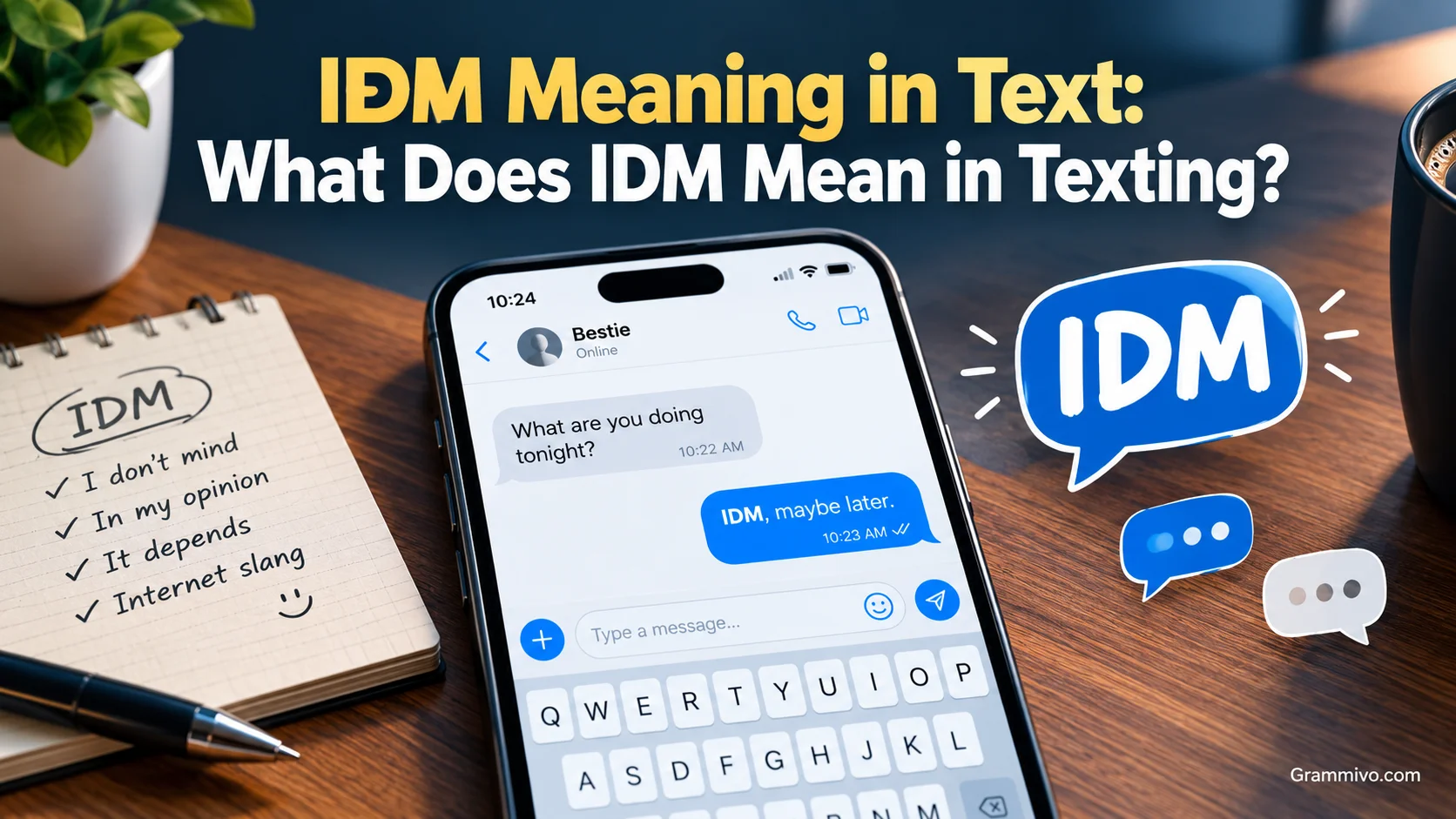
Have you ever received a text that says “IDM” and wondered what the other person meant? This short abbreviation appears in text messages, social media conversations, and online chats. Although it might look confusing at first, its meaning is usually simple once you understand the context.
IDM most commonly means “I Don’t Mind” in texting. People use it when they have no strong preference, feel comfortable with a suggestion, or are happy to let someone else make a decision. For example, if a friend asks whether you want pizza or burgers and you reply “IDM,” you’re saying that either option works for you.
However, IDM doesn’t always communicate the same feeling. Depending on the conversation, it can sound relaxed, agreeable, neutral, or occasionally indifferent. Understanding the surrounding messages helps you interpret the intended meaning correctly.
This guide explains what IDM means in text messages, how people use it on social media, how to respond naturally, and how it differs from similar abbreviations such as IDK and IDC.
Quick Answer
IDM means “I Don’t Mind” in texting. It’s a casual abbreviation people use when they have no strong preference or don’t object to a particular choice.
Example:
- Friend: Do you want to watch a comedy or an action movie?
- You: IDM, you can choose.
- Meaning: You don’t have a strong preference, so your friend can decide.
IDM is generally informal and works best in conversations with friends, family members, partners, and other people you know. It doesn’t automatically mean that you’re excited about an idea. It simply indicates that you’re comfortable with the available option.
Comparison Overview
IDM belongs to the large group of abbreviations people use to make digital conversations faster. However, several similar-looking expressions have different meanings.
| Abbreviation | Full Form | Meaning in Conversation | Example |
| IDM | I Don’t Mind | You have no strong preference | IDM where we eat. |
| IDK | I Don’t Know | You don’t know the answer | IDK what time she’ll arrive. |
| IDC | I Don’t Care | You express a lack of concern or interest | IDC which movie we watch. |
| IMO | In My Opinion | You introduce your viewpoint | IMO, this movie is better. |
| TBH | To Be Honest | You express an honest opinion | TBH, I prefer staying home. |
| NVM | Never Mind | You withdraw or dismiss a previous request or point | NVM, I figured it out. |
The most important distinction is that IDM communicates flexibility, while IDK communicates uncertainty. IDC can also suggest that something doesn’t matter to you, but it may sound more dismissive than IDM.
For example, “IDM where we eat” usually means you’re happy to let someone else choose. “IDK where we should eat” means you don’t know which restaurant to pick.
Main Differences Between IDM Meaning in Text
IDM has a straightforward definition, but its practical meaning depends on the situation. Understanding its common uses can help you avoid misreading a short message.
IDM Means “I Don’t Mind”
The standard meaning of IDM in everyday texting is “I Don’t Mind.” It expresses the idea that a particular choice, suggestion, or situation doesn’t bother you.
Suppose your friend asks whether you’d prefer meeting on Friday or Saturday. If both days work for you, you might respond with “IDM.” You’re letting your friend know that either day is acceptable.
People commonly use IDM when:
- They don’t have a strong preference.
- They agree to a suggestion without raising an objection.
- They feel comfortable letting someone else decide.
- They don’t consider a particular choice important enough to debate.
- They want to keep a casual conversation short.
However, IDM doesn’t always mean enthusiastic agreement. Someone who writes “IDM” might genuinely be happy with either option, or they might simply be willing to go along with the other person’s choice.
IDM Is Different From Saying “Yes”
Although people sometimes use IDM to accept a suggestion, it isn’t exactly the same as saying yes.
Consider these two responses:
- “Yes, let’s go to the beach!” expresses clear agreement and possibly excitement.
- “IDM going to the beach.” suggests that the person is comfortable with the plan.
The second response doesn’t necessarily show excitement. It simply indicates that the person doesn’t object.
This distinction matters when you’re making plans with someone. If you need an enthusiastic answer or a firm commitment, ask a follow-up question instead of assuming IDM means an enthusiastic yes.
IDM Can Show Flexibility
One of the most common reasons people use IDM is to show that they’re flexible.
For example, imagine that your classmates are deciding where to study. One person suggests the library, while another prefers a coffee shop. If you don’t mind either location, IDM communicates that you’re willing to accommodate the group.
In this situation, IDM helps the conversation move forward without creating unnecessary disagreement.
What Does IDM Stand For?
IDM stands for “I Don’t Mind.” Each letter represents part of the phrase.
- I: The speaker refers to themselves.
- D: Represents “Don’t.”
- M: Represents “Mind.”
People shorten phrases like this because digital conversations often favor quick, convenient responses. Instead of typing the complete expression, they can send three letters and communicate the same basic idea.
For example:
Full phrase: “I don’t mind which restaurant we choose.”
Text abbreviation: “IDM which restaurant we choose.”
Both versions communicate flexibility. The abbreviated version simply uses a more casual style.
IDM is most natural in informal messages. In a formal email, business proposal, or professional discussion, writing “I don’t mind” or explaining your preference directly usually sounds clearer.
How Is IDM Used in Texting?
IDM can serve several purposes in everyday conversations. The surrounding message helps you understand exactly what the sender intends.
Expressing No Preference
People often use IDM when they don’t favor one option over another.
Example:
- Friend: Should we order Chinese food or Mexican food?
- You: IDM. Both sound good.
Here, IDM means that either choice is acceptable. You aren’t asking your friend to guess your preference; you’re telling them that you don’t have a strong one.
Agreeing to a Suggestion
IDM can indicate that you’re comfortable with someone else’s idea.
Example:
- Friend: Would you like to study together after school?
- You: IDM, that works for me.
The response communicates acceptance without making a big deal out of the suggestion.
Still, IDM doesn’t automatically guarantee that someone will follow through. If the plans involve a specific time, location, or commitment, confirm those details.
Letting Someone Else Decide
Sometimes, you genuinely don’t want to make the final decision. IDM can signal that the other person may choose.
Example:
- Partner: Do you want to watch a comedy or a thriller?
- You: IDM, pick whichever you like.
This response allows your partner to choose without worrying about your preference.
However, if you use IDM repeatedly when someone wants your input, they might feel that you’re leaving all the planning to them. Offering a suggestion occasionally can make the conversation feel more balanced.
Showing That Something Doesn’t Bother You
IDM can also communicate that a minor inconvenience isn’t a problem.
Example:
- Friend: Is it okay if we’re ten minutes late?
- You: IDM, just let me know when you’re close.
Here, the speaker indicates that the delay is acceptable. The second part of the reply also makes the message warmer and more practical.
Keeping Conversations Short
Texting often involves quick exchanges in which a long explanation isn’t necessary.
For instance, if someone asks whether you prefer the window seat or the aisle seat, replying “IDM” may be enough when either option works.
Short responses can be convenient, but context matters. If the other person expects a detailed answer, adding a few words can prevent confusion.
IDM Meaning on Snapchat, Instagram, and TikTok
IDM generally keeps the same meaning across social media platforms: “I Don’t Mind.” What changes is the situation in which people use it.
IDM Meaning on Snapchat
On Snapchat, people may use IDM in private chats when discussing plans, preferences, or everyday decisions.
Example:
- Friend: Wanna hang out later or tomorrow?
- You: IDM, whichever works for you.
The sender is comfortable with either option and leaves the decision to their friend.
Because Snapchat conversations can move quickly, abbreviations like IDM fit naturally into short exchanges. However, the abbreviation doesn’t have a separate, official Snapchat-specific meaning.
Read More: ML Meaning in Text: What Does ML Mean in Texting?
IDM Meaning on Instagram
On Instagram, IDM may appear in direct messages when people discuss meetups, shared activities, or simple choices.
Example:
- Friend: Should I tag you in the post?
- You: IDM, go ahead.
In this situation, IDM suggests that the person has no objection to being tagged. The meaning comes from the conversation rather than the platform itself.
IDM Meaning on TikTok
On TikTok, IDM may appear in comments or private messages about videos, trends, recommendations, and plans.
Example:
- Friend: Should I send you more videos like this?
- You: IDM, they’re funny.
The sender indicates that receiving more videos is fine.
As with other platforms, the abbreviation is informal. Don’t assume every appearance of IDM refers to texting slang if the discussion concerns technology, music, or another specialized subject.
IDM Meaning in Group Chats
Group chats are especially useful places for IDM because several people may have different preferences.
Example:
- Alex: Should we meet at the mall or the park?
- Jordan: The mall works for me.
- Taylor: IDM.
- Alex: Okay, let’s meet at the mall.
Taylor’s response indicates that the proposed location is acceptable. It doesn’t necessarily mean the mall is Taylor’s favorite option.
In group conversations, IDM can help settle minor decisions quickly. However, it shouldn’t replace everyone’s input when the choice affects the entire group significantly.
IDM Meaning in a Conversation: Realistic Examples
The best way to understand IDM is to see how it works in everyday exchanges. Here are several examples showing its common meanings.
Choosing a Restaurant
Conversation:
- Friend: Do you want Italian or Indian food tonight?
- You: IDM, both sound good.
- Friend: Let’s get Indian food, then.
Meaning: You don’t have a strong preference between the two cuisines, so your friend chooses.
Deciding When to Meet
Conversation:
- Friend: Are you free Saturday afternoon or Sunday morning?
- You: IDM, either time works.
- Friend: Let’s go with Saturday afternoon.
Meaning: Both times are acceptable to you.
Picking a Movie
Conversation:
- Sibling: Do you want to watch a comedy or an animated movie?
- You: IDM. You choose this time.
- Sibling: Okay, animated movie it is!
Meaning: You’re comfortable with either option and allow your sibling to decide.
Responding to a Change of Plans
Conversation:
- Friend: Is it okay if we meet at the café instead of the park?
- You: IDM, the café works too.
- Friend: Great, see you there!
Meaning: You don’t object to the new location.
Accepting a Small Favor
Conversation:
- Friend: Do you mind if I borrow your charger for a few minutes?
- You: IDM, just bring it back when you’re done.
- Friend: Thanks!
Meaning: You don’t object to lending the charger.
Notice that IDM doesn’t always stand alone. Adding a short explanation can make your response sound friendlier and clarify what you’re agreeing to.
How to Reply to IDM in Text
Your response should depend on what the other person is discussing. In many situations, you can simply move the conversation forward.
When Someone Has No Preference
If someone says IDM while you’re choosing between options, pick one and confirm it.
Example:
- Them: IDM where we eat.
- You: Great, let’s try the new burger place.
Other natural replies include:
- “Okay, let’s go with that.”
- “Cool, I’ll choose the place.”
- “Sounds good!”
- “Perfect, I’ll make the reservation.”
When Someone Accepts Your Suggestion
If IDM indicates that someone is comfortable with your idea, continue planning.
Example:
- You: Do you want to meet at 5 p.m.?
- Them: IDM.
- You: Great, see you at five!
If the arrangement requires a firm commitment, confirm the time and location rather than relying on an ambiguous one-word answer.
FAQs:
What Does IDM Mean From a Girl?
When a girl sends IDM in a text message, it usually means “I Don’t Mind.” She may be saying that either option works for her or that she’s comfortable with your suggestion.
For example, if you ask whether she’d prefer coffee or lunch and she replies “IDM,” she may be happy with either choice. The abbreviation alone doesn’t reveal whether she’s romantically interested.
What Does IDM Mean From a Guy?
When a guy texts IDM, it generally means “I Don’t Mind.” He might be expressing flexibility, accepting a suggestion, or allowing someone else to choose.
For instance, if you ask whether he wants to meet on Friday or Saturday and he replies “IDM,” he may be available on either day. The context determines the precise meaning.
What Does IDM Mean on Snapchat?
On Snapchat, IDM usually means “I Don’t Mind.” People may use it when discussing plans, choosing activities, or responding to suggestions in private chats.
For example, “IDM, you pick” means that the sender is comfortable letting the other person decide.
What Is the Difference Between IDM and IDK?
IDM means “I Don’t Mind,” while IDK means “I Don’t Know.”
IDM expresses a lack of preference or objection. IDK expresses uncertainty or a lack of knowledge.
For example, “IDM where we go” means any destination is acceptable. “IDK where we should go” means the speaker doesn’t know which destination to choose.
Can IDM Mean “I Don’t Matter”?
“I Don’t Matter” isn’t the standard meaning of IDM in ordinary texting. The widely understood interpretation is “I Don’t Mind.”
However, people sometimes create personal abbreviations or use familiar letters in unusual ways. If someone uses IDM in a conversation about feeling unimportant, consider the full message before deciding what they mean.
Conclusion:
IDM means “I Don’t Mind” in texting. People commonly use it in casual conversations to express flexibility, accept suggestions, or show that they don’t have a strong preference. You’ll often see IDM in text messages, Snapchat chats, Instagram DMs, TikTok conversations, and group chats. Its meaning generally stays the same across these platforms, although specialized discussions may use IDM to refer to identity management or Intelligent Dance Music.
