
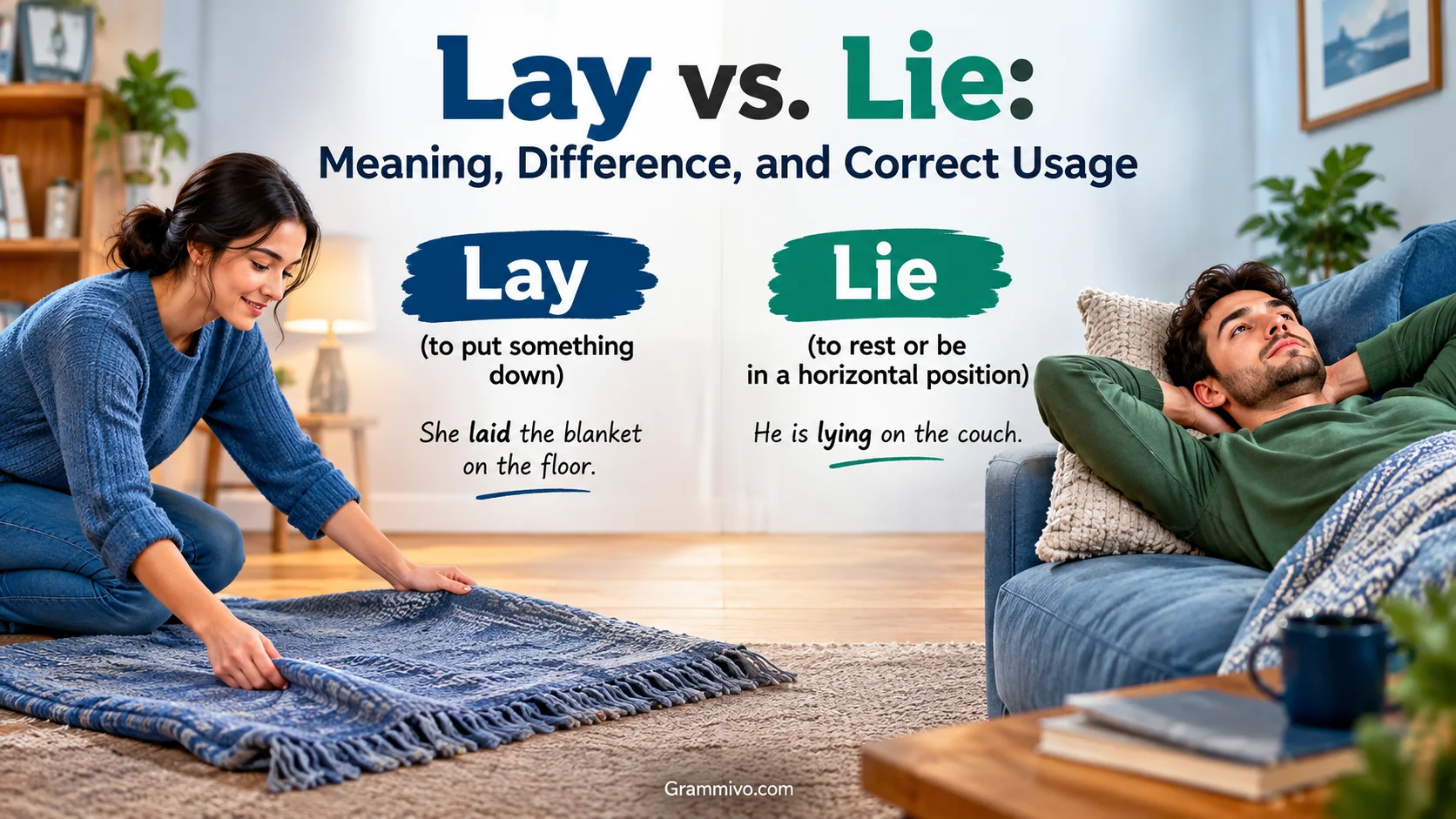
Have you ever wondered whether to write “I need to lay down” or “I need to lie down”? You’re not alone. These two verbs confuse even experienced English speakers because their meanings overlap and their past-tense forms behave differently.
The good news is that you can learn the difference with a few simple rules. Lay means to put something down, while lie means to recline or rest in a horizontal position. However, things get tricky when you talk about the past. The past tense of lie is lay, while the past tense of lay is laid.
For example, you lay your phone on the table, but you lie on the couch when you’re tired. Yesterday, you laid your phone on the table, but you lay on the couch after work.
Understanding these patterns will help you choose the right word in everyday conversations, professional emails, school assignments, and blog posts. Let’s break down the meanings, verb forms, common mistakes, and practical examples so you can use both verbs confidently.
Quick Answer
Lay vs. lie comes down to whether you’re putting something down or reclining yourself.
- Lay: Use this verb when you place something somewhere. It normally takes a direct object. Example: Please lay the keys on the counter.
- Lie: Use this verb when you recline or rest. It doesn’t take a direct object in this sense. Example: I want to lie down for a while.
The past-tense forms are especially important:
- Lay: Lay → laid → laid
- Lie: Lie → lay → lain
Remember that lay can serve two different purposes. It is the present-tense form of the verb meaning “to put something down” and the past-tense form of the verb meaning “to recline.”
Comparison Overview
| Feature | Lay | Lie |
| Main meaning | To put or place something down | To recline or rest |
| Verb type | Transitive in its usual physical meaning | Intransitive in its reclining meaning |
| Takes a direct object? | Yes | No |
| Present tense | Lay | Lie |
| Simple past tense | Laid | Lay |
| Past participle | Laid | Lain |
| Present participle | Laying | Lying |
| Example | I lay the book on the desk. | I lie on the bed. |
| Past-tense example | I laid the book on the desk. | I lay on the bed yesterday. |
| Perfect-tense example | I have laid the book on the desk. | I have lain on the bed all morning. |
The easiest way to distinguish these verbs is to examine the action. If someone places an object somewhere, use lay. If someone reclines or rests, use lie.
Main Differences Between Lay vs. Lie
Meaning of Lay
Lay means to put, place, or set something down. The action involves an object that receives the placement.
For example, when you put a notebook on your desk, you’re laying the notebook down. The notebook is the direct object because it receives the action of the verb.
Consider these examples:
- Please lay your jacket on the chair.
- She lays the baby gently in the crib.
- He laid the documents beside the computer.
- We have laid the foundation for the new building.
- The farmer is laying the tools on the workbench.
Notice that each sentence identifies what someone places somewhere. The object might be a physical item, such as a jacket, or something less tangible, such as a foundation for a future project.
The verb lay also appears in many expressions. You can lay the groundwork for a plan, lay blame on someone, or lay down the law when establishing firm rules.
Meaning of Lie
Lie means to recline, rest, or occupy a horizontal position. Unlike lay, it doesn’t require a direct object when used in this sense.
For example, when you stretch out on your bed, you lie down. You’re not placing another object somewhere; you’re changing your own position.
Here are some common examples:
- I want to lie down after lunch.
- She lies on the couch whenever she watches television.
- The dog is lying beside the fireplace.
- He lay on the grass and watched the clouds.
- They have lain awake for hours.
In each sentence, the subject performs the action without placing a direct object.
The verb can also describe where something rests. For instance, The keys lie on the counter describes their position. It doesn’t necessarily tell us who put them there.
This distinction is useful because the subject doesn’t always have to be a person. Animals, objects, and other things can also lie in a particular position.
Lay vs. Lie Verb Forms and Tenses
The biggest challenge with lay vs. lie is remembering their different verb forms. The present tense is straightforward, but the past tense creates confusion.
| Verb form | Lay (place something) | Lie (recline or rest) |
| Base form | Lay | Lie |
| Third-person singular | Lays | Lies |
| Simple past | Laid | Lay |
| Past participle | Laid | Lain |
| Present participle | Laying | Lying |
These forms follow two separate patterns:
- Lay–laid–laid: Use these forms when placing something.
- Lie–lay–lain: Use these forms when reclining or resting.
For example, you might say, “I lay the blanket on the bed every morning.” If you did that yesterday, you would say, “I laid the blanket on the bed.”
However, if you’re describing your own position, the pattern changes. You might say, “I lie on the bed every afternoon.” When describing yesterday, you’d say, “I lay on the bed.”
The word lain appears in perfect tenses, usually with has, have, or had. For example, “She has lain in bed all morning.”
One more detail matters: lied belongs to a different verb meaning to tell an untruth. Its forms are lie–lied–lied. For example, “He lied about his age.” Don’t confuse that verb with lie meaning to recline.
Lay vs. Lie in the Present Tense
The present tense becomes much easier when you identify whether the verb has a direct object.
Use lay when someone puts something down:
- I lay my phone on the nightstand every night.
- She lays the baby in the crib before leaving the room.
- They lay the cards on the table before playing.
Use lie when someone reclines or rests:
- I lie down whenever I feel exhausted.
- She lies on the sofa after dinner.
- They lie in the shade during the hottest part of the day.
A quick question can help: What is being placed? If the sentence answers that question with a direct object, lay is usually the correct choice.
For example, in “I lay the towel on the chair,” the towel receives the action. In “I lie on the chair,” the subject reclines or rests.
Be careful with the phrase “I lay down.” In the present tense, it may be missing the object if you mean that you recline. The standard form for that meaning is “I lie down.” However, “I lay the baby down” is correct because the baby is the object.
Lay vs. Lie in the Past Tense
The past tense is where many writers stumble. The reason is simple: lay is both a present-tense verb and the past tense of another verb.
When you describe placing something in the past, use laid:
- I laid my wallet on the kitchen counter.
- She laid the baby in the crib.
- They laid the bricks along the garden path.
When you describe reclining in the past, use lay:
- I lay on the couch for an hour.
- She lay in bed until noon.
- They lay beneath the trees and enjoyed the cool breeze.
Compare these sentences:
| Sentence | Meaning |
| I lay the book on the table. | I place the book there now or regularly. |
| I laid the book on the table. | I placed the book there in the past. |
| I lie on the table. | I recline on the table now or regularly. |
| I lay on the table. | I reclined on the table in the past. |
The final two examples might sound unusual in everyday life, but they’re grammatically useful. They show why the surrounding words and context matter.
If you write “Yesterday, I laid on the sofa,” you are using the wrong verb for standard edited English when you mean that you reclined. Write “Yesterday, I lay on the sofa.”
Lay vs. Lie in Perfect Tenses
Perfect tenses combine a form of have with a past participle. For lay, that participle is laid. For lie meaning recline, it’s lain.
Use laid when someone has placed something:
- I have laid the papers on your desk.
- She has laid the baby in the crib.
- They had laid the foundation before construction began.
Use lain when someone has reclined or rested:
- I have lain awake for hours.
- He has lain in bed all morning.
- She had lain on the couch before her friends arrived.
The difference becomes clearer when you compare the incorrect and correct forms:
| Incorrect in standard edited English | Correct | Why |
| I have lay on the bed. | I have lain on the bed. | Have requires the past participle. |
| She has laid down all morning. | She has lain down all morning. | Lain is the participle of reclining lie. |
| They had lay there for hours. | They had lain there for hours. | Had requires the past participle. |
| I have lain the book on the desk. | I have laid the book on the desk. | Laid is the participle of placement lay. |
There is one useful distinction: “I have laid down the rules” is correct because laid down means established or stated the rules. In contrast, “I have lain down” means I have reclined.
The correct choice depends on the meaning, not simply on the words surrounding the verb.
Read More: People vs. Peoples: Meaning, Difference, and Correct Usage
Lay Down vs. Lie Down
The phrases lay down and lie down often cause confusion because both describe actions involving a downward position. However, they don’t mean exactly the same thing.
Use lie down when you recline your own body. Use lay down when you place something else in a particular position.
Consider these examples:
- Correct: I need to lie down for a few minutes.
- Correct: Please lay down the blanket before the guests arrive.
- Correct: She lay down after finishing her work yesterday.
- Correct: He laid down his phone and went outside.
The third sentence uses lay down correctly because lay is the past tense of lie. Meanwhile, the fourth sentence uses laid down because the phone is the object being placed.
The distinction also applies to figurative expressions. When you lay down the rules, you establish expectations or instructions. When you lie down, you rest your body.
A common informal expression is “I’m going to lay down.” Many speakers use it in casual conversation. However, if you mean that you’re going to recline, “I’m going to lie down” is the standard form for edited American English.
Lay vs. Lie With Pronouns and Nouns
Your choice between lay and lie doesn’t depend on whether the subject is I, you, he, she, we, or they. Instead, it depends on what the subject does.
When the subject places something, use the appropriate form of lay:
- I lay the book on the shelf.
- You lay the towel on the chair.
- He lays the newspaper beside his coffee.
- She laid the groceries on the counter.
- They have laid the equipment in the storage room.
When the subject reclines, use the appropriate form of lie:
- I lie on the bed when I’m tired.
- You lie in the shade during hot afternoons.
- He lies on the couch after work.
- She lay on the grass yesterday.
- They have lain in bed since early morning.
Pay attention to the difference between lays and lies. The first means places something, while the second means reclines or rests.
For example, “She lays the baby in the crib” describes an action involving the baby as a direct object. However, “She lies in bed” describes her own position.
FAQs:
Is It Lay Down or Lie Down?
Use lie down when you mean to recline or rest. Use lay down when you place something somewhere, as in “Lay down the blanket.” In the past tense, however, “I lay down” is correct when describing reclining.
Is the Past Tense of Lie Lay or Lied?
Both forms exist, but they belong to different verbs. The past tense of lie meaning recline is lay, as in “I lay on the couch yesterday.” The past tense of lie meaning tell an untruth is lied, as in “He lied to me.”
Is It Laying Down or Lying Down?
Use lying down when someone is reclining. Use laying down when someone is placing something down. For example, “She is lying down” describes her position, while “She is laying down the blanket” describes an action involving an object.
Should I Use Laid or Lain?
Use laid for the past tense and past participle of lay, meaning to place something. Use lain as the past participle of lie, meaning to recline. For example, “I have laid the book down” and “I have lain down” are both correct.
How Do You Know Whether to Use Lay or Lie?
Ask whether the sentence describes placing something or reclining. If you place an object, use lay. If you recline, use lie in the present tense. Then check the tense to choose the appropriate form.
Conclusion:
The difference between lay and lie becomes manageable once you focus on the action. Lay means to put something down, while lie means to recline or rest. The challenge comes from their past-tense forms, particularly because lay serves two grammatical purposes. Keep these two sequences in mind: lay–laid–laid for placement and lie–lay–lain for reclining. Remember that lied belongs to the separate verb meaning to tell an untruth.
