
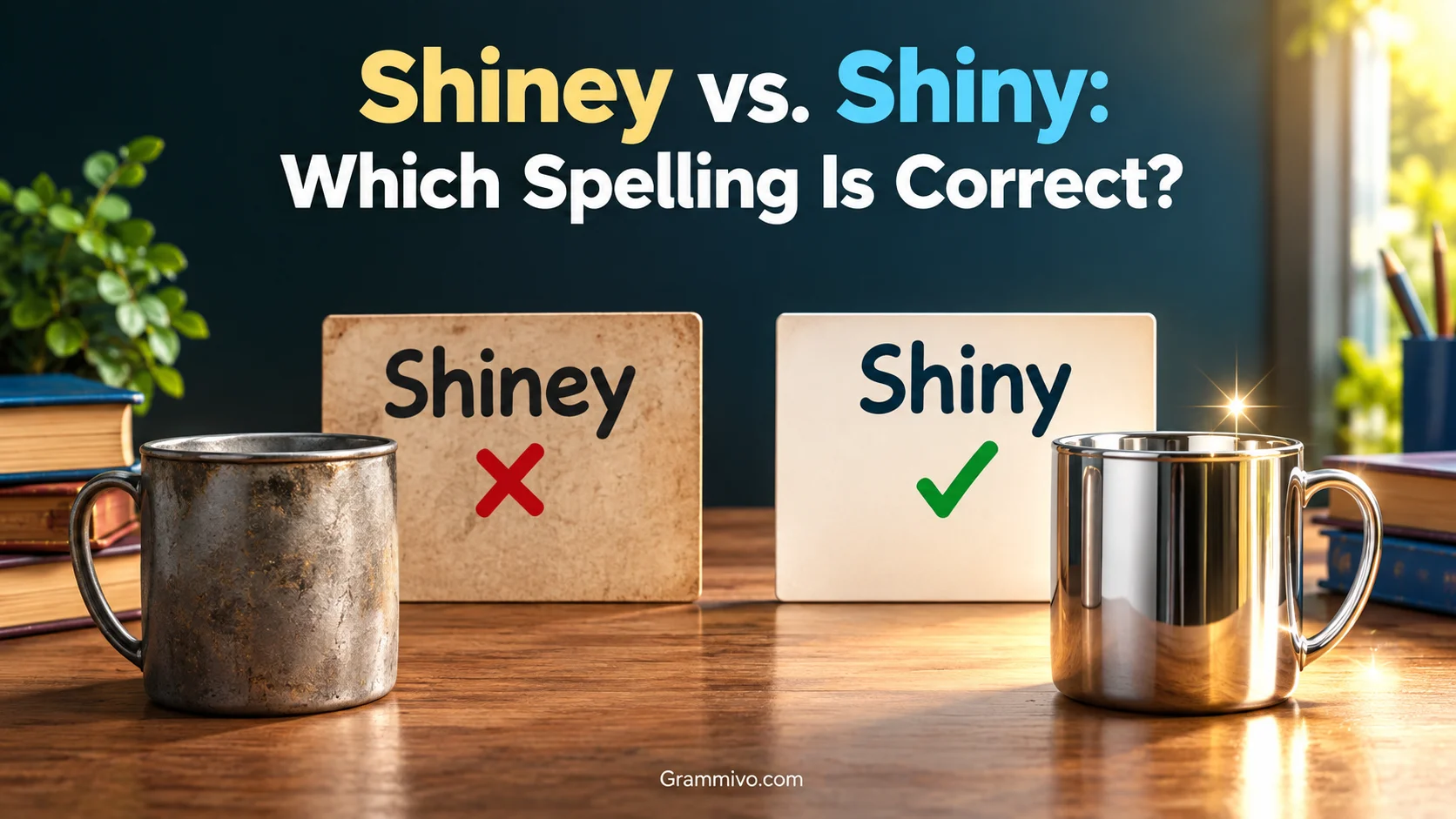
If you’ve ever hesitated between shiney and shiny, you’re not alone. The two spellings look almost identical, which makes the extra e easy to overlook. However, only one form belongs in standard English.
The correct spelling is shiny. It describes something that reflects light, has a smooth surface, or looks bright and polished. Shiney is generally a misspelling that occurs because people naturally connect the adjective with the verb shine.
That small spelling difference has a straightforward explanation. When English forms shiny from shine, the final silent e drops before the suffix -y. This same pattern appears in words such as noise → noisy, spice → spicy, and ice → icy.
Quick Answer
Shiny is the correct standard English spelling. Shiney is usually an incorrect spelling of the same word. The adjective shiny means reflecting light or having a bright, smooth, polished, or glossy appearance.
For example:
- Correct: The new shoes look shiny.
- Incorrect: The new shoes look shiney.
- Correct: She has shiny black hair.
- Incorrect: She has shiney black hair.
The reason is simple: shine + y = shiny, not shiney. The final e in shine disappears when the adjective is formed.
Comparison Overview
| Word | Standard Spelling? | Meaning | Example |
| Shiny | Yes | Reflecting light or having a bright, smooth appearance | The floor looks shiny after polishing. |
| Shiney | No, in standard English | Usually a misspelling of shiny | Avoid shiney in standard writing. |
The distinction matters because shiny functions as a standard English adjective, while shiney doesn’t serve as its accepted spelling in ordinary modern English.
If you’re writing an essay, article, email, school assignment, product description, or professional document, use shiny.
Main Differences Between Shiney vs. Shiny
The main difference is spelling rather than meaning. When someone writes shiney, they almost always intend to write shiny.
Here are the key differences:
- Shiny is the standard spelling.
- Shiney is generally a misspelling.
- Shiny is an adjective.
- Shiny describes something that reflects or appears to reflect light.
- The spelling comes from shine + -y, with the final e removed.
- Shiney shouldn’t be used in standard formal writing.
So, if you need the adjective meaning “reflecting light,” choose shiny every time.
What Does Shiny Mean?
Shiny is an adjective that describes something with a surface or appearance that reflects light. Depending on the context, it can suggest smoothness, brightness, gloss, polish, or luster.
Imagine sunlight hitting a freshly washed car. The light bounces across its smooth surface, creating bright reflections. You could describe that car as shiny.
The word can describe physical objects and surfaces, but its use isn’t limited to hard materials. You can also describe hair, fabric, makeup, eyes, photographs, packaging, and other things as shiny.
Common Meanings of Shiny
The most common uses include:
- Reflecting light: A shiny metal spoon catches the light.
- Having a polished surface: The table became shiny after polishing.
- Having a glossy appearance: The magazine has a shiny cover.
- Looking bright or lustrous: Her hair looked shiny in the sunlight.
- Appearing new or attractive: The child wanted the shiny new toy.
The exact sense depends on what you’re describing.
For example, shiny shoes usually suggests polished leather or another reflective material. Shiny hair, on the other hand, usually suggests hair that reflects light because of its smooth surface or moisture.
Is Shiney a Word?
In standard English, shiney isn’t the accepted spelling of the adjective meaning “reflecting light.”
When people write shiney, they’re typically making a spelling error based on the word shine. The mistake makes sense at first glance because shine already contains the letters e and i, and writers may assume that the adjective should simply add -y.
That would produce shiney. English spelling doesn’t work that way here.
The standard form is:
shine → shiny
The final e disappears before -y.
Therefore, in standard American English, use shiny rather than shiney.
Can Shiney Ever Appear in Writing?
You might occasionally encounter Shiney as a personal name, username, fictional name, business name, or other proper label. A proper name can follow its owner’s chosen spelling even when that spelling differs from standard English.
That doesn’t make shiney the standard spelling of the adjective.
For ordinary descriptive writing, the correct form remains shiny.
Why Is Shiny Spelled Without an E?
The spelling becomes easier to understand when you look at how the word is formed.
The base word is shine. Add the suffix -y, and English removes the final silent e:
shine + y → shiny
This isn’t an arbitrary change. English frequently drops a final silent e when certain suffixes are added.
Consider these related examples:
| Base Word | Derived Word | What Happens |
| shine | shiny | Final e is removed |
| noise | noisy | Final e is removed |
| spice | spicy | Final e is removed |
| ice | icy | Final e is removed |
| slime | slimy | Final e is removed |
| haze | hazy | Final e is removed |
This pattern helps explain why shiney looks plausible but isn’t correct.
The spelling shiney keeps the final e even though standard English removes it when forming shiny.
The Spelling Pattern in Action
Think of the transformation this way:
SHINE → SHIN + Y → SHINY
The pronunciation also changes in a predictable way. Shiny is commonly pronounced SHY-nee.
The base verb shine is pronounced differently because it functions as a separate word with its own vowel pattern.
This is one reason spelling shouldn’t always be handled by simply attaching a suffix to the original word. English morphology often involves small spelling adjustments.
Shiny: Meaning and Examples
Because shiny describes appearance, you can use it in many everyday situations.
Shiny as an Adjective
Shiny modifies a noun and tells you that something has a bright or reflective appearance.
Examples include:
- a shiny coin
- a shiny car
- shiny shoes
- shiny hair
- a shiny countertop
- a shiny floor
- shiny metal
- a shiny jacket
- a shiny package
- a shiny new phone
Notice that the word doesn’t necessarily mean something is perfectly polished.
A surface can look shiny because of its material, moisture, coating, polish, or texture. A wet sidewalk, for instance, may appear shiny even though nobody polished it.
Shiny in Everyday Sentences
Here are some natural examples:
- The new car has a shiny black exterior.
- He polished his shoes until they looked shiny.
- The wet pavement looked shiny under the streetlights.
- She tied her shiny hair into a ponytail.
- The gift came in a shiny silver box.
- Sunlight made the metal surface look incredibly shiny.
- The kitchen counter has a smooth, shiny finish.
- The children were fascinated by the shiny coins.
- The magazine’s shiny cover caught my attention.
- After cleaning the windows, the glass looked bright and shiny.
Each sentence uses shiny as an adjective.
Shiney vs. Shiny Examples
Seeing the two forms side by side makes the difference much clearer.
Correct Examples With Shiny
Use shiny when you mean bright, reflective, glossy, or polished in appearance.
- The shiny floor reflected the ceiling lights.
- She bought a shiny new handbag.
- His shoes were freshly polished and shiny.
- The shiny surface reflected the afternoon sun.
- I noticed a shiny object on the ground.
- The children collected shiny stones from the beach.
- Her hair looked shiny after she washed it.
- The manufacturer gave the product a shiny finish.
Incorrect Examples With Shiney
In standard English, replace shiney with shiny:
- The car has a shiney finish.
- The car has a shiny finish.
- She bought a shiney dress.
- She bought a shiny dress.
- The shoes are shiney after polishing.
- The shoes are shiny after polishing.
- The metal looks shiney in the sunlight.
- The metal looks shiny in the sunlight.
- He has shiney black hair.
- He has shiny black hair.
The correction doesn’t change the meaning. It simply restores the standard spelling.
Shiny vs. Other Similar Words
Shiny overlaps with several words that describe appearance. However, these words aren’t always interchangeable.
Understanding the distinctions can make your writing more precise.
Shiny vs. Glossy
Shiny and glossy are close in meaning, but glossy often emphasizes a smooth surface that reflects light strongly.
For example:
- Shiny shoes emphasize their bright appearance.
- Glossy paper emphasizes its smooth, reflective finish.
You can call a car shiny, while a magazine is often described as having a glossy cover.
The words overlap, but glossy often sounds more specific when discussing finishes and surfaces.
Shiny vs. Bright
Bright has a much broader meaning.
Something can be bright because it produces or reflects a lot of light. It doesn’t have to have a polished or reflective surface.
For example:
The bright yellow wall filled the room with color.
The wall isn’t necessarily shiny.
Compare that with:
The shiny yellow wall reflected the sunlight.
Here, shiny focuses on the surface’s reflective appearance.
Shiny vs. Polished
Polished describes something that has been smoothed or treated to create a particular finish. It can also describe someone’s refined behavior or work.
For example:
He polished the silver until it became shiny.
Something can be polished and shiny, but the two words describe different aspects.
Polished can refer to the process or condition. Shiny focuses primarily on the resulting appearance.
Shiny vs. Lustrous
Lustrous is a more formal or literary adjective meaning that something has a soft, attractive shine.
You might encounter:
- lustrous hair
- lustrous silk
- lustrous pearls
In everyday conversation, shiny is much more common.
If you’re writing for a general audience, shiny usually sounds clearer and more natural.
Read More: Puting vs. Putting: Which Spelling Is Correct?
Why Do People Spell Shiny as Shiney?
The error usually comes from a reasonable but incorrect spelling assumption.
People see the base word shine and then add -y:
shine + y = shiney
That looks logical. Unfortunately, standard English changes the spelling.
The final silent e is removed:
shine + y = shiny
This kind of mistake is common because English spelling doesn’t always provide an obvious visual rule.
Another factor is pronunciation. Since the final e isn’t pronounced separately in shine, writers may struggle to remember whether it remains in the written form.
The best approach is to memorize the derived form directly:
Shine → Shiny
Once that pattern becomes familiar, shiney starts to look as unusual as it actually is.
Common Mistakes With Shiny
Several mistakes tend to appear around this word.
Writing Shiney Instead of Shiny
This is the most obvious error.
Incorrect: The floor is shiney.
Correct: The floor is shiny.
Keeping the Final E From Shine
The word shine does contain a final e, but that doesn’t mean every related form keeps it.
Compare:
- shine
- shines
- shined
- shining
- shiny
Different suffixes can trigger different spelling changes.
Confusing Shine and Shiny
Shine can function as a verb or noun.
For example:
The sun will shine tomorrow.
Here, shine is a verb.
Shiny is an adjective:
The sun made the car look shiny.
Using the correct form depends on the grammatical role of the word.
Assuming Shiny Means Exactly the Same as Glossy
The meanings overlap, but they’re not identical in every context.
A surface can be shiny without being described as glossy. Likewise, glossy often suggests a particular smooth finish.
Choosing between them depends on what you want to emphasize.
How to Remember the Correct Spelling
A simple memory trick can save you from the shiney trap.
Remember:
SHINE → SHINY
Don’t add the entire -y ending to shine while keeping the final *e. Remove the e first.
You can also connect shiny with similar words:
- noise → noisy
- spice → spicy
- ice → icy
- slime → slimy
- shine → shiny
There’s a useful pattern hiding in plain sight.
A Quick Spelling Test
When you’re unsure, ask:
Am I describing something that reflects light?
If the answer is yes, the word you need is almost certainly shiny.
For example:
The new watch has a shiny metal band.
Not:
The new watch has a shiney metal band.
That quick mental check can prevent the mistake before it reaches the page.
Shiny in American English
Shiny is the standard spelling in American English.
It appears frequently in everyday descriptions, product writing, literature, advertising, school assignments, and general conversation.
Its pronunciation is commonly represented as /ˈʃaɪni/, approximately SHY-nee.
The word can modify singular and plural nouns:
- a shiny coin
- two shiny coins
- a shiny surface
- several shiny surfaces
The spelling doesn’t change based on number.
Is Shiny Formal or Informal?
Shiny works across a wide range of contexts.
You can use it in casual speech:
Your new shoes are really shiny.
You can also use it in more formal descriptive writing:
The treatment produces a shiny protective surface.
It isn’t slang or restricted to informal conversation. It’s a normal English adjective with broad everyday use.
A Closer Look at the Word Shine
Understanding shine makes the spelling of shiny easier to remember.
Shine has several related uses.
As a verb:
The sun shines through the window.
It can describe producing or reflecting light:
The polished metal shone under the lamp.
As a noun, shine can refer to brightness or luster:
The polish gave the wood a beautiful shine.
From this family of words comes the adjective shiny:
The polished wood has a shiny surface.
The relationship is clear, but the spelling changes when -y is added.
FAQs:
Is It Shiny or Shiney?
Shiny is the correct standard spelling. Shiney is generally a misspelling.
For example:
The shiny new car stood in the driveway.
Is Shiney a Correct Spelling?
No, shiney isn’t the standard spelling of the adjective meaning “reflecting light.” Use shiny instead.
A word or name might use Shiney as a deliberate proper-name spelling, but that doesn’t make it the standard adjective.
Why Is Shiny Spelled Without an E?
The final e in shine is dropped when the suffix -y forms the adjective:
shine + y → shiny
The same pattern occurs in words such as noise → noisy and spice → spicy.
What Does Shiny Mean?
Shiny means reflecting light or having a bright, smooth, glossy, or lustrous appearance.
For example:
The shiny floor reflected the overhead lights.
How Do You Use Shiny in a Sentence?
Use shiny before a noun or after a linking verb when describing its appearance.
Examples:
She bought a shiny new watch.
The freshly polished table looks shiny.
Conclusion:
When choosing between shiney vs. shiny, the answer is clear: shiny is the standard spelling. The adjective describes something that reflects light or has a bright, smooth, glossy, or lustrous appearance. You can use it for everything from shiny shoes and shiny cars to shiny hair and polished surfaces.
The common error shiney happens because the spelling appears to come directly from shine + y. In standard English, however, the final silent e drops:
