
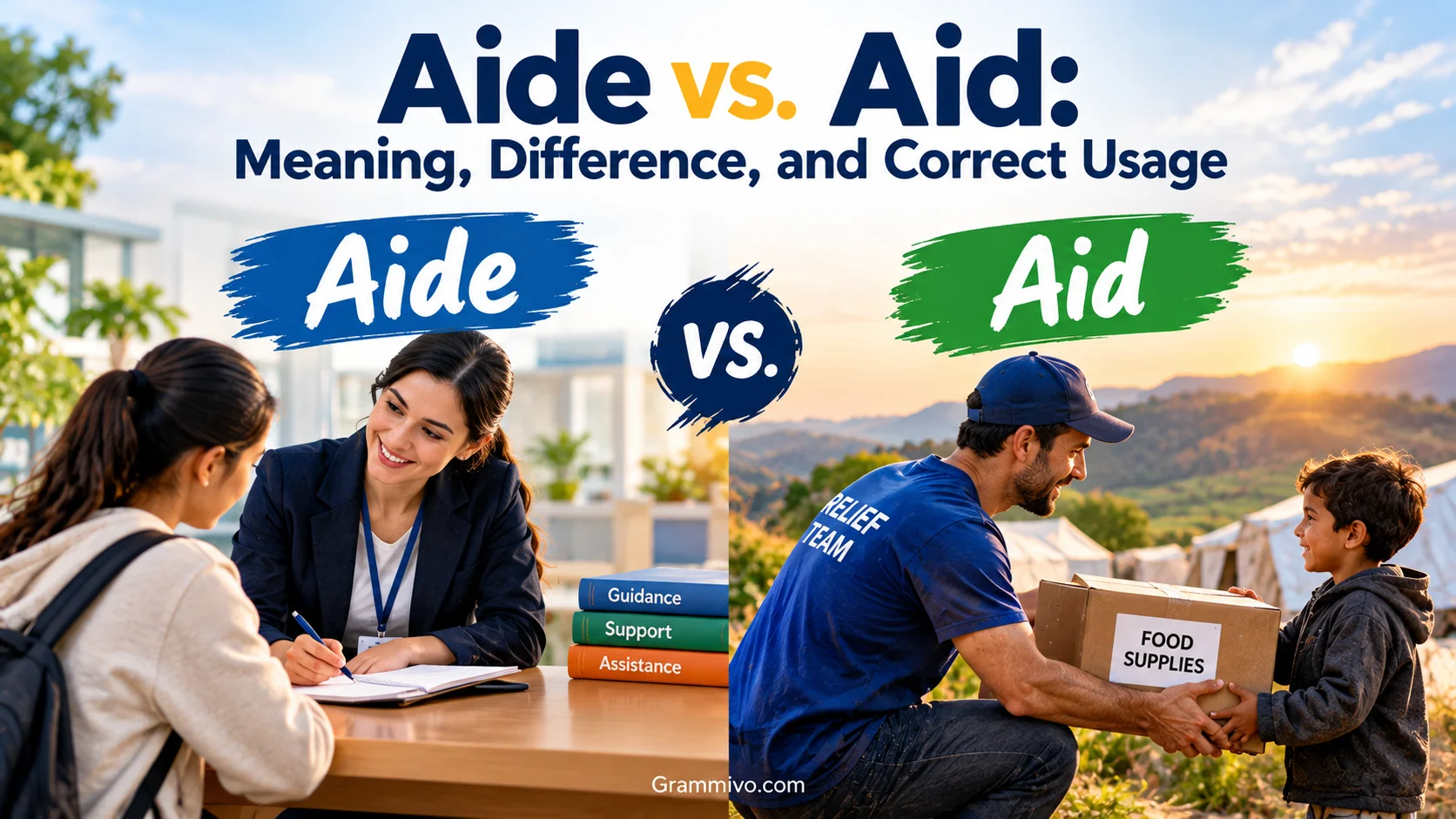
Have you ever wondered whether to write aide or aid? These two words sound exactly alike, yet they serve different purposes in a sentence. Choosing the wrong spelling can change your meaning, especially when you’re writing about someone who provides assistance or the help they offer.
The confusion makes sense because both words relate to helping others. However, an aide is a person who helps, while aid is the help itself or the act of helping. Once you understand this distinction, choosing the correct word becomes much easier.
For example, you might write, “The senator’s aide arranged the meeting.” Here, aide refers to the person responsible for the task. On the other hand, “The organization provided aid to the community” uses aid to describe the assistance people received.
Although the difference looks small, it matters in professional writing, school assignments, news reports, and everyday conversations. Let’s explore the meanings, grammatical roles, common expressions, and practical examples that will help you use both words correctly.
Quick Answer
Aide is a noun that refers to a person who assists someone, often in a professional or official role. Examples include a teacher’s aide, a presidential aide, and a personal aide.
Aid can function as both a noun and a verb. As a noun, it means help or assistance. As a verb, it means to help someone or make a task easier.
Consider these examples:
- Aide: The teacher’s aide helped students complete their assignments.
- Aid as a noun: The school received financial aid to improve its facilities.
- Aid as a verb: Volunteers worked together to aid families affected by the storm.
The easiest way to remember the distinction is this: an aide is someone who helps; aid is the help they provide.
Comparison Overview
Although aide and aid share the same pronunciation, their meanings and grammatical uses differ. Understanding these differences will help you choose the right word without second-guessing yourself.
| Feature | Aide | Aid |
| Part of speech | Noun | Noun and verb |
| Main meaning | A person who assists someone | Help, support, or the act of helping |
| Refers to a person? | Yes | Not usually |
| Describes assistance? | No, not directly | Yes |
| Used as a verb? | No | Yes |
| Pronunciation | /eɪd/ | /eɪd/ |
| Common examples | Teacher’s aide, presidential aide | First aid, financial aid, aid workers |
| Example sentence | The aide prepared the report. | The organization provided aid. |
The most important distinction concerns what each word represents. Aide identifies a person, whereas aid describes assistance or an action that provides help.
For instance, a medical aide might provide aid to an injured patient. Both words fit naturally in the same sentence because they perform different grammatical functions.
Main Differences Between Aide and Aid
The difference between aide and aid becomes clearer when you look at their meanings, grammatical roles, and everyday uses. Although they sound identical, you cannot freely substitute one for the other.
What Does Aide Mean?
The word aide refers to a person who helps another person perform duties, complete tasks, or manage responsibilities. An aide may work in education, healthcare, government, business, or a private household.
An aide often supports someone in a specific role. For example, a teacher’s aide helps a teacher manage classroom activities, while a political aide assists an elected official with daily responsibilities.
The word is a noun. It identifies the person providing assistance rather than the assistance itself.
Examples of aide in sentences:
- The senator’s aide organized her schedule for the week.
- A classroom aide helped the students with their reading exercises.
- The nurse’s aide brought fresh supplies into the patient’s room.
- The principal thanked his aide for preparing the presentation.
- A presidential aide answered questions from the reporters.
In each example, aide refers to a person with an assisting role. The sentence would lose its intended meaning if you replaced aide with aid.
For example, “The senator’s aid organized her schedule” would suggest assistance rather than clearly identifying the person who organized it. In standard usage, “The senator’s aide organized her schedule” is the appropriate choice.
Common Types of Aides
Aides work in many settings, and their responsibilities depend on the person or organization they support.
| Type of aide | Meaning | Example |
| Teacher’s aide | Assists a teacher with classroom duties | The teacher’s aide helped students practice spelling. |
| Political aide | Supports a politician or elected official | The political aide prepared briefing materials. |
| Presidential aide | Assists a president with official responsibilities | A presidential aide arranged the meeting. |
| Medical aide | Helps provide patient care or related support | The medical aide helped the patient get comfortable. |
| Personal aide | Assists someone with everyday or professional tasks | Her personal aide organized the appointments. |
| Administrative aide | Helps with office and administrative duties | The administrative aide updated the records. |
These job titles share one important feature: each refers to a person who provides assistance.
However, an aide’s exact duties vary by workplace. A classroom aide might help students follow instructions, while a political aide might prepare research, coordinate meetings, or communicate with staff.
Is Aide Always a Job Title?
No. Although aide often appears in professional titles, you can also use it as a general noun.
For example:
- The manager asked an aide to deliver the documents.
- Her trusted aide accompanied her to the conference.
- The official consulted his senior aide before making a decision.
These sentences don’t require a formal job title. They simply identify someone who assists another person.
Also, aide doesn’t necessarily mean that someone holds a lower position in every respect. The word describes an assisting role, but the person’s authority, qualifications, and responsibilities depend on the job.
Read More: Wiener vs. Weiner: Meaning, Difference, and Correct Usage
What Does Aid Mean?
Aid means help, support, or assistance. Unlike aide, it doesn’t ordinarily identify the person who provides that help.
You can use aid when discussing financial support, medical assistance, emergency relief, educational resources, or any action that helps someone achieve a goal.
For example, a charity might provide aid to families after a natural disaster. In this sentence, aid refers to the resources and assistance the charity offers.
The word has two common grammatical roles: noun and verb.
Aid as a Noun
When aid functions as a noun, it refers to the help someone receives or provides. It can describe money, supplies, services, information, or practical support.
Examples of aid as a noun:
- The students received financial aid to pay for college.
- Emergency workers delivered aid to the affected communities.
- The injured hiker needed medical aid.
- The charity provided food and shelter as aid.
- A hearing aid helped him hear conversations more clearly.
Notice that the noun aid can refer to different kinds of assistance. Sometimes it describes a broad form of support, as in humanitarian aid. In other cases, it refers to a specific device, as in hearing aid.
Here are some common noun phrases that use the word:
| Expression | Meaning | Example |
| Financial aid | Money or financial support | She applied for financial aid before enrolling in college. |
| First aid | Immediate care for an injury or sudden illness | The coach administered first aid after the accident. |
| Medical aid | Medical help or treatment | The injured worker received medical aid. |
| Humanitarian aid | Assistance intended to relieve human suffering | Relief agencies delivered humanitarian aid after the earthquake. |
| Emergency aid | Urgent help during a crisis | The community requested emergency aid after the flood. |
| Hearing aid | A device that helps a person hear | His hearing aid made conversations easier to follow. |
| Legal aid | Legal assistance, often provided to people who cannot afford a lawyer | The tenant contacted a legal aid organization. |
These expressions appear frequently in education, healthcare, public services, and everyday communication.
One useful detail is that a hearing aid is a device, not a person. This shows why you must consider the entire expression rather than assume aid always refers to an abstract idea.
Aid as a Verb
When aid functions as a verb, it means to help, assist, support, or make something easier.
For example, “The volunteers worked to aid the victims” means the volunteers took action to help the victims.
Unlike aide, the verb aid can describe a direct action. You can use it when someone helps another person, supports a process, or contributes to a particular result.
Examples of aid as a verb:
- Volunteers worked around the clock to aid displaced families.
- The new software can aid employees in organizing their work.
- Clear instructions will aid students in understanding the assignment.
- The donation helped aid the recovery effort.
- Researchers developed a tool to aid doctors in detecting certain conditions.
In each sentence, aid describes the act of helping or making something easier.
You can also use different verb forms depending on the sentence:
| Verb form | Example |
| Aid | These resources aid new employees. |
| Aids | The guide aids readers in understanding the rules. |
| Aided | The volunteers aided families after the storm. |
| Aiding | The organization is aiding communities in need. |
The verb aid often sounds slightly more formal than help. Both words can be correct, but aid frequently appears in professional, academic, medical, and official writing.
For instance, “The study may aid future research” sounds natural in an academic paper. In everyday conversation, “The study may help future researchers” communicates the same basic idea.
Aide vs. Aid: Person, Help, and Action
The simplest way to separate these words is to ask what the sentence describes. Is it identifying someone, describing assistance, or explaining an action?
- Use aide when the sentence identifies a person who assists someone.
- Use aid as a noun when the sentence describes help or support.
- Use aid as a verb when the sentence describes the act of helping.
Compare these examples:
| Sentence | Correct word | Why? |
| The governor’s ___ prepared the briefing. | Aide | The missing word identifies a person. |
| The charity delivered emergency ___. | Aid | The missing word refers to assistance. |
| Volunteers worked to ___ the injured. | Aid | The missing word describes an action. |
| The teacher’s ___ distributed the worksheets. | Aide | The missing word identifies a classroom assistant. |
| The school received federal ___. | Aid | The missing word refers to financial support. |
| The program will ___ struggling readers. | Aid | The missing word means help. |
A quick substitution test can make your decision easier. If assistant fits naturally, you probably need aide. If help or assist fits, you probably need aid.
For example, “The politician’s assistant prepared the report” works well. Therefore, aide fits the original sentence: “The politician’s aide prepared the report.”
By contrast, “The organization provided assistance to the families” corresponds to “The organization provided aid to the families.”
When to Use Aide
Use aide whenever you need a noun that identifies someone who assists another person. The word is especially common in workplaces, schools, healthcare settings, and government offices.
Use Aide for Assistants and Support Staff
When a person helps someone manage responsibilities, aide may be the right word.
Examples include:
- The executive’s aide arranged transportation for the meeting.
- A classroom aide helped students prepare for the science fair.
- The director’s aide collected the necessary documents.
- The politician thanked her aide for handling the schedule.
In each case, the word refers to an identifiable person. It doesn’t describe money, supplies, or assistance as an abstract concept.
Use Aide in Official and Professional Titles
Many organizations use aide in job titles to describe people who support specific roles.
Examples include legislative aide, teacher’s aide, and administrative aide. These expressions tell readers something about the person’s responsibilities.
However, don’t assume that every assistant must be called an aide. Depending on the workplace, assistant, associate, attendant, or another title may be more accurate.
For example, a company might employ an administrative assistant rather than an administrative aide. Follow the person’s actual title when writing about a specific position.
Use Aide When Referring to a Person in a Sentence
Sometimes the word appears without a detailed job title. That’s perfectly acceptable.
- One aide stayed behind to answer questions.
- The official spoke privately with a senior aide.
- An aide accompanied the patient to the examination room.
The word works because the sentence refers to a person who provides assistance.
When to Use Aid
Choose aid when you’re talking about assistance itself or describing an action that helps someone.
Use Aid to Describe Help or Support
As a noun, aid often refers to assistance provided during difficult circumstances or toward a particular goal.
Examples:
- The community raised money to provide aid after the fire.
- Many students depend on financial aid to attend college.
- The relief agency distributed aid to displaced residents.
- The injured cyclist received immediate aid.
In these sentences, aid describes the support people receive. It doesn’t identify the person delivering that support.
Use Aid to Describe an Action
When aid is a verb, it tells readers that someone or something helps.
For example:
- The new checklist will aid employees in avoiding mistakes.
- Community volunteers aided the search effort.
- The updated guide is aiding students as they learn grammar.
You can often replace aid with help without changing the basic meaning. However, aid may sound more appropriate in formal writing.
Compare:
- Formal: The findings may aid future investigations.
- Conversational: The findings may help future investigations.
Both sentences are correct. Your choice depends on the tone and audience.
Use Aid in Established Expressions
Some phrases use aid so regularly that the word becomes familiar as part of the expression.
Examples include:
- First aid: Immediate care for an injury or sudden illness.
- Financial aid: Money or resources that help cover expenses.
- Humanitarian aid: Assistance intended to reduce suffering.
- Legal aid: Legal services provided to people who need assistance accessing them.
- Hearing aid: A device that helps a person hear.
- Aid package: A collection of resources or assistance provided for a specific purpose.
These expressions retain the spelling aid because they refer to assistance, a helping device, or a package of support rather than a person who assists someone.
FAQs:
Is Aide or Aid Correct?
Both aide and aid are correct English words. The right choice depends on what you mean.
Use aide for a person who assists someone. Use aid for help, support, or the act of helping.
For example, “The aide delivered aid” is correct because the sentence refers to both a person and assistance.
What Is the Difference Between Aide and Aid?
The main difference is their meaning and grammatical function. Aide is a noun that identifies a person who provides assistance. Aid can be a noun meaning help or a verb meaning to help.
For example, a teacher’s aide helps students, while educational aid provides students with support or resources.
Are Aide and Aid Pronounced the Same?
Yes. In standard American English, both words are pronounced /eɪd/, which sounds like the word made without the initial m.
Because they are homophones, listeners generally cannot distinguish them by sound alone. You must rely on context when choosing the spelling in writing.
Can Aid Be Used as a Verb?
Yes. Aid can function as a verb meaning to help, assist, or make something easier.
For example, “The instructions will aid beginners in learning the process” uses aid as a verb. You can also write, “The instructions will help beginners learn the process.”
The word aide, by contrast, is a noun and doesn’t serve as the standard verb meaning to help.
Is an Aide a Person Who Helps Someone?
Yes. An aide is someone who assists another person with specific tasks or responsibilities.
Aides work in many settings, including schools, government offices, healthcare facilities, and private households. Their duties vary according to their positions.
For example, a teacher’s aide may help manage classroom activities, while a political aide may prepare briefing documents for an elected official.
Conclusion:
The difference between aide and aid comes down to one simple distinction: aide is a person, while aid is help or the act of helping. Use aide when referring to someone who assists another person, such as a teacher’s aide or a political aide. Choose aid when discussing assistance, whether it’s financial aid, first aid, humanitarian aid, or an action that helps someone.
