Have you ever typed “prety” and wondered whether it might be another spelling of “pretty”? You’re not alone. The two forms look almost identical, and the missing t can easily slip past you when you’re typing quickly. However, they aren’t two accepted spellings with different meanings.
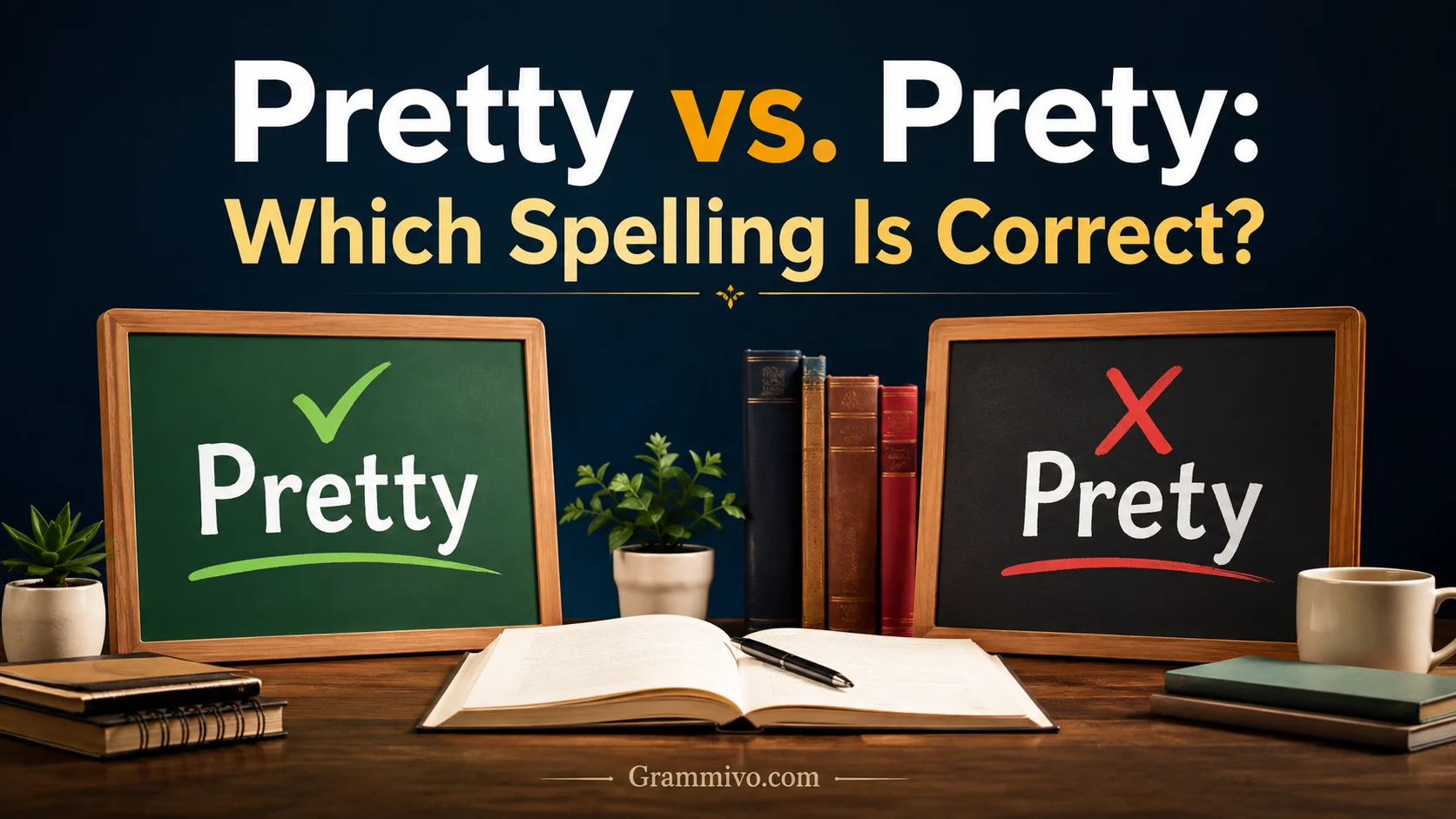
Pretty is the correct spelling in standard English. Prety is a misspelling when you intend to use the English word pretty. The difference comes down to one small letter, but that letter matters. Whether you’re writing a school assignment, email, social media post, or professional document, pretty is the form you should use.
The word itself is also more versatile than many people realize. It can describe physical attractiveness, pleasant appearances, or even a degree or extent when it works as an adverb. Understanding those uses makes the spelling easier to remember and helps you use the word naturally.
Quick Answer
Pretty is correct, while prety is incorrect in standard English. The word pretty is spelled P-R-E-T-T-Y, with two t letters in the middle. Prety usually occurs because someone accidentally leaves out one of those letters.
Correct: She wore a pretty dress.
Incorrect: She wore a prety dress.
A useful memory trick is simple: pretty has two Ts.
Pretty vs. Prety: Which One Is Correct?
The correct spelling is pretty. The form prety isn’t a standard alternative spelling of the same word.
That distinction matters because English sometimes allows multiple accepted spellings. For example, color and colour are both standard forms in different varieties of English. Canceled and cancelled can also both be correct depending on the variety and style guide. Pretty vs. prety isn’t that kind of situation.
There is no standard English spelling rule that recognizes prety as an alternative form of pretty. If you’re describing something attractive, pleasant, or charming, use pretty.
| Word | Standard English? | Meaning |
| pretty | Yes | Attractive, pleasing, fairly, or quite |
| prety | No | Usually a spelling mistake for pretty |
The easiest way to spot the difference is to look at the middle of the word:
PRE + TT + Y = PRETTY
The double t isn’t optional.
For example:
- She has a pretty smile.
- That is a pretty garden.
- The movie was pretty good.
- I’m pretty sure you’re right.
In every one of these sentences, pretty contains two t letters.
Why Is “Pretty” Spelled With Two Ts?
The spelling pretty has developed through the history of English rather than from a simple modern spelling rule. The word ultimately traces back to Old English prættig, which carried senses connected with being crafty, clever, or skillful. Over centuries, its form and meaning changed considerably.
By Middle English, forms such as pretti appeared. The modern spelling eventually settled as pretty.
That history explains an important point: you shouldn’t try to invent a modern spelling rule that says every word sounding like pretty must contain double t. English spelling doesn’t work that neatly.
Instead, treat pretty as a word whose standard spelling you need to recognize.
A practical memory trick works better than a complicated rule:
Pretty has two Ts.
You can even break it visually into three parts:
PRE | TT | Y
That tiny mental pause can prevent the most common spelling error.
Why People Write “Prety”
The mistake usually happens for ordinary reasons. Someone may type too quickly, rely on pronunciation, or simply overlook the missing letter during proofreading.
The error is particularly easy to make because the two spellings look so similar:
- pretty
- prety
Only one letter separates them.
On a phone keyboard, the mistake can happen even more easily. When you’re typing quickly, your fingers may move from t to y before you register that the second t is missing.
What Does “Pretty” Mean?
The most familiar meaning of pretty is attractive or pleasing to look at.
You can use it for people, clothing, flowers, buildings, scenery, decorations, artwork, and countless other things.
For example:
- She has a pretty smile.
- They live in a pretty little town.
- Those flowers are pretty.
- He bought a pretty blue shirt.
- We walked through a pretty garden.
The word often carries a softer tone than stronger words such as stunning or spectacular. Calling something pretty can suggest that it is charming, graceful, delicate, or pleasing.
That doesn’t mean pretty always describes something delicate. Context controls the strength and tone.
Consider these examples:
“That’s a pretty house.”
This sounds warm and complimentary. It suggests the house looks attractive.
“That’s a stunning house.”
This sounds stronger. The speaker is emphasizing a more striking impression.
“That’s a beautiful house.”
This can express deeper or broader admiration.
So while pretty and beautiful overlap, they’re not interchangeable in every situation.
Pretty Can Also Be an Adverb
One of the most useful things to understand about pretty is that it doesn’t always mean attractive.
In informal English, particularly in everyday American conversation, pretty can work as an adverb meaning fairly, quite, or to a considerable degree.
For example:
- The test was pretty difficult.
- I’m pretty tired today.
- That restaurant is pretty expensive.
- She runs pretty fast.
- We’re pretty close to the station.
- I’m pretty sure that’s the right answer.
In these sentences, pretty doesn’t describe someone’s appearance. It modifies another word.
Compare:
She looks pretty.
Here, pretty is an adjective describing her appearance.
She looks pretty tired.
Here, pretty works as an adverb modifying tired.
That distinction becomes especially important for English learners. The same spelling can perform different grammatical jobs depending on the sentence.
Pretty as an Adjective
When pretty describes a noun or someone’s appearance, it functions as an adjective.
Examples:
- a pretty dress
- a pretty face
- a pretty flower
- a pretty village
- a pretty picture
Pretty as an Adverb
When pretty modifies an adjective or adverb, it can function as an adverb.
Examples:
- pretty difficult
- pretty quickly
- pretty expensive
- pretty well
- pretty clearly
This is one reason the word appears so frequently in everyday conversation.
Pretty vs. Prety Examples
The simplest way to understand the difference is to compare correct and incorrect sentences.
| Incorrect | Correct |
| She has a prety dress. | She has a pretty dress. |
| What a prety flower! | What a pretty flower! |
| That’s a prety good idea. | That’s a pretty good idea. |
| The view is prety amazing. | The view is pretty amazing. |
| She lives in a prety town. | She lives in a pretty town. |
| I’m prety sure. | I’m pretty sure. |
| He bought a prety necklace. | He bought a pretty necklace. |
| It was prety cold outside. | It was pretty cold outside. |
Notice something important: the correction doesn’t change the meaning of the sentence. It simply restores the missing t.
Correct Examples With “Pretty”
“The sunset was pretty.”
Here, pretty describes the sunset.
“That was a pretty difficult question.”
Here, pretty modifies difficult.
“She chose a pretty dress for the wedding.”
Here, pretty describes the dress.
“I’m pretty confident about the result.”
Here, pretty modifies confident.
These examples show why you shouldn’t define pretty only as a synonym for beautiful. Its everyday use is much broader.
How to Remember the Correct Spelling of Pretty
If prety keeps appearing in your writing, don’t memorize a complicated spelling rule. Use a simple visual cue.
Remember the Double T
Think:
PRETTY = PRE + TT + Y
The middle of the word contains TT.
Another useful phrase is:
Two Ts make it pretty.
It’s short enough to remember when you’re proofreading.
Break the Word Into Sounds and Letters
You can also mentally separate the spelling:
P-R-E-T-T-Y
Then check the middle before you move on.
This works especially well when you’re proofreading a resume, essay, article, email, or other important document.
Don’t Trust Pronunciation Alone
American English pronunciation can make the spelling seem less obvious. In natural speech, the two written t letters don’t necessarily sound like two sharply separated t sounds.
That doesn’t change the spelling.
The same principle appears throughout English. Written letters and spoken sounds don’t always match perfectly. That’s one reason experienced writers recognize common words visually rather than trying to reconstruct every spelling from pronunciation.
Common Misspellings of Pretty
Although prety is the most direct error in this comparison, other forms can appear when people type quickly or spell the word from memory.
Common mistakes include:
- prety
- preety
- preetty
- pritty
None of these replaces pretty as the standard spelling.
The errors happen for different reasons. Someone might omit a letter, insert an extra vowel, or rely too heavily on how the word sounds.
| Misspelling | Correct form | Likely issue |
| prety | pretty | One t missing |
| preety | pretty | Extra e |
| preetty | pretty | Extra e and incorrect letter pattern |
| pritty | pretty | Incorrect vowel |
The key isn’t to memorize every possible typo. That would be like keeping a catalog of wrong turns. Remember the correct form instead:
pretty
Pretty in Different Forms
The word pretty also appears in several related grammatical forms. Learning these forms can reinforce the spelling.
| Form | Use | Example |
| pretty | Base adjective/adverb | She looks pretty. |
| prettier | Comparative | This dress is prettier. |
| prettiest | Superlative | That’s the prettiest flower. |
| prettily | Adverb | The room was prettily decorated. |
| prettiness | Noun | The garden’s prettiness attracted visitors. |
The comparative and superlative forms are particularly common.
Prettier
Use prettier when comparing two things or people.
This dress is prettier than the other one.
The spelling changes from pretty to prettier, but the word still begins with prett-.
Prettiest
Use prettiest when identifying the highest degree of attractiveness within a group.
That was the prettiest garden on the street.
Again, the double t remains visible.
Prettily
Prettily is an adverb derived from pretty.
The table was prettily decorated with flowers.
It’s less common in everyday American conversation than pretty, but it remains a legitimate word.
Prettiness
Prettiness is a noun referring to the quality of being pretty.
The prettiness of the garden came from its simple design.
These related forms help reveal why recognizing the prett- spelling pattern matters.
Pretty vs. Beautiful: Are They the Same?
Pretty and beautiful overlap, but they aren’t exact substitutes.
Pretty often sounds lighter, softer, or more casual. Beautiful can carry greater emotional or aesthetic weight.
Compare:
She has a pretty smile.
This sounds natural, warm, and complimentary.
She has a beautiful smile.
This can sound more emphatic or emotionally expressive.
The distinction becomes clearer with objects and experiences.
A small arrangement of flowers might be pretty. A breathtaking mountain landscape might be beautiful or spectacular.
Still, there’s no rigid boundary. English speakers can use pretty for many things that are genuinely beautiful.
The best word depends on the impression you want to create.
Read More: Its vs. It’s: Meaning, Examples, and Correct Usage
Pretty in Common Expressions
You probably encounter pretty more often than you realize because it appears in several common expressions.
Pretty Much
Pretty much usually means almost, nearly, or in practical terms yes.
That’s pretty much everything we need.
It can also signal that something is essentially true.
I’ve pretty much finished the project.
Pretty Well
Pretty well can mean quite well or, in some contexts, almost.
She knows the city pretty well.
The expression is common in conversational English.
Pretty Good
Pretty good means fairly or quite good.
The new restaurant is pretty good.
Depending on tone and context, it can represent moderate praise or fairly strong approval.
Pretty Sure
Pretty sure means you feel highly confident about something, although you’re not claiming absolute certainty.
I’m pretty sure the meeting starts at nine.
This phrase is extremely common in everyday American speech.
Pretty Please
Pretty please is an informal, often playful way to make a request.
Can I have the last cookie, pretty please?
The phrase can sound childish, humorous, affectionate, or deliberately playful depending on the speaker and situation.
Cost a Pretty Penny
The expression cost a pretty penny means that something was expensive.
That new laptop cost a pretty penny.
Here, pretty is part of an established idiomatic expression rather than a straightforward description of physical attractiveness.
Is “Prety” Ever Correct?
In ordinary English writing, prety isn’t the correct spelling of pretty.
That doesn’t mean the sequence of letters can never appear anywhere. A username, brand name, surname, fictional name, or other proper designation could theoretically use Prety as a chosen form.
However, those special uses don’t make prety an accepted spelling of the ordinary English adjective or adverb.
If your sentence means attractive, pleasant, fairly, or quite, the standard word is:
pretty
So if you’re writing:
“She has a prety smile.”
Change it to:
“She has a pretty smile.”
The correction is straightforward.
How to Pronounce “Pretty”
In American English, pretty is commonly pronounced approximately /ˈprɪt̬i/.
For an English learner, it can sound roughly like PRIT-ee, although that approximation doesn’t capture every detail of natural American pronunciation.
The spelling is:
P-R-E-T-T-Y
The pronunciation is not a perfect letter-for-letter reflection of the spelling. That’s normal in English.
In natural American speech, the t sound can undergo the familiar pronunciation pattern often called flapping when it occurs in an appropriate environment. As a result, the middle of pretty may sound softer than a learner expects from seeing tt.
That pronunciation difference doesn’t justify writing prety.
Spelling and pronunciation are related, but they’re not identical systems.
For a reliable pronunciation reference, Cambridge Dictionary provides both British and American pronunciations.
Pretty vs. Prety in Texting and Online Writing
Fast digital communication creates perfect conditions for small spelling errors.
When you’re texting a friend, a missing t might go unnoticed. The meaning remains obvious because readers can usually reconstruct the intended word from context.
For example:
“That dress is so prety!”
Most readers immediately understand that the writer meant pretty.
Still, context doesn’t make the spelling correct.
The distinction becomes more important in formal writing, including:
- Job applications
- Resumes
- School assignments
- Business emails
- Website content
- Reports
- Academic papers
- Published articles
- Marketing materials
A single typo won’t necessarily ruin a piece of writing. However, repeated spelling mistakes can make your work look rushed or poorly edited.
A useful rule is simple: casual communication may tolerate typos, but standard spelling remains pretty.
FAQs:
Is “pretty” or “prety” correct?
Pretty is correct. Prety is a misspelling when you mean the standard English word pretty.
Why does pretty have two Ts?
The spelling developed through the historical evolution of the English word. In modern English, pretty is simply the established standard spelling, so the double t needs to be retained.
Is “prety” a real English word?
Not as the standard spelling of pretty. You may encounter Prety in a name, username, or other special context, but that doesn’t make it the standard English spelling.
What does pretty mean?
As an adjective, pretty commonly means attractive, pleasing, or charming. As an informal adverb, it can mean fairly, quite, or to a considerable degree.
Can pretty be an adverb?
Yes. In sentences such as “The test was pretty difficult,” pretty modifies the adjective difficult.
What is the comparative form of pretty?
The comparative form is prettier.
This picture is prettier than the first one.
Conclusion:
When choosing between pretty vs. prety, there’s no complicated distinction to memorize. Pretty is the correct standard English spelling, while prety is normally a misspelling. The word pretty does much more than describe attractive things. It can function as an adjective, work as an informal adverb, form words such as prettier and prettiest, and appear in everyday expressions such as pretty much and pretty sure.
