
Have you ever wondered whether to write premier or premiere when describing something important or a special event? These two words look almost identical and sound remarkably similar. However, they carry different meanings and serve different grammatical purposes.
The confusion often appears when people write about movies, television shows, businesses, universities, and political leaders. For example, you might describe a university as a premier institution but attend a movie’s premiere. Switching these words can change the meaning of your sentence.
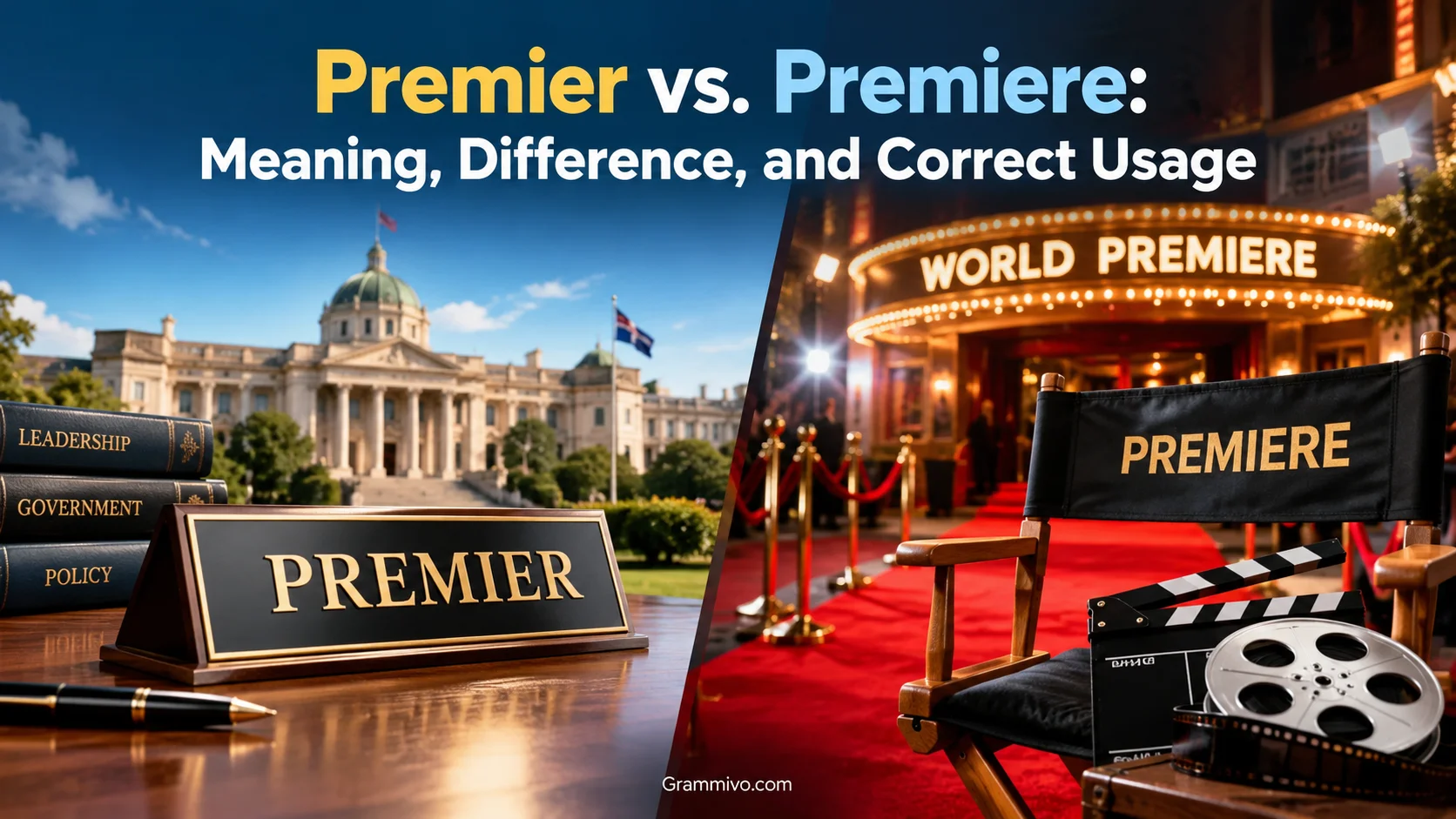
Although both words relate to the idea of being first, their actual uses differ. Premier generally describes something leading, important, or top-ranking. Premiere refers to the first public showing or performance of something.
Understanding this distinction will help you choose the correct spelling in everyday writing, professional communication, and formal documents. Let’s explore their meanings, grammatical roles, differences, and practical examples.
Quick Answer
Premier means first in importance, rank, position, or quality. It functions as an adjective and a noun. As a noun, it can refer to a prime minister or chief minister.
Premiere means the first public performance, screening, or presentation of something. It functions as both a noun and a verb.
Consider these examples:
- Premier: Harvard is considered a premier educational institution.
- Premiere: We attended the premiere of the new movie.
The easiest way to remember the difference is to associate premier with a leading position and premiere with a first public performance.
Comparison Overview
Although premier and premiere share similar spellings and pronunciations, they aren’t interchangeable. Their grammatical functions and meanings help distinguish them.
| Feature | Premier | Premiere |
| Main meaning | First in rank, importance, or quality | First public showing or performance |
| Part of speech | Adjective and noun | Noun and verb |
| Common usage | Business, politics, education, sports | Movies, television, theater, music |
| Refers to | Leadership or superior standing | A debut or first presentation |
| Example | A premier university | A movie premiere |
| Pronunciation | pruh-MEER | prih-MEER or pruh-MEER |
The main distinction comes down to context. When you describe something as leading or highly regarded, use premier. When you discuss the first public presentation of a creative work, use premiere.
What Does Premier Mean?
Premier describes something that holds the highest position, greatest importance, or leading status within a particular category. It commonly appears in professional, educational, political, and commercial writing.
For example, a company might call itself a premier service provider to highlight its reputation and position within an industry. Similarly, a university might earn recognition as a premier research institution because of its academic achievements.
The word can also function as a noun. In political contexts, a premier is a head of government, particularly in certain countries and regional administrations.
The meaning depends on how you use it. As an adjective, it describes status or quality. As a noun, it identifies a political leader.
Premier as an Adjective
When premier functions as an adjective, it describes something considered first-rate, leading, or especially important.
Writers often use it to emphasize the reputation, quality, or standing of a person, organization, product, or event.
For instance, calling a hospital a premier medical institution suggests that it has an outstanding reputation or occupies a leading position in healthcare.
However, the word doesn’t automatically prove that something ranks number one. It expresses high standing or distinction rather than a guaranteed position in an official ranking.
Examples of premier as an adjective:
- The company has become a premier provider of cybersecurity services.
- She received an invitation to a premier business conference.
- This university is one of the country’s premier educational institutions.
- The city hosts a premier international sporting event every year.
- He works with a premier team of medical specialists.
- The hotel offers accommodation in one of the region’s premier locations.
- Their restaurant has established itself as a premier dining destination.
Notice how premier describes the standing or quality of something in each sentence. It doesn’t refer to a first performance or public debut.
Premier as a Noun
Premier also functions as a noun that identifies a political leader, usually a prime minister or chief minister.
The title appears in several political systems around the world. Its exact meaning depends on the country’s constitutional structure and government terminology.
For example, Canadian provinces use the title premier for their heads of government. Australia’s states and territories also have premiers who lead their respective governments.
In these contexts, the word identifies an official position rather than describing something as excellent.
Examples of premier as a noun:
- The provincial premier announced a new economic development plan.
- The premier met with international representatives to discuss trade.
- Canada’s premier addressed concerns about public healthcare.
- The state premier introduced new transportation policies.
- The premier attended an official meeting with the prime minister.
A useful distinction is that premier can describe a leading institution or identify a political leader. Its grammatical role tells you which meaning applies.
Read More: Noisy vs. Noisey: Meaning, Difference, and Correct Usage
What Does Premiere Mean?
Premiere refers to the first public presentation, screening, or performance of something. It most commonly appears in entertainment, especially when discussing movies, television programs, theatrical productions, and musical performances.
When a new movie receives its first public screening, that event is called its premiere. Similarly, when a television network broadcasts a new series for the first time, the series premieres on that date.
Unlike premier, which can describe a leading position, premiere focuses on the idea of an initial public appearance.
It functions as both a noun and a verb. Understanding these two grammatical roles will help you use it correctly.
Premiere as a Noun
As a noun, premiere describes the first public showing or performance of a creative production. The event often attracts audiences, critics, journalists, celebrities, and people involved in the production.
Movie premieres are particularly well known. They frequently include red carpets, interviews, photography, and special screenings before a film reaches general audiences.
However, the word isn’t limited to cinema. You can also use it for television programs, theatrical performances, musical compositions, and other creative works.
Examples of premiere as a noun:
- The movie’s premiere attracted several famous actors.
- We purchased tickets for the premiere of a new theatrical production.
- The television series had its premiere last weekend.
- Everyone discussed the documentary after its premiere.
- The singer attended the premiere of her concert film.
- The orchestra announced the premiere of a newly composed symphony.
- The audience gave the production a standing ovation at its premiere.
In these sentences, premiere identifies the first public presentation or the event associated with it.
An important detail: A premiere doesn’t always mean the first time anyone has seen or experienced something. A production may have private screenings, rehearsals, or previews before its official public premiere.
For example, a movie’s director might show an unfinished version to producers before its official premiere. Those private screenings don’t necessarily count as the movie’s public premiere.
Premiere as a Verb
Premiere also works as a verb. It means to present, introduce, or show something publicly for the first time.
The verb commonly appears in entertainment news, movie announcements, television schedules, and promotional materials.
For example, when a streaming platform introduces a new original series, you might read that the show will premiere on a particular date.
The word changes form depending on the sentence’s tense:
| Verb form | Example |
| Present | The network premieres a new series tonight. |
| Past | The director premiered his documentary last year. |
| Future | The film will premiere next month. |
| Present participle | The production is premiering this weekend. |
| Past participle | The musical has premiered in several cities. |
Examples of premiere as a verb:
- The director will premiere his latest film in November.
- The television network premiered a new drama last night.
- The artist plans to premiere her latest musical composition.
- The streaming service will premiere three original documentaries.
- The theater company premiered its newest production yesterday.
- The filmmaker is premiering his independent movie at a festival.
The key is to recognize the action. If something is being introduced publicly for the first time, premiere is usually the correct verb.
Main Differences Between Premier vs. Premiere
The difference between premier and premiere becomes easier to understand when you examine their meanings, grammatical functions, and everyday applications.
Both words have a connection to the idea of being first. However, they express different kinds of priority.
Premier emphasizes position, importance, or excellence. Premiere emphasizes a first public presentation or performance.
Let’s examine their differences more closely.
Difference in Meaning
The most important distinction involves what each word communicates.
Premier describes something that holds a leading position or enjoys an especially high reputation. It can also identify a political leader.
Premiere identifies the first public appearance of a creative production or the act of presenting it for the first time.
Consider these examples:
- Premier: The organization is one of the premier research centers in the country.
- Premiere: The organization hosted the premiere of its new documentary.
The first sentence describes the organization’s reputation. The second identifies an event.
Difference in Grammatical Function
Another important difference involves how each word behaves in a sentence.
Premier functions as an adjective or noun. Premiere functions as a noun or verb.
| Word | Grammatical role | Example |
| Premier | Adjective | She joined a premier consulting firm. |
| Premier | Noun | The premier addressed the public. |
| Premiere | Noun | The premiere attracted a large audience. |
| Premiere | Verb | The studio will premiere its new film. |
This distinction matters because a word’s grammatical role affects how you construct your sentence.
For example, you can write:
- The premier hospital opened a new department.
- The hospital hosted the premiere of its health documentary.
Both sentences are grammatically correct, but they communicate different ideas.
Difference in Usage and Context
The surrounding subject often reveals which word you need.
Premier commonly appears in discussions involving:
- Leading businesses and organizations.
- Top-ranked universities and educational institutions.
- High-quality products and professional services.
- Important sporting events and competitions.
- Political leaders and government officials.
Premiere commonly appears in discussions involving:
- Movie screenings and film festivals.
- Television series and new episodes.
- Theater productions and stage performances.
- Musical compositions and concert productions.
- Documentaries and other creative projects.
For example, a newspaper might describe a university as a premier institution while announcing the premiere of a documentary about its history.
The subject provides a useful clue. Look at what the sentence describes before choosing your spelling.
Difference in Word Endings
The additional letter e in premiere helps distinguish its spelling from premier.
However, you shouldn’t rely entirely on the final letter to determine meaning. The word’s grammatical role and context matter much more.
A useful memory trick is:
- Premier: Think of priority, position, and prestige.
- Premiere: Think of a first performance or first public showing.
This simple association can help you avoid mistakes when writing quickly.
When to Use Premier vs. Premiere
Choosing between these words becomes straightforward once you identify the message you want to communicate.
Are you describing something important or highly regarded? Use premier. Are you referring to the first public presentation of a creative work? Use premiere.
FAQs:
Is Premier or Premiere Correct?
Both premier and premiere are correct English words. However, they have different meanings and grammatical functions.
Use premier to describe something leading or highly regarded. Use premiere when referring to a first public showing or presentation.
What Is the Difference Between Premier and Premiere?
Premier describes something that holds a leading position, high rank, or distinguished reputation. It can also refer to a prime minister or chief minister.
Premiere refers to the first public performance, screening, or presentation of something. It can function as both a noun and a verb.
Is Premier Another Word for Best?
Yes, premier can suggest that something is among the best or most distinguished in its category.
For example, a premier hospital generally has a strong reputation for quality healthcare.
However, the word doesn’t necessarily establish that something is officially ranked number one. It often expresses distinction rather than a precise ranking.
Does Premiere Mean First?
Premiere refers to the first public showing, performance, or presentation of a creative work.
For example, a movie premiere is its first official public screening or special initial presentation.
The word doesn’t simply replace first in every sentence. It specifically relates to an initial public presentation.
Is Premiere a Noun or a Verb?
Premiere functions as both a noun and a verb.
As a noun, it identifies the first public presentation of a production.
Example: The movie’s premiere attracted a large audience.
As a verb, it describes the act of presenting something publicly for the first time.
Example: The director will premiere his new documentary next month.
Conclusion:
Although premier and premiere look and sound similar, their meanings are quite different. Understanding their grammatical roles makes choosing the correct word much easier. Use premier when describing something leading, distinguished, or highly regarded. It can also identify a political leader, such as a prime minister or chief minister.
Use premiere when discussing the first public screening, performance, or presentation of a creative production. Remember that it can function as both a noun and a verb. The simplest trick is to associate premier with position and premiere with performance. Once you understand this distinction, you’ll have no trouble using both words correctly in your writing.
