
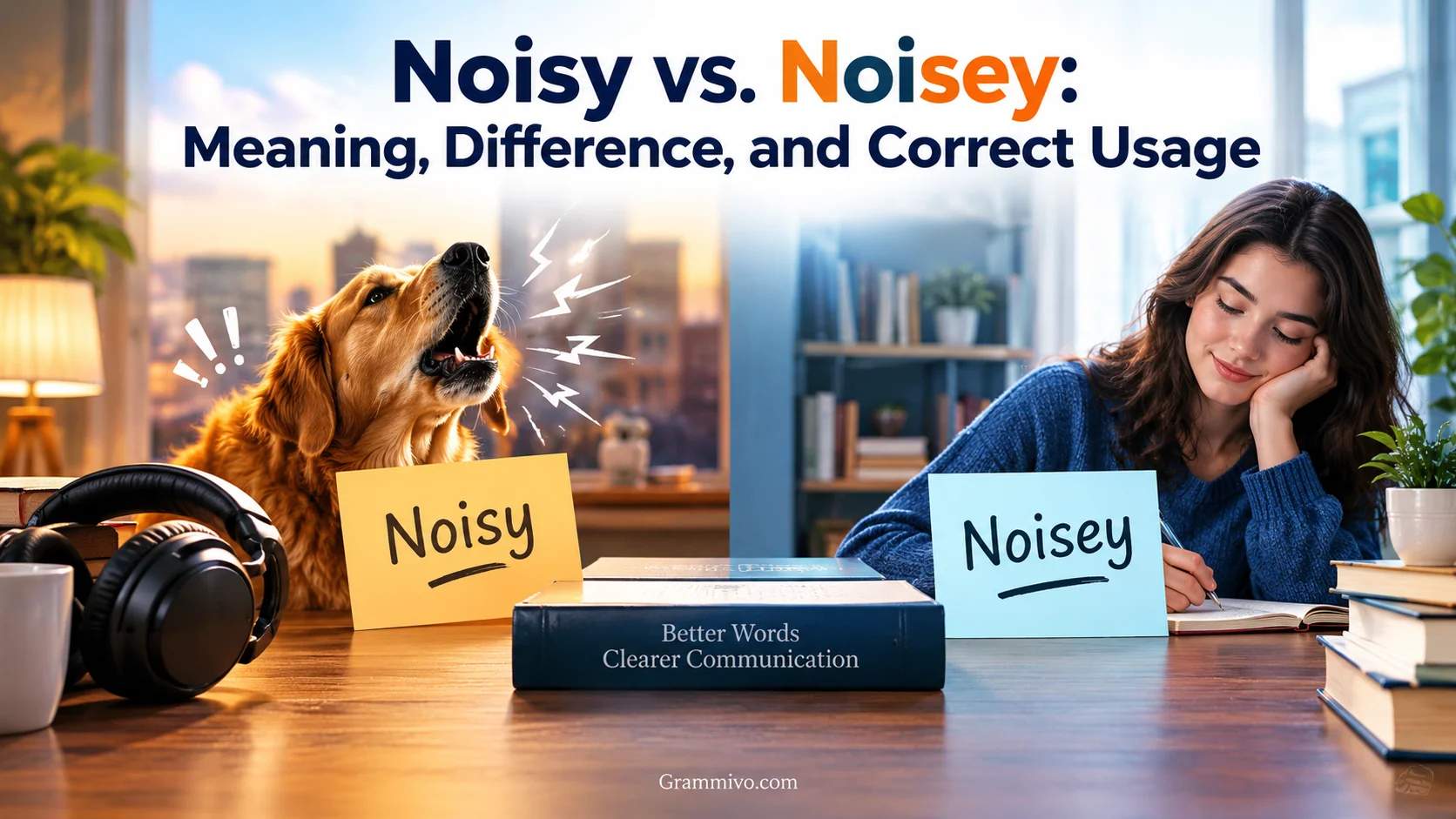
Have you ever wondered whether noisy or noisey is the correct spelling? You’re not alone. These two forms look almost identical, which makes it easy to add an unnecessary letter when writing quickly. However, only one follows standard English spelling rules.
The confusion usually comes from the word noise. Since it ends in an e, some writers assume that the letter should remain when forming its adjective. English spelling doesn’t always work that way. When you add the suffix -y to noise, you remove the final e to create noisy.
Although noisey occasionally appears in informal writing, it isn’t the standard spelling. Whether you’re describing loud neighbors, a crowded classroom, or a busy machine, noisy is the form you should use.
Quick Answer
Noisy is the correct spelling in standard English. It describes someone or something that makes a lot of noise or produces excessive sound. Noisey is a common misspelling and doesn’t have a separate standard English meaning.
For example:
- Correct: The children became noisy during the school break.
- Incorrect: The children became noisey during the school break.
Remember the simple relationship: noise becomes noisy, not noisey. Use noisy in everyday conversations, academic assignments, professional documents, and other forms of standard writing.
Comparison Overview
Although noisy and noisey look similar, their spelling status is different. One is a recognized English adjective while the other is generally an incorrect spelling of that adjective.
| Feature | Noisy | Noisey |
| Spelling status | Correct | Nonstandard misspelling |
| Meaning | Making a lot of noise | No separate standard meaning |
| Part of speech | Adjective | Not a standard adjective |
| Pronunciation | /ˈnɔɪ.zi/ | Usually intended to sound like noisy |
| Formal writing | Acceptable | Avoid |
| Everyday usage | Standard | Generally incorrect |
| Example | A noisy classroom | A noisey classroom |
The important distinction isn’t pronunciation. Both forms are usually intended to represent the same spoken word. The difference lies entirely in their spelling.
If you’re writing an email, school assignment, article, or social media post, choose noisy. You don’t need the extra letter.
Main Differences Between Noisy vs. Noisey
Understanding the difference becomes easier when you examine how each form works in English. The distinction involves spelling conventions, word formation, meaning, and practical usage.
Noisy Is the Correct Standard Spelling
Noisy is an established English adjective that describes something producing a lot of sound. It can refer to people, animals, machines, vehicles, rooms, or entire environments.
For example, you might describe a busy restaurant as noisy because several conversations happen simultaneously. Similarly, a faulty air conditioner might be noisy because it produces an unusually loud rattling sound.
The word also appears in figurative contexts. For example, someone might describe a visually crowded advertisement as noisy because it contains too many competing colors and design elements.
Here are some natural examples:
- The noisy traffic made it difficult to hear the announcement.
- Our neighbors have a noisy dog that barks throughout the night.
- The office becomes noisy whenever the entire team meets.
- This old washing machine is becoming increasingly noisy.
- The children were too noisy during the movie.
In each sentence, noisy describes a person, object, or environment associated with considerable sound or activity.
Noisey Is a Common Misspelling
Noisey isn’t the standard spelling of the adjective. Writers generally produce it by keeping the final e from noise before adding another letter.
However, standard English spelling changes the word to noisy.
Consider these examples:
- Incorrect: The noisey street disturbed our sleep.
- Correct: The noisy street disturbed our sleep.
- Incorrect: My neighbors are always noisey.
- Correct: My neighbors are always noisy.
- Incorrect: That noisey machine needs repair.
- Correct: That noisy machine needs repair.
You might occasionally encounter Noisey as a deliberately chosen username, business name, artistic label, or other proper name. Such creative uses don’t change the standard spelling of the adjective.
What Does Noisy Mean?
The word noisy describes something that makes a lot of noise or produces sounds that people may find distracting, unpleasant, or excessive.
It’s commonly used when sound becomes noticeable enough to affect an environment or interfere with an activity.
For example, imagine studying in a library when a group of people starts talking loudly. You might describe their conversation as noisy because it interrupts the quiet atmosphere.
However, noisy doesn’t always mean unpleasant. A birthday party can be noisy because guests are laughing, singing, and celebrating. In that situation, the sound might create excitement rather than irritation.
The meaning depends on the context.
Noisy as an Adjective
In grammar, noisy functions as an adjective. An adjective describes or gives more information about a noun.
It helps explain the sound produced by a person, place, animal, object, or situation.
For instance:
- Noisy children: Children who make considerable noise.
- Noisy neighbors: Neighbors who frequently create loud sounds.
- Noisy streets: Roads filled with traffic, horns, and other sounds.
- Noisy equipment: Machines that operate with noticeable sound.
- Noisy environments: Places where several sounds occur simultaneously.
The word can appear before a noun or after a linking verb.
Before a noun:
- We moved away from the noisy apartment.
- The noisy crowd filled the stadium.
After a linking verb:
- The classroom became noisy.
- These machines are unusually noisy.
Both constructions are grammatically correct.
Different Contexts Where Noisy Is Used
The word noisy works in several everyday situations. Understanding these contexts helps you use it more naturally.
People and animals: You can describe children, crowds, pets, or neighbors that produce considerable sound.
Example: The noisy puppies kept everyone awake.
Places and environments: Use it for locations with noticeable background sounds or frequent activity.
Example: The airport becomes noisy during peak travel hours.
Machines and equipment: It describes appliances, vehicles, or tools that produce loud or distracting sounds.
Example: My refrigerator makes a noisy humming sound.
Social gatherings: Parties, celebrations, and sporting events can become noisy because of conversations, cheering, and music.
Example: The wedding reception was noisy but enjoyable.
Figurative descriptions: In certain contexts, noisy can describe something visually cluttered or full of competing elements.
Example: The website has a noisy design with too many colors and advertisements.
What Does Noisey Mean?
Noisey generally represents an incorrect spelling of noisy. It doesn’t carry a separate standard English definition that distinguishes it from the correct adjective.
The mistake often happens because English writers try to preserve the original spelling of noise. They see the final e and assume it should remain when adding the -y suffix.
Unfortunately, that assumption produces the wrong spelling.
The correct transformation is:
Noise + y = Noisy
Not:
Noise + y = Noisey
This small spelling difference matters in formal and everyday writing. Although readers will probably understand what someone means by noisey, the spelling can make otherwise polished writing look careless.
Is Noisey a Real Word?
The answer depends on what you mean by a real word.
People sometimes use unusual spellings intentionally. A company might choose Noisey as its brand name. An artist might use it as a username or a creative label.
However, those uses don’t make it the standard spelling of the adjective meaning loud or full of noise.
In ordinary English writing, dictionaries and established spelling conventions recognize noisy as the correct form.
Consider these situations:
| Situation | Appropriate spelling |
| School assignment | Noisy |
| Professional email | Noisy |
| Academic writing | Noisy |
| Everyday conversation | Noisy |
| Creative brand name | Noisey may be intentional |
| Standard adjective meaning loud | Noisy |
Therefore, unless you’re reproducing an intentional name or stylized spelling, avoid noisey.
Read More: Savior vs. Saviour: Meaning, Difference, and Correct Usage
Examples of Incorrect Noisey Usage
Seeing incorrect examples alongside their corrections can help you recognize the mistake more quickly.
| Incorrect sentence | Correct sentence |
| The noisey classroom distracted me. | The noisy classroom distracted me. |
| My neighbors are very noisey. | My neighbors are very noisy. |
| That noisey engine needs attention. | That noisy engine needs attention. |
| The restaurant gets noisey at night. | The restaurant gets noisy at night. |
| We live near a noisey highway. | We live near a noisy highway. |
Notice that the correction doesn’t require changing the sentence structure. You simply replace noisey with noisy.
Why Is Noisy Spelled Without an E?
The spelling of noisy becomes much easier to understand when you examine its word formation.
The word comes from the noun noise. English speakers use the suffix -y to form adjectives that describe a quality or characteristic associated with something.
When this suffix attaches to certain nouns ending in a silent e, the final e disappears.
That’s exactly what happens with noise.
- Original noun: Noise
- Adjective-forming suffix: -y
- Correct adjective: Noisy
The final e drops before the suffix begins. This produces a shorter and accepted spelling.
The Relationship Between Noise and Noisy
Although noise and noisy share the same root, they serve different grammatical purposes.
Noise is a noun. It refers to a sound or collection of sounds.
Noisy is an adjective. It describes something that produces or contains considerable noise.
Compare these examples:
| Noise (Noun) | Noisy (Adjective) |
| The noise disturbed my sleep. | The noisy neighbors disturbed my sleep. |
| I heard a strange noise. | The machine sounds noisy. |
| The noise came from outside. | The outside area is noisy. |
| Too much noise affects concentration. | A noisy room affects concentration. |
The difference is straightforward. You use noise to name the sound and noisy to describe its source or surroundings.
For example, consider this sentence:
“The noisy construction workers created so much noise that nobody could concentrate.”
Here, noisy describes the workers while noise identifies the sound they produce.
Both words are correct because they perform different grammatical jobs.
Similar Words That Follow the Same Spelling Pattern
English contains several words that follow a similar spelling pattern. Learning these examples can help you remember why noisy doesn’t need an extra e.
| Original Word | Correct Adjective | Incorrect Form |
| Ice | Icy | Icey |
| Spice | Spicy | Spicey |
| Grease | Greasy | Greasey |
| Ease | Easy | Easey |
| Noise | Noisy | Noisey |
The pattern is consistent: the final silent e disappears before the suffix -y.
For example, ice becomes icy rather than icey. Similarly, spice becomes spicy rather than spicey.
These comparisons provide a useful memory trick. When you know how icy and spicy work, remembering noisy becomes much easier.
However, English spelling contains exceptions and different word-formation patterns. Don’t assume every word ending in e follows this exact rule.
How to Use Noisy Correctly in Sentences
Knowing the correct spelling is only half the job. You should also understand how to use noisy naturally in different situations.
The adjective works with singular and plural nouns. It can describe temporary sounds, regular disturbances, and ongoing conditions.
Noisy in Everyday Conversations
Everyday conversations provide plenty of opportunities to use noisy.
You might describe a crowded market, a barking dog, or a busy family gathering. The word communicates that an environment produces considerable sound without requiring a complicated explanation.
Examples include:
- This restaurant is too noisy for a quiet conversation.
- The children become noisy whenever they play together.
- I couldn’t sleep because the neighbors were noisy.
- Our street gets noisy during rush hour.
- The party was noisy but everyone had fun.
- Why is your laptop making such a noisy sound?
Writing tip: Use noisy when you want a simple and natural description. You don’t need a more complicated adjective unless the situation calls for greater precision.
Noisy in Academic and Professional Writing
The word also works in formal writing. However, your choice should match the subject and intended meaning.
For example, a student might describe a noisy classroom when discussing distractions and learning conditions. An engineer might use the same adjective when describing machinery that produces excessive sound.
Consider these examples:
- Excessively noisy workplaces can make communication difficult.
- The laboratory equipment produces a noisy operating sound.
- Researchers examined how noisy environments affect concentration.
- The building’s ventilation system becomes noisy during operation.
- Employees reported problems with noisy office surroundings.
In technical writing, you may need a more precise term. For instance, high sound levels, background noise, or mechanical noise might communicate specific information more accurately.
Nevertheless, noisy remains a perfectly acceptable adjective in professional contexts.
Common Expressions and Word Combinations With Noisy
Certain combinations appear frequently in everyday English. Learning them can make your writing sound more natural.
| Expression | Meaning | Example |
| Noisy neighbors | Neighbors who make considerable noise | Our noisy neighbors often play music late. |
| Noisy environment | A place with excessive or noticeable sound | I struggle to work in a noisy environment. |
| Noisy classroom | A classroom filled with distracting sounds | The teacher quieted the noisy classroom. |
| Noisy machine | Equipment that produces considerable sound | The noisy machine needs maintenance. |
| Noisy crowd | A group of people making loud sounds | A noisy crowd celebrated the victory. |
| Noisy street | A road with considerable traffic or activity | We moved away from the noisy street. |
| Noisy room | A room with noticeable background sounds | The noisy room made studying difficult. |
These expressions are useful because they show how naturally noisy combines with different nouns.
FAQs:
Is Noisy or Noisey the Correct Spelling?
Noisy is the correct spelling in standard English. It describes something that makes considerable sound or creates a loud environment. Noisey is generally a misspelling and shouldn’t appear in formal or professional writing.
Why Do People Spell Noisy as Noisey?
People often write noisey because they try to preserve the final e in the original word noise. However, the final e drops when the suffix -y is added. That’s why the correct spelling is noisy.
Is Noisey Ever Acceptable in English?
Noisey may appear as an intentional creative spelling in brand names, usernames, or artistic expressions. However, it isn’t the standard spelling of the adjective meaning loud. For ordinary writing, always choose noisy.
What Is the Plural of Noisy?
Adjectives don’t normally have plural forms in English. The word noisy stays the same whether it describes one object or several.
For example:
- The noisy child disturbed the class.
- The noisy children disturbed the class.
The adjective doesn’t change when the noun becomes plural.
What Is the Difference Between Noisy and Loud?
Noisy generally describes something that produces considerable or distracting sound. Loud specifically emphasizes the volume or intensity of a sound.
For example, a crowded restaurant can be noisy because several people talk simultaneously. A loud explosion produces an intense sound that stands out immediately.
Conclusion:
The difference between noisy and noisey comes down to one unnecessary letter. Noisy is the correct standard English spelling while noisey is generally a misspelling. The correct form comes from noise with the final e removed before adding the suffix -y. This follows a familiar pattern found in words such as icy, spicy, and greasy. Whenever you describe loud neighbors, busy streets, crowded classrooms, or noisy machines, choose noisy. Remember the spelling rule and you’ll avoid this common mistake in your everyday writing.
