
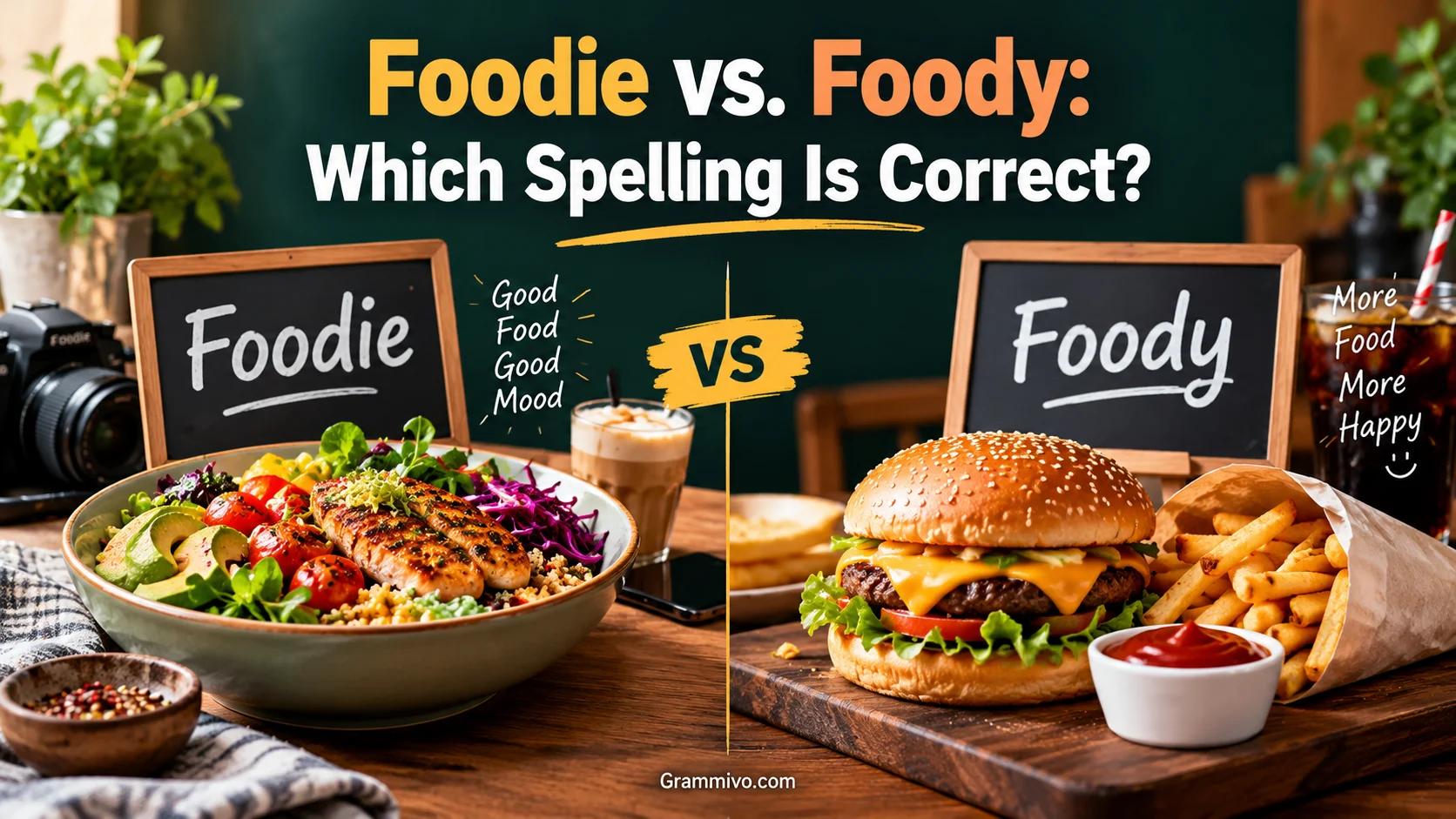
When describing a person who loves food, enjoys trying new dishes, talks about restaurants, or cares about cooking and flavors, foodie is the safest spelling in US English. Foodie vs. Foody can cause confusion because English forms some words by adding -y to a noun, such as Cloudy from cloud and messy from mess.
That makes foody look like a logical formation, but the spelling formula doesn’t always apply neatly. Although foody appears in dictionaries and informal writing, foodie remains the established word for someone with a strong interest in food and culinary experiences.
Its meaning and function can change with context, yet foody isn’t the usual standard replacement. That small spelling difference matters because a natural sentence gives your writing look a more familiar feel to readers.
Quick Answer
Foodie is the standard and widely recognized spelling when you mean a person who is very interested in food or enjoys exploring food and culinary experiences.
Foody does appear in English, but it is much less common and can have different descriptive uses depending on the context. It isn’t generally the spelling you should choose when you’re talking about someone who loves food.
For example:
- Correct and natural: “Maria is a foodie who loves trying new restaurants.”
- Less standard for this meaning: “Maria is a foody who loves trying new restaurants.”
A useful rule is simple:
Use “foodie” for a person who loves or knows a lot about food.
When you want to describe something as having a food-related quality, however, context matters. That’s where foody and other food-related adjectives may appear.
Comparison Overview
| Feature | Foodie | Foody |
| Standard everyday form for a food enthusiast | Yes | No |
| Commonly used as a noun | Yes | Rarely |
| Refers to a person interested in food | Yes | Usually not the preferred form |
| Common in modern English | Very common | Much less common |
| Suitable for general US English | Yes | Context-dependent |
| Typical meaning | A person passionate about food | A less common descriptive form or variant |
| Best choice for a food enthusiast | Foodie | Not usually |
| Example | “He’s a foodie.” | “The restaurant has a foody theme.” |
The key difference isn’t simply the final two letters. Foodie has a well-established meaning and role in everyday English. Foody, by contrast, doesn’t have the same level of standardization or frequency.
Main Differences Between Foodie vs. Foody
The most important difference between foodie vs. foody is their typical grammatical use. Foodie is primarily a noun. It identifies a person who takes an enthusiastic interest in food.
Foody is much less settled. Depending on where and how you encounter it, it may function as an informal adjective or appear as a variant connected with food. That makes it less suitable when you simply want to identify someone as a food enthusiast.
Foodie Refers to a Person
The word foodie normally describes someone who has an enthusiastic interest in food. That interest can involve restaurants, cooking, ingredients, culinary traditions, food history, or simply discovering new dishes.
A foodie doesn’t have to be a professional chef. In fact, that’s an important distinction.
Someone can be a foodie without having formal culinary training. A person who spends weekends searching for interesting restaurants can easily describe themselves as a foodie. So can someone who enjoys cooking regional dishes at home.
Consider these examples:
- “I’m a foodie, so I always check the local restaurants when I travel.”
- “Jake became a foodie after learning to cook.”
- “She’s a serious foodie who knows every bakery downtown.”
- “The food festival attracted thousands of foodies.”
In each sentence, foodie identifies a person.
Foody Has a Less Established Role
The spelling foody can be encountered in English, but it doesn’t carry the same standard everyday meaning as foodie.
That’s why replacing foodie with foody can make a sentence sound unusual. English readers have become highly accustomed to foodie as the noun for a food enthusiast.
For example:
“She’s a foodie.”
The sentence feels natural and immediately understandable.
Compare it with:
“She’s a foody.”
The second sentence may be understood from context, but many readers will wonder whether foody is simply a misspelling of foodie.
This difference is important in polished writing. A word doesn’t become equally standard merely because its spelling seems logical.
What Does Foodie Mean?
Foodie is a noun used for someone who has a strong interest in food and culinary experiences.
The word can describe a broad range of interests. A foodie might care about:
- New restaurants
- Cooking techniques
- Ingredients
- Regional cuisines
- Food markets
- Baking
- Fine dining
- Street food
- Food photography
- Recipes
- Culinary traditions
- Food-related travel
The term is also flexible. It can describe casual enthusiasm or a deep interest in culinary culture.
Foodie as a Noun
The most common grammatical use is straightforward:
food + -ie = foodie
The resulting word doesn’t mean merely “a person who eats food.” Everyone eats food. Instead, foodie suggests unusual enthusiasm or interest in food.
For example:
“Nina is a foodie who plans her vacations around local restaurants.”
The sentence suggests that food plays a meaningful role in Nina’s interests.
Another example:
“My brother isn’t a professional chef, but he’s a huge foodie.”
This shows that culinary expertise isn’t required.
Foodie Can Describe Different Levels of Interest
Calling someone a foodie doesn’t necessarily tell you how knowledgeable they are.
One foodie might enjoy trying new pizza places. Another might study regional cooking traditions and understand complex culinary techniques.
That flexibility makes the term useful in casual English.
You might hear:
- casual foodie — someone who simply loves good food
- serious foodie — someone deeply interested in culinary experiences
- foodie culture — a broader interest in food and dining
- foodie destination — a place known for appealing culinary experiences
The word has therefore developed beyond its narrowest dictionary-style definition.
What Does Foody Mean?
Foody is much less common than foodie, and its interpretation depends on context.
In some uses, foody functions as an informal descriptive word suggesting something connected with or characteristic of food. In other cases, people use it when they actually mean the noun foodie.
That distinction matters.
If you’re writing:
“He’s a foody.”
you probably intend to say:
“He’s a foodie.”
The second version is the established choice.
However, if someone deliberately uses foody as an adjective to describe something food-related, the context can be different.
Why Foody Causes Confusion
The spelling foody looks intuitive because English frequently forms adjectives with -y.
Consider:
- taste → tasty
- health → healthy
- spice → spicy
- cream → creamy
- salt → salty
That pattern might make foody look natural. Yet English vocabulary contains plenty of irregular formations and specialized words.
The established noun for a food enthusiast is foodie, not foody.
That’s a good reminder that spelling can’t always be predicted from a single word-building rule.
Foodie vs. Foody: Spelling Difference
The visible difference is tiny:
Foodie → F-O-O-D-I-E
Foody → F-O-O-D-Y
Both begin with food. The ending changes the word’s appearance and, in standard usage, its role.
The -ie ending in foodie is part of the established spelling of the noun. It isn’t simply an accidental alternative to -y.
If you’re referring to a person who loves food, remember:
food + ie → foodie
That spelling is familiar to readers across a wide range of everyday contexts.
Foodie vs. Foody: Meaning Difference
The meaning difference becomes clearer when you place the words into sentences.
Foodie
Foodie normally refers to a person.
“Daniel is a foodie.”
Here, foodie is a noun describing Daniel.
Foody
Foody can appear as a less common descriptive form. Its interpretation depends on the sentence and source.
For example, a writer might use foody informally to suggest that something has a food-related character. However, that doesn’t make it a substitute for the noun foodie.
This distinction prevents a common error:
❌ “My friend is a foody.”
✅ “My friend is a foodie.”
When the subject is a person who loves food, foodie is the clear choice.
Why Is Foodie the Preferred Spelling?
Language users tend to favor forms that become established through repeated use. Foodie has become a familiar part of modern English vocabulary.
Its meaning is easy to recognize, its spelling is widely established, and it appears naturally in conversations about restaurants, cooking, travel, and culinary interests.
The word also fits comfortably into different grammatical forms:
- foodie
- foodies
- foodie’s
- foodies’
For example:
“The restaurant’s new menu has attracted local foodies.”
The plural foodies is especially common in restaurant and food-writing contexts.
The popularity of the term has also grown alongside modern food culture. Restaurant reviews, cooking websites, culinary television, food photography, and social platforms have all created more situations where people need a concise word for food enthusiasts.
Is Foody a Correct Word?
The answer requires some nuance.
Foody can occur as an English word, but it isn’t normally the preferred spelling for a person who loves food.
That’s different from saying that every appearance of foody is automatically a spelling error.
Context matters.
If someone writes:
“She’s a foody.”
they most likely intended foodie.
If foody appears as an informal adjective describing something associated with food, the writer may have chosen the form deliberately. However, that usage is less established and can sound unusual to many readers.
For general US English writing, foodie is the safer and more recognizable choice when referring to a person.
Foodie or Foody in American English
In US English, foodie is the familiar term for someone who is especially interested in food.
You’ll encounter it in everyday conversation and informal writing:
- “She’s a foodie.”
- “This city is perfect for foodies.”
- “Foodies will love the weekend market.”
- “I’m becoming a foodie.”
The word works naturally in restaurant reviews, travel writing, lifestyle articles, and casual conversation.
By contrast, foody isn’t the normal choice for that meaning.
If you’re preparing content for an American audience, choosing foodie avoids unnecessary confusion.
Foodie or Foody in British English
British English also uses foodie to refer to someone who is enthusiastic about food.
Therefore, this isn’t a simple case where American English uses foodie and British English uses foody. Both varieties recognize foodie as the established term.
Regional vocabulary can certainly differ between American and British English. In this case, however, the main distinction between foodie and foody isn’t explained by the US-versus-UK spelling pattern.
For broad English writing, foodie remains the more recognizable choice.
Common Mistakes With Foodie and Foody
A few mistakes appear repeatedly because the spellings look so similar.
Using Foody for a Food Enthusiast
This is the most important error to avoid.
❌ “My cousin is a foody.”
✅ “My cousin is a foodie.”
The noun foodie already provides the exact word needed.
Assuming -Y Must Be Correct
English spelling doesn’t always work like a mathematical formula.
You can’t simply take every noun and add -y to create its standard adjective or noun form.
For instance, foodie developed as an established word with its own spelling. Its familiarity matters more than whether foody looks predictable.
Read More: Awhile vs. A While: Meaning, Difference, and Correct Usage
Confusing a Person With a Food Description
This distinction is especially useful:
Foodie = person
Food-related adjective = describes something connected with food
For example:
“She is a foodie.”
Here, you’re identifying a person.
But:
“The restaurant has a strong food-focused identity.”
Here, you’re describing something about the restaurant.
The grammatical job of the word matters.
Foodie Synonyms and Related Words
Several words can describe someone with a strong interest in food. However, they aren’t perfect substitutes in every context.
| Word | General meaning | Typical use |
| Foodie | Person enthusiastic about food | Everyday English |
| Gourmet | Someone interested in high-quality or sophisticated food | Dining and culinary contexts |
| Epicure | Person devoted to refined enjoyment, especially food and drink | More formal or literary |
| Food enthusiast | Person with strong interest in food | Clear and neutral |
| Culinary enthusiast | Person interested in culinary subjects | More formal |
Foodie is usually the most casual and accessible choice.
Calling someone a gourmet can suggest an interest in refined or high-quality food. Calling someone an epicure sounds considerably more formal.
So, while these words overlap, they aren’t interchangeable in every sentence.
Foodie in Modern Culture
The word foodie has become particularly useful because food now occupies many different areas of everyday culture.
People don’t only eat meals. They photograph them, review them, recreate them, travel for them, and discuss where ingredients come from.
That broader interest gives foodie plenty of practical uses.
A person might:
- Search for hidden neighborhood restaurants.
- Travel to experience regional cuisine.
- Experiment with unfamiliar ingredients.
- Follow professional chefs.
- Collect cookbooks.
- Attend food festivals.
- Compare different coffee shops.
- Write restaurant reviews.
- Share recipes online.
None of these activities is required to qualify someone as a foodie. They simply illustrate the broad range of interests associated with the word.
Foodie vs. Foody: Examples in Context
Examples make the distinction much easier to remember.
Restaurants
“She’s a foodie who visits a new restaurant every Friday.”
The noun foodie clearly identifies the person.
Cooking
“As a foodie, Mark enjoys experimenting with traditional recipes.”
Again, foodie refers to Mark.
Travel
“The city has become a popular destination for foodies.”
Here, the plural form refers to multiple food enthusiasts.
Food Description
If you’re describing the food itself, don’t automatically reach for foodie.
“The menu offers a rich selection of regional dishes.”
Here, the sentence describes food rather than a person.
This is one reason context matters more than simply memorizing two spellings.
Case Study: Choosing the Right Word
Imagine you’re writing a restaurant article about a traveler named Emma.
You write:
“Emma is a foody who plans every trip around local restaurants.”
The reader can probably understand your meaning. Yet foody may look like a typo.
Now change one word:
“Emma is a foodie who plans every trip around local restaurants.”
The sentence immediately feels natural.
Why?
Because foodie is an established noun for a person with strong culinary interests. The reader doesn’t have to stop and interpret the word.
This illustrates an important principle in practical writing: the most familiar established form usually communicates your meaning with less friction.
FAQs:
Is “foodie” or “foody” correct?
Foodie is the standard and more familiar spelling for a person who loves food, restaurants, cooking, and trying new dishes.
Is “foody” a real word?
Yes, foody appears in some dictionaries and informal usage. However, it isn’t normally the standard spelling for a person who has a strong interest in food.
Why is “foodie” spelled with “ie”?
Foodie is the established English form for a food enthusiast. English spelling doesn’t always follow a simple rule of adding -y to a noun.
Can I use “foodie” in US English?
Yes. Foodie is the natural choice in everyday US English, including blogs, reviews, social media posts, and other public writing.
What is the difference between “foodie” and “foody”?
Foodie commonly describes a person who loves or takes a strong interest in food. Foody has some informal or dictionary uses, but it is less familiar for this meaning.
Conclusion:
When choosing between Foodie vs. Foody, foodie is the safer choice for normal US-English writing. Use it when describing someone who enjoys food, restaurants, cooking, recipes, and culinary experiences. Although foody can appear in some contexts, foodie is the established form most readers will recognize immediately.
