
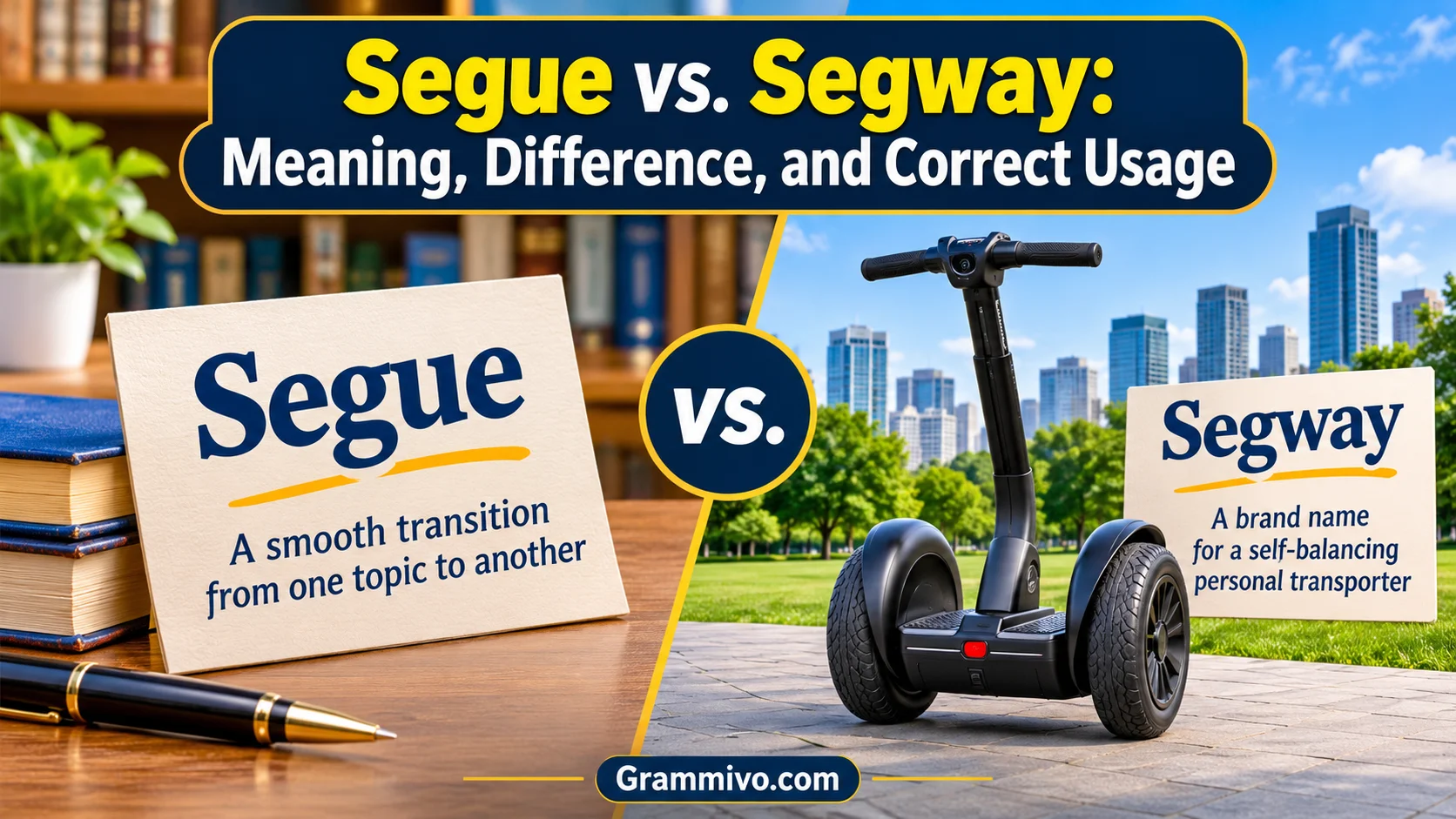
Have you ever wanted to describe a smooth transition between two topics but hesitated between segue and Segway? You’re not alone. These two words sound exactly alike, yet their meanings have almost nothing in common. One describes how ideas connect naturally while the other refers to a well-known personal transportation device.
The confusion makes sense because segue has an unusual spelling for its pronunciation. Meanwhile, Segway looks more familiar because it contains the recognizable word way. As a result, writers sometimes use the transportation brand’s spelling when they actually mean a transition between subjects.
However, choosing the correct word becomes easy once you understand their meanings and contexts. Whether you’re writing an email, preparing a presentation, describing a musical performance, or talking about electric transportation, this guide will help you use both words confidently.
Quick Answer:
Segue means to move smoothly from one subject, activity, scene, or musical passage to another. It works as both a noun and a verb.
Segway is a brand name associated with self-balancing personal electric transportation devices. It refers to a physical product rather than a transition between ideas.
Here are two examples that show the difference:
- Segue: The manager used a customer story to segue into the next presentation topic.
- Segway: The tourists rented a Segway to explore the historic district.
Both words are pronounced approximately SEG-way. However, their spelling, meaning, grammatical roles, and usage differ.
Easy way to remember:
- Use segue when you’re talking about transitions.
- Use Segway when you’re talking about the transportation brand or device.
Comparison Overview
The following table highlights the main differences between segue and Segway.
| Feature | Segue | Segway |
| Meaning | A smooth transition between ideas or activities | A personal electric transportation device or brand |
| Pronunciation | SEG-way | SEG-way |
| Part of speech | Noun and verb | Proper noun |
| Origin | Italian | Brand name |
| Capitalization | Usually lowercase | Capitalized when referring to the brand |
| Common context | Conversations, writing, music, presentations, and films | Transportation, tourism, recreation, and security |
| Example | Let’s segue into another topic. | We rented a Segway for the tour. |
| Plural form | Segues | Segways |
| Main purpose | Connecting one thing to another | Providing personal transportation |
The biggest distinction is straightforward: a segue connects ideas while a Segway carries people. Remembering this difference will prevent most spelling and word-choice mistakes.
What Does Segue Mean?
Segue refers to a smooth and natural transition from one thing to another. It commonly describes moving between subjects, conversations, activities, scenes, or musical passages without an awkward interruption.
For example, imagine you’re discussing vacation plans with a friend. The conversation moves from hotel prices to restaurant recommendations. That natural shift is a segue.
The word can describe both the transition itself and the action of making that transition. That’s why writers and speakers use segue as a noun and a verb.
In everyday English, you’ll encounter it in situations such as:
- Moving from one discussion topic to another.
- Introducing a new section during a presentation.
- Connecting scenes in a movie or television show.
- Transitioning between songs or musical passages.
- Shifting from one activity to another.
Unlike an abrupt change, a good segue helps the next subject feel connected to the previous one.
Examples of Segue in Sentences
Understanding segue becomes easier when you see how people use it in different situations.
Here are some practical examples:
- Conversation: We talked about our weekend plans before the discussion segued into work.
- Presentation: The speaker used a funny anecdote to segue into the serious part of her presentation.
- Writing: The author created a natural segue between the introduction and the main argument.
- Music: The orchestra segued from the opening melody into a powerful musical passage.
- Television: The host used a short joke to segue into the next interview.
- Business meeting: After reviewing the budget, the manager found a way to segue into the marketing strategy.
- Everyday conversation: Her question about dinner provided a perfect segue into discussing the weekend.
Notice that each example involves a connection between two different subjects or activities.
Common Ways to Use Segue
Although segue appears in several settings, its central meaning remains the same. It describes a smooth movement from one thing to another.
Segue between conversation topics
People often use segue when conversations move naturally between subjects.
For example:
“Your new job sounds exciting. That reminds me of something I wanted to ask you about.”
The first statement creates a natural connection to another topic.
Segue into a presentation topic
Presenters use transitions to prevent their talks from feeling like disconnected collections of information.
For example:
“Now that we’ve discussed the challenges facing small businesses, let’s segue into practical solutions.”
This sentence prepares the audience for a change in direction.
Segue between movie scenes
Filmmakers use visual and audio transitions to connect scenes. A scene might fade into another or continue through a related sound or action.
A smooth transition helps maintain the story’s flow.
Segue between musical passages
Musicians use segue when one section of music flows directly into another. Instead of stopping completely, the performance moves naturally into its next passage.
For example, a band might segue from a quiet instrumental section into an energetic chorus.
Segue from one activity to another
The word also describes everyday changes in activities.
For example:
“After finishing breakfast, we segued into a discussion about our travel plans.”
Here, the word describes a natural shift from one activity to another.
Segue as a Noun and Verb
One useful detail about segue is that it works as both a noun and a verb. Understanding these grammatical roles helps you use it correctly.
Segue as a noun
As a noun, segue refers to the transition itself.
Examples:
- The introduction provides a smooth segue into the main discussion.
- His question created an unexpected segue into another subject.
- The documentary uses a clever segue between historical events.
- That joke was a perfect segue into the next part of the show.
Segue as a verb
As a verb, segue describes the action of transitioning smoothly.
Examples:
- Let’s segue into the next section of the meeting.
- The conversation naturally segued toward childhood memories.
- The presenter segued from statistics to personal experiences.
- The music segues into a slower and more emotional passage.
Its verb forms include:
- Present: segue
- Third-person singular: segues
- Past tense: segued
- Present participle: segueing
Important: You can say “The discussion had a smooth segue” or “The discussion smoothly segued into another topic.” Both constructions are correct.
Read More: Molding vs. Moulding: Meaning, Difference, and Correct Usage
What Does Segway Mean?
Segway refers to a brand associated with personal electric transportation devices. The original Segway Personal Transporter became famous for its two-wheel, self-balancing design. Riders stand on a platform and steer using a handlebar.
Unlike a traditional bicycle or scooter, the original Segway uses balancing technology to help riders remain upright. Its electric motor responds to the rider’s movements and steering inputs.
The company introduced the original Segway Personal Transporter in 2001. Inventor Dean Kamen developed the device with the goal of creating a new form of personal transportation. Its distinctive design attracted attention from tourists, businesses, security teams, and technology enthusiasts.
Today, the Segway name is also associated with a broader range of electric mobility products. These include electric scooters and other personal transportation devices.
However, Segway remains a brand name. It isn’t another spelling of the word segue.
Examples of Segway in Sentences
Here are some examples showing how to use Segway correctly when discussing transportation.
- The tourists rented a Segway to explore the city.
- Our tour guide explained how to operate the Segway safely.
- The security guard rode a Segway around the shopping center.
- She learned to balance on a Segway during her vacation.
- Several visitors used Segways to travel around the attraction.
- The company introduced electric Segway models for urban transportation.
- We watched a demonstration of a self-balancing Segway.
In every example, Segway refers to a transportation device or product associated with the brand.
Common Uses of a Segway
Segway devices have appeared in several transportation and recreational settings. Their compact design and electric operation make them useful in certain environments.
Guided city tours
Tour operators sometimes use Segway devices to provide sightseeing experiences. Visitors can cover more ground than they might on foot while enjoying an outdoor tour.
Tourist attractions
Some recreational destinations offer Segway experiences. Participants receive basic operating instructions before exploring designated areas.
Security patrols
Security personnel have used personal transporters to move around large properties. These devices can help workers cover extensive indoor or outdoor spaces.
Personal transportation
Electric mobility devices provide another option for short-distance travel. Depending on the model, riders can use them for commuting or recreational trips.
Commercial environments
Businesses may use electric mobility products for certain workplace transportation needs. Their usefulness depends on the location, safety rules, and specific equipment.
It’s worth remembering that not every electric scooter or self-balancing vehicle is a Segway. Different manufacturers produce similar products under separate brand names.
Is Segway a Brand Name or a Generic Word?
Segway is a proper brand name rather than a generic English word for every personal transportation device.
This distinction matters because people sometimes use recognizable brand names to describe entire product categories. For example, some people use brand names casually even when discussing products made by competing companies.
However, that doesn’t automatically make the brand name a generic term.
Consider these examples:
- Correct: She rented a Segway for the sightseeing tour.
- More general: She rented an electric scooter for the sightseeing tour.
- Incorrect brand assumption: Every self-balancing electric vehicle is a Segway.
The last statement incorrectly treats one brand as the name of an entire product category.
Capitalization also matters. When referring to the brand, write Segway with a capital S. When discussing an unrelated product category, use the appropriate general term, such as electric scooter or self-balancing personal transporter.
Main Differences Between Segue and Segway
Although segue and Segway share the same pronunciation, their meanings and grammatical functions differ significantly. Understanding these distinctions helps you choose the correct spelling in everyday writing.
Segue vs. Segway: Meaning and Usage
The most important difference concerns what each word describes.
Segue describes a smooth transition between two things. You can use it when discussing ideas, conversations, presentations, activities, and musical passages.
Segway identifies a transportation brand and its associated products. You use it when discussing personal electric mobility devices.
Compare these sentences:
| Segue | Segway |
| Let’s segue into another subject. | Let’s take a ride on the Segway. |
| The host used a joke to segue into the interview. | The host arrived at the event on a Segway. |
| The music segues into a different melody. | The tourists rented several Segways. |
| Her comment created a natural segue. | His Segway needed to be charged. |
The context makes the correct spelling clear. If you’re describing a transition, choose segue. If you’re referring to the transportation brand, choose Segway.
Segue vs. Segway: Pronunciation
One reason people confuse these words is their identical pronunciation.
Both words are pronounced approximately SEG-way.
The first syllable sounds like “seg” in the word segment. The second syllable sounds like “way*.
Here is a simple pronunciation breakdown:
| Word | Pronunciation | Syllables |
| Segue | SEG-way | Two |
| Segway | SEG-way | Two |
The spelling of segue surprises many English learners because it doesn’t follow the pronunciation they might expect from its letters.
That’s partly because English borrowed the word from Italian. Its pronunciation reflects its history rather than a straightforward English spelling pattern.
When speaking, listeners usually understand the intended meaning from context. When writing, however, you must select the correct spelling.
Segue vs. Segway: Part of Speech
Another important difference involves grammar.
Segue functions as both a noun and a verb. It describes a transition or the act of transitioning.
Examples:
- Noun: The transition between the two chapters provides a natural segue.
- Verb: The writer segues from the historical background into the main argument.
Segway, by contrast, functions primarily as a proper noun referring to the brand or its products.
Examples:
- The Segway is popular among certain sightseeing operators.
- We rented two Segways for the afternoon.
You wouldn’t normally use Segway as a verb to describe changing subjects. Likewise, segue doesn’t identify an electric transportation device.
Frequently Asked Questions
Is It Segue or Segway When Changing Topics?
The correct word is segue when you’re describing a transition between topics.
For example:
“Let’s segue into the next part of our discussion.”
Here, segue describes moving smoothly from one subject to another. Segway would be incorrect because the sentence doesn’t involve transportation.
Are Segue and Segway Pronounced the Same?
Yes. Both words are pronounced approximately SEG-way.
They share the same pronunciation but have different spellings and meanings. You must rely on context to understand which word someone means.
Is Segue a Real English Word?
Yes. Segue is an established English word borrowed from Italian.
It describes a smooth transition between subjects, activities, scenes, or musical passages. English speakers commonly use it as both a noun and a verb.
For example:
“The conversation segued into a discussion about travel.”
Why Is Segway Capitalized?
Segway is a brand name associated with personal electric transportation devices.
Brand names are proper nouns, so they generally begin with capital letters. That’s why you write Segway rather than segway when referring to the brand.
Can Segue Be Used as Both a Noun and a Verb?
Yes. Segue works as both a noun and a verb.
As a noun, it describes the transition itself:
“That was a smooth segue into the next subject.”
As a verb, it describes the action of transitioning:
“Let’s segue into another discussion.”
Both constructions are grammatically correct.
Conclusion:
Although segue and Segway sound identical, they serve entirely different purposes. Segue describes a smooth transition between ideas, conversations, activities, or musical passages. Segway refers to a personal transportation brand and its associated devices. The easiest way to remember the difference is to associate segue with connecting ideas and Segway with transportation.
