
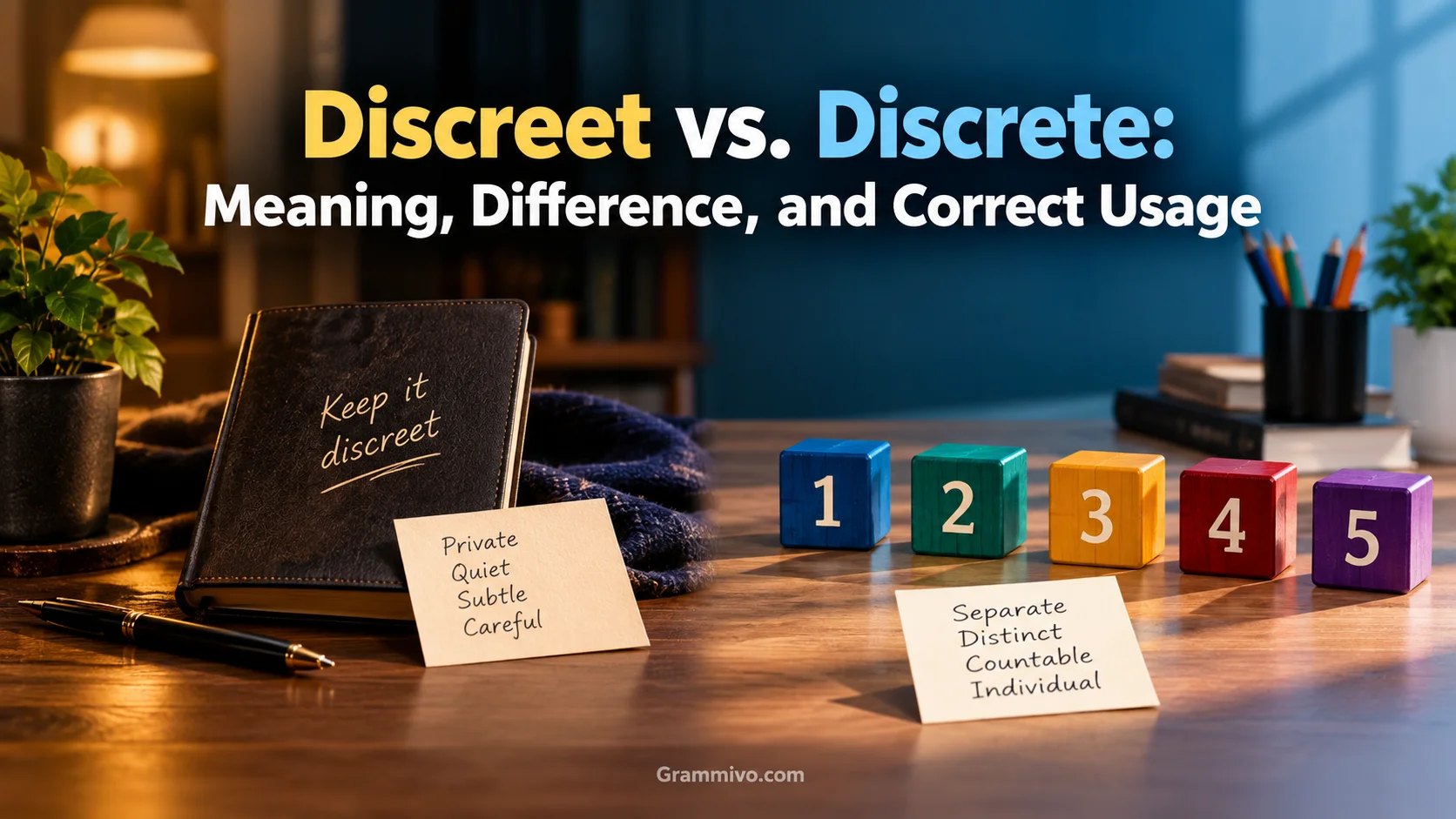
If you’ve ever hesitated between discreet and discrete, you’re not alone. These two words look almost identical, sound similar, and share a related history. Yet they describe very different ideas.
Discreet usually relates to being careful, tactful, private, or unobtrusive. Discrete, on the other hand, means separate, distinct, or individually identifiable. One concerns how you behave. The other often describes how things are divided or distinguished.
That small spelling difference can change the meaning of an entire sentence. For example, “Please be discreet about the conversation” asks someone to keep the matter private. Meanwhile, “The data falls into discrete categories” means the categories are separate and clearly defined.
Understanding the distinction becomes especially important in professional, academic, scientific, and everyday writing. Once you recognize the core meanings, however, choosing the right word becomes much easier.
Quick Answer
Discreet means careful, tactful, private, or designed not to attract attention. Discrete means separate, distinct, or individually distinguishable.
- Discreet: Please be discreet about the confidential discussion.
- Discrete: The researcher divided the results into discrete groups.
A simple way to remember the difference is this:
Discreet concerns careful behavior.
Discrete concerns separate things.
So if you’re talking about confidentiality, tact, or avoiding attention, choose discreet. If you’re talking about separate units, categories, values, or components, choose discrete.
Comparison Overview
The following table makes the basic difference between discreet vs. discrete easy to see.
| Word | Meaning | Typical Use | Example |
| Discreet | Careful, tactful, private, or unobtrusive | Behavior, conversations, actions, sensitive matters | She was discreet about the private meeting. |
| Discrete | Separate, distinct, or individually identifiable | Groups, categories, components, values, data | The study examined three discrete populations. |
| Discreetly | In a careful, tactful, or unobtrusive way | Actions and behavior | He discreetly left the room. |
| Discretely | Separately or distinctly | Technical, mathematical, or descriptive contexts | The variables were measured discretely. |
Both words are adjectives, although their related adverbs are discreetly and discretely. They aren’t interchangeable.
Main Differences Between Discreet vs. Discrete
The clearest difference between discreet vs. discrete lies in what each word describes.
Discreet focuses on conduct or presentation. Someone who acts discreetly avoids unnecessary attention and handles sensitive situations with care.
Discrete focuses on separation or distinction. When things are discrete, you can identify them as separate units rather than viewing them as one continuous whole.
Think of two situations.
A manager quietly discusses an employee’s private issue in a closed office. The manager is being discreet.
A company divides its customers into five clearly defined age groups. Those groups are discrete.
The first example concerns behavior. The second concerns separation. That distinction is the key.
What Does Discreet Mean?
Discreet describes someone or something that shows good judgment by avoiding unwanted attention, protecting privacy, or handling a sensitive situation carefully.
When you call someone discreet, you’re usually saying that the person knows when to speak, when to stay quiet, and how to avoid making a situation awkward.
For example:
- She was discreet when discussing the customer’s complaint.
- The detective made a discreet inquiry.
- He gave her a discreet signal from across the room.
- The hotel offers discreet service to high-profile guests.
- She found a discreet place to make the phone call.
In each sentence, the idea involves care, privacy, restraint, or subtlety.
The word doesn’t necessarily mean that something is secret. That’s an important distinction. A person can behave discreetly simply because drawing attention would be inappropriate or inconvenient.
For instance, imagine that you’re attending a wedding and notice a guest has spilled coffee on their shirt. You might quietly point it out rather than announcing it to the entire room. That would be a discreet response.
Discreet Means More Than “Secret”
Although discreet often appears in situations involving confidential information, its meaning extends beyond secrecy.
Something can be discreet because it:
- Avoids attracting attention
- Protects someone’s privacy
- Shows tact
- Handles an awkward situation carefully
- Doesn’t appear flashy or conspicuous
- Uses subtle rather than obvious actions
Consider the phrase “a discreet entrance.” It doesn’t necessarily mean a secret entrance. It could simply mean an entrance located somewhere less noticeable.
Likewise, a discreet design might be simple and unobtrusive rather than hidden.
Discreet in Everyday Situations
You’ll often encounter discreet when describing ordinary social behavior.
Imagine you’re at a restaurant with friends when someone receives a personal phone call. Instead of asking loudly, “Who was that?”, you wait until the person returns.
That restraint is discreet.
Similarly, if you need to correct someone’s pronunciation during a meeting, whispering the correction privately is more discreet than interrupting them in front of everyone.
The underlying principle is simple: don’t create unnecessary attention or embarrassment.
What Does Discrete Mean?
Discrete means separate, distinct, or individually identifiable.
If several things are discrete, you can distinguish one from another. They don’t necessarily exist in isolation, but they have clear boundaries or identities.
For example:
- The machine contains several discrete components.
- The survey divided respondents into discrete groups.
- The program stores information in discrete units.
- The experiment produced three discrete outcomes.
- The report identifies four discrete stages.
Here, nothing relates to secrecy or tact. The focus is entirely on separation or distinction.
A useful mental picture is a row of individual boxes. Each box represents something separate from the others. Those boxes are discrete units.
Read More: Deep-Seated vs. Deep-Seeded: Which One Is Correct?
Discrete in Mathematics and Science
The word discrete has an especially important technical meaning in mathematics, statistics, computer science, and other fields.
A discrete quantity consists of distinct, countable values. It doesn’t smoothly fill every possible point between two values.
For example, the number of students in a classroom is discrete. You might have:
- 20 students
- 21 students
- 22 students
You wouldn’t normally have 21.5 students.
By contrast, measurements such as height, temperature, and elapsed time can vary continuously. A person’s height could be 170 centimeters, 170.1 centimeters, or 170.15 centimeters.
This distinction produces the important statistical terms discrete data and continuous data.
Discrete Data vs. Continuous Data
| Type | Meaning | Example |
| Discrete data | Values that are separate and typically countable | Number of books, cars, or customers |
| Continuous data | Values that can take any value within a range | Height, weight, temperature, or time |
Suppose a store records the number of customers entering each hour. The counts are discrete.
Now imagine the store records how long each customer spends inside. That measurement can vary along a continuous scale.
This technical use explains why discrete appears so frequently in scientific and academic writing.
Discrete Mathematics
Discrete mathematics studies mathematical structures that are fundamentally separate or countable rather than continuous.
It includes areas such as:
- Logic
- Graph theory
- Combinatorics
- Set theory
- Algorithms
- Number theory
- Discrete probability
Computer science relies heavily on discrete mathematics because computers process information using distinct states and values.
So when you see discrete mathematics, don’t interpret discrete as “quiet” or “subtle.” It has nothing to do with privacy. It refers to mathematical structures that involve distinct, separable elements.
Discreet vs. Discrete in Different Contexts
Context often gives you the answer before you even think about spelling.
Business and Professional Writing
In professional communication, discreet commonly describes how people handle sensitive situations.
For example:
The manager was discreet when discussing the employee’s performance.
The manager showed tact and avoided exposing private information.
However, discrete works when you’re discussing separate business units or categories.
The company operates through three discrete divisions.
The divisions are separate organizational units.
The difference becomes obvious once you identify what the adjective modifies.
Personal Conversations
Suppose a friend tells you something confidential. You promise not to repeat it.
You might say:
Don’t worry. I’ll be discreet.
Here, discreet describes your behavior.
You wouldn’t normally say:
Don’t worry. I’ll be discrete.
That version suggests separation rather than tact and doesn’t communicate the intended meaning.
Academic Writing
Academic writing frequently uses discrete when researchers classify information.
For example:
The participants were divided into four discrete age groups.
Each group represents a separate category.
You might also see phrases such as:
- discrete variables
- discrete observations
- discrete categories
- discrete outcomes
- discrete populations
- discrete events
By contrast, discreet appears when the subject involves human conduct or sensitive information.
Researchers should remain discreet when handling confidential participant information.
Technology and Engineering
Technical writing often uses discrete to describe separate components or signals.
For example:
The system consists of several discrete processing units.
The units are distinct components.
You may also encounter discrete signals, discrete components, and discrete states.
These uses have nothing to do with secrecy. They describe separation, individuality, or distinct states.
Common Phrases With Discreet
Certain word combinations make discreet particularly easy to recognize.
Discreet Conversation
A discreet conversation is handled privately or tactfully.
They had a discreet conversation after the meeting.
Discreet Inquiry
A discreet inquiry seeks information without drawing unnecessary attention.
The journalist made a discreet inquiry about the incident.
Discreet Location
A discreet location is somewhere relatively private or unobtrusive.
They chose a discreet location for the meeting.
Discreet Service
Discreet service emphasizes privacy and minimal intrusion.
The hotel is known for discreet service.
Discreet Glance
A discreet glance is quick and subtle.
She took a discreet glance at the clock.
Notice the pattern. Every phrase involves subtlety, privacy, tact, or reduced attention.
Common Phrases With Discrete
The vocabulary surrounding discrete looks quite different.
Discrete Categories
Discrete categories are separate groups with defined distinctions.
The responses were organized into discrete categories.
Discrete Units
A discrete unit is an individual element that can be distinguished from others.
Each department operates as a discrete unit.
Discrete Components
Discrete components are separate parts of a system.
The device contains several discrete components.
Discrete Variables
A discrete variable takes distinct values rather than every possible value along a continuous range.
The number of children in a household is a discrete variable.
Discrete Events
A discrete event occurs as an identifiable occurrence rather than as a continuously changing process.
This term appears frequently in statistics, probability, computing, and systems analysis.
Discreet vs. Discrete Examples
Examples can make this distinction stick much faster than definitions alone.
Correct Examples With Discreet
- Please be discreet about the upcoming promotion.
- She gave him a discreet warning.
- The employee handled the complaint in a discreet manner.
- He made a discreet exit before the argument began.
- The nurse was discreet when discussing the patient’s information.
- They installed a discreet security camera.
- She found a discreet way to ask about the problem.
In every case, the word suggests tact, privacy, subtlety, or avoiding attention.
Correct Examples With Discrete
- The experiment consisted of several discrete stages.
- The software separates the information into discrete categories.
- The researchers studied two discrete populations.
- The machine contains five discrete components.
- The number of calls received is a discrete variable.
- The graph contains several discrete points.
- The system operates in several discrete states.
Here, the common thread is separation or distinct identity.
Side-by-Side Examples
| Meaning | Correct Sentence | Explanation |
| Privacy | She was discreet about the matter. | She handled sensitive information carefully. |
| Separation | The study used discrete groups. | The groups were separate and distinct. |
| Subtle action | He gave a discreet signal. | The signal avoided unnecessary attention. |
| Separate parts | The device contains discrete components. | The components are individually identifiable. |
| Tact | She made a discreet suggestion. | She expressed the idea carefully. |
| Categories | The data falls into discrete categories. | Each category is distinct. |
Common Mistakes With Discreet and Discrete
Using Discrete When You Mean Private
One of the most common mistakes occurs when writers mean discreet but type discrete.
Incorrect:
Please be discrete about the conversation.
Correct:
Please be discreet about the conversation.
The conversation isn’t being divided into separate pieces. The person needs to protect its privacy.
Using Discreet When You Mean Separate
The reverse mistake happens when someone uses discreet for something that exists in distinct groups.
Incorrect:
The researcher studied three discreet populations.
Correct:
The researcher studied three discrete populations.
The populations are separate groups, so discrete is the appropriate word.
Confusing Discreet With Discretion
The words discreet and discretion are closely related.
Discretion refers to careful judgment, especially when deciding what to say or do.
For example:
The employee showed discretion when handling confidential documents.
Discreet describes the person or behavior:
The employee was discreet when handling confidential documents.
You can think of discretion as the judgment and discreet as the resulting behavior.
Confusing Discrete With Discreteness
The noun discreteness refers to the quality of being separate or distinct.
For example:
The discreteness of the categories made the analysis easier.
Although discreteness is grammatically correct, it appears more often in technical or academic contexts than in everyday conversation.
Discreet vs. Discrete: Word Origin and Etymology
The similarity between these words isn’t an accident.
Both discreet and discrete ultimately trace back to Latin roots associated with distinguishing, separating, or discerning. Their histories overlap, which helps explain why their spellings remain so close.
Over time, English developed two distinct paths for these related forms.
Discrete retained the idea of things being distinguished or separated. That’s why we use it for separate categories, units, values, and components.
Discreet developed toward the idea of showing discernment and good judgment. That meaning eventually became associated with tact, privacy, and avoiding unwanted attention.
So although the words look like twins, their meanings took different roads.
That shared history also explains why spelling them correctly can feel surprisingly tricky.
How to Remember the Difference
A simple memory trick can save you from mixing them up.
Remember Discreet With “Quiet”
Think:
Discreet = quiet, careful, private.
Imagine someone lowering their voice while discussing sensitive information.
Be discreet.
The person should act carefully and avoid drawing attention.
Remember Discrete With “Separate”
Think:
Discrete = distinct, separate, divided.
Imagine individual objects sitting apart from each other.
Discrete categories.
The categories have clear boundaries.
Another useful shortcut is to connect discrete with distinct. Both words begin with the same dis- sound and relate to things being distinguishable.
You don’t need a complicated mnemonic. The semantic difference does most of the work.
FAQs:
Is it discreet or discrete?
Both spellings are correct. They have different meanings.
Use discreet for careful, tactful, private, or unobtrusive behavior. Use discrete for separate or distinct things.
What is the difference between discreet and discrete?
Discreet describes careful or private behavior, while discrete describes things that are separate, distinct, or individually identifiable.
For example, a discreet conversation is private. Discrete categories are separate categories.
Does discreet mean private?
It can. Discreet often describes someone who handles private or sensitive matters carefully.
However, the word can also mean subtle or unobtrusive. A discreet design, for example, may simply avoid attracting attention.
Does discrete mean separate?
Yes. Discrete commonly means separate, distinct, or individually identifiable.
You’ll see it frequently in phrases such as discrete units, discrete categories, discrete variables, and discrete components.
How can I remember discreet vs. discrete?
Remember:
Discreet = careful and private.
Discrete = separate and distinct.
If you’re describing someone’s behavior, discreet is often the right choice. If you’re describing separate categories, units, or values, discrete is usually correct.
Conclusion:
The difference between discreet vs. discrete comes down to two simple ideas. Discreet means careful, tactful, private, subtle, or unobtrusive. It usually describes behavior, communication, actions, or things designed to avoid attention. Discrete means separate, distinct, or individually identifiable. It commonly describes categories, components, values, groups, stages, and technical concepts.
