
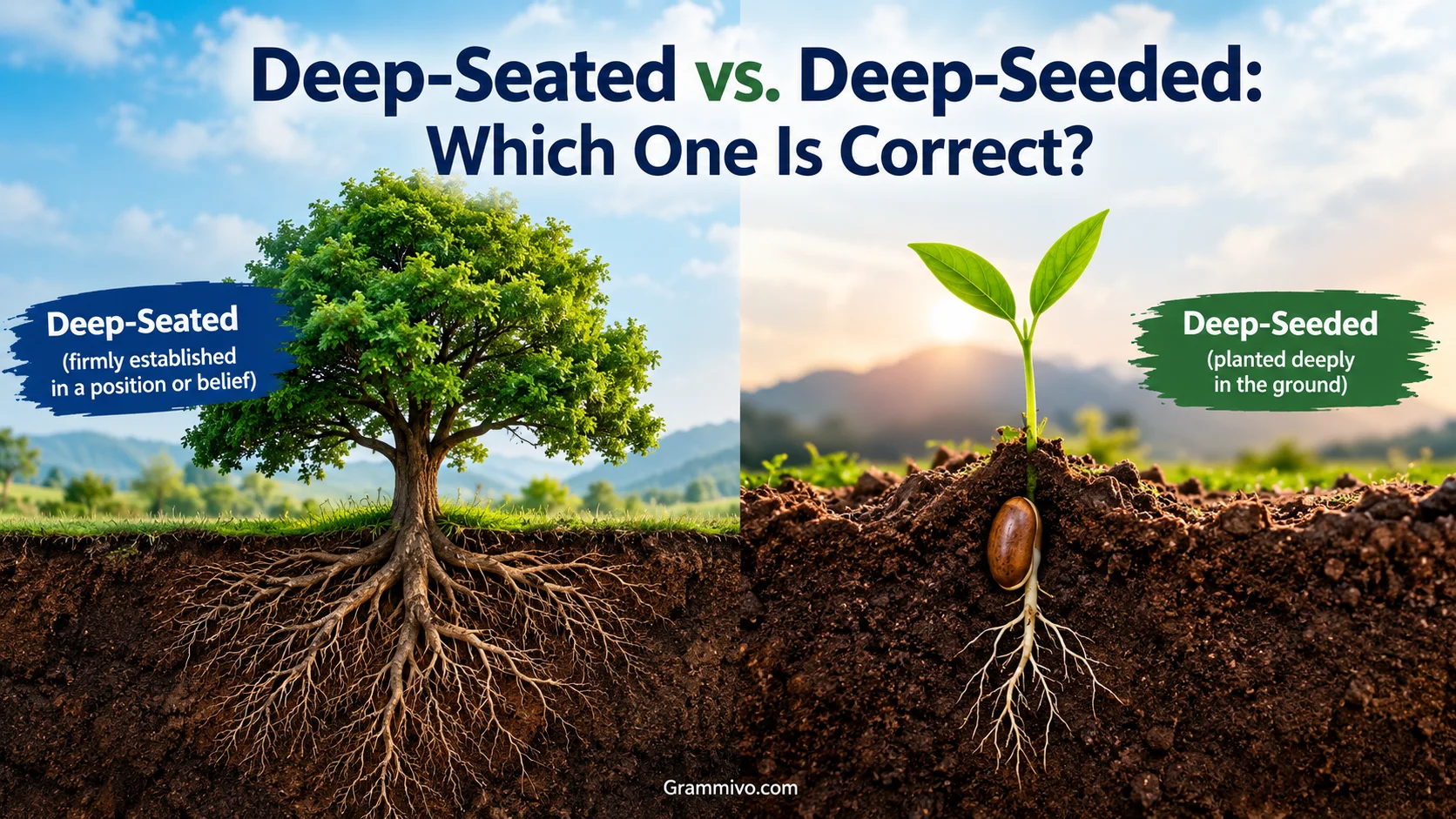
If you’ve ever written deep-seated and wondered whether it should actually be deep-seeded, you’re not alone. The two expressions look and sound close enough to cause confusion, especially because seeded is a familiar English word.
However, there’s a clear distinction. Deep-seated is the standard expression when you mean something that is firmly established, deeply rooted, or difficult to change. Deep-seeded is generally a spelling mistake when writers intend that meaning.
The confusion makes sense at first glance. A seed can be planted deeply, so “deep-seeded” seems like it should describe something deeply established. English, however, doesn’t always follow the most obvious logic. Some expressions survive because of their historical development rather than their literal modern appearance.
Quick Answer
Deep-seated is the correct spelling when you mean something that is deeply established, firmly fixed, or difficult to change. Deep-seeded is normally an incorrect spelling of the expression.
For example:
- Correct: She has a deep-seated fear of flying.
- Incorrect: She has a deep-seeded fear of flying.
The word seated here doesn’t mean sitting in a chair. It carries the older sense of something being firmly established or settled.
Think of it this way: a deep-seated belief has settled firmly within someone’s thinking. It isn’t necessarily easy to remove or change.
Quick rule: If you mean “deeply rooted” or “firmly established,” use deep-seated.
Comparison Overview
The easiest way to understand deep-seated vs. deep-seeded is to compare their spelling, meaning, and normal usage.
| Term | Standard Usage | Meaning | Example |
| Deep-seated | Correct | Firmly established or deeply rooted | She has a deep-seated fear of failure. |
| Deep-seeded | Usually incorrect in this expression | Common spelling mistake for deep-seated | He has a deep-seeded distrust of authority. |
The important point is that deep-seated is the established idiomatic expression. Dictionaries and standard English usage recognize it as the normal form.
The mistaken version often appears because people naturally associate the idea of being deeply established with something being planted like a seed. That mental picture feels reasonable. It just isn’t the expression English uses.
Main Differences Between Deep-Seated vs. Deep-Seeded
The biggest difference is simple: deep-seated is the standard expression, while deep-seeded is generally a mistaken spelling when used with the same meaning.
Deep-Seated Means Firmly Established
Deep-seated describes something that exists strongly and deeply within a person, group, organization, or situation.
It often refers to things that have developed over time and may be difficult to change.
Common examples include:
- deep-seated fear
- deep-seated resentment
- deep-seated belief
- deep-seated prejudice
- deep-seated distrust
- deep-seated conflict
- deep-seated problem
- deep-seated anxiety
- deep-seated disagreement
Consider this sentence:
She has a deep-seated distrust of large corporations.
This doesn’t mean the distrust literally sits somewhere inside her body. It means the feeling has become firmly established in her thinking.
Likewise:
The two communities have deep-seated differences.
The sentence suggests that the differences aren’t recent or superficial. They have developed deeply enough to resist an easy solution.
Deep-Seeded Is Usually a Spelling Error
When writers use deep-seeded to describe a firmly established feeling, belief, or problem, they generally mean deep-seated.
For example:
- ❌ He has a deep-seeded fear of dogs.
- ✅ He has a deep-seated fear of dogs.
The incorrect version probably feels natural because seeded has a clear meaning in English. You can seed a lawn, seed a field, or seed a tournament.
That familiar word can create a false connection.
In the idiom deep-seated, however, the second element is seated, not seeded.
Why the Confusion Happens
The mistake usually comes from the metaphor behind the expression.
Imagine a belief that has been planted in someone’s mind. If that belief has existed for years, it might seem logical to call it deep-seeded.
English speakers often use planting metaphors:
- plant an idea
- plant a doubt
- plant a seed of suspicion
- a seed of an idea
- ideas take root
Because these expressions are perfectly normal, deep-seeded can seem like a logical extension.
Yet the established phrase is deep-seated.
It’s one of those cases where knowing the conventional expression matters more than trying to reconstruct it from modern word associations.
What Does Deep-Seated Mean?
The adjective deep-seated means firmly established, deeply rooted, strongly fixed, or difficult to change.
It usually describes something that has become deeply embedded over time.
For example:
The company has a deep-seated culture of innovation.
The writer isn’t talking about a culture that literally sits somewhere. The phrase emphasizes how firmly that culture has become part of the organization.
Similarly:
His deep-seated resentment didn’t disappear after one apology.
The resentment has existed long enough to become firmly established.
Deep-Seated Can Describe Feelings
Emotions are among the most common things described as deep-seated.
Examples include:
- fear
- anger
- resentment
- jealousy
- distrust
- insecurity
- anxiety
- hatred
- affection
For example:
She has a deep-seated fear of rejection.
This means the fear is powerful and firmly established. It isn’t merely a passing concern.
Another example:
Years of unfair treatment created deep-seated resentment among employees.
Here, the phrase emphasizes duration and intensity.
Deep-Seated Can Describe Beliefs
A belief can also become deep-seated when someone holds it strongly over a long period.
For example:
He has a deep-seated belief that hard work should always be rewarded.
The belief isn’t casual. It forms part of his broader outlook.
You might also write:
The community has a deep-seated belief in tradition.
That wording suggests tradition has become firmly embedded in the community’s values.
Deep-Seated Can Describe Problems
The expression isn’t limited to emotions or personal beliefs.
You can also describe problems, disagreements, and social conditions as deep-seated.
For example:
The investigation uncovered a deep-seated problem within the organization.
This suggests that the problem isn’t a small, isolated mistake. It has become established within the system.
Other examples include:
- deep-seated corruption
- deep-seated inequality
- deep-seated divisions
- deep-seated conflict
- deep-seated disagreement
- deep-seated structural problems
In these contexts, the phrase often implies that solving the problem will require more than a quick fix.
What Does Deep-Seeded Mean?
When deep-seeded appears in sentences such as deep-seeded fear or deep-seeded resentment, it is generally a misspelling of deep-seated.
For standard English writing, use deep-seated instead.
Why “Deep-Seeded” Looks Reasonable
The word seeded is real. That’s what makes this mistake particularly convincing.
You can use seeded in several legitimate ways:
- The farmer seeded the field.
- The gardener seeded the lawn.
- The tournament seeded its top players.
- The clouds were seeded under certain weather-modification experiments.
So when someone encounters a phrase meaning “deeply established,” the idea of something being deeply “seeded” can feel intuitive.
The problem is that deep-seated is an established compound adjective with a different history.
Can “Deep-Seeded” Ever Be Literal?
A careful distinction matters here.
If you’re using seeded literally to describe something involving seeds, the words deeply seeded could potentially be constructed in a literal context. For instance, a writer discussing agricultural planting might describe seeds as being planted deeply.
However, that doesn’t make deep-seeded the correct spelling of the established idiom.
Compare these ideas:
The seeds were planted deeply in the soil.
versus:
She has a deep-seated fear of insects.
The first sentence concerns actual seeds. The second describes a firmly established psychological feeling.
For the idiomatic meaning, choose deep-seated.
Why Is It “Deep-Seated” Instead of “Deep-Seeded”?
The key lies in the older meaning of seated.
Today, seated most commonly makes people think about sitting:
The guests were seated at the table.
But English has long used seat in a broader sense. Something can be seated in a particular place or condition when it is firmly established there.
That idea appears in expressions such as:
- the seat of government
- the seat of power
- the seat of authority
In these expressions, seat doesn’t simply mean a chair. It refers to a place where something is established or centered.
The same general idea helps explain deep-seated.
Something that is deep-seated is figuratively settled deeply and firmly.
The “Settled Deeply” Memory Trick
A useful way to remember the spelling is to connect seated with settled.
If a feeling is deep-seated, imagine that it has settled deep inside someone’s thoughts or emotions.
For example:
Her deep-seated insecurity influenced many of her decisions.
The insecurity has become firmly established.
By contrast, seeded makes you think of seeds.
The gardener seeded the soil.
That distinction gives you a simple mental checkpoint.
Seated = settled firmly.
Seeded = related to seeds or seeding.
Origin and History of Deep-Seated
The expression deep-seated developed from the older figurative use of seat to mean a place where something is firmly located or established.
Over time, English speakers extended that idea beyond physical location.
A feeling could have a “seat.” A belief could have a “seat.” A condition could become firmly “seated” within a person or situation.
Adding deep intensifies that idea.
So deep-seated suggests something that isn’t merely present. It has become strongly established at a deep level.
This historical development explains why the spelling doesn’t follow the modern “planting a seed” interpretation.
The phrase survived because its meaning became conventional.
That happens frequently in English. Many idioms retain older meanings even after the original metaphor becomes less obvious to modern speakers.
Read More: Sisters vs. Sister’s: Meaning, Difference, and Correct Usage
How to Use Deep-Seated Correctly
Using deep-seated correctly is straightforward once you understand its meaning.
With Fears and Emotions
Use deep-seated when an emotion has become firmly established.
Examples:
She has a deep-seated fear of heights.
His deep-seated anger affected the way he handled criticism.
The experience left her with a deep-seated distrust of strangers.
These examples all describe emotions that go beyond a temporary reaction.
With Beliefs and Opinions
You can use deep-seated for strongly established beliefs.
He has a deep-seated belief in personal responsibility.
The debate revealed deep-seated differences between the two groups.
Her deep-seated views about education shaped her career choices.
The expression works especially well when the belief has existed for a long time.
With Social and Cultural Issues
Deep-seated frequently appears in discussions about social problems.
For example:
The reform attempted to address deep-seated inequality.
The negotiations exposed deep-seated divisions within the organization.
The region has experienced deep-seated political conflict for decades.
Here, the adjective suggests that the issue has roots beneath the surface.
With Problems and Conditions
You can also describe a persistent problem as deep-seated.
The company faced a deep-seated management problem.
The audit uncovered deep-seated weaknesses in the financial system.
The team needed to address the deep-seated causes of declining productivity.
This usage often signals that a problem requires structural change rather than a temporary patch.
Deep-Seated vs. Deep-Rooted
Deep-seated and deep-rooted overlap considerably. In many sentences, either expression can work.
| Expression | Core Idea | Typical Emphasis |
| Deep-seated | Firmly established | Something settled deeply in thought, feeling, or a situation |
| Deep-rooted | Strongly established | Something with enduring or extensive roots |
| Entrenched | Firmly established and resistant to change | Systems, attitudes, practices, or positions |
| Deeply ingrained | Thoroughly embedded | Habits, behaviors, beliefs, and attitudes |
Consider:
She has a deep-seated fear of failure.
This emphasizes the firmly established nature of the fear.
You could also say:
She has a deep-rooted fear of failure.
That works too, although deep-seated fear is a particularly natural collocation.
For habits, deeply ingrained may sound more natural:
The habit is deeply ingrained.
English gives you several ways to express the same general concept. Context determines which one sounds most natural.
Deep-Seated Synonyms
Depending on the sentence, these words can replace deep-seated:
- Deep-rooted
- Entrenched
- Firmly established
- Deeply ingrained
- Embedded
- Fixed
- Long-standing
- Strongly held
- Persistent
- Established
However, don’t treat these words as perfect substitutes.
For example, entrenched often suggests resistance to change:
An entrenched political system
Meanwhile, deep-seated often works especially well with emotions:
A deep-seated fear
And long-standing focuses more strongly on duration:
A long-standing disagreement
Choosing the right synonym can subtly change the meaning.
Deep-Seated in American English
In standard American English, deep-seated is the established spelling for the idiomatic meaning.
The same form appears in formal writing, journalism, academic prose, business communication, and everyday conversation.
Examples include:
The policy failed to address deep-seated concerns.
He struggled with a deep-seated fear of failure.
The organization faced deep-seated internal conflicts.
The expression is common enough that it works naturally in both casual and formal contexts.
Deep-Seated Hyphenation Rules
The standard form is usually written with a hyphen:
deep-seated
When the compound adjective directly modifies a noun, the hyphen helps readers recognize the phrase as one unit.
Examples:
- deep-seated belief
- deep-seated fear
- deep-seated resentment
- deep-seated problem
- deep-seated conflict
- deep-seated prejudice
You may also see the phrase after a linking verb:
Her fear is deep-seated.
The established compound remains recognizable as deep-seated.
Why the Hyphen Matters
Consider the phrase:
a deep-seated belief
The hyphen signals that deep and seated work together as a compound modifier for belief.
This isn’t unique to the expression. English uses hyphens in many compound adjectives to make relationships between words clearer.
FAQs:
Is “deep-seated” or “deep-seeded” correct?
Deep-seated is correct when you mean something that is firmly established or deeply rooted. Deep-seeded is generally a misspelling when used with that meaning.
What does deep-seated mean?
Deep-seated means firmly established, deeply rooted, or difficult to change. It commonly describes fears, beliefs, emotions, attitudes, conflicts, and persistent problems.
Why do people spell it “deep-seeded”?
The mistake probably comes from the familiar word seeded and the idea of something being planted deeply. Because ideas and feelings can metaphorically “take root,” deep-seeded can seem logical even though the standard expression is deep-seated.
Is deep-seated hyphenated?
Yes. The standard compound adjective is written deep-seated.
Examples include deep-seated fear, deep-seated belief, and deep-seated resentment.
Is deep-seated the same as deep-rooted?
They have very similar meanings and can often be used interchangeably. Deep-seated emphasizes something firmly established, while deep-rooted often highlights the idea of strong or enduring roots.
Conclusion:
When you’re deciding between deep-seated vs. deep-seeded, the answer is clear: deep-seated is the standard expression. Use it when something is firmly established, deeply rooted, strongly fixed, or difficult to change. It works naturally with fears, beliefs, resentment, distrust, prejudice, conflicts, social problems, and other deeply established conditions.
