
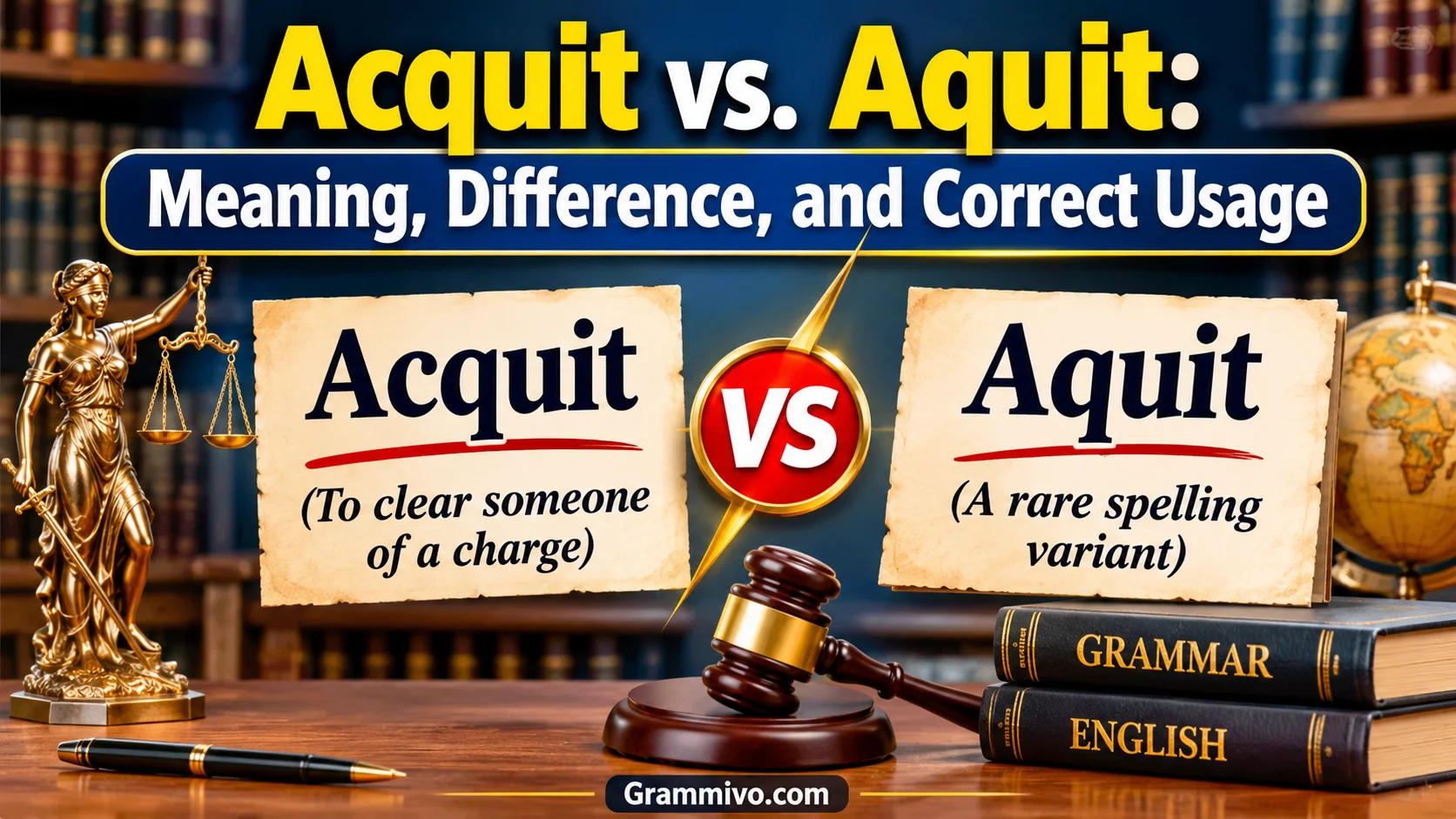
Have you ever wondered whether acquit or aquit is the correct spelling? These two spellings look almost identical, which makes it easy to overlook the extra letter. However, only one follows standard English spelling rules.
The confusion often appears in legal writing, everyday conversations, school assignments, and professional documents. Since both versions look and sound similar, people sometimes leave out one letter without realizing they’ve made a mistake.
The correct spelling is acquit, with two C’s. It is a verb that primarily means to declare someone not guilty of a criminal charge. It can also describe how someone performs or conducts themselves in a particular situation.
On the other hand, aquit is a common misspelling. It has no recognized meaning as a standard English word. Understanding the difference will help you avoid spelling mistakes and use the correct form confidently.
Quick Answer:
Acquit is the correct spelling, while aquit is incorrect in standard English.
The word acquit means to officially declare someone not guilty of a crime or charge. It can also mean to behave or perform in a particular way, especially in the expression acquit oneself.
Here are two examples:
- Correct: The jury decided to acquit the defendant because the evidence wasn’t sufficient to establish guilt.
- Incorrect: The jury decided to aquit the defendant because the evidence wasn’t sufficient to establish guilt.
Remember that acquit always contains two C’s. If you write aquit with only one C, you’ve misspelled the word.
Comparison Overview: Acquit vs. Aquit
Although acquit and aquit differ by only one letter, their status in standard English isn’t the same. One is an established verb with specific meanings, while the other is a spelling error.
| Comparison | Acquit | Aquit |
| Correct spelling | Yes | No |
| Part of speech | Verb | No standard grammatical classification |
| Meaning | To declare someone not guilty or conduct oneself in a particular way | No established standard meaning |
| Number of letters | 6 | 5 |
| Double C | Yes | No |
| Pronunciation | /əˈkwɪt/ | No standard pronunciation |
| Usage | Legal and everyday English | Common spelling mistake |
| Past tense | Acquitted | Not applicable |
| Present participle | Acquitting | Not applicable |
The main difference is straightforward: acquit is the accepted English spelling, whereas aquit is incorrect.
You’ll encounter acquit most often in legal discussions, news reports, court decisions, and descriptions of someone’s behavior. The incorrect spelling usually results from forgetting the second C.
What Does Acquit Mean?
Acquit is a verb that means to declare someone not guilty of a criminal accusation. In legal situations, a judge or jury may acquit a defendant when the prosecution hasn’t established guilt under the applicable legal standard.
However, the word has another meaning outside the courtroom. It can describe how someone behaves, handles responsibilities, or performs in a particular situation.
Let’s explore both meanings.
Acquit Meaning in Legal Contexts
In legal English, acquit refers to a decision that clears a defendant of a particular criminal charge.
When someone faces criminal accusations, the prosecution must establish the required elements of the offense. If the evidence doesn’t meet the applicable standard of proof, the court or jury may find the defendant not guilty.
For example:
- The jury acquitted the defendant after reviewing the evidence.
- The judge decided to acquit the accused because the prosecution failed to prove its case.
- The court acquitted her of all charges.
An important distinction is that acquittal doesn’t always establish factual innocence. It means the legal process did not establish guilt for the charge being considered.
For example, a jury might acquit someone because the available evidence leaves reasonable doubt. That decision doesn’t necessarily mean every allegation was false.
The exact legal consequences of an acquittal can also depend on the jurisdiction and circumstances.
Acquit Meaning in Everyday English
Outside legal situations, acquit can describe someone’s conduct or performance.
This meaning most commonly appears in the expression acquit oneself. It refers to how successfully or appropriately someone handles a particular responsibility, challenge, or situation.
Consider these examples:
- She acquitted herself well during the job interview.
- The new manager acquitted himself professionally during the difficult meeting.
- Despite the unexpected questions, he acquitted himself admirably.
- The students acquitted themselves confidently during the presentation.
In these sentences, acquit doesn’t refer to a criminal trial. Instead, it describes someone’s ability to handle a situation.
For instance, if someone performs exceptionally well during a challenging presentation, you might say they acquitted themselves well.
What Does Acquit Oneself Mean?
The expression acquit oneself means to conduct or behave yourself in a particular way, especially when facing a challenge or responsibility.
Writers often use it with descriptive words such as:
- Well: To perform successfully.
- Admirably: To behave impressively.
- Creditably: To perform in a way that deserves approval.
- Honorably: To behave with integrity.
- Poorly: To perform unsuccessfully.
Examples:
| Expression | Meaning |
| Acquit oneself well | Perform successfully |
| Acquit oneself admirably | Handle a situation impressively |
| Acquit oneself honorably | Behave with honesty and integrity |
| Acquit oneself poorly | Handle a situation unsuccessfully |
This expression sounds somewhat formal. In casual conversation, people often choose simpler alternatives such as do well, perform successfully, or handle something effectively.
What Does Aquit Mean?
Aquit isn’t a correct standard English spelling. It doesn’t have an established dictionary meaning or recognized grammatical function in modern standard English.
People generally write aquit when they accidentally leave out one C from acquit.
For example:
- Incorrect: The court decided to aquit the accused.
- Correct: The court decided to acquit the accused.
The same mistake can appear in different forms of writing, including emails, online articles, educational assignments, and social media posts.
Why Do People Write Aquit Instead of Acquit?
Several factors contribute to this spelling mistake.
Similar appearance: Both versions look almost identical. When someone reads or types quickly, the missing C can easily go unnoticed.
Unfamiliar spelling: Some English learners don’t recognize the double C in acquit. They may assume one C is sufficient.
Typing mistakes: People sometimes omit repeated letters while typing, particularly when they’re focused on speed rather than accuracy.
Pronunciation: Both spellings are often intended to represent the same spoken word. Since pronunciation doesn’t reveal the missing letter, writers may not notice their mistake.
Regardless of the reason, the correct spelling remains acquit.
Why Is It Acquit and Not Aquit?
The spelling acquit follows the established spelling of the English verb. Its double C is an essential part of the word rather than an optional variation.
To understand the difference, consider its spelling structure:
- A
- C
- C
- U
- I
- T
The word contains six letters, including two consecutive C’s.
Removing one C changes the spelling into aquit, which isn’t accepted as the standard form.
The Origin of the Word Acquit
The history of acquit helps explain why its spelling looks slightly unusual.
The word entered English through Anglo-French and Old French forms related to the verb acquiter. Its earlier roots trace back to Latin quietus, meaning free or released.
Over time, the word developed its legal meaning of releasing someone from an obligation or declaring someone free from an accusation.
Its historical spelling also helps explain why the double C remains in modern English.
Does the Double C Affect Pronunciation?
No. The double C doesn’t create two separate sounds.
The word acquit has one pronunciation:
- IPA: /əˈkwɪt/
- Simple pronunciation: uh-KWIT
- Syllables: Two
The stress falls on the second syllable.
The spelling contains two C’s, but the pronunciation uses a single /k/ sound. That’s why someone listening to the word might not recognize whether a writer has included both letters.
Read More: Annually vs. Annualy: Which Spelling Is Correct?
Main Differences Between Acquit vs. Aquit
The distinction between these spellings becomes clearer when you compare their spelling, meaning, grammar, pronunciation, and practical usage.
Spelling Difference Between Acquit and Aquit
The most obvious difference is the number of C’s.
Acquit contains two consecutive C’s, while aquit contains only one.
| Word | Letter Count | Correct? |
| Acquit | 6 | Yes |
| Aquit | 5 | No |
Forgetting the second C creates a spelling mistake. Always write acquit when referring to the legal or behavioral meaning.
Meaning Difference Between Acquit and Aquit
The two spellings don’t represent two different meanings.
Acquit has established meanings in English. It can describe a legal decision or someone’s conduct.
Aquit doesn’t have a recognized standard meaning.
For example:
- Correct: The jury will acquit the defendant.
- Incorrect: The jury will aquit the defendant.
The second sentence contains a spelling error rather than an alternative expression.
Grammatical Difference Between Acquit and Aquit
Acquit functions as a verb. It describes an action involving a legal decision or someone’s behavior.
It can appear in several grammatical forms:
- Base form: Acquit
- Third-person singular: Acquits
- Past tense: Acquitted
- Past participle: Acquitted
- Present participle: Acquitting
Aquit has no corresponding standard verb forms because it isn’t an accepted spelling.
Pronunciation Difference Between Acquit and Aquit
There isn’t an established pronunciation distinction between these spellings because aquit isn’t a standard English word.
The correct word acquit is pronounced uh-KWIT.
Its IPA pronunciation is /əˈkwɪt/.
The first syllable sounds like the unstressed beginning of about. The second syllable rhymes with sit.
Usage Difference Between Acquit and Aquit
Writers use acquit in legal, professional, and everyday contexts.
For example:
- The court acquitted the defendant.
- She acquitted herself well during the presentation.
- The judge will acquit the accused if the evidence doesn’t establish guilt.
You shouldn’t use aquit in these situations. Replace it with acquit to follow standard English spelling.
How to Use Acquit in a Sentence
Understanding a word’s definition is helpful, but seeing it in context makes its usage easier to remember.
The verb acquit generally appears in two situations: legal discussions and descriptions of someone’s performance or behavior.
Using Acquit in Legal Sentences
When discussing criminal proceedings, acquit usually takes a person as its object.
Common sentence structures include:
- Acquit someone of a crime.
- Acquit someone of a charge.
- Someone is acquitted of an offense.
- A jury acquits a defendant.
Examples:
- The jury acquitted the man of the robbery charge.
- The court decided to acquit the defendant after examining the evidence.
- She was acquitted of the allegations against her.
- The judge instructed the jury to consider whether the prosecution had proved its case.
Notice the preposition of. English commonly uses the construction acquit someone of a charge.
Using Acquit in Everyday Sentences
The expression acquit oneself works well when describing someone’s conduct or performance.
Examples:
- Maria acquitted herself well during her first week as a team leader.
- The young athlete acquitted himself admirably in the final match.
- Despite the difficult questions, the candidate acquitted herself confidently.
- He acquitted himself honorably when faced with a difficult decision.
These examples show that acquit isn’t limited to legal situations.
Using Acquit in Professional Writing
The word can also appear in formal workplace communication.
For example:
- The employee acquitted herself professionally during the client meeting.
- The new supervisor acquitted himself well while managing the transition.
- Our representative acquitted herself admirably during the negotiations.
However, consider your audience before choosing this expression. In everyday business communication, performed well or handled the situation effectively may sound more natural.
Common Phrases and Word Forms of Acquit
Learning related forms helps you use acquit correctly in different sentences.
Although the base spelling contains two C’s, its past-tense forms require an additional T before the ending.
Acquit
This is the base form of the verb.
Example: The jury may acquit the defendant.
Acquits
This is the third-person singular present-tense form.
Example: The judge acquits the accused after reviewing the legal requirements.
Acquitted
This is the simple past tense and past participle.
Example: The court acquitted the defendant last week.
Acquitting
This is the present participle or gerund form.
Example: The jury is acquitting the defendant after considering the evidence.
Acquittal
Acquittal is the noun form of acquit. It refers to the legal decision that declares someone not guilty.
Example: The defendant celebrated his acquittal after a lengthy trial.
Here’s a quick comparison:
| Word Form | Part of Speech | Example |
| Acquit | Verb | The court may acquit him. |
| Acquits | Verb | The judge acquits the defendant. |
| Acquitted | Verb | She was acquitted yesterday. |
| Acquitting | Verb | The jury is acquitting him. |
| Acquittal | Noun | The acquittal ended the trial. |
Spelling tip: Notice that acquitted and acquitting contain two T’s. This doubling follows the spelling pattern used when adding certain endings to the verb.
Frequently Asked Questions
Is Aquit a Correct English Word?
No. Aquit isn’t a recognized standard English spelling. It’s generally a misspelling of acquit, which contains two consecutive C’s. If you’re writing a legal document, email, article, or academic assignment, always use acquit.
What Is the Correct Spelling: Acquit or Aquit?
Acquit is the correct spelling. It contains six letters, including two C’s. Aquit contains only five letters and doesn’t follow the accepted spelling. Remember the double C whenever you use this verb.
What Does Acquit Mean in Law?
In legal contexts, acquit means to declare someone not guilty of a criminal charge. A judge or jury may acquit a defendant when the prosecution hasn’t established guilt under the applicable legal standard. An acquittal doesn’t automatically prove factual innocence.
Is Acquit the Same as Exonerate?
No. Acquit describes a legal finding that someone isn’t guilty of a particular criminal charge. Exonerate means to clear someone from blame, responsibility, or suspicion. Although their meanings sometimes overlap, they aren’t always interchangeable.
What Is the Past Tense of Acquit?
The past tense of acquit is acquitted. The word also serves as its past participle. For example: “The jury acquitted the defendant after reviewing the evidence.” Remember that acquitted contains two C’s and two T’s.
What Is the Noun Form of Acquit?
The noun form is acquittal. It describes the legal decision or outcome of declaring someone not guilty. For example: “The defendant’s acquittal brought the trial to an end.”
How Do You Pronounce Acquit?
Acquit is pronounced uh-KWIT. Its International Phonetic Alphabet transcription is /əˈkwɪt/. It has two syllables, with the main stress on the second syllable.
Conclusion:
When comparing acquit vs. aquit, only one spelling is correct in standard English. Acquit contains two consecutive C’s and functions as a verb with both legal and everyday meanings. In legal situations, it means to declare someone not guilty of a criminal charge. Outside the courtroom, it can describe how someone handles a responsibility or performs in a particular situation.
