
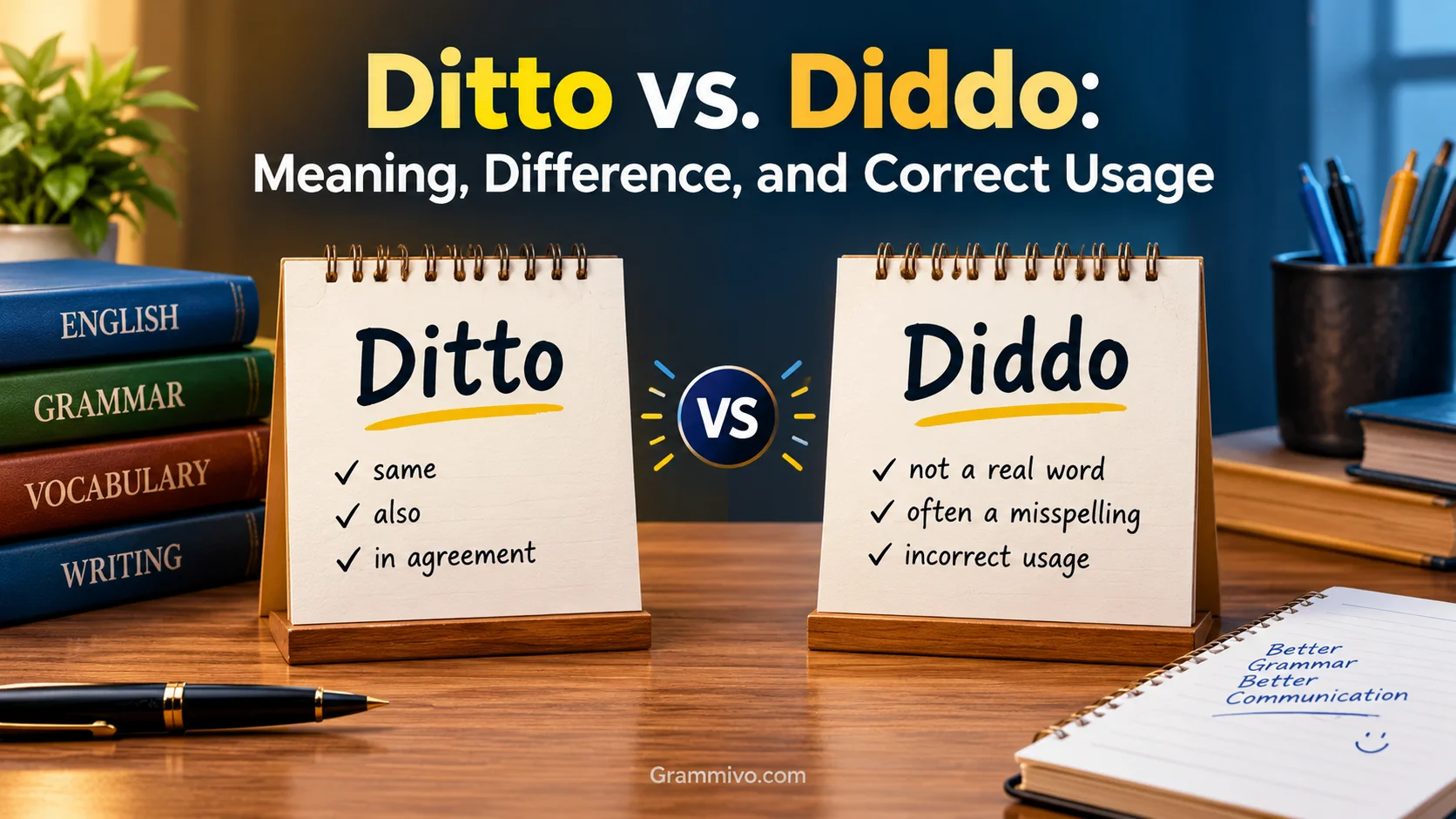
Have you ever written diddo when you meant ditto? These two spellings look similar, but only one is the standard English word for expressing agreement or referring to something already mentioned. The confusion often appears in text messages, social media comments, and everyday conversations.
The correct spelling is ditto, with two t’s. It means “the same,” “likewise,” or “the same thing you just said.” For example, if your friend says, “I love this song,” you can reply, “Ditto!” to express the same feeling.
Although people sometimes write diddo by mistake, it isn’t the standard spelling of this word. Understanding the difference helps you avoid spelling errors and communicate more clearly.
Quick Answer
Ditto is the correct spelling when you mean “the same” or “likewise.” Diddo is generally a misspelling of ditto in this context. You can use ditto to agree with someone, share the same opinion, or avoid repeating information.
Example:
- Correct: “I really enjoyed the movie.” “Ditto!”
- Incorrect: “I really enjoyed the movie.” “Diddo!”
Remember the double t in ditto to spell it correctly.
Comparison Overview
The main difference between ditto and diddo is that ditto is a recognized English word, while diddo is generally an incorrect spelling when used with the same meaning.
| Feature | Ditto | Diddo |
| Spelling status | Standard English word | Generally a misspelling of ditto |
| Meaning | The same, likewise, or as previously stated | No standard equivalent meaning in this context |
| Part of speech | Primarily a noun or adverb in common usage | Not the standard form of the intended word |
| Pronunciation | DIH-toh | No standard pronunciation for the intended meaning |
| Common use | Agreement, repetition, and shared preferences | Usually an accidental spelling error |
| Example | “You look great!” “Ditto!” | “You look great!” “Diddo!” |
| Best choice | Use in standard writing | Avoid when you mean ditto |
The easiest rule to remember: When you want to say “the same here” or “I feel the same way,” write ditto.
Main Differences Between Ditto and Diddo
Although ditto and diddo differ by only one letter, that small change matters in standard English. The correct choice depends on the meaning you want to express, not simply on how the word sounds.
What Does Ditto Mean?
Ditto means the same thing as something already mentioned, written, or expressed. It allows you to refer to an earlier statement without repeating the entire message.
For example, imagine that two friends are discussing their favorite restaurant. One says, “The pasta here is delicious.” The other replies, “Ditto!” The second friend means that they share the same opinion.
The word has several related uses in everyday English:
- Expressing agreement: You agree with someone’s opinion or statement.
- Sharing a feeling: You feel the same way as another person.
- Repeating information: You refer to something already stated instead of writing it again.
- Indicating the same item: You show that a previously mentioned choice or detail applies again.
Consider these examples:
- “I’m excited about our vacation.” “Ditto!”
- “Please order the chocolate cake.” “Ditto for me.”
- “The first box contains 20 notebooks, and the second contains ditto.”
The first two examples demonstrate conversational usage. The third sentence sounds unnatural in ordinary modern English. In a list or inventory, writing “The second box contains the same number” would usually communicate the information more clearly.
This distinction matters because ditto doesn’t automatically fit every sentence involving repetition. You should choose wording that makes the relationship between the two things clear.
Is Diddo a Correct Word?
Diddo is not the standard spelling of the English word ditto. If you want to express agreement or indicate that something is the same, use ditto.
People may type diddo because they misremember the spelling, make a typing error, or write the word as they think they hear it. However, familiar-looking spellings aren’t always correct.
Here are some examples of the difference:
| Incorrect usage | Correct usage |
| “I love that idea.” “Diddo!” | “I love that idea.” “Ditto!” |
| “Have a wonderful weekend!” “Diddo to you.” | “Have a wonderful weekend!” “Ditto to you.” |
| “She said she was tired, and I felt diddo.” | “She said she was tired, and I felt the same way.” |
Notice that the third example needs more than a spelling correction. Replacing diddo with ditto wouldn’t make the sentence sound entirely natural. A better sentence expresses the intended meaning directly.
There is one important qualification: someone could use Diddo as a username, brand name, nickname, or other proper name. That doesn’t make it the standard spelling of the English word. Context determines whether a particular spelling is intentional.
Ditto vs. Diddo: Spelling and Pronunciation
The difference between these spellings becomes easier to remember when you examine their letters and sounds.
Ditto contains five letters: D-I-T-T-O. The middle of the word contains two consecutive t’s. In standard American English, the word is pronounced approximately DIH-toh, with the stress on the first syllable.
The double t is the most useful spelling clue. Even though English spelling can be unpredictable, remembering this familiar letter pattern helps you avoid the common mistake.
Compare the words below:
- Ditto: The standard spelling, pronounced approximately DIH-toh.
- Diddo: A nonstandard spelling when intended to mean “the same.”
- Dido: A different spelling used in proper names, including the name of the ancient queen Dido and the English singer Dido.
Don’t confuse diddo with Dido. Similar-looking words can have different meanings, and a proper name isn’t interchangeable with a common English word.
A simple memory trick can help: Ditto has two T’s for “the same thing, twice.” The phrase isn’t a formal linguistic rule, but it offers an easy reminder of the correct spelling.
How to Use Ditto in a Sentence
You can use ditto in several everyday situations. The key is making sure your reader or listener understands which statement, feeling, or item you’re referring to.
Expressing agreement
When someone shares an opinion you support, ditto can replace a longer response.
Examples:
- “That was the best concert I’ve ever attended.” “Ditto!”
- “I think we should leave early.” “Ditto.”
- “This restaurant has excellent service.” “Ditto!”
In each case, the speaker agrees with the previous statement. The word keeps the conversation moving without requiring a full sentence.
Sharing the same feelings
You can also use ditto to tell someone that you share an emotion or experience.
Examples:
- “I’m nervous about the interview tomorrow.” “Ditto.”
- “I can’t wait for the holidays.” “Ditto!”
- “I’m exhausted after that long trip.” “Ditto. I need a nap.”
The last example combines ditto with an additional comment. This is perfectly natural in casual conversation.
Referring to repeated information
In some written contexts, ditto indicates that information matches something mentioned earlier. This usage is more common in notes, informal records, and certain forms of tabular writing.
For example:
| Day | Lunch preference |
| Monday | Vegetable soup |
| Tuesday | Ditto |
| Wednesday | Vegetable soup |
Here, ditto indicates that Tuesday’s lunch preference matches Monday’s. However, the table works best when readers can easily identify the information being repeated.
For official records, medical forms, financial documents, and other situations where precision matters, writing the actual information often prevents confusion.
Using ditto as a short response
A single word can sometimes communicate a complete thought.
Example:
“I’m bringing snacks for the road trip.”
“Ditto! I’ll bring some fruit.”
The first word expresses agreement or a shared intention. The second sentence clarifies what the speaker plans to contribute.
This flexibility makes ditto useful, but it doesn’t mean you should use it everywhere. A direct response is sometimes clearer, especially when the conversation involves multiple ideas.
Read More: Began vs. Begun: Meaning, Difference, and Correct Usage
Examples of Ditto in Everyday Conversations
Realistic examples make the distinction between ditto and diddo easier to understand. In the following conversations, ditto expresses agreement, shared preferences, or similar experiences.
Example: Talking about a movie
Alex: “That movie had an incredible ending.”
Jordan: “Ditto! I didn’t expect that twist.”
Jordan agrees with Alex and adds a personal observation. The response feels natural because both people are discussing the same movie.
Example: Discussing food
Mia: “I’m ordering a pepperoni pizza.”
Sam: “Ditto for me, please.”
Sam wants the same food. The phrase ditto for me is common in casual conversation, although “I’ll have the same” is another clear option.
Example: Talking about work
Taylor: “This week has been exhausting.”
Morgan: “Ditto. I’m looking forward to the weekend.”
Morgan shares Taylor’s feeling and expands on it. The word creates a quick connection between the two statements.
Example: Sharing an opinion online
Comment: “Everyone deserves a little kindness.”
Reply: “Ditto. A small gesture can make someone’s day.”
The response signals agreement while adding a related thought.
Example: Sending a text message
Friend A: “I’m so ready for Friday.”
Friend B: “Ditto 😂”
The reply is short, informal, and easy to understand. The emoji adds a playful tone, but it doesn’t change the meaning of ditto.
Across these examples, one pattern remains consistent: ditto refers back to something the other person has already said or expressed. If you want to introduce a new idea, explain it separately.
Ditto in Texting and Online Communication
In texting, ditto is a convenient way to agree with someone without typing a lengthy response. You can use it in private messages, group chats, social media comments, and online discussions.
Unlike abbreviations such as LOL or BRB, ditto is a regular English word, not an acronym. It doesn’t represent a series of initials. Instead, it carries the meaning “the same” or “I feel the same way.”
Here are some common texting situations:
| Text message | Reply | Meaning |
| “I miss our old school days.” | “Ditto!” | I miss them, too. |
| “This song is amazing.” | “Ditto 🎵” | I like the song, too. |
| “I’m ready for the weekend.” | “Ditto!” | I feel the same way. |
| “That was a great dinner.” | “Ditto. Everything was delicious.” | I agree with your opinion. |
| “Good luck on your exam!” | “Ditto!” | I wish you good luck, too. |
The last example needs a little context. Ditto can return a greeting or good wish when the other person understands the intended meaning. However, “Good luck to you, too!” is clearer when you want to avoid ambiguity.
Can you write diddo in a text message? You can type any sequence of letters, but if you mean “the same,” ditto is the standard spelling. Using the correct form helps your messages look polished and prevents unnecessary confusion.
Origin and History of the Word Ditto
The history of ditto helps explain why the word has its current meaning.
According to established English usage, ditto comes from the Italian word detto, meaning “said” or “stated.” Italian derives this form from the verb dire, meaning “to say.” The word entered English through Italian usage and became associated with repeating something already mentioned.
Over time, English speakers adopted ditto as a practical way to avoid repeating words, entries, and statements. Its meaning expanded naturally into everyday conversation.
Today, the word appears in several contexts:
- Conversation: Expressing agreement or sharing a feeling.
- Lists and records: Indicating that an entry repeats previously stated information.
- Informal writing: Referring to an earlier statement without repeating it.
- Popular culture: Using the word as a playful or affectionate way to say “same here.”
This history also explains why ditto is a meaningful word rather than an arbitrary spelling. Its established form has a long history in English, while diddo doesn’t serve as the standard spelling for the same concept.
Synonyms and Alternatives to Ditto
Although ditto is useful, it isn’t always the best choice. Depending on the situation, another expression may sound more natural or communicate your meaning more precisely.
| Alternative | Meaning | Example |
| Likewise | In the same way; also | “It was nice meeting you.” “Likewise.” |
| Same here | I feel or think the same way | “I’m hungry.” “Same here.” |
| Me too | I share the same feeling or experience | “I love this book.” “Me too!” |
| I agree | I share your opinion | “We should start early.” “I agree.” |
| The same | An identical or similar thing | “I’ll have the same as you.” |
| So do I | I share the action or preference | “I enjoy reading.” “So do I.” |
| I feel the same way | I share your feelings or opinion | “I’m excited about the trip.” “I feel the same way.” |
When Should You Use Each Alternative?
Use “me too” for shared experiences. If someone says they’re tired, excited, or hungry, this phrase sounds friendly and natural.
Choose “likewise” for polite exchanges. It works well when someone says, “It was a pleasure meeting you.” You can reply, “Likewise.”
Use “I agree” when discussing opinions. It makes your position clear during meetings, discussions, and serious conversations.
Choose “the same” when referring to a specific choice. For example, “I’ll have the same drink you ordered” leaves little room for confusion.
Use “ditto” when you want a short, casual response. It works particularly well when the previous statement makes your meaning obvious.
These expressions overlap, but they aren’t interchangeable in every situation. Choose the phrase that matches your intended meaning and the tone of the conversation.
Common Mistakes When Using Ditto
Most errors involving ditto are easy to fix. However, spelling isn’t the only thing worth checking. You should also consider whether the word fits the sentence.
FAQs:
Is Ditto or Diddo Correct?
Ditto is correct when you mean “the same,” “likewise,” or “what was mentioned before.” Diddo is generally a misspelling of ditto in this context.
Example: “I enjoyed the concert.” “Ditto!”
What Does Ditto Mean in Simple Words?
Ditto means “the same thing” or “I feel the same way.”
For example, if your friend says, “I’m excited about the holidays,” you can reply, “Ditto!” to express the same feeling.
Why Do People Spell Ditto as Diddo?
People may write diddo because of a typing mistake, a faulty memory of the spelling, or confusion about the word’s sounds. However, the standard English spelling remains ditto.
Does Ditto Mean I Agree?
Yes, ditto can mean “I agree” in everyday conversation. More precisely, it indicates that you share the previous speaker’s statement, feeling, or preference.
For example, “This book is fascinating.” “Ditto!” communicates that you find it fascinating, too.
Is Ditto Appropriate for Formal Writing?
It depends on the context. Ditto can work in notes, tables, and informal professional communication. However, phrases such as “the same,” “likewise,” or “the same conclusion” may offer greater clarity in formal documents.
Conclusion:
When comparing ditto vs. diddo, the correct choice is straightforward: ditto is the standard English spelling. It means “the same,” “likewise,” or “the same thing mentioned before.” You can use ditto to agree with someone, share a feeling, or refer to repeated information. It’s especially useful in casual conversations and text messages, where a short response often works best.
