
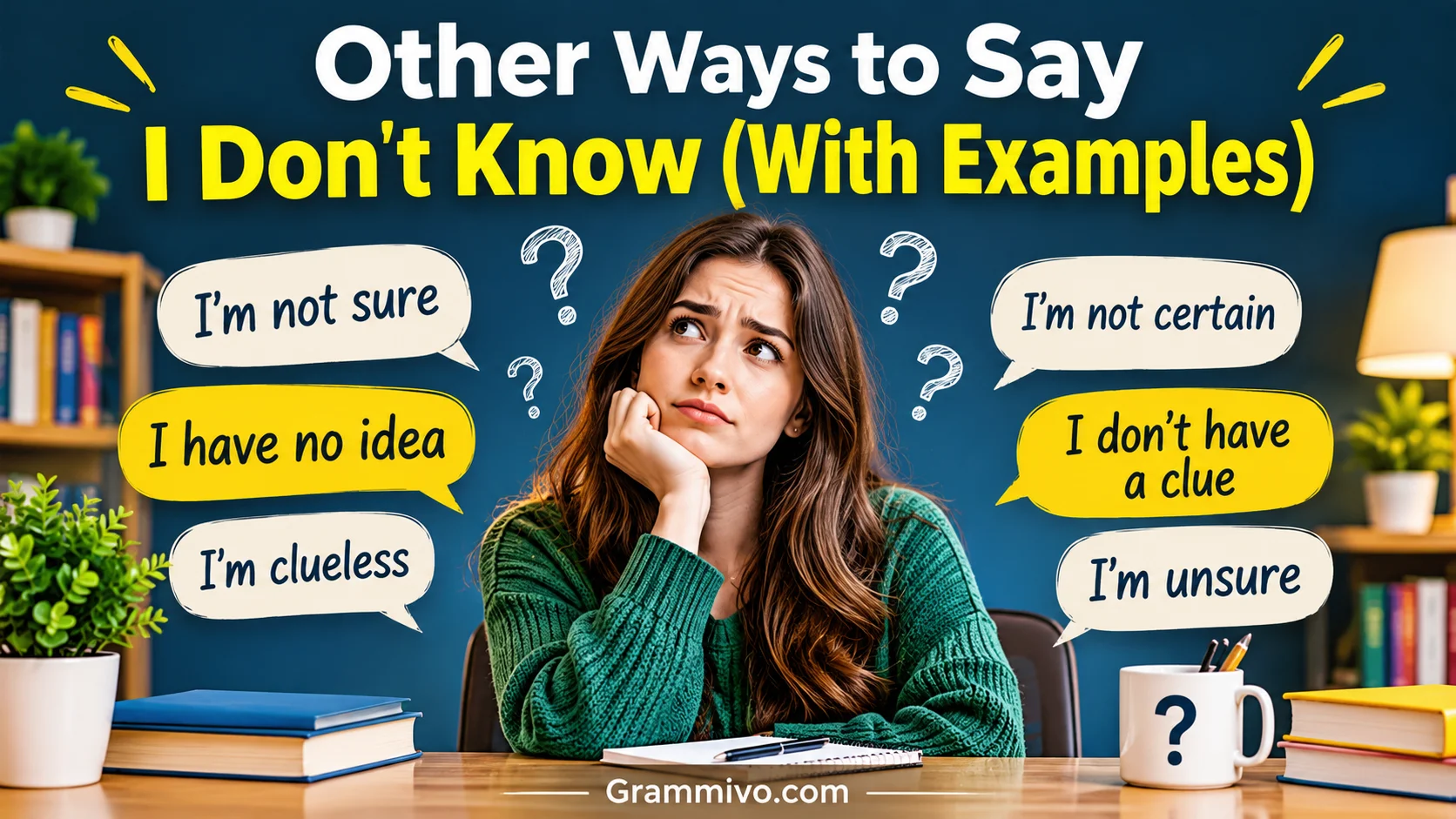
Sometimes, saying “I don’t know” is the simplest way to respond. However, the same phrase doesn’t always suit every conversation. You might need a more professional response at work, a polite answer in an email, or a casual expression when talking with friends. Choosing the right words can also help you sound more confident, approachable, and honest without pretending to have an answer.
If you’re looking for other ways to say I don’t know, this guide covers 15 natural alternatives with practical examples. You’ll learn which expressions work best in professional conversations, everyday situations, and written communication, along with the subtle differences that make each one useful.
Quick Answer:
Here are some natural alternatives to “I don’t know” that you can use in different situations:
- I’m not sure. – A softer way to express uncertainty.
- I’m not certain. – A slightly more formal expression of doubt.
- I can’t say for sure. – Useful when you don’t have enough information to confirm something.
- I don’t have that information. – A professional response when you lack specific details.
- I’m not familiar with that. – Appropriate when discussing an unfamiliar subject.
- That’s outside my area of expertise. – A professional way to acknowledge your limitations.
- I haven’t looked into that. – Explains that you haven’t researched the subject.
- I’m drawing a blank. – A casual way to say you can’t remember something.
- I have no idea. – A direct expression of complete uncertainty.
- Let me check. – A helpful response when you can look for the answer.
Some alternatives communicate uncertainty, while others explain why you cannot answer or what you’ll do next.
Comparison Overview
| Alternative | Best Used For | Tone |
| I’m not sure | Everyday conversations | Neutral, polite |
| I’m not certain | Professional discussions | Formal, neutral |
| I can’t say for sure | Unconfirmed information | Cautious |
| I don’t have that information | Workplace communication | Professional |
| I’m not familiar with that | Unfamiliar topics | Polite |
| Outside my area of expertise | Specialized questions | Professional |
| I’m drawing a blank | Memory-related situations | Casual |
| I have no idea | Informal conversations | Direct |
| Beats me | Conversations with friends | Very casual |
| Let me check | Finding an answer | Helpful, professional |
What Does “I Don’t Know” Mean?
“I don’t know” means you don’t have the knowledge, information, or answer needed to respond to a question. It is a simple expression of uncertainty or a lack of knowledge.
Grammatically, it’s a negative statement formed with the subject I, the auxiliary verb do, the negative word not, and the verb know. In everyday American English, people commonly use its contraction, “I don’t know.”
The expression can communicate several things depending on the situation:
- You genuinely lack the information.
- You aren’t certain about something.
- You haven’t researched a particular subject.
- You cannot remember a specific detail.
- You don’t have enough evidence to give a reliable answer.
For example:
- “I don’t know when the package will arrive.”
- “I don’t know much about commercial real estate.”
The phrase is neither inherently rude nor unprofessional. Its suitability depends on your tone, delivery, and relationship with the person asking.
When Is It Appropriate to Say “I Don’t Know”?
Although the expression works in most everyday situations, some conversations call for a more specific response.
Workplace conversations: You can say “I don’t know” when answering ordinary questions. However, explaining what information you lack or offering to find out may sound more constructive.
Emails and business messages: A direct statement can sometimes feel abrupt without additional context. A phrase such as “I don’t have that information at the moment” sounds more considerate and professional.
Conversations with friends and family: The original expression is perfectly natural. You don’t need formal wording when someone asks an ordinary question.
Formal communication: In reports, presentations, and professional discussions, you may want to explain the limits of your knowledge more precisely.
Personal conversations: When discussing something emotional or uncertain, a softer expression can communicate that you’re being thoughtful rather than dismissive.
Final List of Alternatives:
- I’m Not Sure
- I’m Not Certain
- I Can’t Say for Sure
- I Have No Idea
- I Couldn’t Tell You
- I Don’t Have That Information
- I Don’t Have Enough Information to Answer
- I’m Not Familiar With That
- That’s Outside My Area of Expertise
- I Haven’t Looked Into That
- I’m Drawing a Blank
- Beats Me
- Your Guess Is as Good as Mine
- I Wish I Knew
- Let Me Check
1. I’m Not Sure
Meaning and Usage: “I’m not sure” is one of the most natural and versatile alternatives to “I don’t know.” It communicates uncertainty without sounding overly direct. You can use it when you have partial information but cannot confidently confirm something. It also softens your response in conversations where a definite answer isn’t available.
Examples:
- “I’m not sure whether the restaurant is open on Sundays.”
- “I’m not sure what time the meeting starts.”
- “Are we supposed to submit this today? I’m not sure.”
Best Use For: Everyday conversations, workplace discussions, emails, and situations requiring a polite response.
Tone: Neutral, friendly, and polite.
2. I’m Not Certain
Meaning and Usage: “I’m not certain” communicates that you cannot confirm something with confidence. It sounds slightly more formal than “I’m not sure” and works well in professional conversations. Use it when you want to acknowledge uncertainty without suggesting that you have absolutely no knowledge of the subject.
Examples:
- “I’m not certain whether the figures include shipping costs.”
- “I’m not certain that this is the latest version.”
- “We’re expecting delivery tomorrow, but I’m not certain.”
Best Use For: Professional discussions, business communication, formal conversations, and situations involving unconfirmed details.
Tone: Formal, measured, and professional.
3. I Can’t Say for Sure
Meaning and Usage: This expression means you cannot provide a definite answer because you lack sufficient information or confirmation. Unlike a straightforward “I don’t know,” it can suggest that you have considered the available details but don’t want to make an unsupported claim.
Examples:
- “I can’t say for sure when the repairs will be finished.”
- “I can’t say for sure whether she’ll accept the offer.”
- “The weather looks promising, but I can’t say for sure.”
Best Use For: Predictions, uncertain plans, professional discussions, and questions requiring confirmation.
Tone: Cautious, polite, and thoughtful.
4. I Have No Idea
Meaning and Usage: “I have no idea” communicates a complete lack of knowledge about something. It’s more emphatic than “I’m not sure” and often appears in casual conversations. Although perfectly natural, it can sound blunt in professional situations, especially when someone expects you to provide an informed answer.
Examples:
- “I have no idea where I left my sunglasses.”
- “Do you know why the website isn’t loading? I have no idea.”
- “I have no idea how they managed to finish the project so quickly.”
Best Use For: Informal conversations, discussions with friends, and situations involving complete uncertainty.
Tone: Casual, direct, and sometimes emphatic.
5. I Couldn’t Tell You
Meaning and Usage: “I couldn’t tell you” means you don’t have an answer or cannot provide the requested information. It’s a conversational alternative that can sound natural when someone asks about something outside your knowledge. Depending on your delivery, it may sound friendly or slightly dismissive, so consider your audience.
Examples:
- “I couldn’t tell you why the prices increased.”
- “When will the new manager arrive? I couldn’t tell you.”
- “I couldn’t tell you how many people attended the event.”
Best Use For: Informal discussions and conversations where you cannot provide a definite answer.
Tone: Conversational, neutral, and context-dependent.
Contextual and Professional Alternatives
These expressions explain the reason behind your uncertainty. They’re useful when a simple “I don’t know” wouldn’t communicate enough information.
6. I Don’t Have That Information
Meaning and Usage: This expression explains that you currently lack the specific details someone needs. It’s particularly useful in professional settings because it sounds factual rather than dismissive. It doesn’t necessarily mean you lack general knowledge; you simply don’t have access to the requested information.
Examples:
- “I don’t have that information available right now.”
- “Unfortunately, I don’t have the customer’s updated contact details.”
- “I don’t have that information, but I can check with the accounting team.”
Best Use For: Workplace communication, customer service, business emails, and administrative discussions.
Tone: Professional, neutral, and respectful.
7. I Don’t Have Enough Information to Answer
Meaning and Usage: Use this expression when the available details aren’t sufficient to give an accurate response. It differs from simply lacking knowledge because it identifies missing information as the reason. It’s especially useful when you want to avoid assumptions or misleading answers.
Examples:
- “I don’t have enough information to answer your question accurately.”
- “We don’t have enough information to determine the cause.”
- “I’d need the complete report because I don’t have enough information to make a recommendation.”
Best Use For: Research, workplace decisions, technical discussions, and situations requiring accurate information.
Tone: Professional, careful, and informative.
8. I’m Not Familiar With That
Meaning and Usage: This expression means you don’t have much knowledge or experience with a particular subject, product, process, or situation. It’s a useful alternative when someone introduces an unfamiliar topic. Unlike “I have no idea,” it doesn’t suggest complete ignorance about everything related to the subject.
Examples:
- “I’m not familiar with that software. Could you show me how it works?”
- “I’m not familiar with the company’s new policies.”
- “I’ve heard about the program, but I’m not familiar with its requirements.”
Best Use For: Professional introductions, technical discussions, academic conversations, and unfamiliar subjects.
Tone: Polite, professional, and neutral.
9. That’s Outside My Area of Expertise
Meaning and Usage: This expression acknowledges that a question falls beyond your professional knowledge or specialized skills. It doesn’t mean you know nothing about the subject. Instead, you’re explaining that someone else may be better qualified to provide an accurate answer.
Examples:
- “That’s outside my area of expertise, but our legal team can help.”
- “Tax regulations are outside my area of expertise.”
- “I can review the design, but electrical engineering is outside my area of expertise.”
Best Use For: Workplace discussions, consultations, technical questions, and professional situations involving specialized knowledge.
Tone: Professional, confident, and respectful.
10. I Haven’t Looked Into That
Meaning and Usage: This expression means you haven’t researched, investigated, or examined a particular subject. It’s different from saying you don’t know because it identifies a lack of investigation rather than a permanent lack of knowledge. It also leaves room for you to research the matter later.
Examples:
- “I haven’t looked into the new insurance options yet.”
- “I haven’t looked into why the application was rejected.”
- “That’s an interesting suggestion, but I haven’t looked into its potential costs.”
Best Use For: Work discussions, research, planning, and conversations about subjects you haven’t investigated.
Tone: Neutral, honest, and conversational.
Casual and Memory-Related Alternatives
These expressions work best in relaxed conversations or when you cannot recall something you previously knew.
11. I’m Drawing a Blank
Meaning and Usage: “I’m drawing a blank” means you cannot remember something or think of an answer at that moment. It’s particularly useful for memory-related situations, such as forgetting someone’s name or struggling to recall a specific detail. It doesn’t necessarily mean you lack knowledge about the subject.
Examples:
- “I’m drawing a blank on the name of that movie.”
- “What’s the restaurant we visited last summer? I’m drawing a blank.”
- “I know we’ve discussed this before, but I’m drawing a blank right now.”
Best Use For: Casual conversations, memory-related questions, and situations where you temporarily cannot recall something.
Tone: Friendly, informal, and natural.
12. Beats Me
Meaning and Usage: “Beats me” is a casual idiom meaning you don’t know or understand something. It’s short and conversational, making it a natural choice among friends. However, it can sound dismissive if someone expects a serious answer, particularly in professional communication.
Examples:
- “Why did the neighbors move? Beats me.”
- “Who finished all the cookies? Beats me!”
- “How does this old remote work? Beats me.”
Best Use For: Conversations with friends, family, and other informal situations.
Tone: Very casual, relaxed, and sometimes humorous.
13. Your Guess Is as Good as Mine
Meaning and Usage: This expression means you are just as uncertain as the other person. It’s often used when neither person has enough information to answer a question. Unlike “I don’t know,” it emphasizes shared uncertainty rather than simply describing your own lack of knowledge.
Examples:
- “When will the construction finally end? Your guess is as good as mine.”
- “Why hasn’t the company announced anything? Your guess is as good as mine.”
- “How many people will show up tonight? Your guess is as good as mine.”
Best Use For: Casual discussions, uncertain situations, and conversations where both people lack an answer.
Tone: Informal, friendly, and sometimes humorous.
14. I Wish I Knew
Meaning and Usage: “I wish I knew” expresses uncertainty alongside a feeling of wanting an answer. It can communicate curiosity, frustration, disappointment, or concern depending on the context. Unlike a neutral “I don’t know,” this expression adds an emotional element and often suggests that the answer matters to you.
Examples:
- “I wish I knew when we’ll hear back about the application.”
- “Why has he stopped responding? I wish I knew.”
- “I wish I knew what would make this project easier.”
Best Use For: Personal conversations, emotional situations, and discussions involving unanswered questions.
Tone: Thoughtful, personal, and sometimes frustrated.
Context-Specific Responses That Offer a Next Step
The following expression isn’t a direct synonym. It works when you want to respond constructively instead of simply acknowledging that you don’t know.
15. Let Me Check
Meaning and Usage: “Let me check” means you need to verify something before providing an answer. It doesn’t communicate that you have no way of knowing. Instead, it shows that you’re willing to look for accurate information. It’s especially useful when you can access a document, website, schedule, or another source.
Examples:
- “Let me check the calendar before confirming the appointment.”
- “I’m not sure about the current price. Let me check.”
- “Let me check with the shipping department and get back to you.”
Best Use For: Workplace conversations, customer service, business emails, and everyday situations where you can verify information.
Tone: Helpful, professional, and proactive.
How to Choose the Right Alternative to “I Don’t Know”
The best expression depends on what you want to communicate. Consider these practical tips before choosing your wording.
1. Consider your relationship with the listener.
Use relaxed expressions such as “Beats me” with friends. Choose more respectful wording when speaking with clients, managers, or unfamiliar people.
2. Identify the reason you don’t know.
Are you uncertain, unfamiliar with the topic, missing information, or unable to remember something? Choose an expression that explains the actual situation.
3. Match the formality of the conversation.
“I’m not sure” works in most everyday situations. “I don’t have that information available” is more appropriate for professional communication.
4. Offer a next step when possible.
If you can find the answer, say “Let me check” or explain that you’ll look into it. This makes your response more constructive.
5. Avoid pretending to know something.
Don’t replace uncertainty with a confident-sounding guess. Honest communication is more useful than providing an answer you cannot support.
How to Replace “I Don’t Know” in Real Sentences
Sometimes, the easiest way to learn a new expression is to see how it works in an existing sentence. Here are five practical transformations.
Original: I don’t know whether the client approved the proposal.
Alternative: I’m not certain whether the client approved the proposal.
Why It Works: The replacement communicates the same uncertainty while sounding slightly more formal.
Original: I don’t know where the meeting room is.
Alternative: I’m not familiar with the building layout.
Why It Works: This version explains why you cannot provide directions. It shifts the focus from the missing answer to your unfamiliarity with the location.
Original: I don’t know the exact delivery date.
Alternative: I don’t have that information at the moment.
Why It Works: This sounds more appropriate in customer service or business communication.
Original: I don’t know why the computer keeps shutting down.
Alternative: I haven’t looked into what’s causing the computer to shut down.
Why It Works: The alternative explains that you haven’t investigated the problem. It doesn’t suggest that the cause is impossible to discover.
Original: I don’t know what her name was.
Alternative: I’m drawing a blank on her name.
Why It Works: The replacement sounds more conversational and specifically communicates difficulty remembering something.
What Are the Most Professional Ways to Say “I Don’t Know”?
Professional communication doesn’t require complicated vocabulary. A clear, respectful response usually works best.
Here are some particularly useful choices:
- I don’t have that information available right now. Use this when you lack specific details.
- I’m not certain about that. Choose this when you cannot confidently confirm something.
- I don’t have enough information to answer accurately. Use this when additional details are necessary.
- That’s outside my area of expertise. Choose this when the question requires specialized knowledge.
- Let me check and get back to you. Use this when you can verify the answer.
For example, if a manager asks about an unfinished report, you could say:
“I’m not certain about the final figures yet. Let me check the latest report and get back to you.”
This response acknowledges uncertainty while providing a practical next step.
Frequently Asked Questions:
What Is the Most Common Alternative to “I Don’t Know”?
“I’m not sure” is one of the most versatile alternatives. It works in everyday conversations, workplace discussions, and many written messages. It also sounds slightly softer than “I don’t know,” making it a useful choice when you want to express uncertainty without sounding abrupt.
What Is a Polite Way to Say “I Don’t Know”?
You can say, “I’m not certain about that,” or “I don’t have that information at the moment.” Both expressions communicate uncertainty without sounding dismissive. If you can investigate the question, add an offer to check so the other person knows you’re willing to help.
How Do You Say “I Don’t Know” Professionally in an Email?
Use a clear and respectful expression such as, “I don’t have those details available right now.” You can also write, “Let me verify that information and follow up with you.” These responses acknowledge what you don’t know while keeping the conversation productive.
Is “I’m Not Sure” Better Than “I Don’t Know”?
Neither expression is universally better. “I’m not sure” generally sounds softer and can suggest partial knowledge or uncertainty. “I don’t know” is more direct and clearly acknowledges a lack of knowledge. Choose the one that accurately represents what you know.
Is “Beats Me” a Professional Expression?
No. “Beats me” is an informal idiom best suited to relaxed conversations. It can sound dismissive in meetings, customer interactions, and business emails. In professional settings, use “I’m not sure” or “I don’t have that information” instead.
Conclusion:
Finding other ways to say I don’t know isn’t about avoiding an honest answer. It’s about expressing uncertainty in a way that fits the situation. “I’m not sure” works well in everyday conversations, while “I don’t have that information” sounds more appropriate professionally. Expressions such as “I’m drawing a blank” and “Beats me” add a casual touch.
