
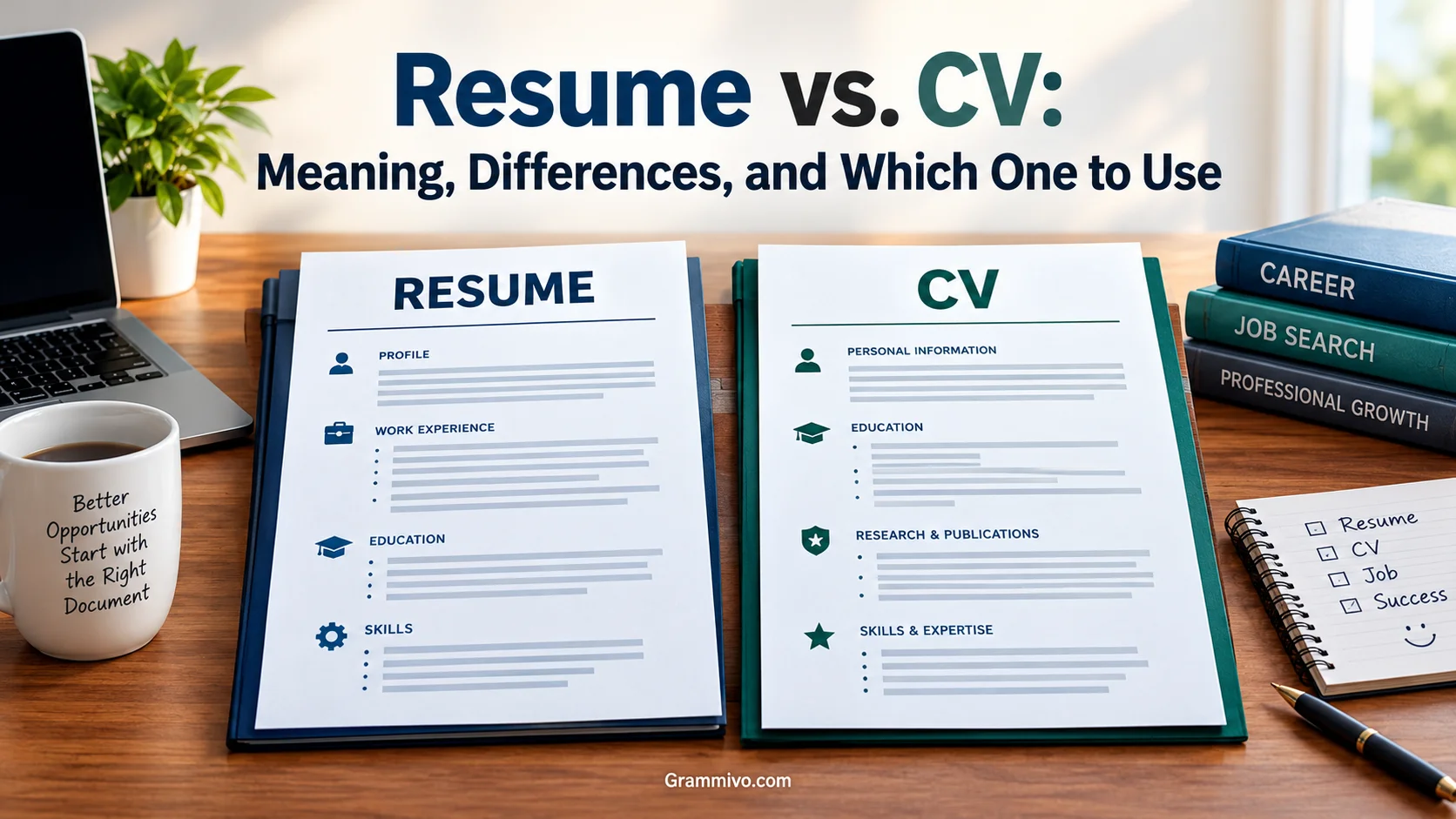
When you’re applying for a job, choosing between a resume and a CV can feel confusing. Both documents describe your qualifications, education, skills, and work experience. However, they serve different purposes depending on the position you’re pursuing and the country where you’re applying.
In the United States, employers generally expect a resume for most jobs. Academic institutions and research organizations often request a CV because it provides a more detailed record of professional and scholarly achievements. Outside the United States, the distinction can be different. For example, employers in the United Kingdom commonly use the term CV for a document that Americans would call a resume.
Understanding these differences helps you prepare the right document, highlight your strongest qualifications, and avoid unnecessary details. Whether you’re a student applying for your first position, an experienced professional changing careers, or a researcher pursuing an academic opportunity, the right choice depends on your goals.
Quick Answer
A resume is a concise, job-focused document that highlights your relevant skills, work experience, education, and achievements. A CV (curriculum vitae) is a more comprehensive document that typically records academic qualifications, research, publications, teaching experience, and professional accomplishments.
In the United States, use a resume for most nonacademic jobs and a CV for academic, research, and certain medical positions when requested. In countries such as the United Kingdom, CV commonly refers to the standard document used for ordinary job applications.
The simplest rule: Check the job advertisement first. The employer’s instructions and the country’s conventions determine which document you should submit.
Comparison Overview
The main difference between a resume and a CV lies in their purpose, level of detail, and common usage. Although the documents share several sections, they organize information differently.
| Feature | Resume | CV (Academic) |
| Primary purpose | Apply for a specific job | Document academic and professional accomplishments |
| Typical length | Often one or two pages | Varies; may extend to several pages |
| Main focus | Relevant skills, experience, and achievements | Education, research, publications, teaching, and accomplishments |
| Level of detail | Selective and targeted | Comprehensive and detailed |
| Customization | Usually tailored to each position | Updated continuously and adapted to specific opportunities |
| Common US usage | Most nonacademic jobs | Academic, research, and certain medical positions |
| Work experience | Emphasizes relevant responsibilities and results | Includes relevant professional and academic appointments |
| Publications | Included when relevant | Often listed in a dedicated section |
| Research experience | Included when relevant to the position | Frequently a major section |
| Update frequency | Revised for each application | Updated as qualifications and accomplishments grow |
| International terminology | Common US term for job applications | May also mean a standard job-application document outside the US |
Important distinction: This table describes common US usage. In the UK and several other countries, a CV may serve the same purpose as an American resume. Neither document has a universal length requirement that applies to every industry or country.
Main Differences Between Resume vs. CV
A resume and a CV may contain similar information, but they present that information for different reasons. A resume helps an employer quickly evaluate your fit for a particular job. An academic CV provides a broader record of your qualifications, professional development, and scholarly contributions.
Let’s examine the differences that matter when you’re preparing an application.
Read More: Eyeing vs. Eying: Meaning, Difference, and Correct Usage
Resume vs. CV: Meaning and Definition
A resume summarizes your professional background, relevant skills, education, and achievements. The word comes from the French résumé, meaning a summary. Its purpose is to give employers a focused picture of what you can contribute.
For example, a software developer applying for a programming position might emphasize programming languages, completed projects, technical certifications, and measurable results. The document doesn’t need to describe every task the developer has performed throughout their career.
A CV, short for curriculum vitae, comes from Latin and roughly means “course of life.” In American academic and research settings, it documents a person’s qualifications and accomplishments in greater detail.
An academic CV might include university degrees, research projects, journal articles, conference presentations, teaching appointments, grants, fellowships, and professional memberships. It can grow throughout a person’s career as they earn new qualifications and contribute to their field.
The distinction becomes clearer when you consider their primary goals:
- Resume: Shows why you’re a suitable candidate for a particular position.
- Academic CV: Records your academic background and professional or scholarly accomplishments.
- International CV: Often serves as the standard job-application document used in countries where employers call it a CV rather than a resume.
These definitions overlap in some situations. Always consider the document’s intended use rather than relying on its name alone.
Purpose and Intended Audience
Although resumes and CVs both introduce you to potential employers, they answer slightly different questions.
A resume answers: “Why should we consider you for this job?”
An academic CV answers: “What qualifications, experience, and accomplishments demonstrate your academic or professional background?”
Consider a marketing professional applying for a brand manager position. The employer wants to see campaign results, market research experience, leadership skills, and relevant achievements. A focused resume brings those details to the forefront.
Now imagine a university researcher applying for a faculty position. The hiring committee may need to evaluate publications, research methods, teaching experience, conference presentations, and grant funding. An academic CV provides space for that evidence.
The intended audience influences what you include and how you organize it.
| Audience | Usually appropriate in the US | Information to emphasize |
| Corporate recruiter | Resume | Relevant experience, skills, results |
| Small business owner | Resume | Versatility, practical experience, achievements |
| University hiring committee | Academic CV when requested | Teaching, research, publications |
| Research institution | CV or resume, depending on the role | Research experience, methods, contributions |
| Graduate school admissions committee | CV or resume, depending on instructions | Education, research, projects, relevant activities |
| International employer | Locally appropriate CV or resume | Qualifications requested by the employer |
A document that works well for one audience may not serve another equally well. Your goal is to make the most relevant evidence easy to find.
Length and Level of Detail
Length is one of the most noticeable differences between an American resume and an academic CV. However, page count alone doesn’t determine which document you’re using.
A resume often runs one or two pages. Students and recent graduates may fit their relevant qualifications on one page, while experienced professionals may need two pages to present substantial achievements clearly.
Senior professionals can sometimes justify additional space when their experience directly supports the position. The key is relevance, not an arbitrary page limit.
An academic CV has no comparable universal maximum. A graduate student may have a relatively short CV, while an established professor might need several pages to document decades of research, teaching, publications, and academic service.
For example:
- A recent graduate applying for an office assistant position might submit a one-page resume.
- A project manager with 12 years of experience might use a two-page resume.
- A professor with 20 years of teaching and research experience might maintain a much longer academic CV.
More pages don’t automatically make a document better. A resume filled with unrelated duties can weaken an application, while an academic CV that omits important publications may fail to represent a researcher’s contributions accurately.
Content and Structure
Both documents typically include contact information, education, and relevant experience. The main difference lies in how much detail each section provides and which accomplishments receive priority.
Common Resume Sections
A resume generally includes the following sections, depending on your background and the position:
- Contact information: Your name, professional email address, phone number, and relevant professional profile.
- Professional summary: A short introduction highlighting your experience, strengths, and career focus when it adds value.
- Work experience: Relevant positions, responsibilities, and achievements, usually listed in reverse chronological order.
- Skills: Job-related technical abilities, tools, languages, and other relevant competencies.
- Education: Degrees, institutions, graduation dates when appropriate, and relevant academic details.
- Certifications and licenses: Credentials that support your qualifications or are required for the position.
- Projects: Relevant personal, academic, freelance, or professional projects.
- Awards and volunteer work: Selected accomplishments that demonstrate relevant abilities or leadership.
You don’t need to include every section. A senior accountant may prioritize professional experience and certifications, while a new graduate may give more space to education and internships.
Common Academic CV Sections
An academic CV may include the same basic information but often provides additional sections, such as:
- Education: Degrees, institutions, fields of study, and sometimes dissertation titles or supervisors.
- Academic appointments: Teaching, research, faculty, and other university positions.
- Research interests: Areas of study relevant to academic applications.
- Publications: Journal articles, books, book chapters, and other scholarly works.
- Research experience: Projects, methods, collaborations, and contributions.
- Teaching experience: Courses taught, instructional responsibilities, and relevant teaching development.
- Conference presentations: Papers, posters, invited talks, and other presentations.
- Grants and fellowships: Funding awards and competitive academic support.
- Awards and honors: Academic recognition, research prizes, and professional distinctions.
- Professional service: Peer reviewing, committee work, editorial responsibilities, and relevant professional activities.
- Professional memberships: Memberships in relevant academic or professional organizations.
- Licenses and certifications: Credentials relevant to the field.
The exact structure depends on your discipline and career stage. A scientist may emphasize research funding and publications, while a university lecturer may give greater attention to teaching and curriculum development.
Formatting and Presentation
A resume should make your strongest qualifications easy to spot. An academic CV should make a broader record of accomplishments easy to navigate.
For a resume, use clear headings, consistent formatting, readable fonts, and concise bullet points. Place the most relevant information where employers can find it quickly. Avoid dense paragraphs that bury your accomplishments.
Academic CVs can use a similar visual style while organizing information into more specialized sections. For example, a researcher might separate peer-reviewed journal articles from conference abstracts, invited presentations, and books.
Both documents benefit from these practices:
- Use consistent fonts, spacing, and heading styles.
- Organize experience in a logical order, usually reverse chronological order.
- Write clear descriptions rather than long blocks of text.
- Use accurate dates and job titles.
- Keep bullet points focused on relevant information.
- Follow any formatting instructions supplied by the employer or institution.
A functional or combination resume may help some applicants emphasize transferable skills, but a reverse chronological format remains a common and widely understood choice. Academic CVs also vary in structure, so follow the expectations of your discipline and institution.
Customization and Updating
A resume usually requires more customization for each job application. An academic CV generally maintains a fuller record of your accomplishments, although you may still adjust its emphasis for a specific opportunity.
Suppose you’re applying for two different positions. One employer needs a project manager with budgeting experience, while another wants someone skilled in team leadership. Your work history may be identical, but the most relevant achievements will differ.
For the budgeting role, emphasize financial planning, resource allocation, and cost control. For the leadership role, highlight team coordination, mentoring, and successful project delivery.
An academic CV follows a different approach. You should maintain a complete, accurate record of relevant publications, presentations, appointments, grants, and other accomplishments. You can then organize or emphasize sections according to the application.
A practical routine helps:
- Update your resume whenever you complete a meaningful project or earn a relevant certification.
- Review your resume against each job description before applying.
- Add new academic publications, presentations, and appointments to your CV as they occur.
- Check dates, titles, and achievement details for accuracy.
- Remove or de-emphasize information that distracts from the opportunity.
Neither document should become a dumping ground for every task you’ve ever completed. Good organization makes your qualifications easier to understand.
FAQs:
Is a CV the Same as a Resume?
Not always. In the United States, a resume usually summarizes qualifications for a specific job, while an academic CV provides a more comprehensive record of scholarly and professional accomplishments.
In the United Kingdom, however, CV commonly refers to the standard document used for job applications. The meaning depends on the country and context.
Is a CV Longer Than a Resume?
An American academic CV is often longer than a resume because it may include publications, research, teaching, grants, and presentations. A resume often runs one or two pages, although length varies with experience and industry.
International job-application CVs can also be concise. There’s no universal page limit for either document.
Do Employers Prefer a Resume or a CV?
Employers generally prefer the document appropriate for the position and local hiring conventions. Most US companies request resumes, while academic institutions often request CVs.
Always follow the job advertisement. Submitting the correct document matters more than choosing the one with the more impressive name.
Can I Use My Resume as a CV?
Sometimes. If an international employer uses CV to mean a standard job-application document, your resume may already have the appropriate structure.
However, if a US university requests an academic CV, you’ll usually need to expand your document to include relevant research, publications, teaching, and other academic accomplishments.
Should Students Use a Resume or a CV?
Students applying for ordinary entry-level jobs in the United States generally need a resume. Those pursuing academic research opportunities or applying to programs that request a CV may need an academic version.
Include relevant coursework, projects, internships, research, volunteer activities, and awards when they strengthen your application.
Conclusion:
The difference between a resume and a CV comes down to purpose, detail, and regional usage. In the United States, a resume is the usual choice for most nonacademic jobs, while an academic CV provides a fuller record of research, teaching, publications, and scholarly accomplishments. However, terminology changes across borders. Employers in the United Kingdom commonly use CV for the standard job-application document, so you shouldn’t assume every CV needs several pages.
