
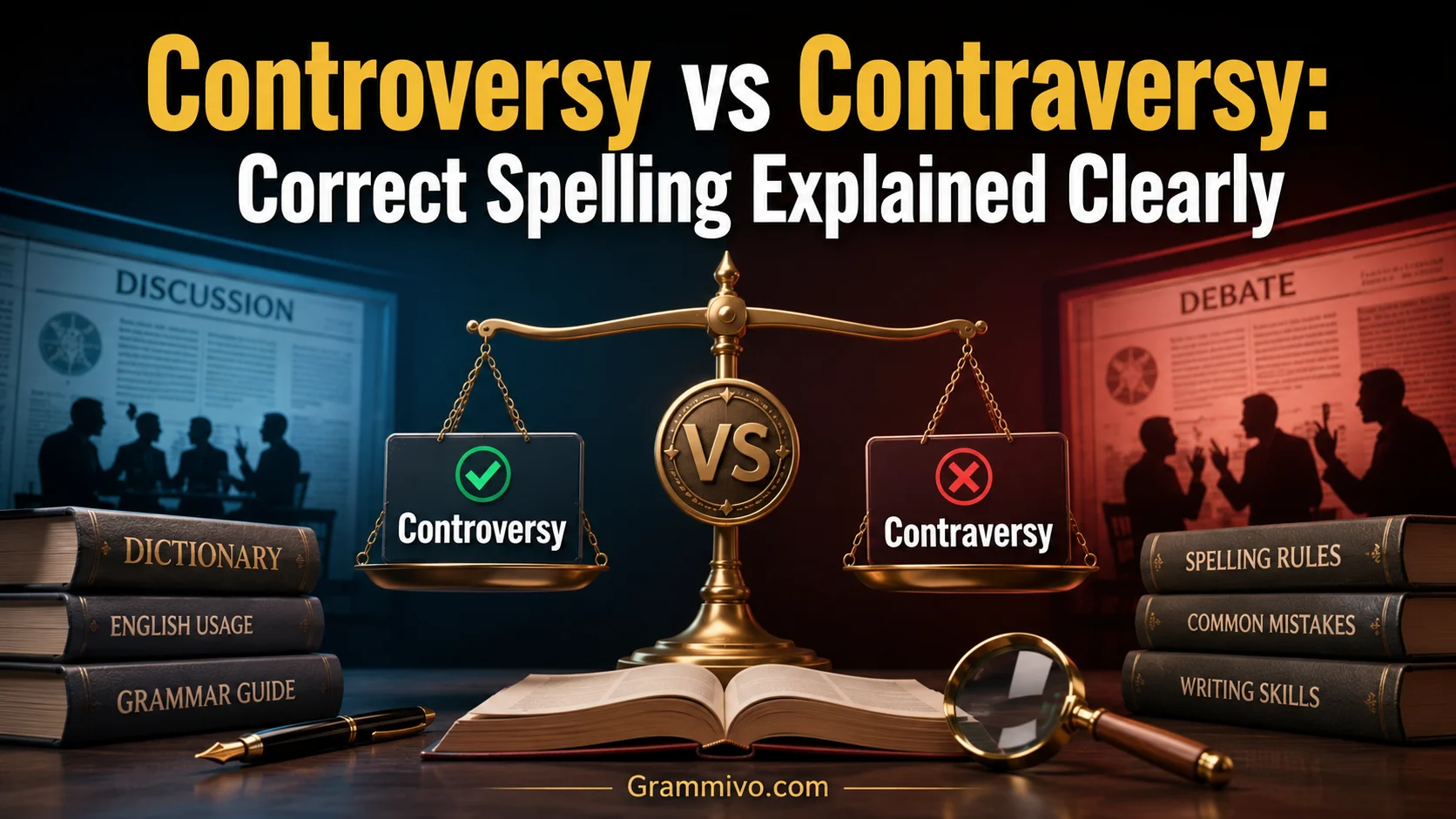
If you’ve ever hesitated between controversy and contraversy, you’re not alone. The two spellings look remarkably similar, and the pronunciation can make the difference even harder to notice. However, only one is the standard English spelling.
The correct form is controversy. The spelling contraversy is a common misspelling and shouldn’t be used in formal, academic, professional, or everyday writing.
The confusion usually comes from the way controversy sounds when spoken quickly. English also contains many familiar words beginning with contra-, such as contrary, contrast, and contradiction. That pattern can make contraversy look perfectly reasonable at first glance.
Once you understand the word’s spelling, pronunciation, origin, and relationship to words such as controversial and controvert, the correct form becomes much easier to remember.
Quick Answer:
The correct spelling is controversy.
Contraversy is incorrect. It doesn’t represent a separate word with a different meaning. Instead, it’s a misspelling that replaces the o in controversy with an a.
| Spelling | Correct? | Meaning |
| Controversy | Yes | A disagreement, dispute, or disputed issue |
| Contraversy | No | Misspelling of controversy |
| Controversial | Yes | Causing or involving controversy |
| Controversies | Yes | Plural form of controversy |
For example:
The mayor’s decision sparked controversy throughout the city.
Not:
The mayor’s decision sparked contraversy throughout the city.
Merriam-Webster defines controversy as a discussion marked by opposing viewpoints and also gives meanings related to dispute or quarrel. Its dictionary entry also traces the word’s history and provides pronunciation information.
Source: Merriam-Webster: Controversy
Controversy vs. Contraversy: What’s the Difference?
There is no legitimate meaning difference between controversy and contraversy. The distinction is simply correct spelling versus incorrect spelling.
Controversy is an established English noun. You can use it when discussing a disputed subject, public disagreement, heated debate, or issue that attracts competing opinions.
Contraversy, on the other hand, doesn’t function as a standard English noun. If you see it in a sentence, the writer almost certainly intended to write controversy.
This matters because a misspelling can affect credibility even when readers understand what you mean. In a school essay, business report, article, application, or professional email, writing contraversy may make the text look poorly edited.
The difference comes down to one important vowel:
controversy
contraversy
The correct word contains o after contr:
contr-o-vers-y
That middle o is worth remembering.
What Does Controversy Mean?
Controversy is a noun for a disagreement, dispute, or disputed matter involving opposing opinions.
The word often describes an issue that has attracted noticeable attention. Politics, entertainment, science, business, sports, education, and social issues can all generate controversy.
For example:
- The new law created controversy among local residents.
- The referee’s decision became a source of controversy.
- The celebrity’s comments sparked widespread controversy.
- There was considerable controversy over the proposed development.
However, controversy doesn’t necessarily mean that everyone involved is angry. Two groups can hold strongly opposing views about an issue without engaging in a personal argument.
A useful distinction is this:
Disagreement can happen between two people.
Controversy often surrounds an issue that attracts competing opinions or broader attention.
The word therefore has a wider social and public flavor than a simple difference of opinion.
Why Is “Contraversy” a Common Misspelling?
The spelling contraversy feels logical because English has many words beginning with contra-.
Consider:
- contradiction
- contrary
- contrast
- contravene
- contraception
- contradictory
Seeing this pattern can lead someone to assume that controversy follows the same spelling structure. It doesn’t.
Pronunciation adds another layer of confusion. When people say controversy naturally, the unstressed vowel sounds can become less distinct. If you’ve mostly heard the word rather than seen it written, contraversy may seem plausible.
This is especially common among English learners. English spelling frequently refuses to behave like a neat mathematical formula. A sound doesn’t always tell you exactly which letters belong on the page.
That’s why visual familiarity matters.
The safest form to memorize is:
CONTROVERSY
Not:
CONTRAVERSY
How to Spell Controversy Correctly
A simple way to remember the spelling is to focus on the middle of the word.
C-O-N-T-R-O-V-E-R-S-Y
The most commonly confused portion is:
controvers-
The incorrect spelling changes this to:
contravers-
That single vowel creates the mistake.
Another useful strategy is to connect controversy with its related words:
- controversy
- controversial
- controversially
- controvert
Notice the shared controvers- pattern.
For example:
The proposal became controversial after the committee announced it.
And:
The proposal generated considerable controversy.
Learning related words together works like building a small spelling network. Instead of memorizing one isolated word, you recognize the same letter pattern across several forms.
Controversy Pronunciation: How Do You Say It?
In standard US English, controversy is commonly pronounced approximately like:
KON-truh-vur-see
The word has four syllables:
con-tro-ver-sy
Pronunciation can vary somewhat among English speakers and regions. Merriam-Webster provides pronunciation variants in its dictionary entry.
The important point for spelling is that pronunciation doesn’t reliably reveal every letter.
For example, the unstressed vowels in spoken English can sound reduced. When someone says the word quickly, you may not clearly hear the exact vowel represented by the written o.
That’s one reason spelling errors often arise when people learn words primarily through conversation.
A good learning habit is to connect sound, spelling, and meaning rather than relying on sound alone.
The Origin of the Word Controversy
The history of controversy explains why its spelling looks the way it does.
The English word ultimately traces back to Latin controversia, meaning a dispute or disagreement. It is related to the Latin adjective controversus, which carried the sense of being turned against or opposed.
The historical development passed through French and Middle English before the word became established in English.
The Latin components are particularly useful because they connect with the idea of opposing positions. The word developed around the concept of something being disputed or argued from opposing sides.
This history doesn’t mean modern English speakers need to know Latin to spell the word. Still, etymology provides a useful explanation for why controversy, rather than contraversy, became the standard form.
Why the Spelling Is “Controversy,” Not “Contraversy”
The biggest trap is assuming that every word beginning with contra- must follow the same spelling pattern.
English doesn’t work that way.
The spelling of controversy reflects its historical development from forms related to Latin controversia. The word’s modern spelling preserves the o in its central structure.
So although controversy begins with letters that resemble other contra- words, you shouldn’t reconstruct its spelling by analogy with them.
Think of it this way:
Similar appearance doesn’t guarantee identical word structure.
That’s a useful lesson beyond this single word. English contains many pairs that look as though they should follow a particular pattern but don’t.
When you encounter a word you’re unsure about, dictionary confirmation beats guesswork.
Controversy in a Sentence: Correct Examples
Seeing the word in realistic sentences makes its usage much easier to understand.
Public Policy
The proposed tax changes sparked controversy among small-business owners.
Here, controversy refers to competing views about a government proposal.
Entertainment
The film generated controversy because of its portrayal of a historical event.
The word describes public disagreement surrounding the film.
Sports
The referee’s final decision became a major source of controversy.
The controversy centers on a disputed decision.
Business
The company’s advertising campaign caused controversy on social media.
The campaign attracted criticism and opposing opinions.
Education
The school’s decision to change its grading policy created controversy among parents.
The noun identifies the disagreement surrounding the policy.
Everyday Discussion
There was some controversy over who should organize the event.
Here, the word doesn’t necessarily imply a national scandal. It can describe a smaller dispute as well.
These examples show an important point: controversy can range from a minor dispute to a major public issue.
Common Phrases With Controversy
Certain verbs naturally appear with controversy. Learning these combinations can make your writing sound more natural.
Spark controversy
Spark controversy means to cause a disputed issue or trigger strong opposing reactions.
The announcement sparked controversy among customers.
Cause controversy
This phrase directly states that something produced disagreement or criticism.
The decision caused controversy within the organization.
Stir controversy
Stir controversy suggests that an action or statement actively creates discussion or disagreement.
The politician’s remarks stirred controversy during the campaign.
Court controversy
To court controversy means to behave in a way that knowingly risks attracting criticism or dispute.
The director appeared to court controversy with the provocative campaign.
Avoid controversy
This means trying not to become involved in a disputed issue.
The company changed its wording to avoid controversy.
A source of controversy
This phrase identifies something that generates disagreement.
The construction project became a source of controversy.
Surrounded by controversy
This describes a person, decision, event, or issue associated with ongoing disputes.
The acquisition was surrounded by controversy from the beginning.
Controversy over something
This construction identifies the subject of disagreement.
There was intense controversy over the proposed changes.
Read More: A Lot vs. Allot: What’s the Difference?
Controversy vs. Debate vs. Disagreement
Although controversy, debate, and disagreement overlap, they don’t mean exactly the same thing.
| Word | Basic Meaning | Typical Use |
| Disagreement | A difference in opinion | Two people disagree about a decision |
| Debate | A structured or extended exchange of opposing views | Candidates debate a policy |
| Controversy | A disputed issue involving opposing opinions | A policy becomes controversial |
A disagreement can be extremely small.
Sarah and Mike had a disagreement about dinner.
A debate often involves an exchange of arguments.
The students held a debate about school uniforms.
A controversy usually centers on an issue that has generated competing reactions.
The decision created controversy among parents.
These words can overlap, but replacing one with another can subtly change the meaning.
Controversy vs. Conflict: Are They the Same?
Conflict and controversy are related, but they’re not interchangeable.
Conflict can describe a struggle between people, groups, countries, interests, or forces. It can also describe an internal psychological struggle.
The two companies became involved in a legal conflict.
By contrast, controversy usually focuses on a disputed question, decision, statement, practice, or issue.
The company’s environmental policy became a controversy.
A useful shortcut is:
Conflict = struggle or clash
Controversy = disputed issue or opposing views
Of course, a controversy can lead to conflict. The two concepts sometimes overlap, but the words emphasize different aspects of the situation.
Common Misspellings of Controversy
Contraversy is the most obvious spelling error in this comparison, but it’s not the only incorrect form people may produce.
Some forms you may encounter include:
| Incorrect Form | Correct Form |
| contraversy | controversy |
| controvercy | controversy |
| controversey | controversy |
| controvery | controversy |
These errors often come from phonetic spelling, misplaced vowels, or uncertainty about the word’s middle letters.
The safest approach is to memorize the central sequence:
CONTROVERS
Once that sequence becomes familiar, the incorrect versions start to look visibly wrong.
Easy Ways to Remember the Correct Spelling
A good spelling trick doesn’t need to be complicated.
Remember “CONTROVERS”
Think:
controversy = CONTROVERS + Y
The related adjective reinforces the pattern:
controversial = CONTROVERS + IAL
And the adverb follows it:
controversially = CONTROVERS + IALLY
You can also use a visual contrast:
| Correct | Incorrect |
| CONTR-O-VERS-Y | CONTR-A-VERS-Y |
| controversy | contraversy |
The key is the O.
Another useful memory connection is the word controvert, which means to dispute or argue against something.
controvert → controversy → controversial
The shared spelling makes these words easier to remember as a group.
Controversy and Related Words
Several English words belong to the same word family.
| Word | Part of Speech | Meaning |
| controversy | Noun | A disputed issue or disagreement |
| controversial | Adjective | Causing or involving controversy |
| controversially | Adverb | In a controversial manner |
| controvert | Verb | To dispute or contradict |
| controversialist | Noun | A person who engages in controversy |
Consider these examples:
The policy generated controversy.
The policy was controversial.
Critics controverted several claims made in the report.
Learning the family together provides a practical spelling advantage. The more often you see controvers-, the less likely you are to replace the o with an a.
Controversy: Singular and Plural Forms
The singular form is:
controversy
The plural form is:
controversies
English changes the final y to ies when forming the plural of this noun.
Examples:
The controversy continues.
Several controversies dominated the meeting.
Notice that the word doesn’t become controversys.
The spelling changes as follows:
controversy → controversies
This same pattern appears in many English nouns ending in a consonant followed by y:
- policy → policies
- city → cities
- theory → theories
- controversy → controversies
The pronunciation also changes slightly because the final syllable changes from -sy to -sies.
FAQs:
Is “contraversy” a word?
Contraversy is not the standard spelling of the English noun. The correct form is controversy.
Is “controversy” the correct spelling?
Yes. Controversy is the standard spelling.
How do you spell controversy?
Spell it:
C-O-N-T-R-O-V-E-R-S-Y
The important middle sequence is controvers-.
Why do people spell controversy as contraversy?
The error likely comes from pronunciation and the influence of familiar contra- words. Contraversy looks plausible even though the standard spelling is controversy.
How do you pronounce controversy?
In US English, it is commonly pronounced approximately KON-truh-vur-see. Pronunciation varies somewhat by speaker and dialect.
Conclusion:
The correct spelling is controversy, not contraversy. If you struggle to remember the spelling, focus on the controvers- sequence and connect it with related words such as controversial and controvert.
When you mean a disputed issue, public disagreement, or matter involving opposing views, write controversy. Once that spelling becomes familiar, contraversy will start to look as out of place as a typo in a dictionary.
