
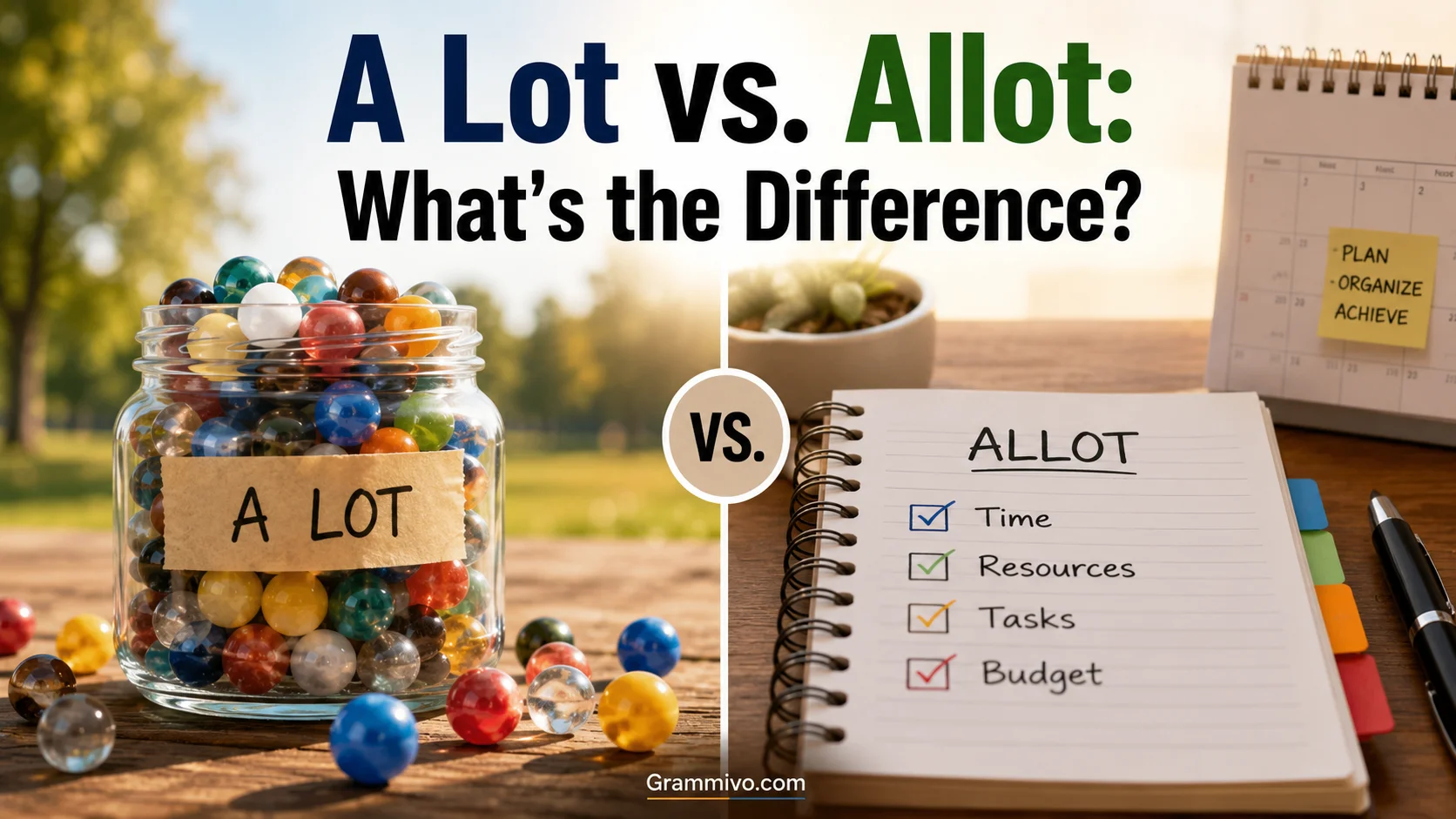
If you’ve ever paused over a lot vs. allot, you’re not alone. These two forms sound nearly identical in everyday speech, yet they play completely different roles in a sentence. One talks about quantity, degree, or frequency. The other describes the act of assigning or distributing something.
The confusion becomes even greater when alot enters the picture. Although you may see it online, alot isn’t the standard spelling when you mean “a large amount” or “very much.”
The good news? The distinction is simple once you connect each form with its meaning. This guide breaks down a lot vs. allot, explains the grammar behind each expression, shows real-world examples, and gives you a quick test for choosing the right form every time.
Quick Answer:
A lot means a large amount, a large number, very much, or frequently. Allot is a verb that means to assign, distribute, or set aside a particular amount of something.
| Word | Meaning | Grammatical role | Example |
| a lot | A large amount or number; very much; frequently | Phrase | “She has a lot of books.” |
| allot | To assign, distribute, or set aside | Verb | “The manager will allot each employee an hour.” |
| alot | Nonstandard spelling of a lot | Incorrect in standard English | “I have alot of work.” |
A simple memory trick works surprisingly well:
- A lot = how much or how often
- Allot = assign or distribute
- Alot = avoid it when you mean a lot
For example, “We have a lot of work” describes the quantity of work. “We will allot two hours to the project” describes how someone assigns time.
What Does “A Lot” Mean?
A lot commonly means a large amount, a large number, or a great deal. It can also mean very much or frequently, depending on how you use it.
When it comes before a noun, the usual structure is a lot of + noun.
Consider these examples:
- “There are a lot of people at the concert.”
- “She has a lot of experience.”
- “We need a lot of water.”
- “He owns a lot of books.”
- “They spent a lot of money.”
Notice that a lot of works with both countable and uncountable nouns.
With a plural countable noun, you might say:
“A lot of students joined the program.”
With an uncountable noun, you could say:
“A lot of information was available.”
In both cases, a lot of expresses a substantial quantity.
The phrase can also stand on its own without a noun. For example, “I learned a lot” means you learned many things or gained substantial knowledge. Similarly, “She travels a lot” means she travels frequently.
How to Use “A Lot” in a Sentence
The easiest way to understand a lot is to look at the different jobs it can do.
A Lot of + Noun
Use a lot of before a noun when you want to express a large quantity or number.
Examples:
- “We have a lot of time.”
- “She bought a lot of clothes.”
- “The company receives a lot of applications.”
- “There’s a lot of traffic downtown.”
The noun determines the meaning, but a lot of remains the quantity expression.
Verb + A Lot
You can place a lot after a verb to mean frequently or very much.
Examples:
- “I exercise a lot.”
- “They travel a lot.”
- “She talks a lot.”
- “We laughed a lot.”
- “He thinks about it a lot.”
Here, a lot doesn’t describe a physical quantity. Instead, it tells you how frequently or strongly something happens.
A Lot + Comparative
You can also use a lot to strengthen a comparative adjective or adverb.
For example:
- “This version is a lot better.”
- “The new route is a lot faster.”
- “That test was a lot easier.”
- “The second option costs a lot less.”
In these sentences, a lot means by a considerable degree.
What Does “Allot” Mean?
Allot is a verb. It means to give, assign, distribute, or set aside something for a particular person, group, purpose, or activity.
That difference matters.
When you allot something, you make a deliberate decision about who gets it or how much gets used.
For example:
- “The teacher allotted 30 minutes for the exam.”
- “The company allotted more money to marketing.”
- “Each speaker was allotted five minutes.”
- “The committee allotted funds to several projects.”
- “The manager allotted tasks to each employee.”
Think of allot as dividing a pie. The pie already exists. Someone decides how much each person, department, project, or activity receives.
That’s why allot frequently appears with things such as:
- time
- money
- space
- resources
- funding
- responsibilities
- tasks
- seats
- supplies
- attention
A Lot vs. Allot: The Key Difference
The central difference between a lot vs. allot comes down to description versus assignment.
A lot tells you that there is a large quantity, degree, or frequency. Allot tells you that someone assigns or distributes something.
| Situation | Correct choice | Example |
| Large quantity of work | a lot | “We have a lot of work.” |
| Assigning time | allot | “We should allot two hours.” |
| Frequent activity | a lot | “She studies a lot.” |
| Distributing money | allot | “The board will allot more money.” |
| Large number of people | a lot | “A lot of people attended.” |
| Assigning responsibilities | allot | “The supervisor allotted tasks.” |
Here’s the fastest way to think about it:
A lot describes quantity. Allot describes distribution.
That single distinction handles most situations.
A Lot vs. Allot in Examples
Seeing the two forms side by side makes the contrast much clearer.
Example 1: Time
A lot: “We have a lot of time before the meeting.”
This sentence says the available time is plentiful.
Allot: “We should allot 30 minutes to the presentation.”
This sentence says someone should assign 30 minutes to the presentation.
Example 2: Money
A lot: “The project requires a lot of money.”
The sentence focuses on the amount required.
Allot: “The company will allot $50,000 to the project.”
The sentence focuses on assigning a specific amount.
Example 3: Work
A lot: “She has a lot of work today.”
This describes the quantity of work.
Allot: “The manager will allot each employee several tasks.”
This describes the distribution of responsibilities.
Example 4: Learning
A lot: “You can learn a lot from practice.”
Here, a lot means a great deal.
Allot: “The instructor allotted an hour for practice.”
Here, allot means assigned a specific amount of time.
A Lot vs. Allot vs. Alot
There are actually three forms people often mix up: a lot, allot, and alot.
Only the first two are standard forms for the meanings discussed here.
A Lot
A lot is the correct two-word expression when you mean:
- many
- much
- very much
- frequently
- a large amount
Example:
“She has a lot of friends.”
Allot
Allot is a verb meaning to assign or distribute.
Example:
“The organizers will allot seats to each group.”
Alot
Alot is not the standard spelling when you mean a lot.
Incorrect:
“I have alot of homework.”
Correct:
“I have a lot of homework.”
The spelling error probably feels natural because a lot is pronounced smoothly in connected speech. When people say it quickly, the two words can sound almost like one unit. Writing, however, keeps them separate.
Why Is “A Lot” Two Words?
The spelling makes more sense when you look at the phrase’s structure.
A lot contains:
- a — an indefinite article
- lot — a noun
Historically and grammatically, lot can refer to a portion, share, or quantity. Over time, a lot developed into a common expression for a large quantity or degree.
You don’t normally combine the article and noun into one word. That’s why alot isn’t the standard spelling.
Compare:
- a lot — correct
- a book — correct
- a house — correct
- a problem — correct
The spelling alot treats the phrase as though it were an established single word. Standard English doesn’t do that.
Grammar Patterns With “A Lot”
Several structures appear regularly in everyday English.
A Lot of + Plural Countable Noun
Use this pattern when you’re talking about many individual things or people.
Examples:
- “A lot of students attended.”
- “A lot of cars were parked outside.”
- “A lot of questions came up.”
- “A lot of people agreed.”
A Lot of + Uncountable Noun
Use it for substances, concepts, or other nouns that aren’t normally counted individually.
Examples:
- “A lot of information was missing.”
- “A lot of money was spent.”
- “A lot of water was wasted.”
- “A lot of research supports the theory.”
You wouldn’t normally say “a lot of informations.” Information is generally uncountable in standard English.
Verb + A Lot
Use a lot after a verb when you mean frequently or very much.
Examples:
- “He works a lot.”
- “She reads a lot.”
- “They argue a lot.”
- “I miss my hometown a lot.”
A Lot + Comparative
Use a lot to emphasize a significant difference.
Examples:
- “This phone is a lot cheaper.”
- “The new version is a lot faster.”
- “Your writing is a lot clearer now.”
Read More: Consensus vs Concensus: Which Spelling Is Correct?
Grammar Patterns With “Allot”
Because allot is a verb, it follows verb patterns.
Allot Something to Someone
This structure is particularly common.
“The company allotted $10,000 to the department.”
Here, $10,000 is what gets assigned, while the department receives it.
More examples:
- “The school allotted additional funds to the library.”
- “The committee allotted seats to each organization.”
- “The government allotted money to the program.”
Allot Someone Something
You can also put the recipient before the thing being assigned.
“The manager allotted each employee an hour.”
Other examples include:
- “The teacher allotted each student five minutes.”
- “The organizer allotted every team two tables.”
- “The supervisor allotted each worker a specific task.”
Be Allotted
The passive construction be allotted is also common.
Examples:
- “Each candidate was allotted ten minutes.”
- “Every department was allotted additional funding.”
- “The team was allotted more space.”
Although active writing often sounds more direct, this construction is useful when the recipient matters more than the person doing the assigning.
Allot, Allocate, and Assign: Are They the Same?
Allot overlaps with allocate and assign, but the words aren’t always interchangeable in tone or context.
Assign often means giving someone a task, duty, role, or responsibility.
“The manager assigned me a project.”
Allocate commonly emphasizes distributing limited resources according to a plan.
“The company allocated $2 million to research.”
Allot also means assigning a share or portion.
“The committee allotted $500,000 to the project.”
A useful comparison looks like this:
| Word | Main idea | Example |
| Assign | Give someone a task, role, or duty | “She assigned me the report.” |
| Allocate | Distribute resources for a purpose | “They allocated funds to research.” |
| Allot | Give or set aside a particular share | “They allotted each team two hours.” |
There is plenty of overlap. Context determines which verb sounds most natural.
Common Mistakes With A Lot and Allot
These errors are easy to fix once you understand what each word does.
Mistake 1: Writing “Alot”
Incorrect:
“There are alot of reasons.”
Correct:
“There are a lot of reasons.”
The standard expression contains two words.
Mistake 2: Using “Allot” to Mean “A Lot”
Incorrect:
“I have allot of homework.”
Correct:
“I have a lot of homework.”
Allot is a verb. It doesn’t mean “many” or “much.”
Mistake 3: Using “A Lot” When You Mean “Assign”
Incorrect:
“The teacher will a lot ten minutes to each student.”
Correct:
“The teacher will allot ten minutes to each student.”
Here, the teacher is assigning a specific amount of time.
Mistake 4: Treating the Words as Interchangeable
They aren’t.
“The company has a lot of resources.”
This describes quantity.
“The company will allot resources to each department.”
This describes distribution.
Changing one word changes the entire grammatical function.
A Lot vs. Allot: An Easy Memory Trick
Here’s a simple substitution test.
If you can replace the expression with much, many, very much, or frequently, use a lot.
“She exercises a lot.”
You could say:
“She exercises frequently.”
If you can replace the word with assign, distribute, or allocate, use allot.
“The manager will allot two hours.”
You could say:
“The manager will allocate two hours.”
This gives you a reliable shortcut:
Quantity or frequency → a lot
Assignment or distribution → allot
If you remember only one rule, remember that one.
A Lot vs. Allot in Formal and Informal Writing
A lot is perfectly normal English. It’s common in conversation, emails, articles, and other everyday writing.
However, in highly formal or academic prose, writers sometimes choose more precise alternatives when the context calls for them.
For example:
- a lot of research → a substantial body of research
- a lot of money → a considerable amount of money
- a lot of people → a large number of people
That doesn’t make a lot incorrect. It simply means that formal writing sometimes benefits from greater precision.
By contrast, allot fits naturally into professional contexts involving schedules, budgets, staffing, resources, and planning.
For example:
“The project manager allotted three weeks for testing.”
That’s concise and professional.
FAQs:
Is “alot” a correct word?
Not when you intend the standard expression meaning “a large amount,” “many,” “very much,” or “frequently.” Write a lot as two words.
Is “a lot” one word or two?
A lot is two words. The spelling alot is not standard for these meanings.
What does “allot” mean?
Allot means to assign, distribute, or set aside a particular share of something.
Are “a lot” and “allot” pronounced the same?
In many varieties of English, they can sound the same or extremely similar in ordinary speech. Their spelling and grammatical roles remain different.
Is “a lot” formal English?
Yes. A lot is standard English and appears in both speech and writing. In especially formal contexts, writers may choose more specific alternatives such as a considerable amount or a large number.
Conclusion:
The difference between a lot vs. allot is straightforward once you focus on what the sentence actually means. A lot expresses a large quantity, a large number, a high degree, or frequent action. It can appear in expressions such as “a lot of money,” “a lot of people,” and “I exercise a lot.” Allot, on the other hand, is a verb. It means to assign, distribute, or set aside a share of something. You might allot time to a meeting, money to a project, or responsibilities to employees.
