
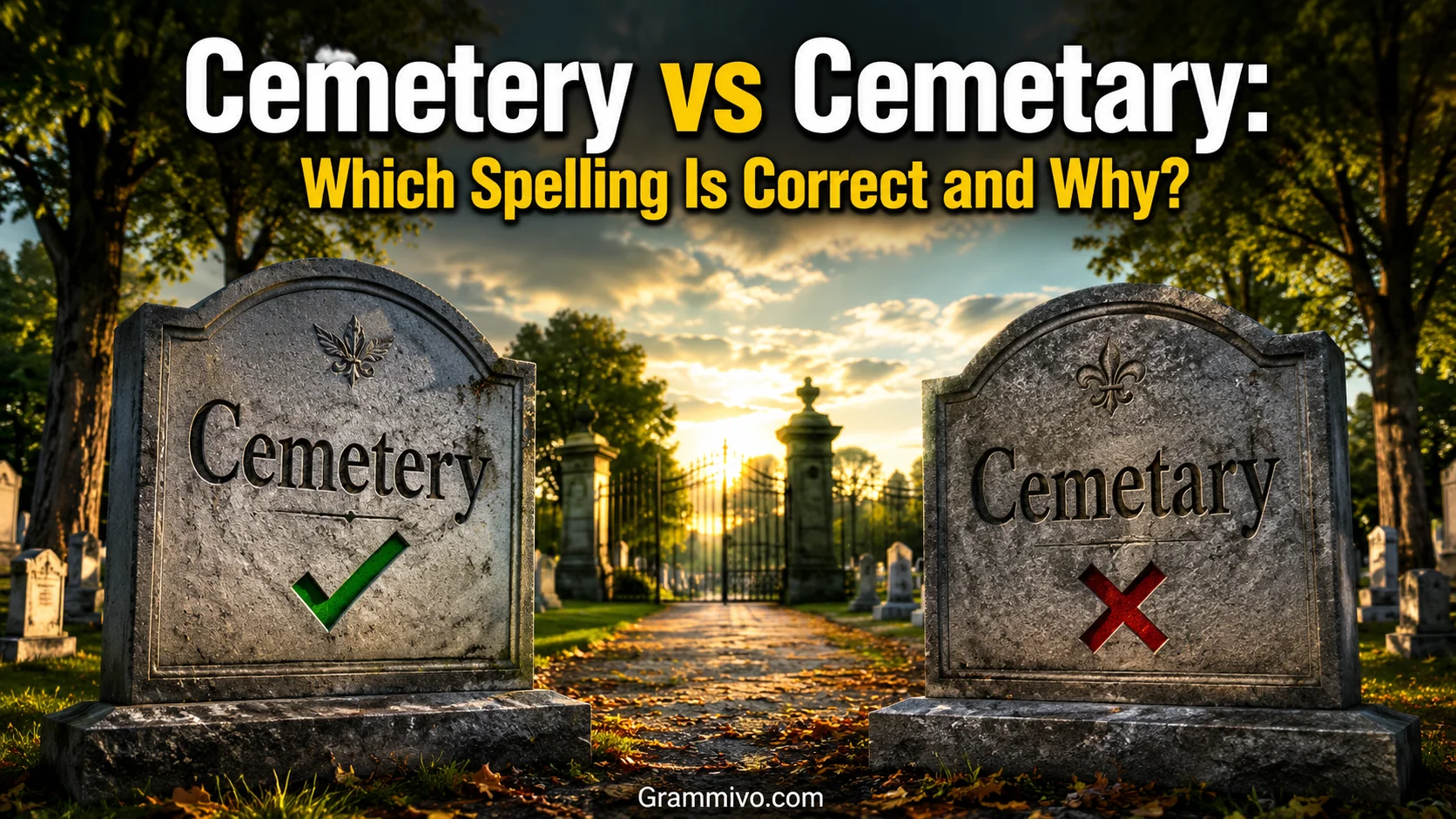
If you’ve ever hesitated over cemetery vs cemetary, you’re not alone. This word creates a surprisingly common spelling problem because its pronunciation doesn’t make every letter obvious. You may know exactly what you want to say, yet still pause before typing it. Is it cemetery or cemetary?
The answer is straightforward: cemetery is the correct spelling. Cemetary is a common misspelling and isn’t the standard spelling of the word in modern English.
The confusion usually comes from the word’s vowel pattern. English contains many familiar words ending in -ary, so it’s easy to write cemetary after hearing the word pronounced aloud. However, the correct ending is -ery, giving us cemetery.
This guide explains the difference, meaning, pronunciation, origin, plural form, common phrases, and practical ways to remember the spelling. It also looks at why cemetary appears so often and how cemetery vs cemetary works in real sentences.
Quick Answer:
Cemetery is correct. Cemetary is incorrect.
A cemetery is a place where people are buried. The standard spelling is:
C-E-M-E-T-E-R-Y
The easiest detail to remember is that cemetery contains three E’s.
| Spelling | Correct? | Meaning |
| Cemetery | Yes | A place where dead people are buried |
| Cemetary | No | A common misspelling of cemetery |
For example:
Correct: We visited the cemetery on Sunday.
Incorrect: We visited the cemetary on Sunday.
The incorrect version doesn’t represent a different type of burial ground. It simply contains the wrong vowel.
So if you’re writing an email, school assignment, article, legal document, inscription, or professional report, use cemetery.
What Does Cemetery Mean?
A cemetery is a place where people are buried after death. It usually contains individual graves, burial plots, monuments, headstones, pathways, landscaping, or other features associated with burial.
The word can describe many different kinds of burial grounds. For example, you might encounter a public cemetery, private cemetery, military cemetery, historic cemetery, or family cemetery.
The setting can vary dramatically. Some cemeteries cover only a small area, while others extend across hundreds of acres.
A cemetery can also have cultural or historical importance. Historic cemeteries often preserve information about earlier communities through grave markers, names, dates, inscriptions, and burial patterns.
Consider these examples:
- The old cemetery sits behind the village church.
- Her grandparents are buried in the same cemetery.
- The city maintains several public cemeteries.
- Researchers examined the historic cemetery records.
- The military cemetery contains graves of service members from several conflicts.
In every example, cemetery functions as a noun.
Cemetary: Why Is This Spelling Incorrect?
Cemetary is incorrect because the standard English spelling is cemetery.
The mistake usually happens because pronunciation and spelling don’t line up perfectly. When people hear the word, the middle vowels can sound weak and indistinct. That makes it easy to reconstruct the spelling incorrectly.
Another factor involves familiar English spelling patterns. Words such as temporary, necessary, and elementary can make an -ary ending feel natural. Someone may therefore write cemetary even though the word actually ends in -ery.
The difference is only one letter, but that letter matters.
Compare the two forms:
CEMETERY
CEMETARY
The fourth vowel is where the error appears. The correct spelling uses E, not A.
This isn’t a case where American and British English use different spellings. Both varieties use cemetery.
It’s also not an archaic-versus-modern spelling issue. Cemetary isn’t an accepted alternative that carries a different meaning. In standard contemporary English, treat it as a spelling error.
Cemetery vs Cemetary: Side-by-Side Comparison
A quick comparison makes the distinction easy to remember.
| Feature | Cemetery | Cemetary |
| Standard spelling | Yes | No |
| Part of speech | Noun | Misspelling |
| Meaning | Burial place | No separate standard meaning |
| Pronunciation | Commonly pronounced roughly “SEM-uh-ter-ee” | Intended to represent the same word |
| Standard American English | Correct | Incorrect |
| Standard British English | Correct | Incorrect |
| Plural | Cemeteries | Not applicable |
The important point is simple: cemetery and cemetary aren’t two competing spellings.
Only one belongs in standard English.
If you’re proofreading a sentence and encounter cemetary, replace it with cemetery.
How Do You Spell Cemetery Correctly?
The correct spelling is:
C-E-M-E-T-E-R-Y
One useful way to memorize it is to focus on the repeated E pattern.
The word contains three E’s:
C-E-M-E-T-E-R-Y
You can also break it into smaller chunks:
cem + e + t + e + ry
That isn’t a pronunciation guide. It’s simply a visual spelling strategy.
Another useful trick is to remember:
A cemetery has E’s, not A’s.
When you’re uncertain, write the word slowly in your head. The correct sequence is C-E-M-E-T-E-R-Y.
What Is the Plural of Cemetery?
The plural of cemetery is cemeteries.
English changes the final -y to -ies when forming the plural of many nouns ending in a consonant followed by y.
| Singular | Plural |
| cemetery | cemeteries |
| city | cities |
| family | families |
| story | stories |
| country | countries |
For example:
The city has three historic cemeteries.
Don’t write cemeterys. The standard plural is cemeteries.
Why Is Cemetery So Easy to Misspell?
The word looks deceptively simple. It has only eight letters, yet its spelling doesn’t follow the pronunciation as neatly as many common English words.
The main difficulty comes from the vowels.
When people say cemetery, the unstressed syllables can become less distinct in ordinary speech. You may recognize the word instantly when someone says it without being able to visualize every letter.
That’s a classic spelling trap.
English has many words whose written forms require memorization rather than perfect sound-to-letter conversion. Cemetery belongs to that group.
The incorrect cemetary spelling also looks plausible because English has many words containing -ary. Once the brain settles on that familiar pattern, the incorrect version can feel surprisingly natural.
That’s why proofreading matters.
If you’re writing quickly, don’t rely entirely on how the word sounds. Check the visual pattern instead:
cemetery
The middle contains E-T-E, not E-T-A.
How Do You Pronounce Cemetery?
In American English, cemetery is commonly pronounced approximately:
SEM-uh-ter-ee
Merriam-Webster provides pronunciation information for the word, while Oxford Learner’s Dictionaries also gives phonetic guidance for learners.
The exact pronunciation can vary slightly depending on accent and speech rate. In everyday conversation, unstressed vowels often become less prominent.
That helps explain the spelling problem.
When you hear someone say cemetery, you don’t necessarily hear every written vowel with equal clarity. The word’s pronunciation therefore isn’t a reliable letter-by-letter spelling guide.
Try saying it slowly:
SEM — uh — TER — ee
Then look at the spelling:
C-E-M-E-T-E-R-Y
The spoken form and written form don’t map perfectly onto one another. That’s normal in English.
Cemetery Word Origin and Etymology
The history of cemetery gives the word an unexpectedly gentle origin.
The English word ultimately traces back to the ancient Greek koimētērion, which referred to a sleeping place or dormitory. The underlying Greek idea connects with koiman, meaning to put to sleep or lie down.
The term passed through Latin and French before developing into the English word cemetery.
A simplified historical pathway looks like this:
Greek koimētērion → Latin coemētērium → French forms → Middle English → modern English cemetery
The ancient association with sleep is significant because many cultures have used sleep as a metaphor for death.
The modern English meaning eventually became a place where the dead are buried.
The word isn’t simply a modern English invention. Its spelling reflects centuries of linguistic change.
Cemetery vs Graveyard: Are They the Same?
Cemetery and graveyard overlap in meaning, but they aren’t always interchangeable in every historical or cultural context.
A graveyard traditionally refers to a burial ground associated with a church. The word is especially common when discussing older churchyards and their graves.
A cemetery, by contrast, can exist independently of a church.
For example:
The village church has an old graveyard beside it.
The city established a large cemetery outside the growing residential district.
Modern English doesn’t always maintain a rigid boundary between the two terms. People sometimes use cemetery and graveyard broadly for burial grounds.
The safest distinction is therefore historical rather than absolute: graveyard traditionally suggests a church-associated burial ground, while cemetery has a broader modern application.
Common Examples Using Cemetery
Seeing the correct word in context makes the spelling easier to retain.
Here are natural examples:
- The cemetery closes its gates at sunset.
- Her family has maintained the grave for decades.
- We walked through the historic cemetery during the afternoon.
- The town restored several damaged headstones in the cemetery.
- His name appears in the cemetery records.
- The military cemetery contains thousands of graves.
- A stone wall surrounds the old cemetery.
- The family purchased a burial plot in the local cemetery.
- Several generations of the family are buried there.
- The historic cemeteries attract researchers and visitors.
Notice that the spelling remains cemetery regardless of the context.
The word doesn’t change simply because you’re talking about a historic, military, rural, urban, or private burial ground.
Common Phrases With Cemetery
You’ll encounter cemetery in many established phrases. Learning these combinations can make the spelling feel more familiar.
| Phrase | Meaning |
| cemetery plot | A designated piece of land for burial |
| cemetery grounds | The land occupied by a cemetery |
| cemetery records | Documents containing information about burials |
| historic cemetery | A cemetery with historical significance or age |
| military cemetery | A cemetery associated with military burials |
| family cemetery | A burial ground used primarily by a family |
| cemetery gate | An entrance gate to a cemetery |
| cemetery records | Information documenting burials and graves |
These combinations also show that cemetery appears naturally in formal and everyday writing.
For instance, someone researching family history might search cemetery records to locate information about an ancestor’s burial. A historian might study a historic cemetery to understand a community’s past.
Cemetery vs Cemetary in a Sentence
The difference becomes obvious when you place both forms next to each other.
Correct
The cemetery is located near the edge of town.
We visited the cemetery to place flowers on her grave.
The church maintains records of everyone buried in the cemetery.
Several historic cemeteries remain in the region.
Incorrect
The cemetary is located near the edge of town.
We visited the cemetary to place flowers on her grave.
The church maintains records of everyone buried in the cemetary.
The sentences themselves are fine. The problem lies entirely in the spelling of the noun.
A useful proofreading question is:
“Did I write cemetery with an E after the T?”
If the answer is no, check the word again.
How to Remember the Spelling of Cemetery
A good spelling trick should be quick enough to use when you’re actually writing. You don’t need an elaborate mnemonic.
The simplest method is the three-E rule:
Cemetery has three E’s.
Write it visually:
C E M E T E R Y
You can count them:
- First E: C-E
- Second E: M-E
- Third E: T-E
Then the word ends with R-Y.
Another method is to remember the central sequence:
E-T-E
Not:
E-T-A
That tiny distinction separates cemetery from cemetary.
A Simple Memory Sentence
Try remembering:
“The cemetery has three E’s.”
It works because the spelling itself becomes the memory cue.
If you regularly type the word, save the correct spelling in your mental vocabulary rather than trying to derive it from pronunciation each time.
Cemetery vs Cemetary for English Learners
English learners often struggle with cemetery because English spelling contains many historical irregularities.
The pronunciation gives only part of the information needed to spell the word. Several vowels become less prominent in normal speech, while the written form preserves them.
This creates a gap between what you hear and what you write.
For English learners, three habits can help:
- Learn the complete spelling, not just the pronunciation.
- Notice the vowel sequence in the written word.
- Practice the word in sentences, rather than memorizing it in isolation.
For example, learn this complete phrase:
The old cemetery is near the church.
Then try:
The city has several historic cemeteries.
This approach teaches both the singular and plural forms.
It’s also useful to distinguish spelling mistakes from grammar mistakes. If someone writes cemetary, the sentence may still have perfect grammar. The problem is simply the word’s spelling.
FAQs:
Is “Cemetary” a Word?
Cemetary is not the standard spelling of the English noun.
You may encounter it online, in informal writing, user-generated content, or other places where spelling errors appear. Its presence in published material doesn’t make it an accepted alternative spelling.
When standard English matters, use cemetery.
That includes:
- Academic writing
- Professional documents
- Websites
- News articles
- School assignments
- Business communication
- Historical research
- Formal correspondence
If a spell-checker flags cemetary, it is identifying a genuine spelling error rather than an optional variation.
Is It Cemetery or Cemetary?
The correct form is cemetery.
The incorrect form is cemetary.
The distinction comes down to one vowel:
CEMETERY
CEMETARY
Remember the E after the T.
If you’re unsure while writing, check the complete sequence:
C-E-M-E-T-E-R-Y
Don’t choose the spelling based solely on pronunciation.
Conclusion:
When choosing between cemetery vs cemetary, there’s only one standard spelling to use: cemetery. It means a place where people are buried. The word commonly appears in phrases such as cemetery plot, cemetery records, historic cemetery, and military cemetery. Its pronunciation can make the spelling tricky because the unstressed vowels aren’t always easy to distinguish in normal speech. That’s why the three-E memory trick works so well:
