
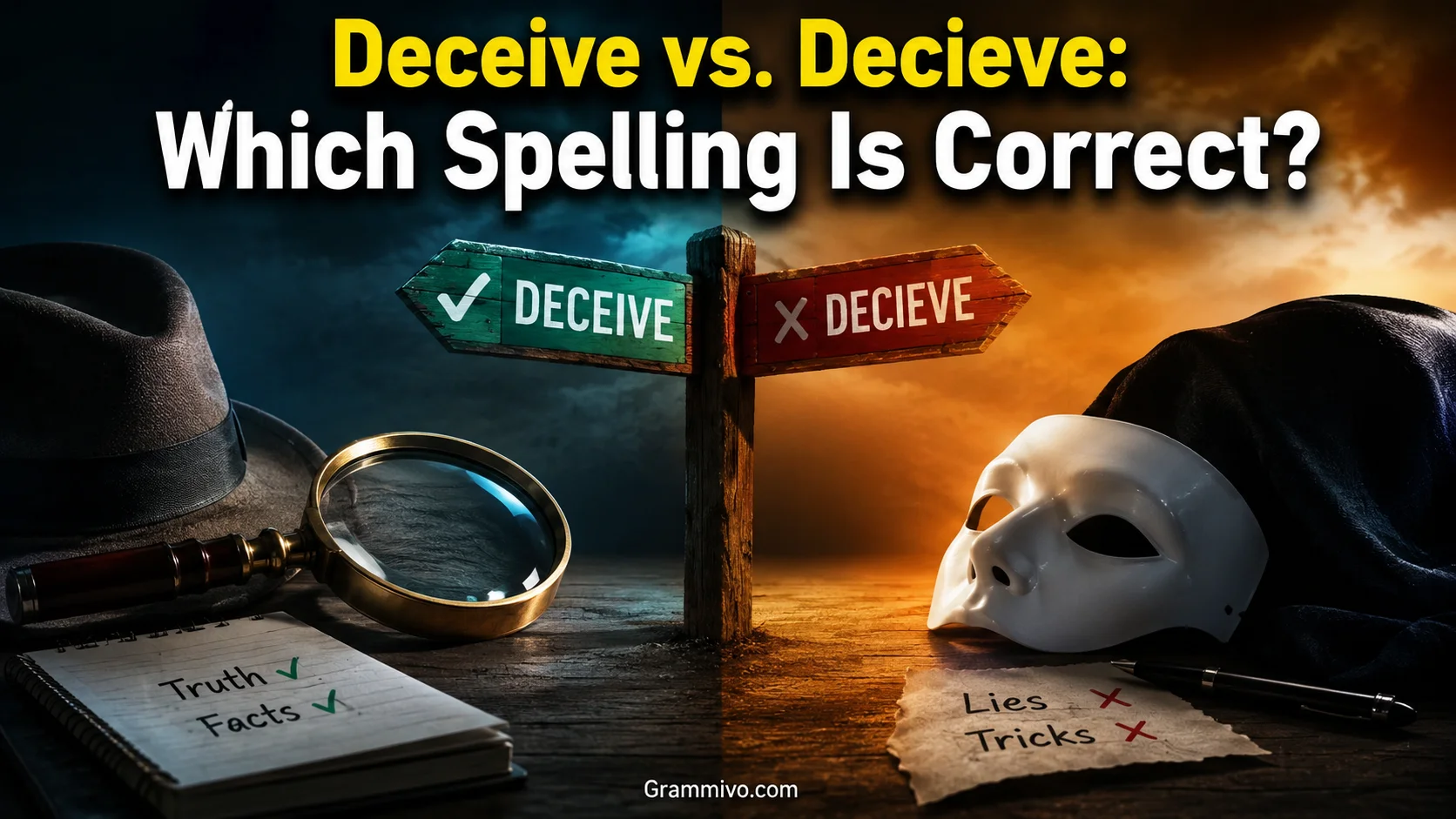
If you’ve ever hesitated between deceive vs. decieve, you’re not alone. This spelling trips people up because English has a famous “i before e” spelling rule that seems to point in the wrong direction. The correct spelling, however, is straightforward: deceive.
The word decieve is a common misspelling. It isn’t a standard English spelling with a separate meaning. The correct form contains -cei-, not -cie-. Once you recognize the spelling pattern shared by words such as receive, perceive, and conceive, the correct form becomes much easier to remember.
This guide explains the difference between deceive and decieve, including meaning, pronunciation, spelling, grammar, related words, common mistakes, and practical examples.
Quick Answer
Deceive is the correct spelling. Decieve is incorrect.
| Spelling | Correct? | Meaning |
| deceive | Yes | To deliberately make someone believe something false or misleading |
| decieve | No | A common misspelling of deceive |
The correct spelling is:
D-E-C-E-I-V-E → deceive
The incorrect version is:
D-E-C-I-E-V-E → decieve
The easiest detail to remember is the -ceive ending. You’ll see the same spelling pattern in several familiar words, including receive, perceive, conceive, and deceive.
For example:
- Correct: She tried to deceive the investigators.
- Incorrect: She tried to decieve the investigators.
If you’re writing for school, work, publishing, or professional communication, use deceive.
Deceive vs. Decieve: What’s the Difference?
The difference is spelling rather than meaning. Deceive is an established English verb, while decieve is simply a misspelling.
The confusion usually comes from the placement of i and e. In deceive, the letters after c appear as ei:
dec + ei + ve
In decieve, they appear as ie:
dec + ie + ve
That small switch changes a correct word into an incorrect spelling.
This mistake often happens because English learners encounter the familiar mnemonic “i before e, except after c.” While that saying can help with some words, it isn’t a complete rule for English spelling. In fact, deceive is one of the words where the spelling pattern after c is especially useful.
Compare these words:
| Correct word | Spelling pattern |
| deceive | -ceive |
| receive | -ceive |
| perceive | -ceive |
| conceive | -ceive |
Seeing the group together makes the pattern much clearer.
Why Is “Deceive” the Correct Spelling?
The standard spelling is deceive, with ei after the letter c.
English spelling doesn’t always follow one simple phonetic or mnemonic rule. Many words preserve spelling patterns that developed through the history of the language. That’s why memorizing a useful word family can work better than trying to force every word into one spelling formula.
The ending -ceive is particularly useful.
Consider:
- receive
- perceive
- conceive
- deceive
Although these words have different meanings, they share the same -ceive spelling.
The word deceive ultimately traces back through French to Latin dēcipere, meaning to ensnare, catch, or deceive. Its spelling developed through historical changes rather than from a modern English spelling rule.
That history also explains why the word may not look exactly how you’d expect from its pronunciation.
For everyday writing, though, you don’t need to memorize its entire linguistic history. Remembering deceive = -ceive is enough.
Why Is “Decieve” Wrong?
Decieve is wrong because it places the letters i and e in the wrong order.
The correct sequence is:
…cei…
The incorrect sequence is:
…cie…
This mistake has no effect on the word’s intended meaning. A reader will usually understand what someone means when they write decieve. However, standard English spelling requires deceive.
Look at the difference:
- deceive — correct
- decieve — incorrect
Now put them into sentences:
- Correct: The advertisement could deceive customers.
- Incorrect: The advertisement could decieve customers.
The error may look minor, but spelling accuracy matters in formal writing. A single misplaced letter can make otherwise polished content appear careless.
What Does “Deceive” Mean?
Deceive means to deliberately cause someone to believe something that isn’t true. It can involve lying, hiding information, creating a false impression, or otherwise leading someone toward a false belief.
For example:
The seller tried to deceive customers about the product’s condition.
The seller isn’t simply making an innocent mistake. The sentence suggests an intention to create a false impression.
Another example is:
He deceived his friends by pretending that everything was fine.
Here, the deception involves presenting a false picture of reality.
The word can also describe self-deception:
You’d be deceiving yourself if you ignored the evidence.
In that construction, deceive yourself means to convince yourself of something that isn’t true or to avoid accepting an uncomfortable reality.
How to Use “Deceive” in a Sentence
Deceive is a transitive verb, which means it commonly takes a direct object. In everyday English, that object is often a person or group.
Common structures include:
- deceive someone
- deceive someone into doing something
- deceive yourself
- be deceived by something
- try to deceive someone
Here are practical examples:
| Structure | Example |
| deceive someone | The scammer tried to deceive the customer. |
| deceive someone into doing something | They deceived him into signing the contract. |
| deceive yourself | Don’t deceive yourself about the risks. |
| be deceived by something | Many buyers were deceived by the misleading advertisement. |
| try to deceive someone | She didn’t try to deceive anyone. |
The construction deceive someone into doing something is especially useful when the deception causes another person to take an action.
For example:
The fake website deceived several customers into entering their banking information.
The sentence doesn’t merely say that the customers received false information. It explains the result of that deception.
Deceive Pronunciation
In standard American English, deceive is pronounced approximately:
/dɪˈsiːv/
A simple pronunciation guide is:
dih-SEEV
The stress falls on the second syllable.
The spelling may look more complicated than the pronunciation. That’s another reason learners sometimes write decieve. They hear the long ee sound and may not remember which letters represent it.
Compare the pronunciation of these related words:
- deceive — dih-SEEV
- receive — rih-SEEV
- perceive — per-SEEV
- conceive — kun-SEEV
The shared -ceive pattern is visible in writing and produces a similar ending sound.
Deceive Verb Forms
Because deceive is a regular verb, its main forms follow a predictable pattern.
| Verb form | Correct spelling | Example |
| Base form | deceive | Don’t deceive people. |
| Third-person singular | deceives | The story deceives readers. |
| Past tense | deceived | He deceived the buyer. |
| Past participle | deceived | She was deceived by the offer. |
| Present participle | deceiving | They were deceiving customers. |
One particularly common mistake appears in the -ing form.
The correct spelling is:
deceiving
Not:
decieving
The same spelling pattern remains visible:
deceive → deceiving
You can also see the related forms deception and deceptive.
Deceive, Deceit, Deception, and Deceptive
These words belong to the same word family, but they don’t perform the same grammatical job.
| Word | Part of speech | Meaning |
| deceive | Verb | To mislead someone |
| deceit | Noun | Dishonest behavior or conduct |
| deception | Noun | The act or process of deceiving |
| deceptive | Adjective | Likely to create a false impression |
Here’s how they work in sentences:
- Deceive: The company attempted to deceive customers.
- Deceit: His deceit eventually became obvious.
- Deception: The investigation uncovered a large-scale deception.
- Deceptive: The advertisement made deceptive claims.
Notice how the grammar changes even though the words are closely related.
This distinction becomes useful when you’re editing formal writing. If you need an action, deceive works as the verb. If you need to describe the dishonest act itself, deception or deceit may fit better.
Deceive vs. Mislead
Deceive and mislead overlap considerably, but they’re not always interchangeable in tone or emphasis.
To deceive someone generally means to cause that person to accept something false or misleading. The word often suggests deliberate dishonesty.
To mislead someone means to guide that person toward a wrong understanding or conclusion. The misleading information can come through statements, omissions, presentation, or context.
Consider this example:
The salesperson deliberately deceived the customer about the vehicle’s accident history.
The sentence strongly suggests intentional dishonesty.
Now consider:
The advertisement misled customers about how long the product would last.
Here, the emphasis falls on the false impression created by the advertisement.
The two verbs can overlap, but deceive often carries a stronger sense of intentional trickery.
The “I Before E” Rule and Deceive
The spelling of deceive is a good reason not to treat “i before e, except after c” as an absolute rule.
The traditional mnemonic is useful in some situations, but English contains many exceptions and competing patterns. Trying to apply it mechanically can actually create mistakes.
If you remember only:
“I before E, except after C”
you might correctly expect ei in deceive. But many learners don’t remember the exception consistently, especially when writing quickly.
A better strategy is to memorize the -ceive family.
Think of this group:
- conceive
- deceive
- perceive
- receive
The spelling becomes much easier when you treat these as members of the same family rather than isolated words.
The same idea works with other spelling families throughout English. Pattern recognition often beats memorizing dozens of disconnected rules.
Read More: Cemetery vs Cemetary: Which Spelling Is Correct and Why?
How to Remember the Spelling of Deceive
If deceive vs. decieve keeps causing trouble, use a simple memory strategy.
Remember “CEI” in Deceive
Break the word into a memorable visual sequence:
DE + CEI + VE
The middle is CEI, not CIE.
You can mentally highlight the three letters:
de-CEI-ve
Group It With Similar Words
Connect deceive to familiar words ending in -ceive:
- receive
- perceive
- conceive
- deceive
When one spelling pattern appears across several words, your memory has more than one anchor.
Use the Word in a Sentence
A sentence can reinforce spelling better than an isolated word:
Don’t deceive yourself about the spelling: it’s deceive.
The repetition may feel a little obvious. That’s the point.
Watch the “IE” Trap
When you write decieve, pause after the c.
Ask yourself:
Does this belong to the -ceive family?
If the answer is yes, write -cei-.
Common Misspellings of Deceive
The most common mistake is decieve, but other variations can appear when someone writes the word from memory.
| Incorrect form | Correct form |
| decieve | deceive |
| deceeve | deceive |
| deceve | deceive |
| deceiv | deceive |
| decieving | deceiving |
| decieved | deceived |
The important point is that decieve isn’t an alternative spelling. It is simply incorrect.
The same issue can carry into related forms. Someone who writes decieve may also write decieved or decieving. Learning the root spelling helps prevent those mistakes.
Deceive vs. Decieve in Different Contexts
The spelling doesn’t change depending on where you use the word.
Whether you’re writing a text message, business report, school paper, or formal article, the standard spelling remains deceive.
Everyday Conversation
I wouldn’t deceive you about something that important.
Business Writing
The company must not deceive consumers through misleading claims.
Academic Writing
The experiment demonstrated how visual cues can deceive observers.
Formal Writing
The evidence suggests that the witness attempted to deceive investigators.
Digital Communication
Don’t let a polished website deceive you into assuming a product is legitimate.
Context can change the meaning or tone of the sentence, but it doesn’t change the spelling.
Common Expressions With Deceive
Several useful expressions contain deceive or one of its related forms.
Deceive Yourself
This means to avoid accepting reality or to convince yourself of something untrue.
She was deceiving herself by assuming the problem would disappear.
Deceive Someone Into Doing Something
This construction describes deception that leads another person to take an action.
The fraudster deceived victims into sending money.
Appearances Can Deceive
This expression warns that something may look different from what it really is.
The house looks small from the street, but appearances can deceive.
Intent to Deceive
This phrase appears frequently in legal, business, and formal contexts.
The investigators found evidence of an intent to deceive.
These expressions demonstrate that deceive isn’t limited to simple statements about lying. It can describe many ways of creating a false belief.
FAQs:
Is “Decieve” a Word?
No. Decieve is not the standard spelling of an English word.
When someone writes decieve, they almost always intend to write deceive.
Therefore, avoid decieve in formal and informal writing alike.
Is It “Deceive” or “Decieve”?
The correct form is deceive.
Remember:
DECEIVE = correct
DECIEVE = incorrect
The key spelling sequence is CEI.
If you remember that deceive belongs with receive, perceive, and conceive, you’ll have a reliable mental shortcut.
Why Do People Spell “Deceive” as “Decieve”?
The most obvious reason is confusion over the order of i and e.
The word’s pronunciation doesn’t clearly tell you whether the spelling should contain ei or ie. Meanwhile, the familiar “i before e” saying can create additional uncertainty.
English also contains many words that don’t fit simple spelling mnemonics perfectly. As a result, learners often rely on sound rather than recognizing the word’s spelling pattern.
The solution isn’t to memorize every exception in English.
Instead, remember the small family:
conceive, deceive, perceive, receive
That gives you a practical pattern you can use immediately.
How Do You Pronounce “Deceive”?
The standard US pronunciation is /dɪˈsiːv/.
In simple terms, it sounds like:
dih-SEEV
The second syllable receives the main stress.
The ending sounds like “seev,” which is similar to the endings of receive and perceive.
What Is the Past Tense of “Deceive”?
The past tense is deceived.
For example:
The customer deceived his competitors.
More naturally:
The customer was deceived by the fraudulent offer.
Because deceive is a regular verb, you form the past tense by adding -d to the base form.
deceive → deceived
Don’t write decieved.
Conclusion:
When you’re choosing between deceive vs. decieve, there’s no real contest. Deceive is the correct spelling, while decieve is a misspelling. The most useful thing to remember is the -ceive pattern. Connect deceive with receive, perceive, and conceive, and the spelling becomes much easier to recall.
