
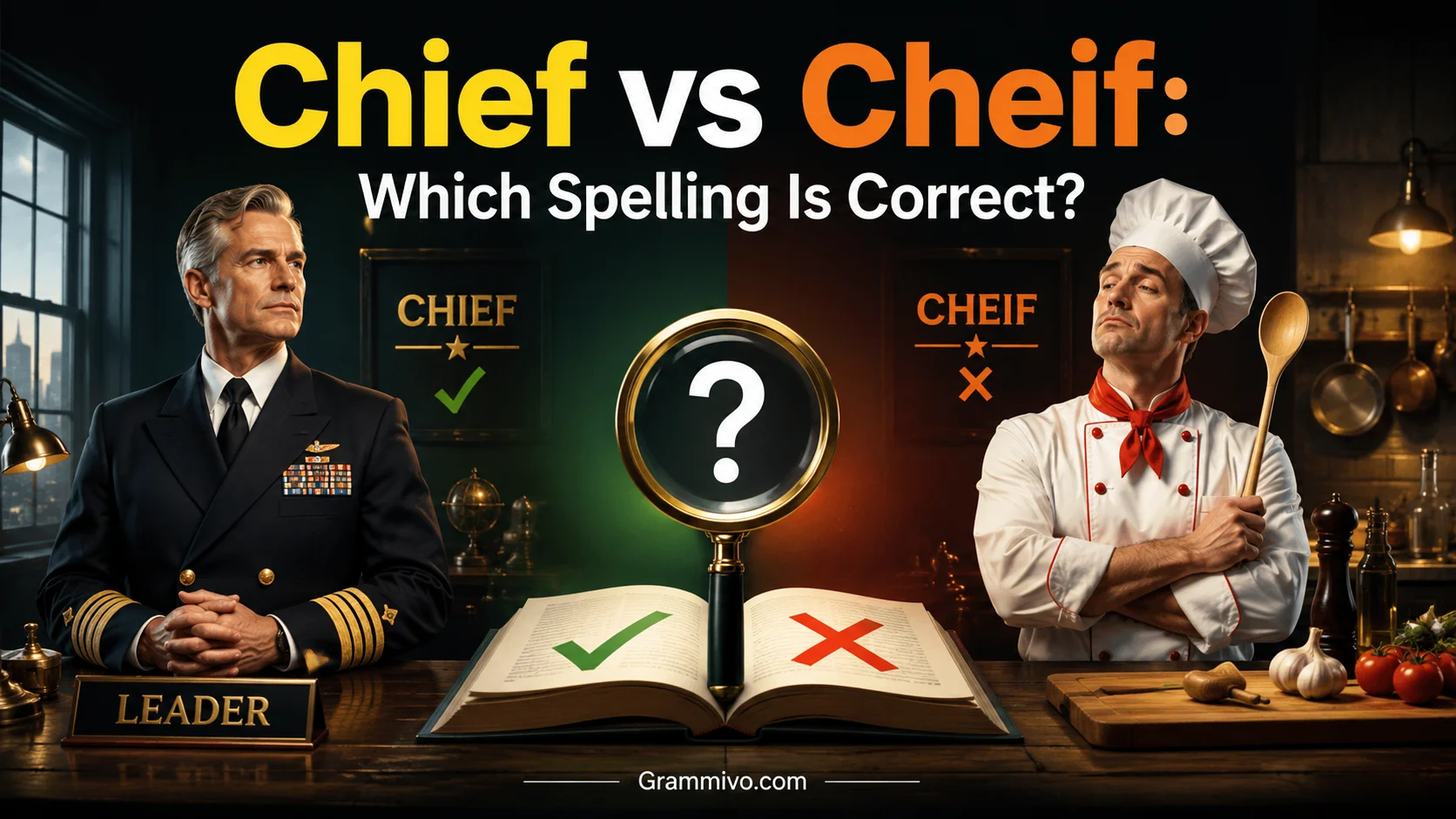
If you’ve ever hesitated between chief vs cheif, you’re not alone. The two spellings look remarkably similar, and the unusual “ie” sequence in chief can make the word surprisingly easy to misspell. However, there’s a simple answer: chief is the correct standard spelling, while cheif is a misspelling in modern English.
The word chief has several useful roles in English. It can describe a leader or person in charge, such as a police chief or tribal chief. It can also mean main, primary, or most important, as in “the chief reason.” Understanding these meanings makes the word easier to recognize and use correctly.
This guide explains chief vs cheif in detail, including spelling, pronunciation, definitions, examples, common mistakes, word history, and practical ways to remember the correct form.
Quick Answer
Chief is the correct spelling.
Cheif is not the standard modern spelling of the word. It usually appears when someone accidentally reverses the “ie” in chief to “ei.”
| Spelling | Correct? | Meaning |
| Chief | Yes | A leader, head, or something most important |
| Cheif | No | A common misspelling of chief |
| Chef | Yes, but different word | A professional cook |
For example:
- Correct: The police chief spoke at the meeting.
- Incorrect: The police cheif spoke at the meeting.
- Different word: The chef prepared the meal.
The easiest spelling to remember is:
C-H-I-E-F = chief
Chief vs Cheif: What Is the Difference?
The main difference between chief and cheif is spelling rather than meaning. Chief is the established English word. Cheif is normally an accidental letter reversal.
The mistake happens because English contains many words with “ei” and “ie.” When people write quickly, they may remember the sounds of a word without remembering the exact order of its letters.
Consider these examples:
- chief — correct
- brief — correct
- thief — correct
- grief — correct
- belief — correct
These words share a useful visual pattern: ie.
That doesn’t mean every English word follows a simple “i before e” rule. English spelling has plenty of exceptions. Instead, it helps to recognize chief as a word that specifically uses “ief.”
Chief Is the Standard Spelling
The standard spelling is chief.
It contains:
c + h + i + e + f
The word works as both a noun and an adjective.
As a noun, it can refer to a leader:
“The police chief addressed the crowd.”
As an adjective, it can mean most important:
“Safety was the chief concern.”
Cheif Is a Common Misspelling
Cheif reverses the middle vowels:
c + h + e + i + f
That spelling doesn’t represent the standard modern English word chief.
You might encounter cheif in informal messages, online comments, schoolwork, or documents. Seeing it in print doesn’t make it an accepted alternative spelling.
What Does Chief Mean?
The word chief has two major everyday meanings.
First, it can identify a leader or head of a group. Second, it can describe something as most important or primary.
Those meanings are closely related. A chief traditionally stands at the head of a group, while something described as “chief” stands first in importance.
Chief as a Noun
As a noun, chief means a leader or person who holds the highest position within a particular group or organization.
For example:
- police chief
- fire chief
- tribal chief
- department chief
- chief of staff
- commander in chief
The exact responsibilities depend on the organization.
A police chief, for example, typically leads a police department. A fire chief leads a fire department or fire service. A tribal chief refers to a leader within a particular tribal community or political structure.
The word doesn’t automatically mean that someone has authority over an entire country or organization. Its meaning depends on the context.
Chief as an Adjective
As an adjective, chief means main, primary, principal, or most important.
For example:
- “Her chief concern was safety.”
- “The chief reason for the change was cost.”
- “His chief goal was to improve customer service.”
- “The chief problem involved poor communication.”
Here, chief doesn’t mean “leader.” It describes importance.
Compare these two sentences:
“The chief arrived at noon.”
Here, chief functions as a noun and refers to a leader.
“Safety was the chief concern.”
Here, chief functions as an adjective and means most important.
How Do You Pronounce Chief?
Chief is pronounced like “cheef.”
Its pronunciation is commonly represented as /tʃiːf/ in phonetic notation.
The beginning sounds like “ch” in chair. The vowel has the long ee sound found in words such as see and tree.
The word rhymes with:
- brief
- grief
- thief
- belief
This pronunciation provides another useful clue. Although the spelling contains “ie,” the word has a straightforward long-e sound.
Chief vs Cheif Pronunciation
There isn’t a separate standard pronunciation that turns cheif into an alternative form of chief.
When someone writes cheif, they usually intend to write chief.
So if you’re speaking about a leader, department head, or something most important, the standard written form remains:
chief
Why Is Chief Spelled With “IE”?
The spelling chief comes from the historical development of the word through earlier forms of English and French. Its history helps explain why its modern spelling doesn’t always feel intuitive.
Merriam-Webster traces chief through Middle English and Anglo-French forms and ultimately connects it with Latin caput, meaning “head.”
That connection makes semantic sense. A person’s head is at the top of the body, while a chief traditionally stands at the head of a group.
The spelling, however, developed through centuries of language change. Modern English spelling isn’t a perfect system where pronunciation always tells you exactly which letters to use.
That’s why relying entirely on a rule such as “I before E except after C” can cause trouble. English has numerous exceptions.
A better approach for chief is simply to memorize its distinctive ending:
CH + IEF
Chief vs Cheif Spelling Comparison
| Feature | Chief | Cheif |
| Standard English spelling | Yes | No |
| Correct letter order | ie | ei |
| Pronunciation | “cheef” | Not a standard alternative |
| Common meaning | Leader or most important | No standard meaning |
| Can be a noun? | Yes | No |
| Can be an adjective? | Yes | No |
| Used in job titles? | Yes | No |
| Suitable for formal writing? | Yes | No |
The difference looks tiny, but a two-letter reversal changes a correct word into a spelling error.
This matters particularly in professional writing. A phrase such as “chief executive officer” appears frequently in business, government, and corporate documents. Writing “cheif executive officer” makes the error immediately noticeable.
Chief in Everyday Sentences
The best way to understand chief is to see how it behaves in real sentences.
Chief Meaning “Leader”
- The police chief held a press conference.
- The fire chief inspected the building.
- The department chief approved the proposal.
- The tribal chief addressed the community.
- The commander in chief issued a statement.
In each example, chief identifies a person with a leadership role.
Chief Meaning “Most Important”
- Safety remains our chief concern.
- Cost was the chief reason for the decision.
- Her chief objective was to reduce waste.
- Trust became the company’s chief priority.
- The chief problem was a lack of communication.
In these sentences, chief means main or most important.
Chief vs Chef: Don’t Confuse These Words
The spelling mistake cheif sometimes becomes more confusing because of the separate word chef.
The words chief and chef look similar, but they have different meanings.
| Word | Meaning | Example |
| Chief | Leader, head, or most important | The police chief spoke to reporters. |
| Chef | Professional cook | The chef prepared the dinner. |
| Cheif | Misspelling of chief | Avoid this spelling in standard writing. |
A useful memory trick is to connect chef with food and chief with leadership or importance.
For example:
The chef cooks.
The chief leads.
That simple contrast can prevent three words from getting tangled together.
Common Phrases With Chief
The word chief appears in many established English expressions. Learning these phrases can make the correct spelling easier to remember.
Chief of Staff
A chief of staff generally serves as a senior coordinator or manager for a leader, executive, political office, military organization, or other institution.
Example:
The chief of staff organized the director’s schedule.
The exact duties vary by setting.
Chief Executive Officer
A chief executive officer, commonly abbreviated, is the senior executive responsible for leading a company or organization.
Example:
The chief executive officer announced the company’s new strategy.
Notice the spelling:
chief executive officer
Not:
cheif executive officer
Chief Justice
Chief Justice is a title used for the presiding or highest-ranking justice in certain courts, including the Supreme Court of the United States.
Example:
The Chief Justice delivered the opinion of the court.
The title’s capitalization depends on how it is being used.
Chief Concern
When someone calls something their chief concern, they mean it is their most important concern.
Example:
Protecting customers became the company’s chief concern.
Here, chief doesn’t refer to a person.
Commander in Chief
Commander in chief refers to the person who holds supreme command of a country’s armed forces under its constitutional or governmental system.
In the United States, the president serves as commander in chief of the U.S. armed forces.
Why Do People Spell Chief as Cheif?
The chief vs cheif mistake usually comes down to letter order.
The letters ie and ei create trouble in many English words. When people write from memory, they may place the vowels in the wrong sequence.
Several factors can contribute to the mistake:
- Visual similarity: chief and cheif look almost identical.
- Fast typing: A quick keyboard error can reverse two letters.
- Spelling uncertainty: The “ie/ei” pattern isn’t always intuitive.
- Sound-based spelling: Pronunciation doesn’t clearly reveal the letter order.
- Memory interference: Other words can influence how someone spells the word.
The mistake is understandable. It still isn’t correct in standard English.
Read More: Definite vs. Deffinite: Which Spelling Is Correct?
Common Chief Spelling Mistakes
Because chief appears in many titles and expressions, spelling errors can spread into longer phrases.
Here are some common corrections:
| Incorrect | Correct |
| cheif | chief |
| police cheif | police chief |
| fire cheif | fire chief |
| cheif executive officer | chief executive officer |
| cheif of staff | chief of staff |
| cheif concern | chief concern |
| cheif justice | Chief Justice |
One useful editing trick is to search specifically for “cheif” before submitting a document. Word processors and spell-check tools will often flag it, but manual proofreading still matters.
How to Remember the Spelling of Chief
A good memory trick doesn’t need to be complicated. The goal is to make the correct letter order easy to retrieve.
Remember “IEF”
Focus on the final four letters:
IEF
The word ends in:
CH + IEF
Not:
CH + EIF
Writing the word this way a few times can help reinforce the pattern.
Connect Chief With Brief
The words chief and brief both contain ief.
Compare them:
- chief
- brief
This doesn’t create a universal spelling rule. It simply gives your memory a useful visual connection.
Think “Chief = Leader”
Picture a person standing at the front of a group. That person is the chief.
Then connect the image with the spelling:
Chief → leader → I before E
The association gives the spelling a meaning-based anchor rather than treating it as a random collection of letters.
Use the Word in a Sentence
Instead of memorizing a word in isolation, put it into a sentence:
“The police chief arrived.”
Or:
“Safety is the chief concern.”
Context strengthens recognition. Once you’ve seen the correct spelling repeatedly, cheif starts to look obviously wrong.
Chief vs Cheif in American English
In American English, chief is the standard spelling.
There isn’t a standard American variant spelled cheif.
The same basic spelling is also used in other major varieties of English. Differences between American and British English can affect many words, especially spelling choices such as color/colour or center/centre. However, chief/cheif isn’t one of those cases.
So you shouldn’t treat cheif as a British alternative to chief.
For US English writing, use:
chief
Chief: Synonyms and Related Words
Understanding synonyms can help clarify the meaning of chief.
When chief means a leader, related words include:
- leader
- head
- director
- commander
- principal
- headman
When chief means most important, useful alternatives include:
- main
- primary
- principal
- leading
- foremost
- greatest
The exact synonym depends on context.
For example:
“The chief of police spoke.”
Here, leader or head may work as a general substitute.
But:
“Her chief concern was safety.”
Here, main or primary works better.
Replacing chief with a synonym isn’t always a perfect one-for-one exchange. Tone and context matter.
Is Chief a Noun or an Adjective?
Chief can be both a noun and an adjective.
As a noun:
The chief met with the officers.
Here, chief names a person.
As an adjective:
Safety was the chief concern.
Here, chief modifies concern.
This flexibility explains why the word appears in both job titles and ordinary descriptive phrases.
FAQs:
Is chief or cheif correct?
Chief is correct. Cheif is a common misspelling and isn’t the standard modern spelling.
How do you spell chief correctly?
The correct spelling is C-H-I-E-F.
What does chief mean?
Chief can mean a leader or head of a group. As an adjective, it can mean main, primary, or most important.
How do you pronounce chief?
Chief is pronounced “cheef” and rhymes with brief, grief, and thief.
Why is chief often misspelled as cheif?
The most common reason is likely confusion over the order of i and e. The two spellings look nearly identical, which makes the error easy to make when writing quickly.
Conclusion:
The chief vs cheif question has a straightforward answer: chief is the correct spelling. Use chief when you mean a leader, head, or person in charge. Use it as an adjective when you mean main, primary, or most important. The incorrect form cheif usually results from reversing the ie sequence. The word also shouldn’t be confused with chef, which refers to a professional cook.
