
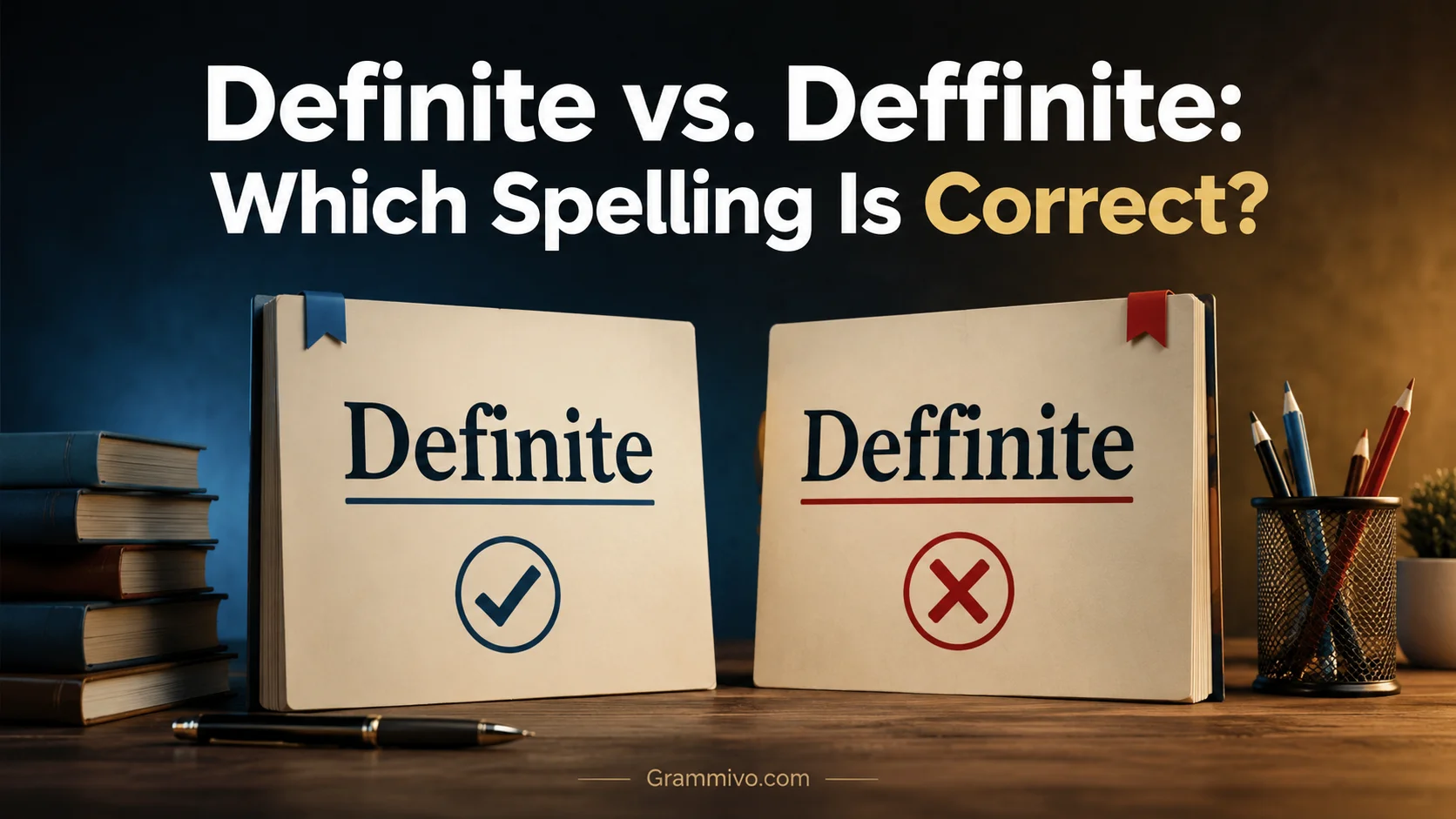
If you’ve ever paused over definite vs. deffinite, you’re not alone. The two spellings look almost identical, and the strong f sound in definite can make the extra f feel tempting. However, only one spelling is correct in standard English.
The correct spelling is definite. Deffinite is a misspelling and shouldn’t be used in formal writing, schoolwork, business communication, or published content.
The word definite means something clear, certain, fixed, or precisely defined. You might talk about a definite answer, a definite date, definite plans, or a definite improvement. Once you understand its spelling, meaning, pronunciation, and connection with words such as define, finite, and definitely, the confusion becomes much easier to avoid.
Quick Answer
Definite is the correct spelling.
Deffinite is incorrect.
| Spelling | Correct? | Meaning |
| definite | Yes | Clear, certain, fixed, or specific |
| deffinite | No | Common misspelling of definite |
| definitely | Yes | Certainly or without doubt |
| definitive | Yes | Conclusive or authoritative |
For example:
We need a definite answer before Friday.
Here, definite means a clear or certain answer.
You should not write:
We need a deffinite answer before Friday.
The extra f doesn’t belong in the word.
Definite vs. Deffinite: The Main Difference
The difference between definite and deffinite is spelling rather than meaning.
Deffinite, on the other hand, is simply a misspelling. It doesn’t represent a separate English word with a different definition.
The mistake usually comes from inserting an unnecessary second f:
- Correct: definite
- Incorrect: deffinite
Think of the spelling as:
D-E-F-I-N-I-T-E
There is only one f.
Why the Extra “F” Looks Tempting
Pronunciation can sometimes make spelling feel less obvious than it should.
When you say definite, the f sound stands out clearly. A writer typing quickly might instinctively double the consonant, especially if they haven’t memorized the written form.
English contains plenty of spelling patterns that don’t perfectly match pronunciation. That’s why relying entirely on sound can lead you down the wrong path.
The safest approach is to remember the visual structure:
de + finite = definite
That small trick can make the spelling stick.
What Does “Definite” Mean?
Definite generally describes something that is clear, certain, settled, or precisely identified.
Merriam-Webster gives several related senses for the word, including something that has distinct or clearly defined limits and something that is certain or fixed.
In everyday English, the word often carries the idea of no meaningful uncertainty.
Consider these examples:
- “Do you have a definite date?”
- “She gave me a definite answer.”
- “There has been a definite improvement.”
- “We need a definite plan.”
- “He has a definite advantage.”
The exact shade of meaning changes with the noun that follows it.
A definite date is a date that has been settled.
A definite answer is an answer that provides clarity.
A definite improvement is an improvement that seems clear or noticeable.
Definite Can Mean Clear or Certain
One of the most common uses of definite describes certainty.
For example:
“There is a definite possibility that the meeting will move.”
Here, definite emphasizes that the possibility is real or clearly present. It doesn’t necessarily mean the event itself is certain.
That’s an important distinction.
Compare:
- “The meeting is definite.”
- “There is a definite possibility of a meeting.”
The first suggests something settled or certain. The second says the possibility itself is clear or genuine.
Context determines the precise meaning.
Definite Can Mean Specific
Definite can also describe something clearly identified.
For example:
“The project needs a definite goal.”
That means the project needs a goal that isn’t vague or undefined.
Compare:
- Definite goal: Increase online sales by 15%.
- Vague goal: Improve sales somehow.
The first gives you a clear target. The second leaves plenty of room for interpretation.
How Do You Spell Definite?
The correct spelling is:
D-E-F-I-N-I-T-E
A useful way to remember it is to notice the word finite inside it:
de + finite = definite
The word finite means limited or having an end. Although you shouldn’t treat every spelling connection as a perfect rule, this visual relationship provides a useful memory aid.
Here are the letters broken into parts:
DE + FIN + ITE
The most important thing to remember is that the word contains only one F.
Common Incorrect Spellings
People sometimes produce several variations when they aren’t sure how to spell the word.
| Incorrect spelling | Correct spelling |
| deffinite | definite |
| definate | definite |
| definit | definite |
| definete | definite |
| definitly | definitely |
| definately | definitely |
Notice something important here: definite and definitely are related, but they’re not spelled exactly the same way.
That’s where another common spelling trap begins.
How Do You Pronounce “Definite”?
In American English, definite is commonly pronounced approximately:
DEF-uh-nit
The final -ite doesn’t sound like the “ite” in words such as bite or kite.
That’s worth remembering because English spelling can sometimes encourage an incorrect pronunciation.
Definite vs. “Definite” Pronunciation
A common mistake would be to pronounce the word as though every written letter receives its own strong sound.
In natural American English, the final syllable is much lighter:
DEF-uh-nit
Not:
DEF-in-EYE-t
Learning the pronunciation can actually help you recognize the word when you hear it. However, pronunciation alone won’t reliably tell you how every letter should appear on the page.
Why Do People Spell It “Deffinite”?
The spelling deffinite most likely comes from a straightforward spelling instinct: writers hear a strong f sound and add another f.
The problem is that English doesn’t determine spelling simply by doubling a consonant whenever its sound feels prominent.
For example, compare:
- definite
- different
- difficult
- final
The letter f appears only once in each of these words.
The best solution isn’t to invent a complicated spelling rule. Instead, memorize the correct form and connect it with familiar words.
Definite → finite → definitely
That chain gives you a useful visual anchor.
Definite vs. Definitely
This is one of the most important distinctions to understand because people often confuse the two words.
Definite is an adjective.
Definitely is an adverb.
Compare:
“She gave a definite answer.”
Here, definite describes the noun answer.
Now look at:
“She will definitely come.”
Here, definitely modifies the verb come. It tells you how certain the speaker feels about the action.
| Word | Part of speech | Example |
| definite | Adjective | “We need a definite answer.” |
| definitely | Adverb | “I’ll definitely attend.” |
The spelling changes when -ly is added.
“Definitely” Is Not “Definately”
A surprisingly common spelling error is:
definately
The correct spelling is:
definitely
A useful memory trick is to keep finite visible:
de + finite + ly = definitely
So:
- definite
- definitely
Not:
- deffinite
- definately
If you remember finite, you have a strong clue for both spellings.
Definite vs. Definitive
Definite and definitive are legitimate words. They are related, but they aren’t interchangeable.
Definite usually means clear, certain, fixed, or specific.
Definitive often means authoritative, conclusive, or providing a final answer.
Consider these examples:
“We need a definite date for the event.”
The date needs to be settled.
“The researchers published the definitive study on the subject.”
The second sentence suggests that the study carries strong authority or provides a conclusive treatment of the subject.
A simple comparison helps:
| Word | Core idea | Example |
| definite | Clear, certain, fixed, or specific | “We need a definite date.” |
| definitive | Conclusive or authoritative | “The report offers a definitive explanation.” |
This distinction becomes especially useful in academic, professional, and technical writing.
Definite vs. Define
The words definite and define share a historical relationship.
Define is a verb. It means to explain what something means or to establish its limits or nature.
Definite is an adjective describing something clear, fixed, or distinctly identified.
For example:
“The dictionary defines the term.”
But:
“The contract contains a definite deadline.”
The first sentence focuses on establishing meaning. The second focuses on clarity and certainty.
This connection also provides another spelling clue. If you can remember define, finite, and definite as related-looking words, the unusual spelling becomes easier to recognize.
Read More: Changeable vs. Changable: Which Spelling Is Correct?
Definite and the Definite Article
The word definite also has a specific grammatical meaning.
In English grammar, the is called the definite article.
Why?
Because the generally points to a particular person, place, thing, or group that the speaker and listener can identify from context.
Compare:
“I saw a dog outside.”
The listener doesn’t necessarily know which dog you mean.
Now:
“The dog was wearing a red collar.”
Now the phrase points to a particular dog.
The contrast is:
- a/an = indefinite article
- the = definite article
This is one of the most important grammatical uses of the word definite.
Definite vs. Indefinite
The natural opposite of definite is often indefinite.
These words form a useful contrast:
| Definite | Indefinite |
| Clear | Unclear |
| Specific | Unspecified |
| Fixed | Not fixed |
| Certain | Uncertain |
| Precisely identified | Not precisely identified |
For example:
“We have a definite meeting time.”
The time has been settled.
“We have an indefinite meeting time.”
The timing hasn’t been clearly established.
However, the exact opposite depends on context. Uncertain, vague, unspecified, and indefinite can all work in different situations.
Common Uses of “Definite”
The word appears naturally with many nouns. Learning these combinations can help you use it correctly rather than simply memorizing the spelling.
Definite Answer
“I need a definite answer before I make the reservation.”
The answer needs to settle the question.
Definite Date
“We’ll announce a definite date next week.”
The date will be fixed rather than tentative.
Definite Plan
“Do you have any definite plans for Saturday?”
This asks whether the person’s schedule contains something settled.
Definite Decision
“The committee hasn’t made a definite decision yet.”
The committee hasn’t reached a final or settled position.
Definite Improvement
“Her writing shows a definite improvement.”
The improvement is clear enough to notice.
Definite Advantage
“The larger battery gives the phone a definite advantage.”
The advantage is clear or meaningful.
Definite Possibility
“There’s a definite possibility that prices will change.”
Here, definite strengthens the idea that the possibility is real or apparent. It doesn’t automatically mean the outcome will happen.
Definite in Everyday Sentences
Seeing the word in natural contexts makes its meaning much easier to absorb.
- “Can you give me a definite answer?”
- “We need a definite date.”
- “That’s a definite improvement.”
- “She has a definite advantage.”
- “I’m looking for a definite explanation.”
- “There isn’t a definite timeline yet.”
- “He made a definite commitment.”
- “The evidence points to a definite pattern.”
- “We need something more definite.”
- “The company hasn’t announced a definite launch date.”
- “Her response gave us a definite direction.”
- “The proposal needs a more definite goal.”
Notice how the meaning shifts slightly depending on the noun. That’s normal. The central idea remains clarity, certainty, or specificity.
Definite vs. Certain vs. Specific
These three words overlap, but they aren’t perfect substitutes.
Definite often suggests something settled, clear, or clearly established.
Certain emphasizes freedom from doubt.
Specific emphasizes precise identification or detail.
Consider this comparison:
| Word | Main emphasis | Example |
| definite | Clear or settled | “We need a definite date.” |
| certain | Free from doubt | “I’m certain he’s right.” |
| specific | Precisely identified | “Give me a specific example.” |
You could sometimes replace one with another, but the sentence may lose some of its original meaning.
For instance, a specific answer gives particular information. A definite answer gives a clear or settled answer. A certain answer emphasizes confidence in its correctness.
Small differences like these make vocabulary more precise.
Case Study: Choosing the Right Word in an Email
Imagine a manager needs employees to confirm attendance at an event.
A vague email might say:
“Please let us know if you think you might attend.”
That doesn’t create a firm commitment.
A clearer version would say:
“Please provide a definite answer by Thursday.”
Here, definite tells readers that the manager needs a clear yes-or-no response.
Now imagine the manager has already selected the date:
“The event has a definite date of September 18.”
In this context, definite means fixed or settled.
This simple example shows why the word matters. It isn’t merely a formal alternative to clear. It communicates the absence of uncertainty in a specific situation.
FAQs:
Is it definite or deffinite?
Definite is correct. Deffinite is a misspelling.
Is “deffinite” a word?
No. Deffinite isn’t a standard English word. Use definite instead.
How do you spell definite?
The correct spelling is:
D-E-F-I-N-I-T-E
Remember that it contains only one f.
What does definite mean?
Definite means clear, certain, fixed, or precisely identified. For example, a definite date is a date that has been settled.
How do you pronounce definite?
In American English, definite is commonly pronounced DEF-uh-nit, represented by Cambridge Dictionary as /ˈdef.ə.nət/.
Conclusion:
When choosing between definite vs. deffinite, there’s no real contest: definite is the correct spelling. Use definite when you mean something clear, certain, fixed, or specific. Don’t add a second f, even though the pronunciation can make that spelling feel tempting. Also keep its related forms straight. Definitely expresses certainty, while definitive usually describes something conclusive or authoritative.
