
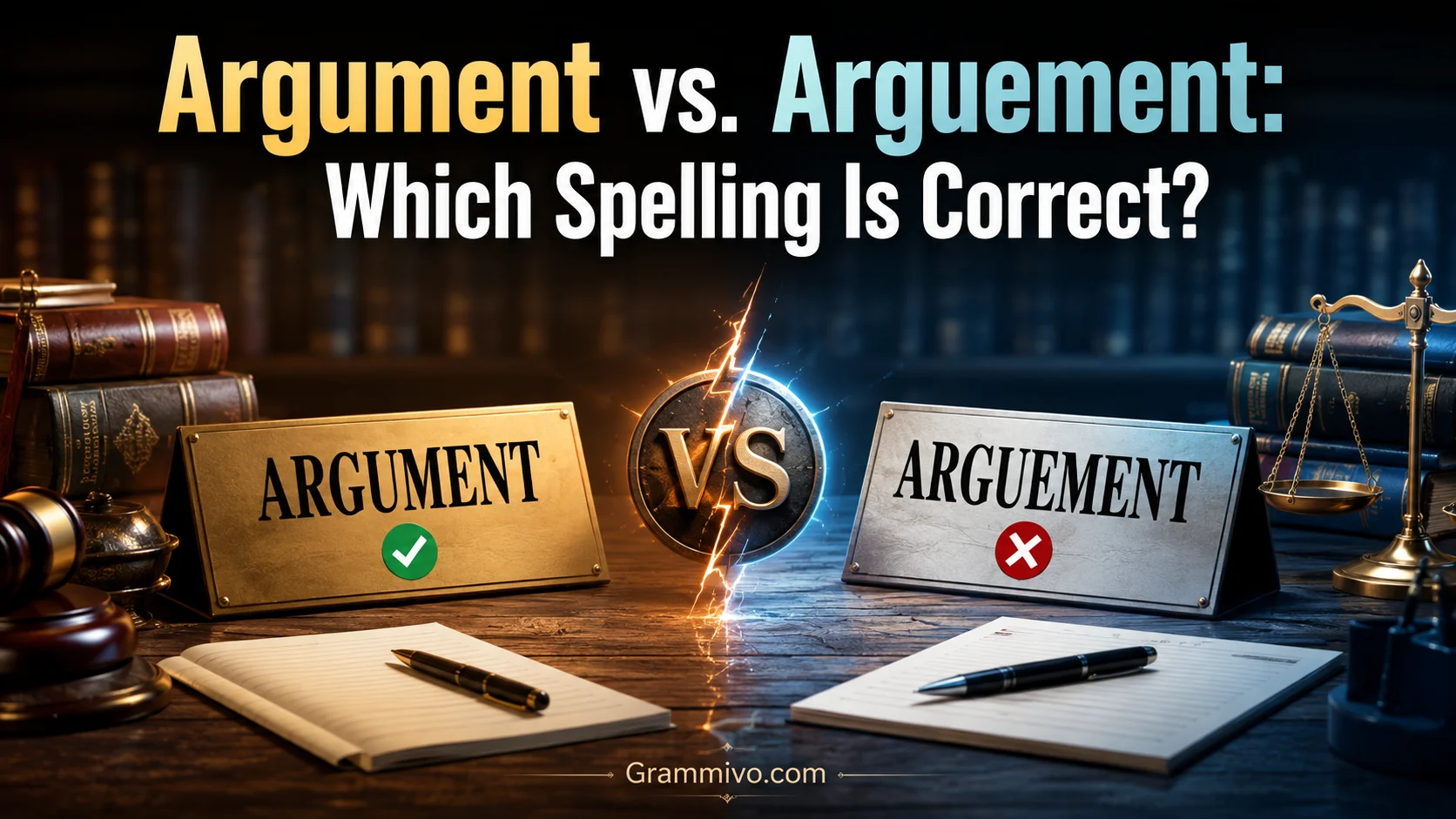
If you’ve ever paused while typing argument because arguement suddenly looked right, you’re not alone. These two spellings differ by just one letter, which makes the mistake surprisingly easy to make. However, only one is the standard spelling in modern English.
The correct spelling is argument. The spelling arguement is incorrect in standard modern English. That extra e often sneaks in because the word argument comes from the verb argue, making it tempting to spell the noun as though you simply added -ment to the complete form of argue.
That logic feels reasonable at first glance. English spelling, however, doesn’t always work like a mathematical equation. You can’t always take a verb and attach a suffix while keeping every letter unchanged.
In this guide, you’ll learn the difference between argument vs. arguement, what argument means, why arguement is a common mistake, how to pronounce the correct word, and several practical ways to remember its spelling.
Quick Answer:
Argument is the correct spelling.
Arguement is a common misspelling and isn’t the standard spelling of the word in modern English.
| Word | Correct spelling? | Meaning |
| Argument | Yes | A reason supporting an idea, or a disagreement |
| Arguement | No | Common misspelling of argument |
The correct spelling is:
A-R-G-U-M-E-N-T
The easiest point to remember is the middle of the word:
ARGU-MENT
There is no extra E between U and M.
For example:
- Correct: She presented a strong argument.
- Incorrect: She presented a strong arguement.
Major dictionaries recognize argument as the standard word. defines argument as a reason or set of reasons offered in support of a position. It also lists the word in the sense of a disagreement or quarrel.
What Is the Correct Spelling: Argument or Arguement?
When you’re choosing between argument and arguement, choose argument every time in standard English.
The spelling contains the sequence -ument, not -uement.
Think of it this way:
argument → correct
arguement → incorrect
The mistake usually happens because people connect the noun too closely to the verb argue.
The verb is spelled:
argue
The noun is spelled:
argument
It may seem natural to write argue + ment as arguement. English doesn’t form this noun that way, though. The established spelling is simply argument.
This distinction matters especially in formal writing. A misspelling can distract readers from your actual point. In an essay, business report, application, article, or professional email, writing argument correctly keeps the sentence polished and credible.
Argument vs. Arguement at a Glance
Here’s the distinction in its simplest form:
| Question | Answer |
| Which spelling is correct? | Argument |
| Is arguement standard English? | No |
| Does argument have an extra E after U? | No |
| What is the plural? | Arguments |
| What is the related verb? | Argue |
| What is the adjective? | Argumentative |
One tiny letter creates the entire confusion. Remove that unnecessary e, and you’ve got the correct word.
Why Is Arguement Wrong?
The spelling arguement is wrong because standard English spells the noun as argument, without an e between the u and m.
The error makes sense when you look at the word argue. Someone may unconsciously break the word into:
argue + ment
That produces the tempting but incorrect form:
arguement
The standard noun doesn’t preserve the final e from argue, though. Instead, it appears as:
argument
This kind of spelling confusion happens with many English words. Speakers often assume that related words should retain exactly the same letters. In reality, suffixes can affect spelling, pronunciation, or the form of a word.
The important thing isn’t to memorize a complicated historical rule. You simply need to recognize the standard spelling.
The Extra E in Arguement
Compare the two forms carefully:
ARGUMENT
A-R-G-U-M-E-N-T
ARGUEMENT
A-R-G-U-E-M-E-N-T
Notice where the difference occurs.
The incorrect spelling inserts an E after U:
ARGU-E-MENT
The correct spelling moves directly from U to M:
ARGU-MENT
That small visual distinction makes the mistake much easier to spot.
If you’re proofreading your work, scan the middle of the word. When you see argue-ment, stop and check it.
What Does Argument Mean?
The word argument has more than one common meaning. Its meaning depends heavily on context.
In one sentence, an argument can be a carefully constructed set of reasons. In another, it can describe a heated disagreement between people.
That double meaning sometimes confuses English learners because the two uses seem almost unrelated. They aren’t. Both involve people expressing positions, reasons, or opposing views.
Argument as a Reason or Position
An argument can mean a reason or collection of reasons used to support a particular idea, opinion, or conclusion.
For example:
“The strongest argument for public transportation is its potential to reduce traffic.”
Here, argument doesn’t mean a fight. It means a reasoned case supporting an idea.
Academic writing frequently uses the word this way.
Consider:
“The author makes a convincing argument about the effects of social media.”
The writer isn’t necessarily arguing with someone face-to-face. Instead, the writer presents a position and supports it with evidence or reasoning.
Argument as a Disagreement
In everyday conversation, argument often means a disagreement or quarrel.
For example:
“They had an argument about where to spend their vacation.”
Here, the word describes a conflict between people rather than a formal chain of reasoning.
Another example is:
“I don’t want to get into an argument right now.”
The context makes the meaning clear.
Argument in Academic Writing
In an essay, research paper, or editorial, an argument usually refers to the central position the writer develops and supports.
A strong academic argument generally includes:
- A clear claim
- Relevant evidence
- Logical reasoning
- Supporting examples
- Consideration of opposing views
- A conclusion that follows from the evidence
For instance, an essay arguing that schools should start later might claim that later start times benefit students. The writer would then support that claim with research, evidence, and logical explanation.
So when you see argument in academic writing, don’t automatically interpret it as a quarrel.
How Do You Spell Argument?
The correct spelling is:
A-R-G-U-M-E-N-T
Break it into a useful visual pattern:
ARGU + MENT
Or, more simply:
ARGU-MENT
The key is to avoid inserting the extra e found in argue.
| Correct | Incorrect |
| argument | arguement |
| arguments | arguements |
A useful proofreading technique involves checking the word from the middle outward.
Start with:
ARGU
Then add:
MENT
You get:
ARGU + MENT = ARGUMENT
You don’t need:
ARGUE + MENT = ARGUEMENT
That second construction is exactly where the spelling error comes from.
How to Remember Argument Spelling
The simplest memory trick is to remember:
Argument = ARGU + MENT
Don’t write the entire word argue before adding the ending.
Another useful trick is to focus on the sequence:
U-M
When you’re unsure, ask yourself:
Does the word go U-M or U-E-M?
The answer is U-M.
So:
argu + ment = argument
This small visual cue can prevent the mistake surprisingly well.
Argument Examples in Everyday Sentences
Seeing the word in different contexts makes its meaning and spelling easier to remember.
Here are examples using argument correctly:
- She presented a strong argument during the meeting.
- His argument was based on reliable evidence.
- We had an argument about the best way to solve the problem.
- The lawyer developed a detailed argument for the defense.
- Her main argument was easy to understand.
- They ended their argument after discussing the issue calmly.
- The article makes an interesting argument about education.
- I don’t want another argument over something so small.
- The professor challenged his argument with a difficult question.
- She supported her argument with several examples.
Notice how the meaning changes with context.
In “The lawyer developed a detailed argument,” the word refers to reasoning.
In “They had an argument,” it refers to a disagreement.
The spelling remains exactly the same in both cases.
Read More: Colleague vs Collaegue: Which Spelling Is Correct?
Argument Examples in Academic and Professional Writing
The word argument appears frequently in serious writing because writers often need to explain, defend, or challenge ideas.
Consider these examples:
“The report presents a compelling argument for expanding the program.”
Here, argument means a reasoned case.
“The student’s argument needs stronger evidence.”
Again, the word refers to reasoning rather than a personal dispute.
“The editorial’s central argument focuses on consumer protection.”
This usage describes the main position developed by the editorial.
In professional settings, you may also see phrases such as:
- strong argument
- weak argument
- convincing argument
- logical argument
- central argument
- main argument
- supporting argument
- counterargument
- valid argument
- persuasive argument
These combinations are common because argument plays an important role in discussions involving evidence and reasoning.
Argument vs. Arguement Examples: Correct and Incorrect
A side-by-side comparison can make the spelling difference crystal clear.
| Incorrect | Correct |
| She made a strong arguement. | She made a strong argument. |
| His arguement lacked evidence. | His argument lacked evidence. |
| They had an arguement yesterday. | They had an argument yesterday. |
| The lawyer presented an arguement. | The lawyer presented an argument. |
| I understand your arguement. | I understand your argument. |
The pattern never changes.
Whenever the noun is intended, use argument.
A Simple Editing Test
When proofreading, search your document for:
arguement
If you find it, replace it with:
argument
This works particularly well when editing long essays, reports, or articles. A spelling checker may catch the mistake too, but knowing the correct form helps you recognize it yourself.
Argument vs. Argue: What’s the Difference?
Argue and argument are closely related, but they don’t perform the same grammatical job.
Argue is a verb.
Argument is a noun.
Compare these sentences:
“They argue about politics.”
“They had an argument about politics.”
In the first sentence, argue describes an action.
In the second, argument names the disagreement.
The same distinction appears when argue means presenting reasons rather than fighting.
“The researcher argues that the policy needs revision.”
“The researcher presents an argument for changing the policy.”
The two words are related, but you can’t simply interchange them.
| Word | Part of speech | Example |
| argue | Verb | “They argue about the issue.” |
| argument | Noun | “They had an argument.” |
| argued | Past-tense verb | “She argued against the proposal.” |
| arguing | Present participle/gerund | “They were arguing.” |
| argumentative | Adjective | “He became argumentative.” |
Understanding this relationship also explains why arguement can look tempting. The spelling of argue remains visible in your mind even though the noun has a different spelling pattern.
Argument vs. Arguement and the “-Ment” Ending
One reason this spelling error persists is the appearance of the suffix -ment.
English uses -ment to form many nouns from verbs.
For example:
- develop → development
- establish → establishment
- achieve → achievement
- govern → government
- encourage → encouragement
Because this pattern occurs so often, it can encourage people to think:
argue + ment = arguement
But that’s not how the standard spelling works here.
The correct word is simply:
argument
The spelling shouldn’t be reconstructed mechanically every time you use it. Treat argument as the established noun form.
This is an important lesson for English spelling in general: word relationships can help you understand vocabulary, but they don’t always tell you exactly how every related word is spelled.
How Do You Pronounce Argument?
In US English, argument is commonly pronounced roughly like:
AR-gyuh-mənt
The pronunciation doesn’t sound like a separate syllable corresponding to the mistaken e in arguement.
When saying the word naturally, the middle tends to flow quickly:
AR-guh-ment
The exact sound can vary slightly depending on the speaker and regional speech patterns. That variation doesn’t change the spelling.
Pronunciation can sometimes reinforce the correct spelling, but don’t rely on sound alone. English spelling and pronunciation don’t always line up neatly.
Is Arguement Ever Correct?
For modern standard English, arguement isn’t the correct spelling of the noun you’re looking for.
If you’re writing an email, essay, report, article, résumé, school assignment, or professional document, use:
argument
The form arguement can appear online because people make spelling mistakes. Seeing a word repeatedly on websites or social media doesn’t automatically make it standard.
It’s also worth separating modern usage from historical word forms. Some historical dictionaries and language resources record unusual or obsolete spellings that aren’t appropriate for ordinary contemporary writing. For present-day standard English, the practical answer remains straightforward:
Use argument.
FAQs:
Is it argument or arguement?
Argument is the correct spelling. Arguement is a common misspelling.
Is arguement a word?
In modern standard English, arguement isn’t the standard spelling of the noun. Use argument instead.
Why do people spell argument as arguement?
The mistake likely comes from the spelling of argue. Because argue ends in -ue, writers may incorrectly carry that final e into the noun.
How do you spell argument?
Spell it:
A-R-G-U-M-E-N-T
The key sequence is U-M, not U-E-M.
Does argument have an E?
Yes, argument contains an e, but its position matters. The correct spelling is arguMENT, with no e between u and m.
Conclusion:
When choosing between argument vs. arguement, there’s a clear winner. Argument is the correct spelling. Arguement is a common misspelling. The word argument can describe a reasoned position, a disagreement, a legal position, an academic claim, or a persuasive case. Its meaning changes with context, but its spelling doesn’t.
