
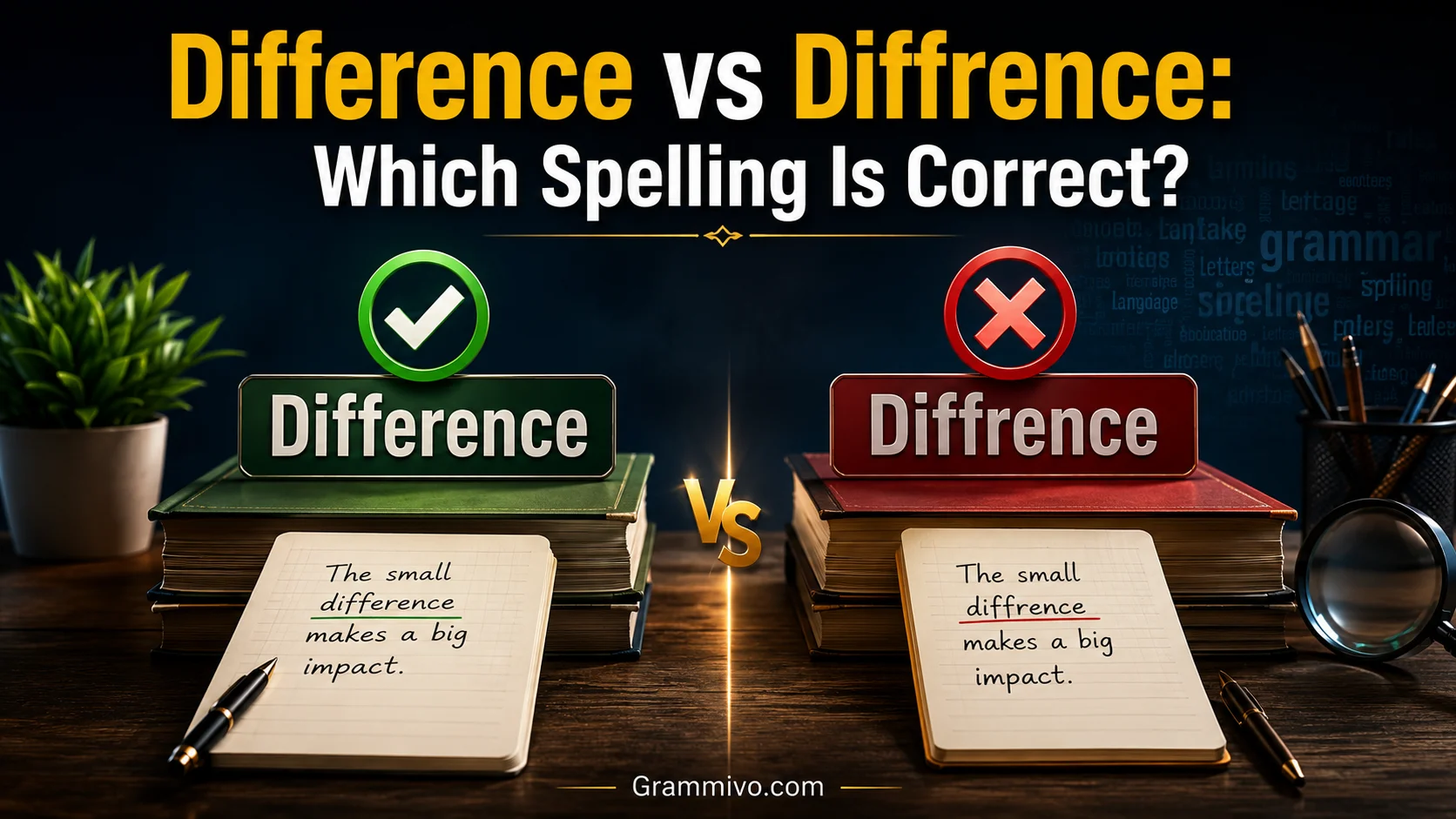
If you’ve ever typed “diffrence” instead of “difference,” you’re not alone. This spelling mistake happens easily because the word contains several letters that sound less distinct in normal speech. Still, there’s a clear answer: difference is the correct spelling, while diffrence is a misspelling.
The two forms don’t represent different meanings, dialects, or grammatical choices. When someone writes “diffrence,” they almost always intend to write difference. The missing e makes the spelling incorrect.
Understanding the structure of the word makes the correct version much easier to remember. Difference connects closely with the word differ, which means “to be unlike” or “to disagree.” Once you recognize that connection, the spelling becomes far less troublesome.
Quick Answer
Difference is the correct spelling in American English and standard English generally. Diffrence is incorrect.
| Spelling | Correct? | Meaning |
| difference | Yes | A distinction, variation, disagreement, or mathematical result |
| diffrence | No | Misspelling of “difference” |
The easiest way to remember it is:
DIFFER + ENCE = DIFFERENCE
Notice the e after the second f and before r. That letter is part of the correct spelling and shouldn’t disappear.
For example:
- Correct: “What is the difference between these two products?”
- Incorrect: “What is the diffrence between these two products?”
The first sentence uses the standard spelling. The second contains a simple spelling error.
Difference vs Diffrence: The Main Difference
There actually isn’t a vocabulary difference between difference and diffrence. One is correct and the other isn’t.
Difference is a standard English noun. It describes a way in which two or more things aren’t the same. It can refer to physical characteristics, opinions, quantities, behaviors, results, or other forms of distinction.
Diffrence, on the other hand, doesn’t function as a separate English word with its own definition. It’s simply a misspelled version of difference.
Consider this example:
“There’s a noticeable difference between the two photographs.”
Here, difference identifies the distinction between the photographs.
Writing:
“There’s a noticeable diffrence between the two photographs.”
doesn’t create a new meaning. It only introduces a spelling mistake.
This distinction matters when you’re writing an email, essay, report, application, article, or other professional material. Spell-checkers may catch the error, but knowing the correct spelling yourself is more reliable.
What Does Difference Mean?
The noun difference has several closely related meanings. Its central idea is not being the same.
For example, if one shirt is blue and another is green, their colors create a difference. If two people hold opposing opinions, they may have differences. In mathematics, subtraction produces a difference between quantities.
Here are the major uses:
| Meaning | Example |
| A distinction between things | “There’s a clear difference between the two designs.” |
| A variation in quality or amount | “We noticed a difference in price.” |
| A disagreement | “They had political differences.” |
| A mathematical result | “The difference between 20 and 12 is 8.” |
| An effect or change | “Your support made a difference.” |
The context determines which meaning applies.
Difference as a Distinction
This is probably the most common everyday use.
When you say there is a difference between two things, you’re pointing out something that makes them unlike each other.
For example:
“The biggest difference between the phones is their camera system.”
The word doesn’t necessarily suggest that one thing is better. It simply identifies a distinction.
Difference as a Disagreement
Difference can also describe a disagreement between people.
For example:
“The two partners had differences over how to run the company.”
Here, the word refers to conflicting opinions rather than physical characteristics.
This use appears frequently in phrases such as settle your differences.
Difference in Mathematics
Mathematics gives the word a more specific meaning.
When you subtract one number from another, the result can be called the difference.
For example:
18 − 7 = 11
The difference between 18 and 7 is 11.
Likewise:
100 − 63 = 37
The difference is 37.
This mathematical use still connects to the basic idea of things being unequal. Subtraction tells you how far apart two quantities are.
Why Is “Diffrence” Incorrect?
The spelling diffrence drops an important e from the word.
The correct spelling is:
d-i-f-f-e-r-e-n-c-e
The incorrect version is:
d-i-f-f-r-e-n-c-e
The missing letter appears after the second f.
One useful way to understand the spelling is to connect difference with its related word differ.
Differ means to be unlike something or someone.
For example:
“Their opinions differ.”
From this family of words, you get:
- differ — verb
- different — adjective
- difference — noun
- differences — plural noun
That connection provides a practical spelling clue.
If you remember differ, you’re less likely to accidentally write diffrence.
How Do You Spell Difference?
The correct spelling is:
D-I-F-F-E-R-E-N-C-E
A useful pronunciation-and-spelling breakdown is:
dif-fer-ence
The word contains two consecutive f letters and several vowels that can become easy to overlook when typing quickly.
A simple memory trick is to build it from differ:
DIFFER + ENCE = DIFFERENCE
Don’t remove the e from differ.
A Simple Spelling Check
When you’re unsure, pause after diff and ask yourself:
“Does differ fit here?”
It does:
differ → difference
That mental connection can help you catch the missing letter before submitting your writing.
Difference vs Different
One common source of confusion involves difference and different. They come from the same word family, but they perform different grammatical jobs.
Difference is primarily a noun.
Different is an adjective.
Compare these sentences:
“There is a difference between the two plans.”
“The two plans are different.”
The first sentence names the distinction. The second describes the plans.
| Word | Part of Speech | Example |
| differ | Verb | “Their opinions differ.” |
| different | Adjective | “Their opinions are different.” |
| difference | Noun | “There is a difference between their opinions.” |
Knowing this word family helps with both grammar and spelling.
Difference vs Differ
The words differ and difference are closely connected, but they aren’t interchangeable.
Differ works as a verb.
“The two reports differ in several ways.”
Difference works as a noun.
“There are several differences between the reports.”
The simplest test is to ask what role the word plays.
If you’re describing an action or state, you may need differ.
If you’re naming the distinction itself, you probably need difference.
Examples of Differ and Difference
- “The twins differ in personality.”
- “There is a noticeable difference in their personalities.”
- “Their answers differ.”
- “There is a difference between their answers.”
- “The two methods differ considerably.”
- “The difference between the methods is important.”
This word-family connection also makes difference easier to spell correctly.
How to Use Difference in a Sentence
The word difference appears in everyday conversation, academic writing, business communication, mathematics, and countless other settings.
Here are some natural examples:
- “Can you tell the difference between these two fabrics?”
- “There’s a major difference in quality.”
- “The price difference is surprisingly small.”
- “Their cultural differences didn’t prevent them from becoming friends.”
- “The difference between the two measurements is significant.”
- “A few minutes can make a difference.”
- “They eventually settled their differences.”
- “The new policy made a noticeable difference.”
- “What’s the difference between these two options?”
- “The difference is easier to see in natural light.”
Notice that difference usually identifies some form of contrast, separation, variation, or effect.
Common Phrases With Difference
English uses difference in many established expressions. Learning these phrases can help you use the word naturally rather than simply memorizing its spelling.
The Difference Between
This phrase introduces a comparison.
“What’s the difference between a debit card and a credit card?”
It’s one of the most common structures involving difference.
Tell the Difference
Tell the difference means to recognize how two things aren’t the same.
“Can you tell the difference between real leather and synthetic leather?”
Make a Difference
Make a difference means to have an effect or produce a meaningful change.
“A small improvement can make a big difference.”
The phrase doesn’t necessarily involve comparing two objects.
Make No Difference
This expression means that something doesn’t matter to the outcome.
“It makes no difference which route we take.”
Settle Your Differences
This phrase means to resolve disagreements.
“They met privately to settle their differences.”
A World of Difference
This expression describes a very large or noticeable improvement.
“A good night’s sleep can make a world of difference.”
These phrases are worth learning because they appear frequently in natural English.
Difference vs Diffrence Examples
Seeing the incorrect and correct forms side by side makes the spelling issue obvious.
| Incorrect | Correct |
| “What is the diffrence?” | “What is the difference?” |
| “I don’t know the diffrence.” | “I don’t know the difference.” |
| “There is a big diffrence.” | “There is a big difference.” |
| “Can you explain the diffrence?” | “Can you explain the difference?” |
| “The diffrence is easy to see.” | “The difference is easy to see.” |
| “What’s the diffrence between them?” | “What’s the difference between them?” |
| “We noticed a price diffrence.” | “We noticed a price difference.” |
| “Their diffrences caused conflict.” | “Their differences caused conflict.” |
The important point is that diffrence never becomes correct simply because the surrounding sentence changes.
Whether you’re writing casually or formally, the standard spelling remains difference.
Common Misspellings of Difference
The missing e isn’t the only way people misspell this word. Typing quickly can produce several variations.
Some examples include:
- diffrence
- diference
- diferrence
- differrence
- diffrencee
These forms aren’t alternative spellings. They’re errors.
The most common problem involves forgetting the e in the sequence:
d-i-f-f-e-r
That is why remembering differ can be more useful than trying to memorize the entire word as an isolated string of letters.
Why Does “Diffrence” Look So Natural?
There’s a simple reason the error can escape notice.
When people read familiar words, they don’t always process every letter individually. The brain often recognizes the overall shape and pattern of a familiar word. When typing quickly, it’s therefore possible to omit a letter without immediately noticing.
Pronunciation can contribute as well. In ordinary speech, unstressed vowels aren’t always strongly emphasized. That can make the spelling less obvious to learners.
However, the standard written form remains fixed:
difference
Read More: Argument vs. Arguement: Which Spelling Is Correct?
How to Remember the Spelling of Difference
The best spelling tricks connect the word to something you already know.
Remember “Differ”
Start with:
DIFFER
Then add:
ENCE
Together:
DIFFER + ENCE = DIFFERENCE
This is much easier to recall than memorizing every letter independently.
Remember the Double F
The beginning contains:
DIFF
not:
DIF
So the word starts with two f letters.
Watch the E After FF
The most important point for the diffrence mistake is:
DIFF-E-R
That e needs to stay there.
Use a Mental Sentence
Try remembering:
“Things differ, so there is a difference.”
The sentence links the verb and noun naturally.
That makes the spelling easier to retrieve when you’re writing.
Difference in American English
For US English readers, there is no spelling variation between difference and diffrence.
Difference is the standard spelling in American English.
This isn’t one of those cases where American and British English use different spellings. For example, words such as color/colour and center/centre have recognized regional variants. Difference doesn’t work that way.
The correct form remains:
difference
Whether you’re writing for a US school, workplace, website, application, or everyday conversation, use difference.
Difference in British English
British English also uses difference.
That means the spelling is consistent across the major varieties of standard English.
| Variety | Correct Form |
| American English | difference |
| British English | difference |
| Canadian English | difference |
| Australian English | difference |
So if you encounter diffrence in a text, don’t assume it’s a regional spelling. It’s simply an error.
Difference in Mathematics
The word difference has a precise mathematical use.
When one number is subtracted from another, the resulting value is commonly called the difference.
For example:
14 − 5 = 9
The difference between 14 and 5 is 9.
Another example:
72 − 28 = 44
The difference is 44.
This term appears frequently in elementary mathematics and everyday discussions about quantities.
You might hear:
“What is the difference between 850 and 625?”
The calculation is:
850 − 625 = 225
Therefore, the difference is 225.
In this context, the word still expresses the basic concept of separation between two quantities.
Difference and “Make a Difference”
One especially important expression is make a difference.
Here, difference doesn’t mean a disagreement or numerical gap. It means an effect, impact, or meaningful change.
For example:
“Regular exercise can make a difference in how you feel.”
The sentence says that regular exercise can have a meaningful effect.
Similarly:
“Your feedback made a difference.”
This means the feedback had an impact on the situation.
The phrase can also appear with modifiers:
- make a big difference
- make a real difference
- make a significant difference
- make a positive difference
- make a noticeable difference
These expressions are common in both casual and professional English.
FAQs:
Is “diffrence” a word?
No. Diffrence is not the standard spelling of the English noun difference. It’s a misspelling.
Is “difference” correct?
Yes. Difference is the correct standard spelling.
How do you spell difference?
Spell it:
D-I-F-F-E-R-E-N-C-E
A useful memory aid is:
DIFFER + ENCE = DIFFERENCE
What is the meaning of difference?
Difference refers to a distinction, variation, disagreement, or gap between things. In mathematics, it can refer to the result of subtraction.
What is the plural of difference?
The plural is differences.
“There are several differences between the two designs.”
Conclusion:
When choosing between difference and diffrence, there’s no complicated rule to memorize. The missing e in diffrence turns an otherwise familiar word into a spelling error. The easiest way to avoid it is to remember the connection with differ: Whether you’re talking about a distinction between two products, a disagreement between people, a mathematical subtraction result, or the impact of an action, the word remains difference.
