
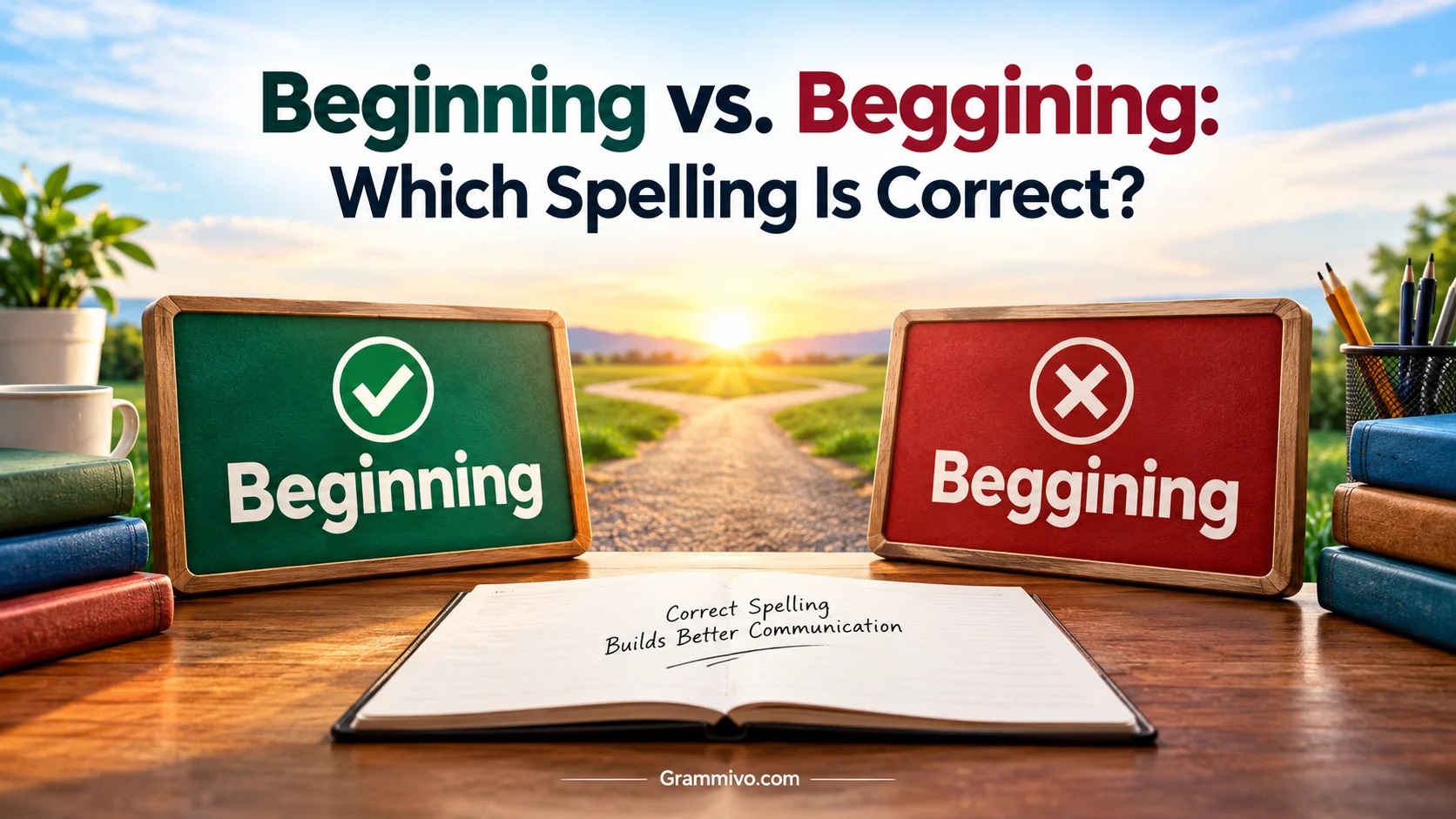
If you’ve ever paused while typing “beginning”, you’re not alone. The word contains several repeated letters, which makes it surprisingly easy to spell incorrectly. One of the most common mistakes is writing “beggining” instead of “beginning.”
So, when comparing beginning vs. beggining, there is a clear winner: beginning is the correct English spelling. Beggining is a misspelling and doesn’t represent a separate word with a different meaning.
The correct spelling is:
B-E-G-I-N-N-I-N-G
The word refers to the start, first part, or early stage of something. You might talk about the beginning of a movie, the beginning of a relationship, the beginning of a school year, or the beginning of a new project.
Quick Answer:
Beginning is correct. Beggining is incorrect.
| Spelling | Correct? | Meaning |
| Beginning | Yes | The start or first part of something |
| Beggining | No | A misspelling of beginning |
| Begining | No | A misspelling that omits an “n” |
| Biginning | No | An incorrect spelling |
The correct spelling is beginning, with one g in the middle of the word and two n’s together:
beginning
A useful way to remember it is:
BEGIN + NING = BEGINNING
If you’re writing a formal email, school assignment, article, résumé, or business document, use beginning, never beggining.
Beginning vs. Beggining: The Key Difference
The difference between beginning and beggining isn’t a difference in meaning. It’s a difference between a correct spelling and an incorrect one.
Beginning is an established English word. It functions primarily as a noun, although it also appears in common expressions and constructions related to the verb begin.
Beggining, on the other hand, is simply a spelling error. English dictionaries don’t recognize it as the standard spelling of the word.
The confusion usually comes from the arrangement of letters. The word beginning contains both repeated letters and the letter sequence “ginning.” When people write quickly, they may remember the general sound without remembering the exact letter order.
Compare the two forms closely:
- Correct: beginning
- Incorrect: beggining
Notice what happens after “be”:
- beginning → b-e-g-i-n-n-i-n-g
- beggining → b-e-g-g-i-n-i-n-g
The incorrect version inserts an extra g and loses one of the required n’s.
That small change completely breaks the standard spelling.
Why Is “Beginning” the Correct Spelling?
The spelling becomes easier to understand when you look at its base word: begin.
The verb begin means to start something or cause something to start. When English adds -ing to begin, the spelling changes slightly:
begin + ing → beginning
Why does the final n double?
The word begin has the pattern consonant-vowel-consonant at the end:
b e g i n
More specifically, the final stressed syllable is -gin, which contains a short vowel followed by a single consonant. In standard English spelling, a one-syllable word or a final stressed syllable of a longer word can double its final consonant before a suffix beginning with a vowel, such as -ing.
That’s why we get:
- begin → beginning
- run → running
- sit → sitting
- stop → stopping
However, the rule has important exceptions and depends on factors such as syllable stress and word structure. That’s why simply memorizing the pattern can sometimes be safer than trying to apply a spelling rule mechanically.
The key point remains simple:
The final “n” doubles. The “g” doesn’t.
Why Do People Spell It “Beggining”?
The misspelling beggining is understandable because English spelling doesn’t always match pronunciation perfectly.
When you say beginning, the sounds flow together quickly. In ordinary conversation, you don’t pronounce every letter separately. Your brain therefore stores the word primarily as a sound pattern rather than as a sequence of individual letters.
Several factors can encourage the wrong spelling.
The Existing “g” Creates Confusion
The word already contains a g:
beginning
Because begin starts with beg-, writers sometimes assume that adding -ing creates another g near the middle.
It doesn’t.
The spelling retains the original g and doubles the final n.
The Word Resembles “Begging”
Another source of confusion is the word begging.
Compare:
- beginning
- begging
Both begin with beg, and both contain repeated letters. However, they have completely different meanings.
Begging means asking earnestly or pleading for something.
Beginning means the start of something.
That visual similarity can cause a writer to accidentally transfer the spelling pattern from begging into beginning.
Fast Typing Can Cause Letter Swaps
Typing quickly creates another problem. Words containing repeated letters often trigger mistakes because your fingers have to produce a precise sequence.
That’s especially true with words such as:
- beginning
- occurrence
- necessary
- accommodation
- embarrassment
A quick spell-check can catch these errors, but knowing the correct pattern makes them less likely in the first place.
How to Remember the Spelling of Beginning
The simplest memory trick is to break the word into recognizable pieces:
BEGIN + NING
That gives you:
BEGINNING
Another useful reminder is:
Begin with “begin,” then add “ning.”
You can also focus on the two letters that cause the most trouble:
beginni…
Once you reach the n, remember that it appears twice:
…nning
The full spelling is:
b-e-g-i-n-n-i-n-g
A quick visual check can help:
| Part | Letters |
| Base | begin |
| Ending | -ing |
| Combined form | beginning |
| Important change | Final n doubles |
Don’t memorize beggining as an alternative. It isn’t one.
Beginning: Meaning and Definition
The noun beginning refers to the point at which something starts. It can also describe the first part of an event, period, process, story, or experience.
The word can describe both a precise moment and a broader early period.
For example:
- The beginning of the movie was slow.
- We arrived at the beginning of the ceremony.
- She remembers the beginning of her career clearly.
- The beginning of winter brought colder temperatures.
- They’ve been friends since the beginning.
In each sentence, beginning points toward the start or earliest stage of something.
How to Use “Beginning” in a Sentence
The word works naturally in many kinds of writing, from casual conversations to formal documents.
Beginning of a Specific Event
Use the beginning of when referring to the first part of an event or activity.
We missed the beginning of the concert.
Here, beginning identifies the opening portion of the concert.
Beginning of a Period
You can also use it with periods of time.
The beginning of the year brought several changes.
Other examples include:
- the beginning of the month
- the beginning of the semester
- the beginning of summer
- the beginning of the decade
- the beginning of the week
Beginning of a Story
In literature and storytelling, beginning refers to the opening portion of a narrative.
The beginning of the novel introduces the main character.
A story’s beginning usually establishes important elements such as setting, characters, conflict, or context.
Beginning of a Process
The word can describe the first stage of a process.
At the beginning of the project, the team had only three members.
This usage works for business projects, research, construction, education, and countless other situations.
“Beginning” in Common Expressions
The word appears in several familiar English expressions. Understanding these phrases helps you use it naturally.
At the Beginning
At the beginning generally refers to a starting point.
We discussed the rules at the beginning of the meeting.
You can use it for events, periods, activities, and processes.
Examples:
- at the beginning of the class
- at the beginning of the book
- at the beginning of the year
- at the beginning of the journey
In the Beginning
In the beginning often means at first or during the earliest stage.
In the beginning, I found the new software difficult to use.
This phrase can imply that the situation later changed.
For example:
In the beginning, the business struggled, but sales improved later.
From the Beginning
From the beginning means starting at the earliest point.
She understood the problem from the beginning.
It often emphasizes that something was true or known from the start.
From Beginning to End
This expression means throughout the entire thing.
He watched the documentary from beginning to end.
You can use it for movies, books, performances, processes, events, and experiences.
Beginning vs. Begging: Don’t Confuse These Words
The spelling of begging may help explain why some people accidentally write beggining.
These are different words:
| Word | Meaning | Example |
| Beginning | The start of something | The beginning of the movie was exciting. |
| Begging | Asking earnestly or pleading | He was begging for another chance. |
The two words share the letters beg at the start, but their structures and meanings differ.
Beginning comes from begin.
Begging comes from beg.
That distinction matters because the doubled consonant occurs in different places.
- begin → beginning
- beg → begging
Once you separate the base words, the spelling becomes much easier to remember.
Beginning vs. Begining: Another Common Misspelling
Begining is another frequent error.
This time, the writer leaves out one of the two n’s.
The correct form is:
beginning
Not:
begining
Not:
beggining
Not:
biginning
You can see the correct structure more clearly by highlighting the repeated letter:
begiNNing
The two n’s are essential.
| Spelling | Status | Problem |
| beginning | Correct | Standard spelling |
| beggining | Incorrect | Adds an extra g and loses an n |
| begining | Incorrect | Omits one n |
| biginning | Incorrect | Places the letters incorrectly |
| beginingg | Incorrect | Adds an unnecessary g |
If you’re proofreading your writing, check the middle of the word first. That’s where most mistakes occur.
Read More: Embarrass vs. Embarass: Which Spelling Is Correct?
Common Sentences With the Wrong Spelling
Seeing the mistake in context makes it easier to recognize.
Example 1
Incorrect:
At the beggining of the story, the hero lives alone.
Correct:
At the beginning of the story, the hero lives alone.
Example 2
Incorrect:
We missed the beggining of the presentation.
Correct:
We missed the beginning of the presentation.
Example 3
Incorrect:
The beggining of the semester was hectic.
Correct:
The beginning of the semester was hectic.
Example 4
Incorrect:
From the beggining, she knew the plan would work.
Correct:
From the beginning, she knew the plan would work.
Example 5
Incorrect:
The movie has a confusing beggining.
Correct:
The movie has a confusing beginning.
These examples show an important point: the spelling error doesn’t change the intended meaning. It simply makes the writing incorrect according to standard English spelling conventions.
Is “Beggining” Ever Correct?
No. Beggining is not the standard spelling of an English word.
If you intend to refer to the start or first part of something, use beginning.
This applies across formal and informal writing:
- Beginning — correct
- Beggining — incorrect
You might occasionally see beggining in social media posts, comments, informal messages, or unedited webpages. Its appearance doesn’t make it an accepted spelling.
A misspelling can become common because people repeat it. That still doesn’t turn it into the standard form.
For professional or academic writing, stick with beginning.
Pronunciation of “Beginning”
The pronunciation can also help you recognize the word when you hear it.
A simple pronunciation guide for English learners is:
bih-GIN-ing
The strongest stress falls on the middle syllable:
be-GIN-ning
However, pronunciation alone won’t tell you where every letter belongs. English contains many words whose spelling and pronunciation don’t line up perfectly.
That’s why connecting the pronunciation with the spelling pattern helps:
be-GIN-ning → begin + ning → beginning
Synonyms for “Beginning”
Sometimes you need a different word to avoid repetition. Several synonyms work well, although their meanings and levels of formality aren’t identical.
| Synonym | Typical meaning or use |
| Start | General, everyday term |
| Opening | First part of an event, speech, book, or performance |
| Origin | Source or point from which something develops |
| Onset | Beginning of an event or condition |
| Inception | Formal term for the start of something |
| Commencement | Formal beginning |
| Introduction | Opening section or initial presentation |
| Launch | Start of a product, project, campaign, or venture |
| Dawn | Figurative or literary beginning |
For everyday conversation, start often sounds more natural.
For example:
The beginning of the meeting was awkward.
can become:
The start of the meeting was awkward.
Both are correct, but the second sounds slightly more conversational.
By contrast, inception has a more formal tone:
The company has grown significantly since its inception.
Choosing the right synonym depends on the context, audience, and tone.
FAQs:
Is “beggining” a correct spelling?
No. Beggining is a misspelling. The correct spelling is beginning.
Is it beginning or beggining?
Use beginning. It means the start or first part of something.
Does beginning have two n’s?
Yes. The correct spelling contains two consecutive n’s:
beginning
Does beginning have two g’s?
The word contains two g’s in total, but they aren’t next to each other.
The spelling is:
b-e-g-i-n-n-i-n-g
One g appears after be, while the other appears at the end.
How do you spell beginning?
Spell it:
B-E-G-I-N-N-I-N-G
A useful memory formula is:
BEGIN + NING = BEGINNING
Conclusion:
When comparing beginning vs. beggining, the answer is straightforward: Beginning is correct. Beggining is incorrect. Remember that beginning refers to the start or first part of something. Whether you’re talking about a movie, meeting, semester, relationship, project, or new chapter in life, this is the spelling you want.
