
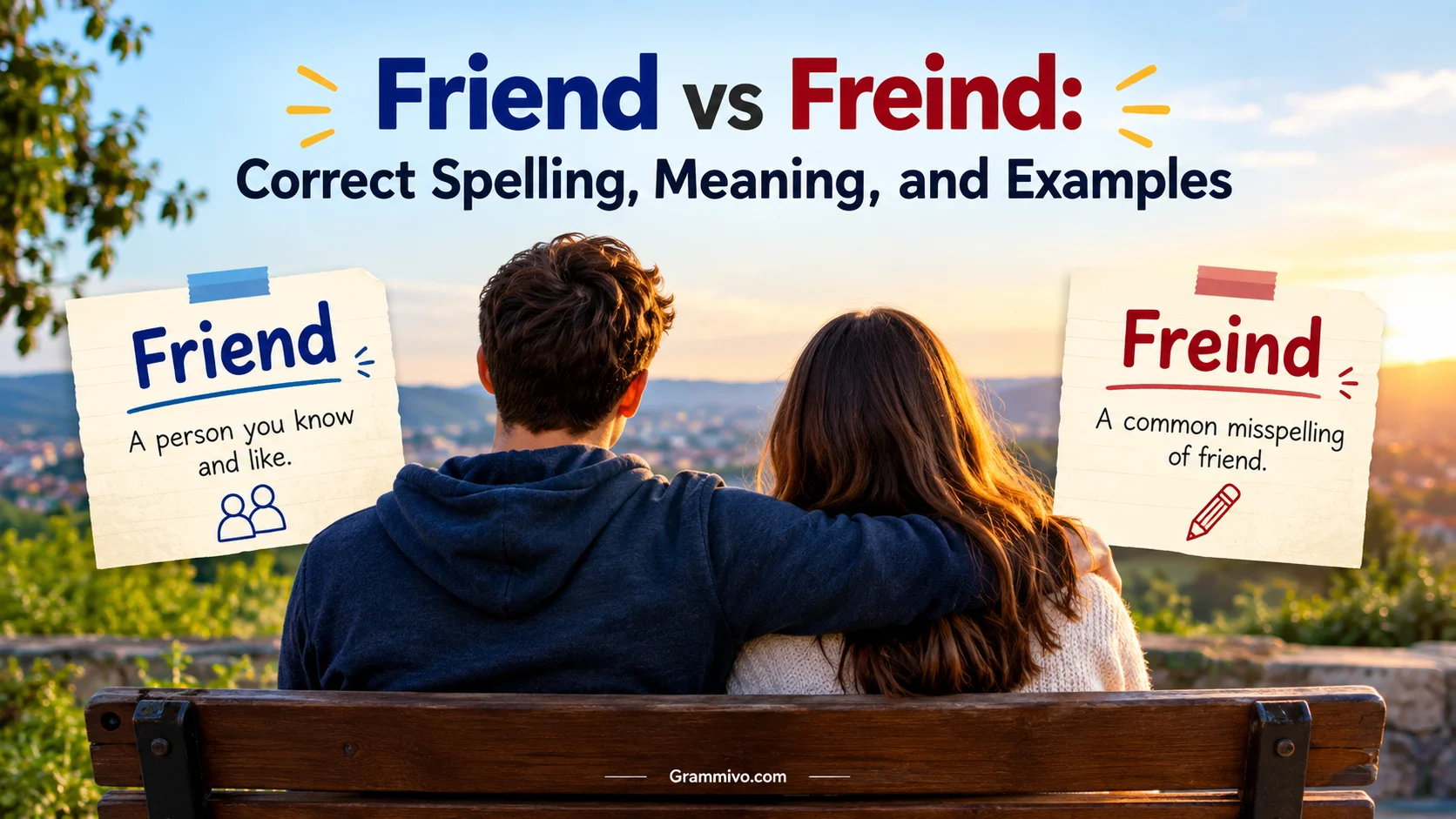
Have you ever typed “freind” and then stopped because something looked wrong? You’re not alone. Friend vs freind is a common spelling question because the letters i and e appear in an order that can easily trip you up.
The good news is simple: friend is the correct spelling. Freind is a misspelling and doesn’t represent a separate word in standard modern English.
The confusion usually comes from remembering the vowel order incorrectly. English has plenty of words with both ie and ei, which makes rules such as “i before e” useful in some cases but unreliable as a universal solution.
Quick Answer
Friend is correct. Freind is incorrect.
| Spelling | Correct? | Meaning |
| Friend | Yes | A person you know and like, typically someone with whom you share affection, trust, or companionship |
| Freind | No | A common misspelling of friend |
The correct spelling is:
F-R-I-E-N-D → friend
The incorrect version switches the i and e:
F-R-E-I-N-D → freind
If you’re writing an email, school assignment, social media post, text message, or professional document, use friend.
What Does “Friend” Mean?
The word friend usually refers to someone with whom you have a relationship based on mutual liking, trust, affection, or companionship.
You might call someone a friend because you spend time together, share interests, support each other, or simply enjoy each other’s company. The relationship doesn’t have to look the same for everyone.
For example, a childhood friend may be someone you’ve known since elementary school. A work friend might be someone you enjoy talking with during the workday. A close friend may know personal details about your life and support you through difficult moments.
The word can describe relationships of different levels of closeness.
Common expressions include:
- best friend
- close friend
- old friend
- childhood friend
- family friend
- school friend
- work friend
- mutual friend
- online friend
- new friend
The important point is that friend has a real meaning in English, while freind does not function as a standard alternative spelling.
Friend as a Noun
Most often, friend works as a noun.
Examples:
- “Sarah is my closest friend.”
- “I met an old friend at the grocery store.”
- “My friend recommended this restaurant.”
- “He invited several friends to his birthday party.”
Here, friend names a person who has a friendly relationship with someone.
Friend as a Verb
English also uses friend as a verb, particularly in the context of social media.
For example:
“I friended him on Facebook.”
In this usage, friended means that someone added another person as a friend on a social networking platform.
Why Is “Freind” Incorrect?
Freind is generally a spelling mistake rather than a different English word.
The error happens when writers reverse the positions of i and e. Instead of writing:
fri + end
they accidentally write:
fre + ind
That small change creates an incorrect spelling.
The mistake can be especially easy to make when you’re typing quickly. Your brain recognizes the word before you consciously process every letter. As a result, you may know exactly what you mean while your fingers produce freind instead of friend.
This is one reason familiar words can sometimes produce surprising spelling errors.
Consider these examples:
- “She is my best freind.”
- “She is my best friend.”
- “I invited my freinds over.”
- “I invited my friends over.”
- “My freind’s car is outside.”
- “My friend’s car is outside.”
The meaning remains obvious to most readers, but the spelling still needs correction in polished writing.
Why Do People Spell “Friend” as “Freind”?
The friend vs freind confusion mainly comes from the order of the vowels.
English spelling doesn’t always match pronunciation in a neat, predictable way. You can’t simply hear the word friend and know with certainty whether the written form should contain ie or ei.
Several factors can contribute to the mistake.
The I/E Order Is Easy to Reverse
The biggest issue is simple visual confusion.
The correct sequence is:
F-R-I-E-N-D
A writer may remember the same letters but put the vowels in the wrong order:
F-R-E-I-N-D
Because both versions contain the same letters, the incorrect spelling can look surprisingly convincing at first glance.
Fast Typing Encourages Mistakes
When you type quickly, your fingers often follow familiar patterns rather than consciously spelling each word.
That’s why common words can sometimes contain mistakes. The writer isn’t necessarily unaware of the correct spelling. They may simply type the letters in the wrong sequence.
Pronunciation Doesn’t Give You the Full Answer
In standard English, friend is commonly pronounced approximately like “frend.”
The written ie doesn’t sound like the long vowel found in words such as field. Instead, the pronunciation is relatively short.
That disconnect between spelling and pronunciation makes memorization more important.
English Has Conflicting Spelling Patterns
English contains words with ie and words with ei.
Compare:
| IE spelling | EI spelling |
| friend | receive |
| believe | ceiling |
| chief | deceive |
| field | receipt |
| piece | perceive |
These examples show why relying on one simple rule can sometimes lead you astray.
Friend and the “I Before E” Rule
You may have learned the classic spelling advice:
“I before E except after C.”
At first glance, friend seems to fit the ie part of that pattern.
However, the famous rule has many exceptions and limitations. English spelling contains enough irregularities that you shouldn’t treat it as a perfect mathematical formula.
For example:
- friend → ie
- believe → ie
- chief → ie
- receive → ei
- ceiling → ei
- weird → ei
- height → ei
The word friend is best learned as its own spelling rather than forcing it into a rule that doesn’t cover every English word.
A useful approach is to recognize the word visually:
friend
Once that shape becomes familiar, you’ll be less likely to reverse the vowels.
Friend vs Freind Pronunciation
The correct word friend is pronounced roughly like “frend.”
In many standard varieties of English, its pronunciation is represented in the International Phonetic Alphabet as /frɛnd/.
The vowel sound is similar to the vowel in words such as:
- bed
- red
- send
- ten
For example:
friend → frend
The incorrect spelling freind doesn’t have a separate standard pronunciation because it isn’t an accepted alternative spelling of the word.
This distinction matters. A spelling error doesn’t automatically create a new pronunciation or meaning.
Friend in Example Sentences
Seeing friend in complete sentences makes the correct spelling easier to recognize.
Everyday Examples
- “My friend lives across the street.”
- “I called my friend after work.”
- “She introduced me to her best friend.”
- “We’re going to the movies with some friends.”
- “My childhood friend moved to another city.”
- “He became a good friend during college.”
- “A mutual friend introduced us.”
- “I haven’t seen my old friend in years.”
Possessive Examples
The possessive form is friend’s when something belongs to one friend.
“My friend’s phone is on the table.”
For multiple friends, use friends’ when something belongs to more than one friend.
“The friends’ cars were parked outside.”
These forms are useful because spelling mistakes often carry over into related forms.
| Form | Correct Example |
| friend | “She is my friend.” |
| friends | “My friends are visiting.” |
| friend’s | “My friend’s house is nearby.” |
| friends’ | “The friends’ project won.” |
| friended | “He friended me online.” |
Friend vs Freind in Different Types of Writing
The correct spelling doesn’t change according to the type of writing.
Whether you’re sending a casual text or preparing a formal report, friend remains the correct form.
| Writing situation | Correct example |
| Text message | “I’m meeting a friend tonight.” |
| “A friend recommended your service.” | |
| School assignment | “The character develops a strong friendship with his friend.” |
| Social media | “I added my friend yesterday.” |
| Professional writing | “She has been a longtime friend of the organization.” |
| Personal letter | “It was great hearing from you, my friend.” |
Casual writing may contain typos because people often type quickly. However, being casual doesn’t make freind a correct spelling.
If you’re proofreading a document, correcting freind → friend is straightforward.
Common Misspellings of Friend
Freind is one of several mistakes people make with this word.
Here are some common incorrect forms:
- freind
- firend
- frined
- frend
- friiend
The correct form is:
- friend
Among these errors, freind is particularly understandable because it contains the correct letters but places e and i in the wrong order.
That’s also why proofreading helps. A quick visual comparison can reveal the mistake immediately.
Friend vs Freind vs Frend
It’s useful to distinguish spelling errors that occur for different reasons.
| Version | Status | Problem |
| friend | Correct | Standard English spelling |
| freind | Incorrect | Reverses i and e |
| frend | Incorrect | Omits i |
| firend | Incorrect | Rearranges the vowels |
| frined | Incorrect | Rearranges the middle letters |
None of these alternatives should replace friend in standard English writing.
Read More: Beginning vs. Beggining: Which Spelling Is Correct?
Easy Tricks to Remember How to Spell Friend
A good memory trick should be simple enough to recall when you’re writing quickly.
One of the easiest is:
FRI + END = FRIEND
Think of the word as:
fri-end
You can also connect it with the phrase:
“A friend to the end.”
That isn’t a formal spelling rule. It’s simply a memory device that keeps the correct ie sequence in your mind.
Another useful technique involves visual repetition.
Write the word several times:
friend — friend — friend
Then use it naturally in a sentence:
“My friend always knows how to make me laugh.”
The more often you see the correct spelling, the more familiar its visual pattern becomes.
A Simple Visual Memory Trick
Focus on the middle:
FRIEND
Notice that I comes before E.
Then remember:
FRIEND has IE.
That tiny association can prevent the most common mistake.
A Practical Case Study: Why Familiar Words Still Get Misspelled
Imagine someone writing a quick text:
“Hey, can you ask my freind if she’s coming?”
The writer clearly knows the intended word. The sentence makes perfect sense. Yet the spelling contains a vowel reversal.
Now compare that with a slower proofreading process:
“Hey, can you ask my friend if she’s coming?”
The correction takes only a second.
This illustrates an important point about spelling mistakes: recognizing a word and reproducing its exact spelling are related skills, but they aren’t identical.
A person can understand a word perfectly while occasionally misspelling it.
The same thing happens with many familiar English words. Fast typing, fatigue, distraction, and uncertainty about letter order can all produce errors.
For friend, the easiest solution is to memorize the visual pattern:
FRIEND
rather than trying to reconstruct the spelling every time.
The History Behind the Spelling of Friend
The spelling of friend has a long history in English and Germanic languages.
The modern English word ultimately traces back to Old English frēond, which was related to the verb meaning “to love.”
This historical connection helps explain why the word doesn’t follow modern spelling patterns as neatly as a newly created word might.
Over centuries, English spelling changed as pronunciation, regional usage, and writing conventions developed. Modern friend represents the standard spelling used in contemporary English.
Historical variants don’t mean that freind is an acceptable modern spelling.
That’s an important distinction. English has changed considerably over time, but modern writers should follow current standard spelling when producing polished English.
Friend vs Freind: What Should You Use in Formal Writing?
Always choose friend in formal writing.
That includes:
- essays
- resumes
- cover letters
- business emails
- reports
- applications
- articles
- academic assignments
- professional documents
A spelling error may not change the reader’s understanding, but it can affect how polished your writing appears.
For example:
“My freind recommended this company.”
The reader understands the sentence immediately. Still, the misspelling can make the writer appear less careful.
The corrected version is:
“My friend recommended this company.”
The difference is only two letters in the middle, but accurate spelling creates a cleaner impression.
FAQs:
Is “friend” or “freind” correct?
Friend is correct. Freind is a misspelling.
How do you spell friend correctly?
Spell it:
F-R-I-E-N-D
The middle sequence is IE, not EI.
Is “freind” a real word?
In contemporary standard English, freind isn’t an accepted alternative spelling of friend. It’s normally treated as a misspelling.
Why do people spell friend as freind?
The most common reason is that people reverse the i and e. The two spellings look similar, and English has many inconsistent vowel patterns.
Is friend spelled differently in American and British English?
No. Friend is the standard spelling in both American and British English.
Conclusion:
When you’re choosing between friend vs freind, there’s no need to second-guess yourself. Whether you’re writing a text, school assignment, business email, social media caption, or personal letter, stick with friend. It’s the standard spelling across both American and British English.
